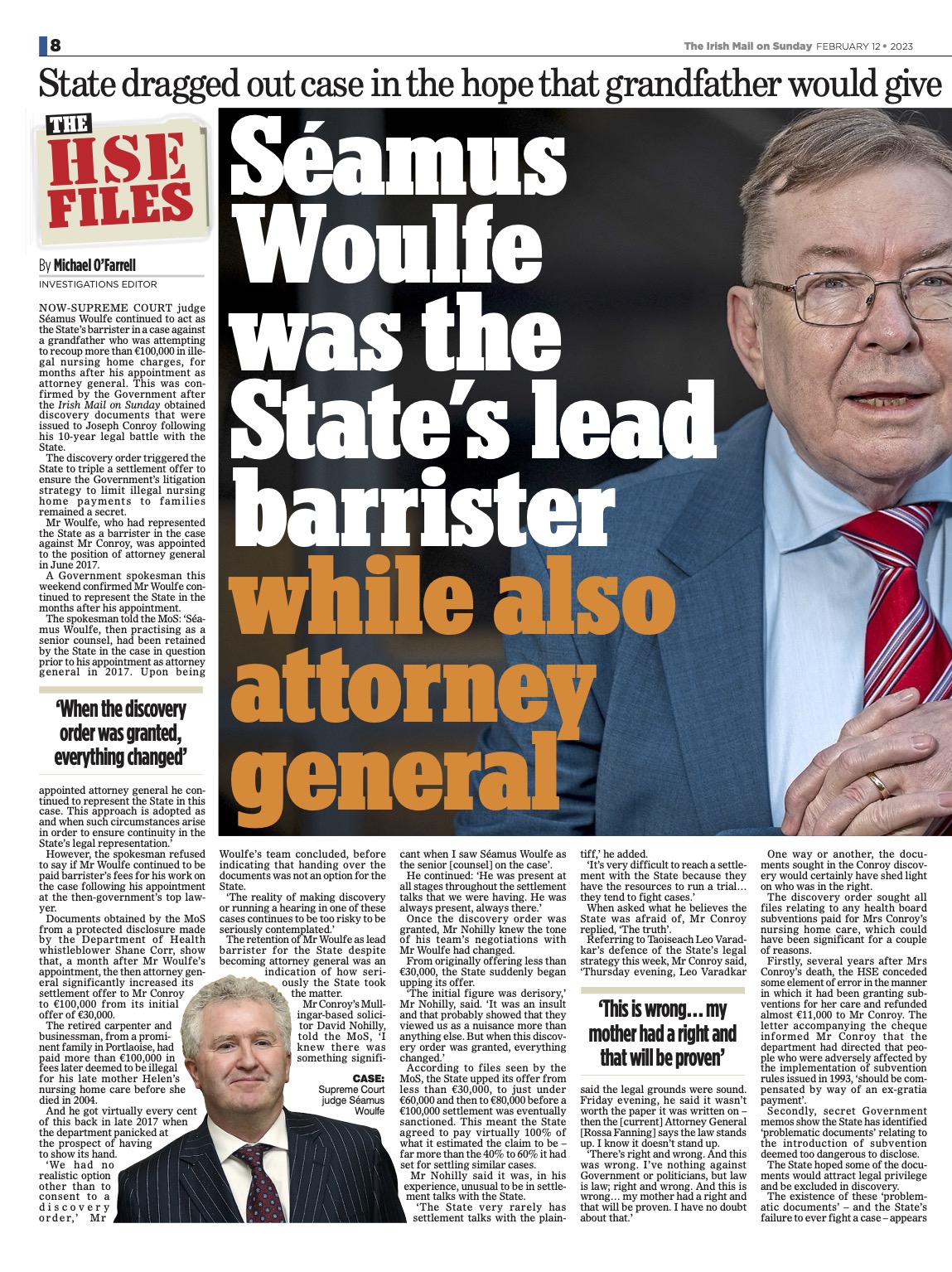
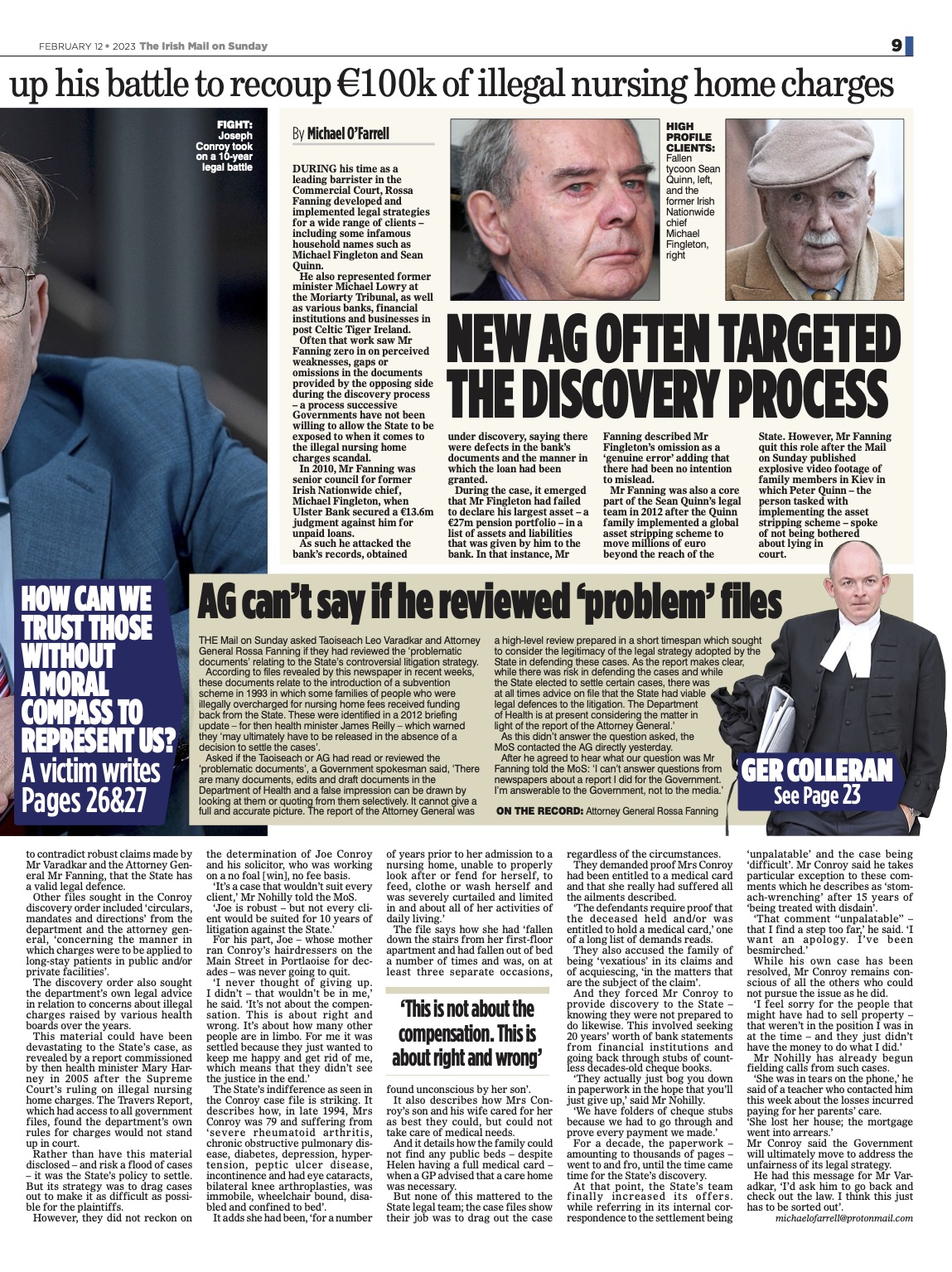
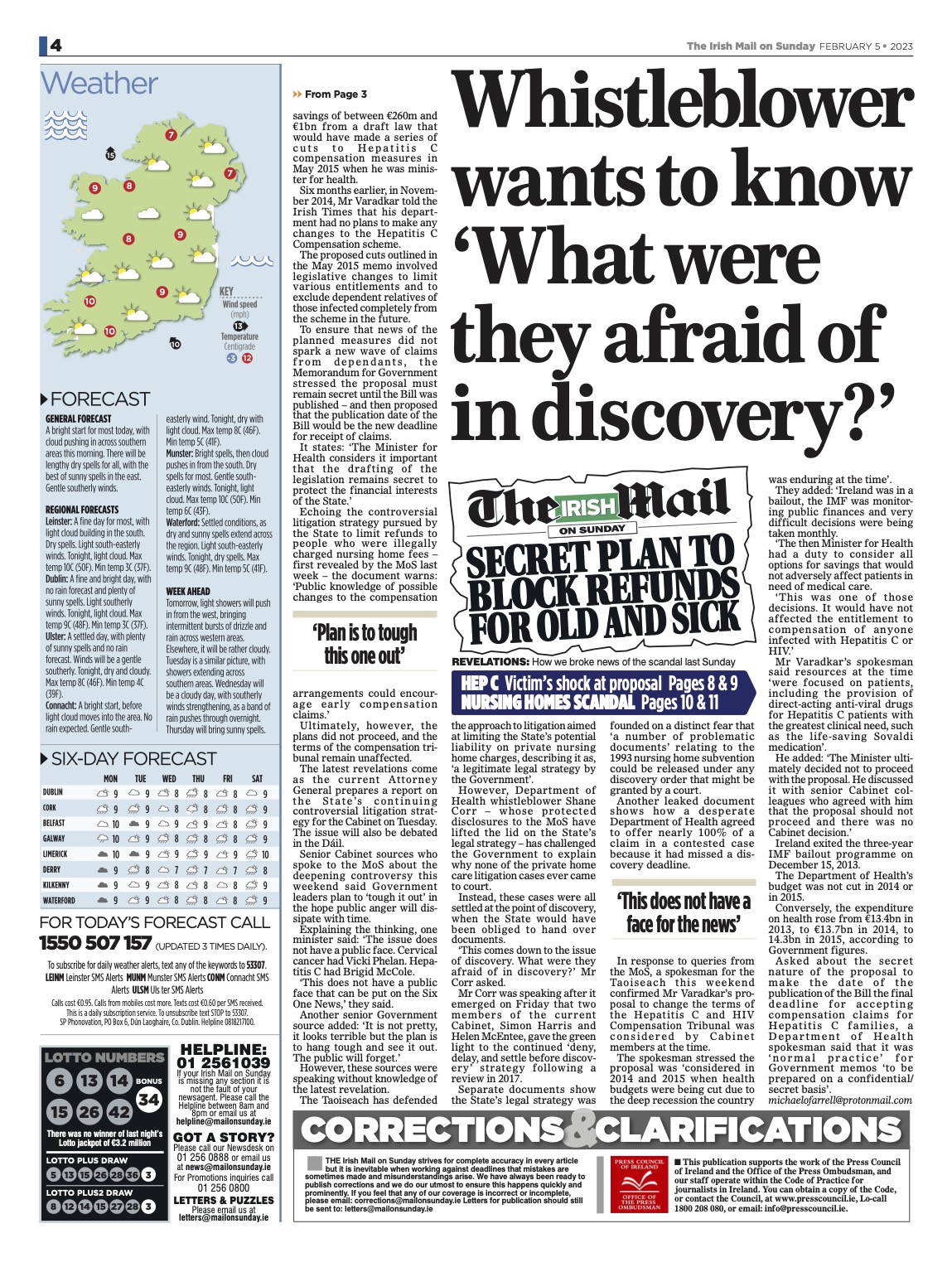
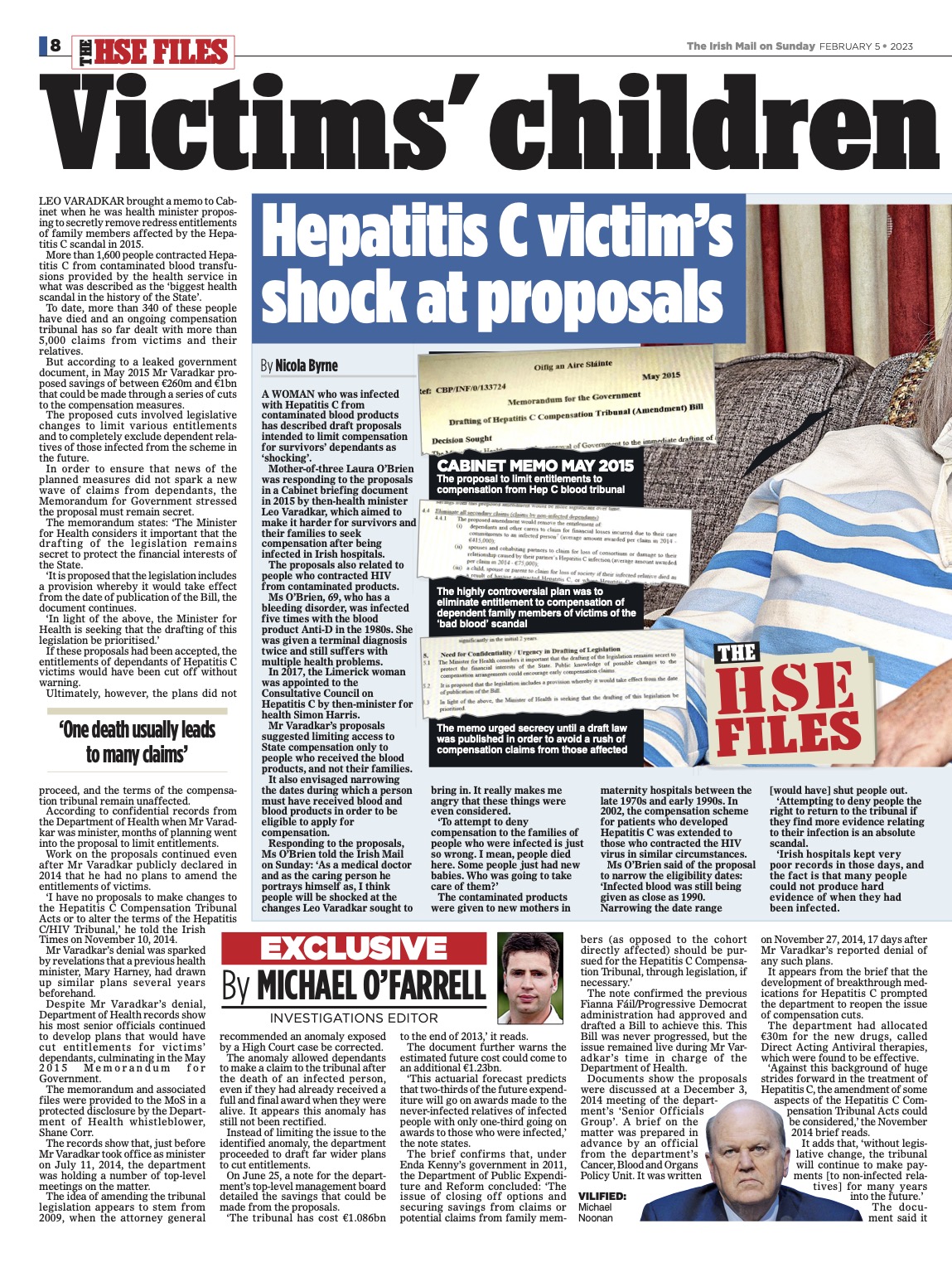
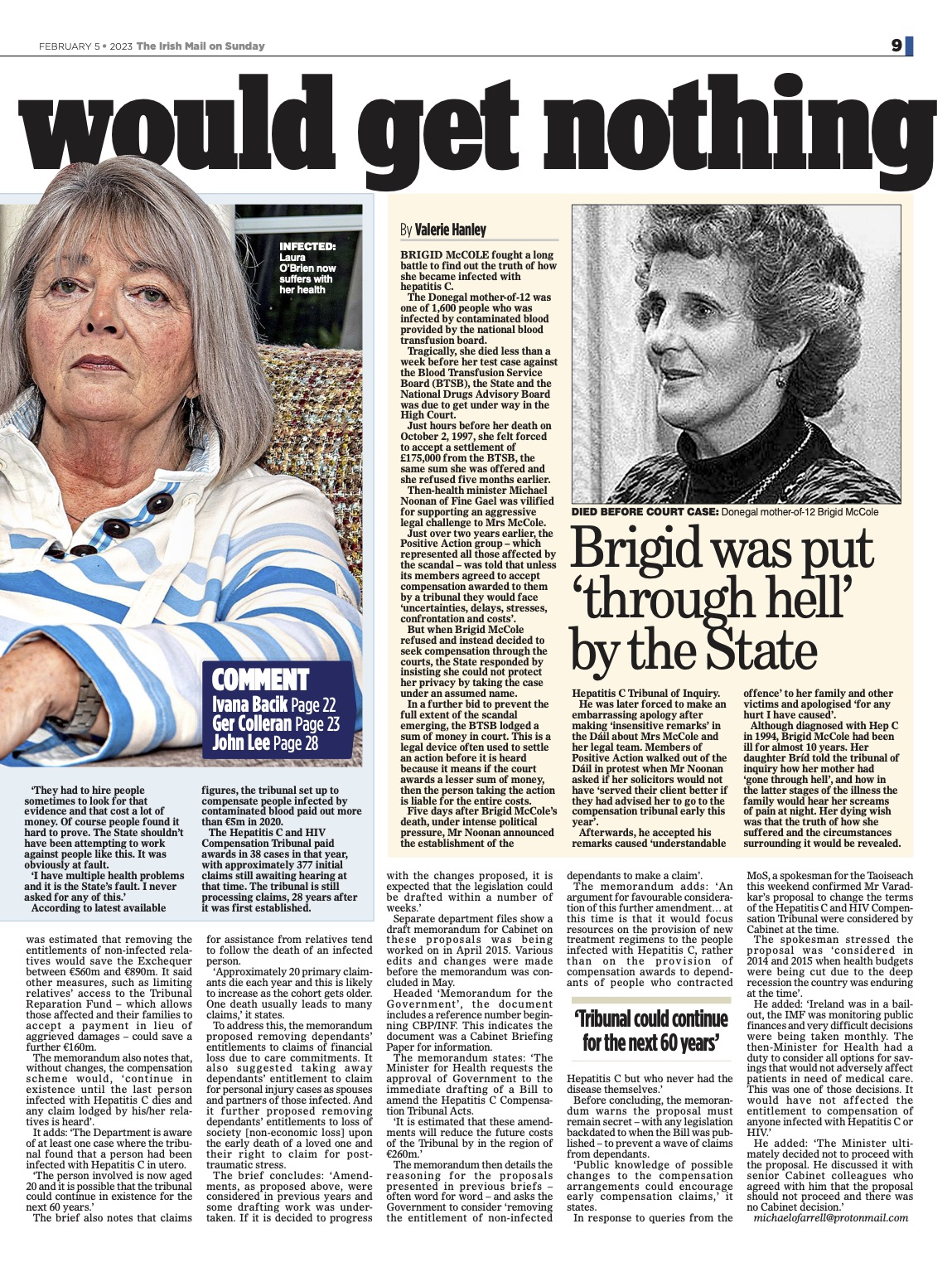
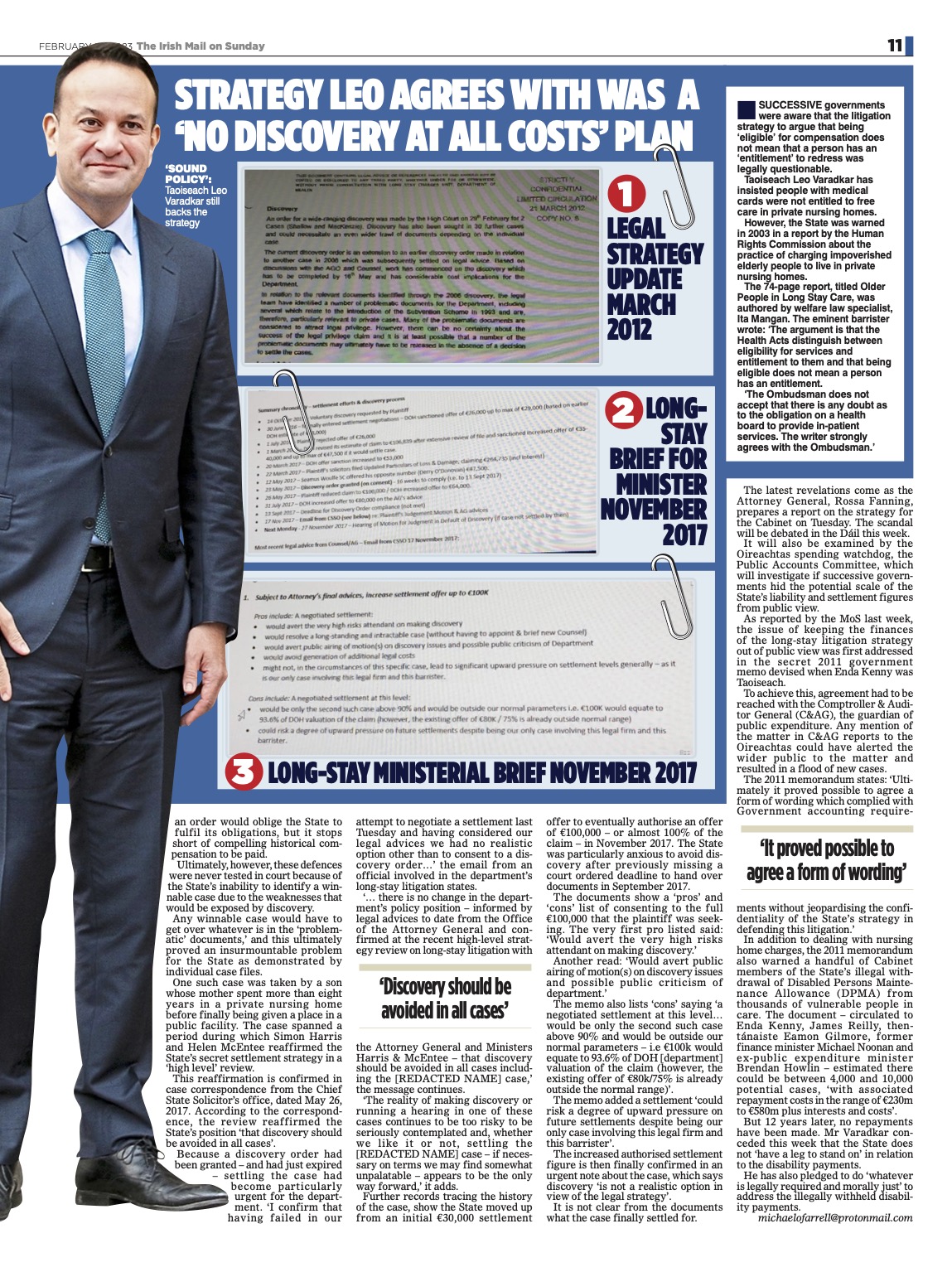
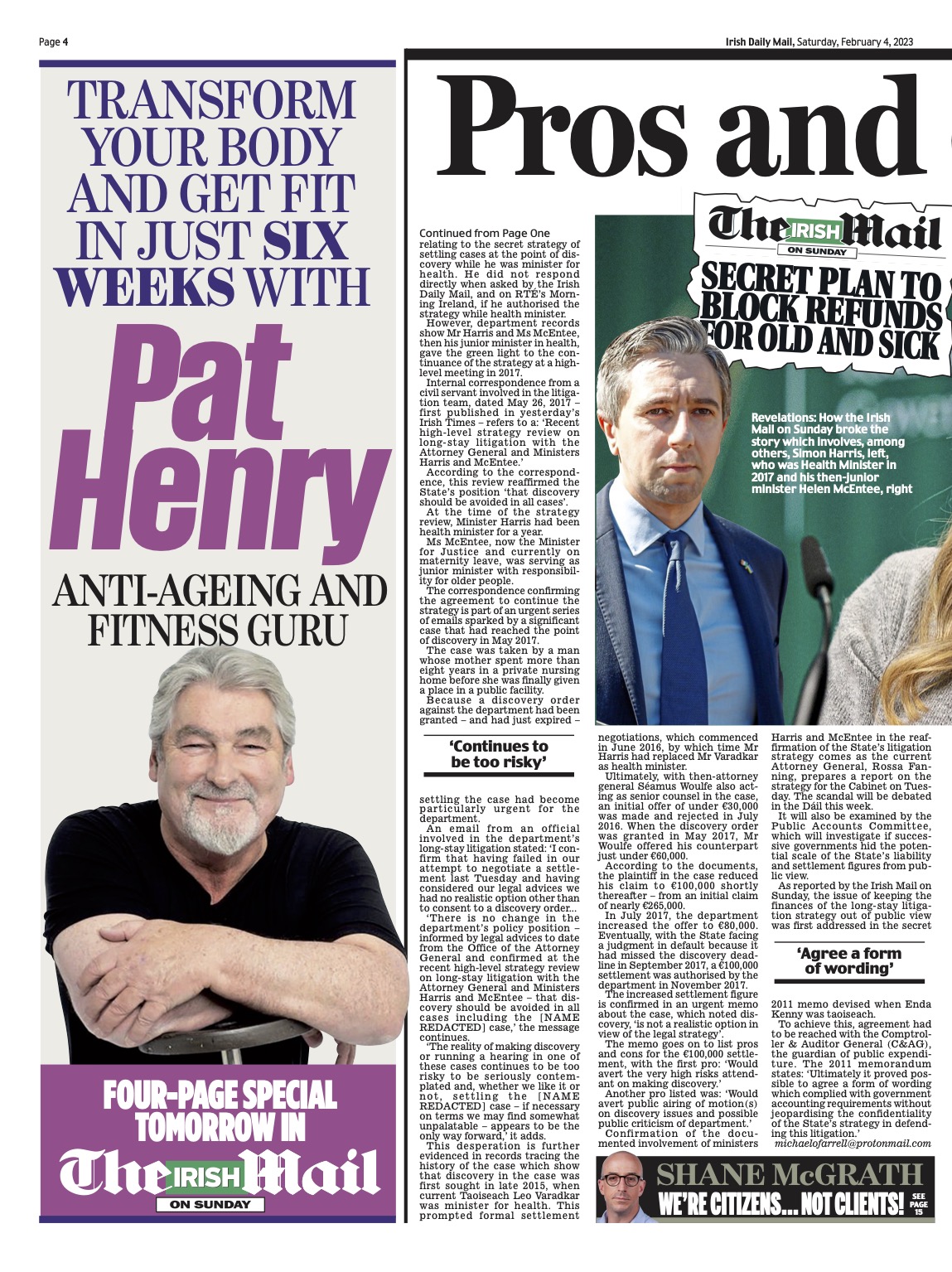
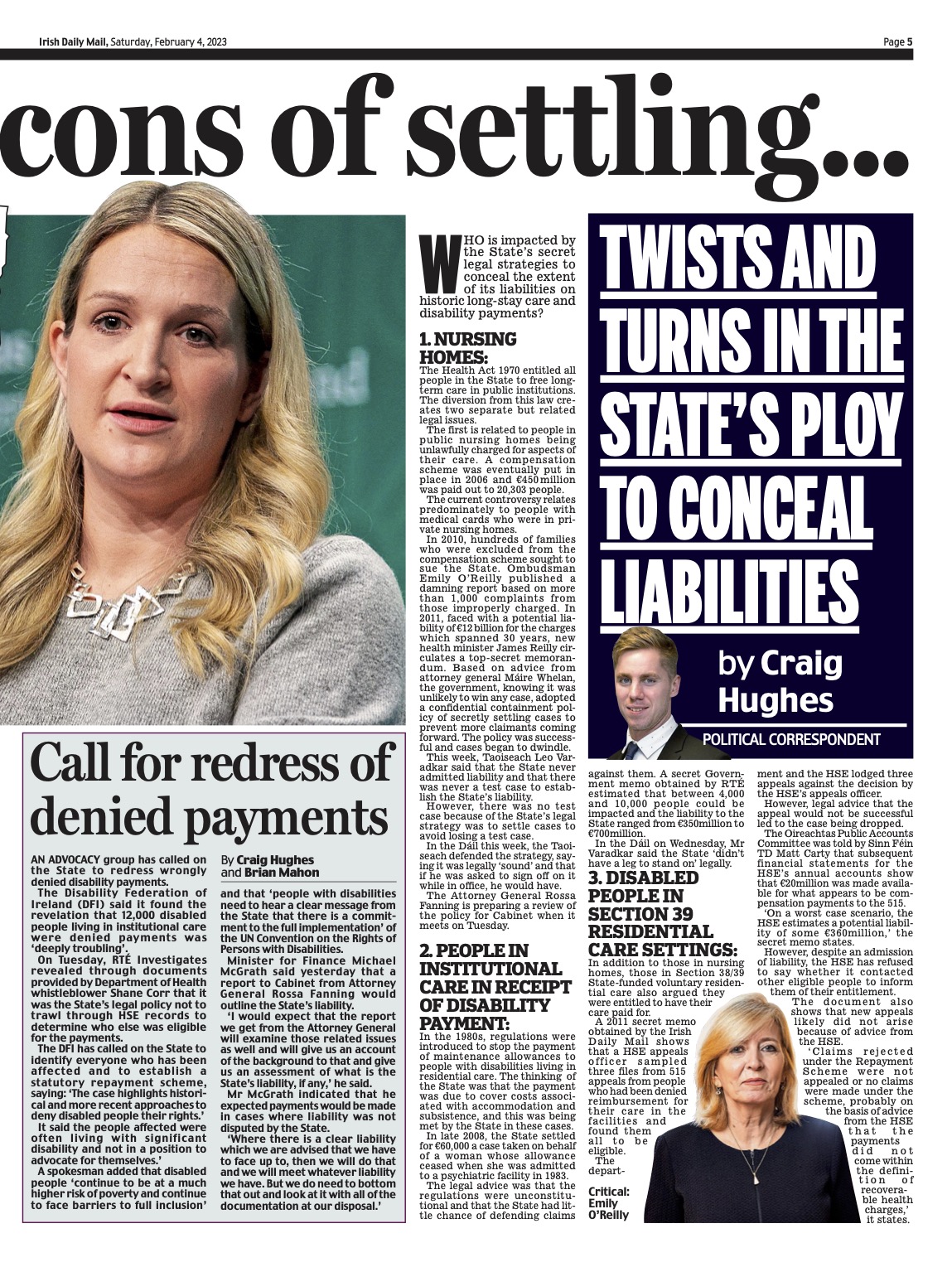
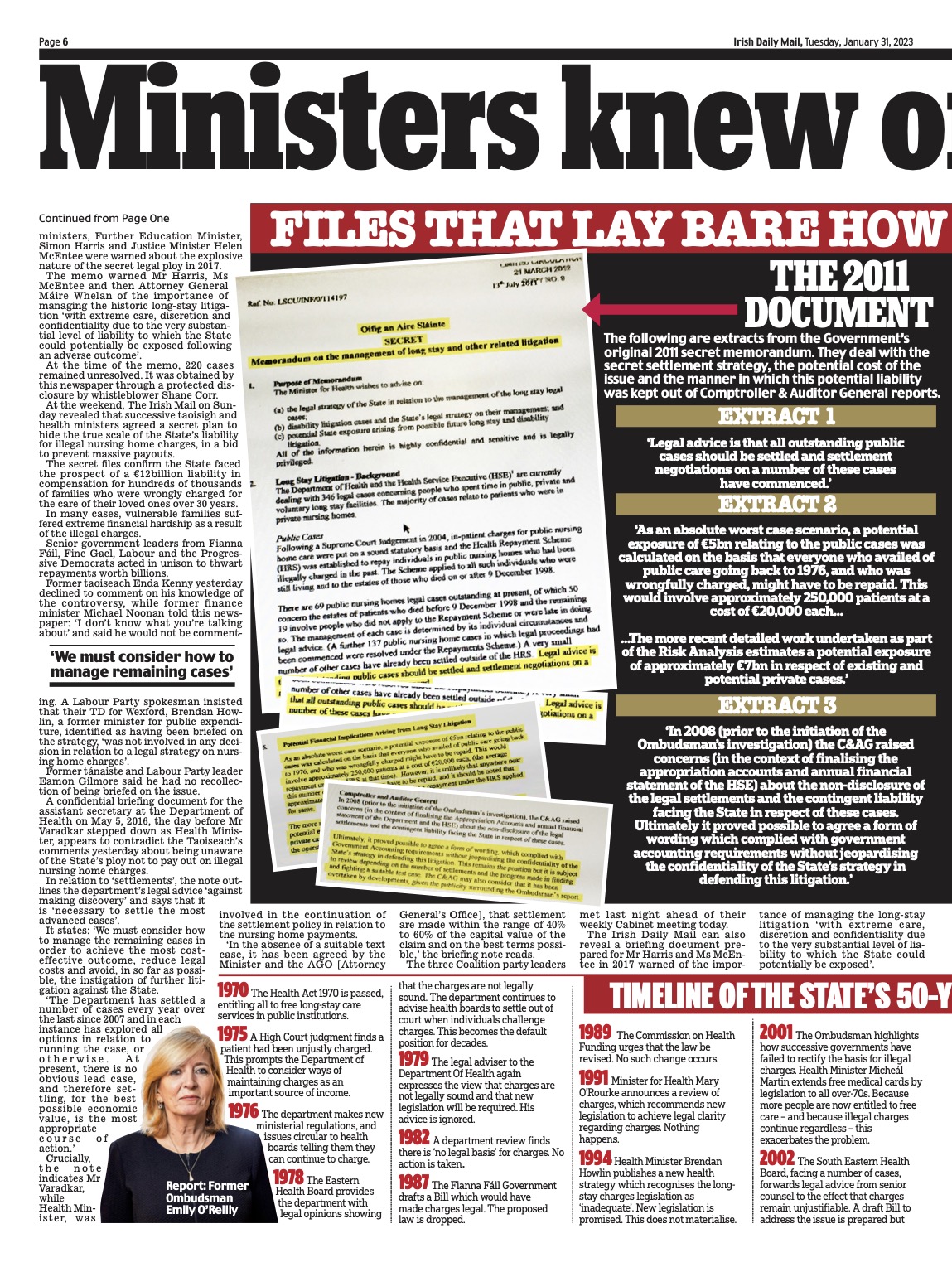
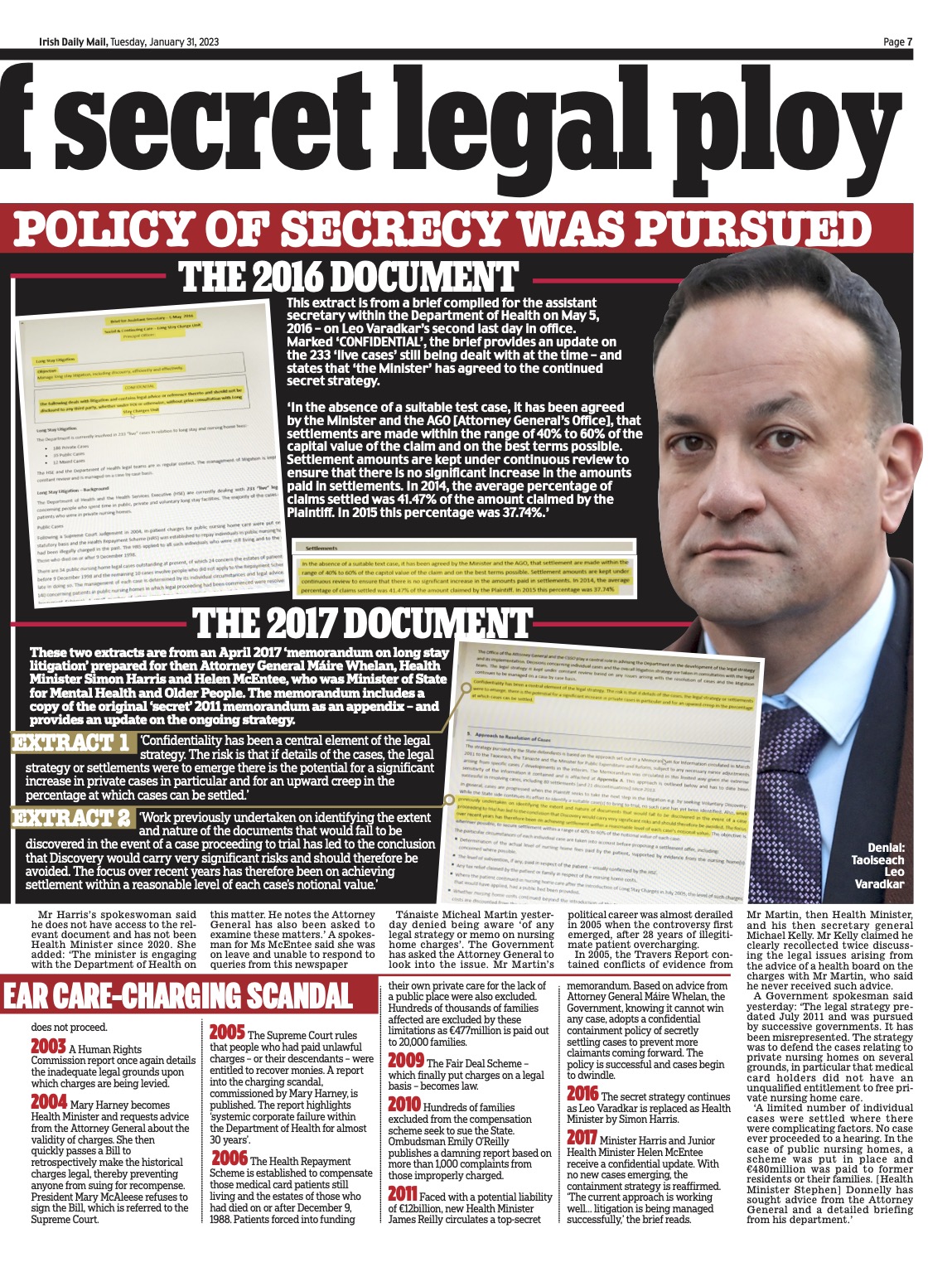
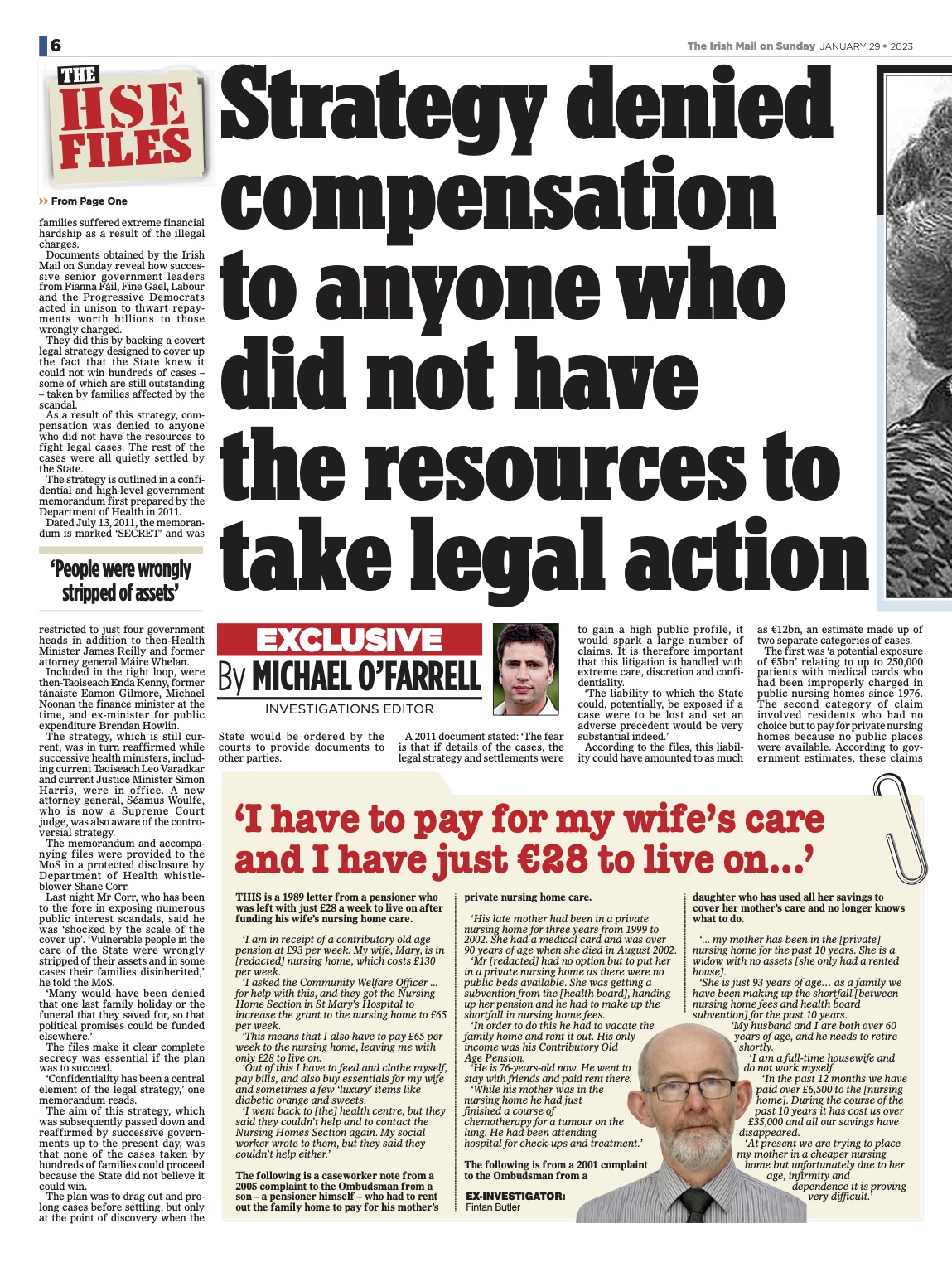
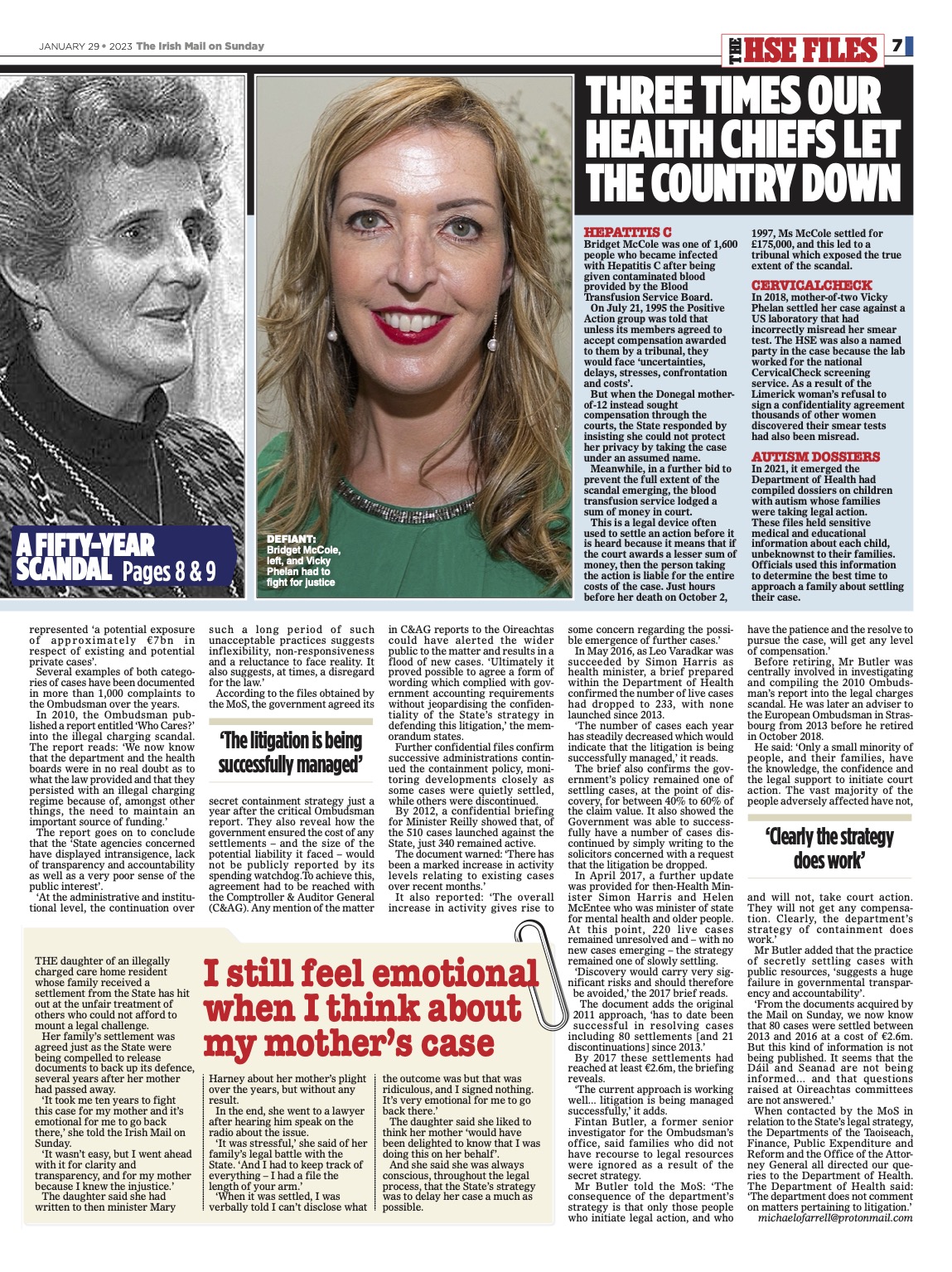
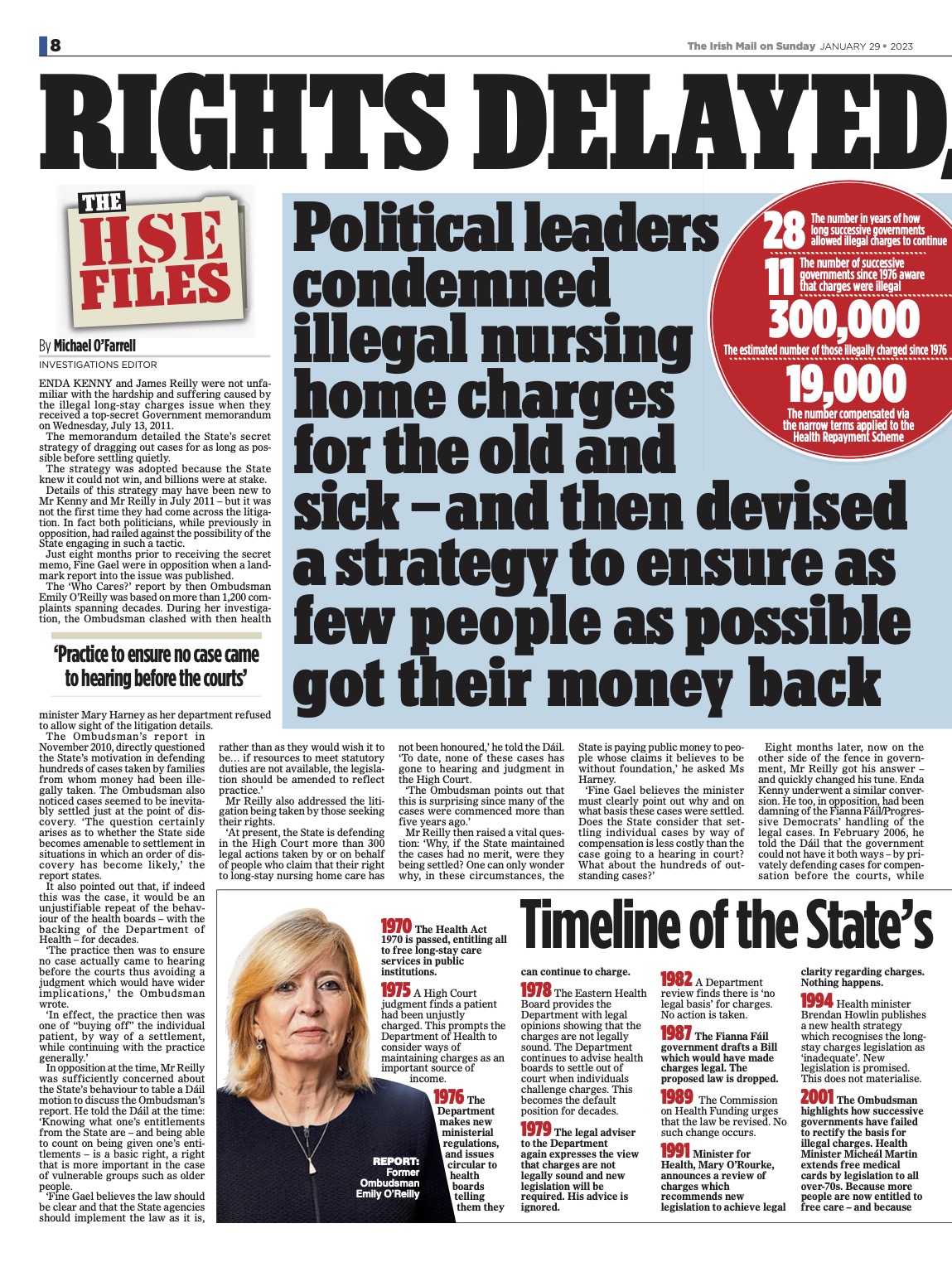
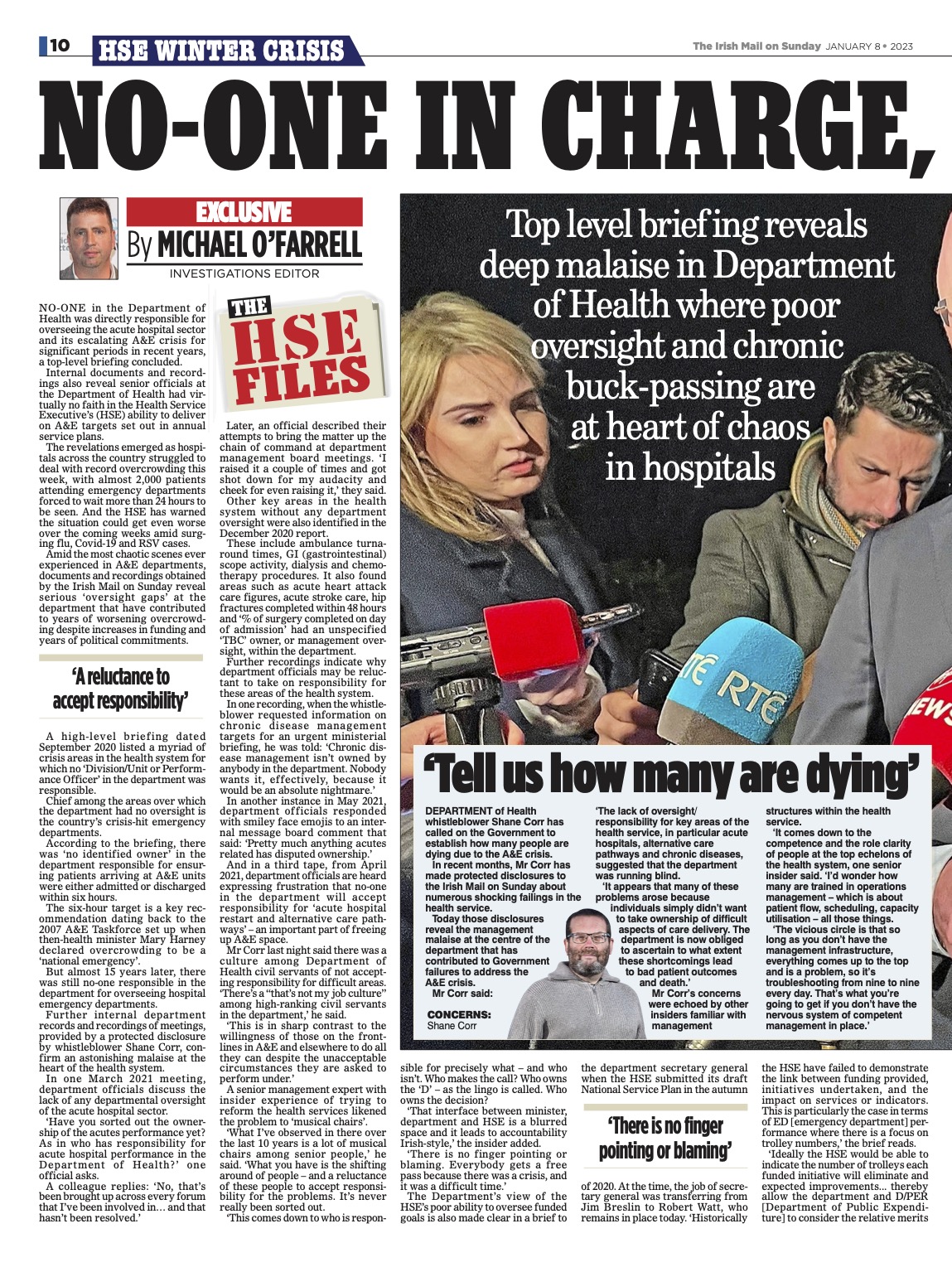
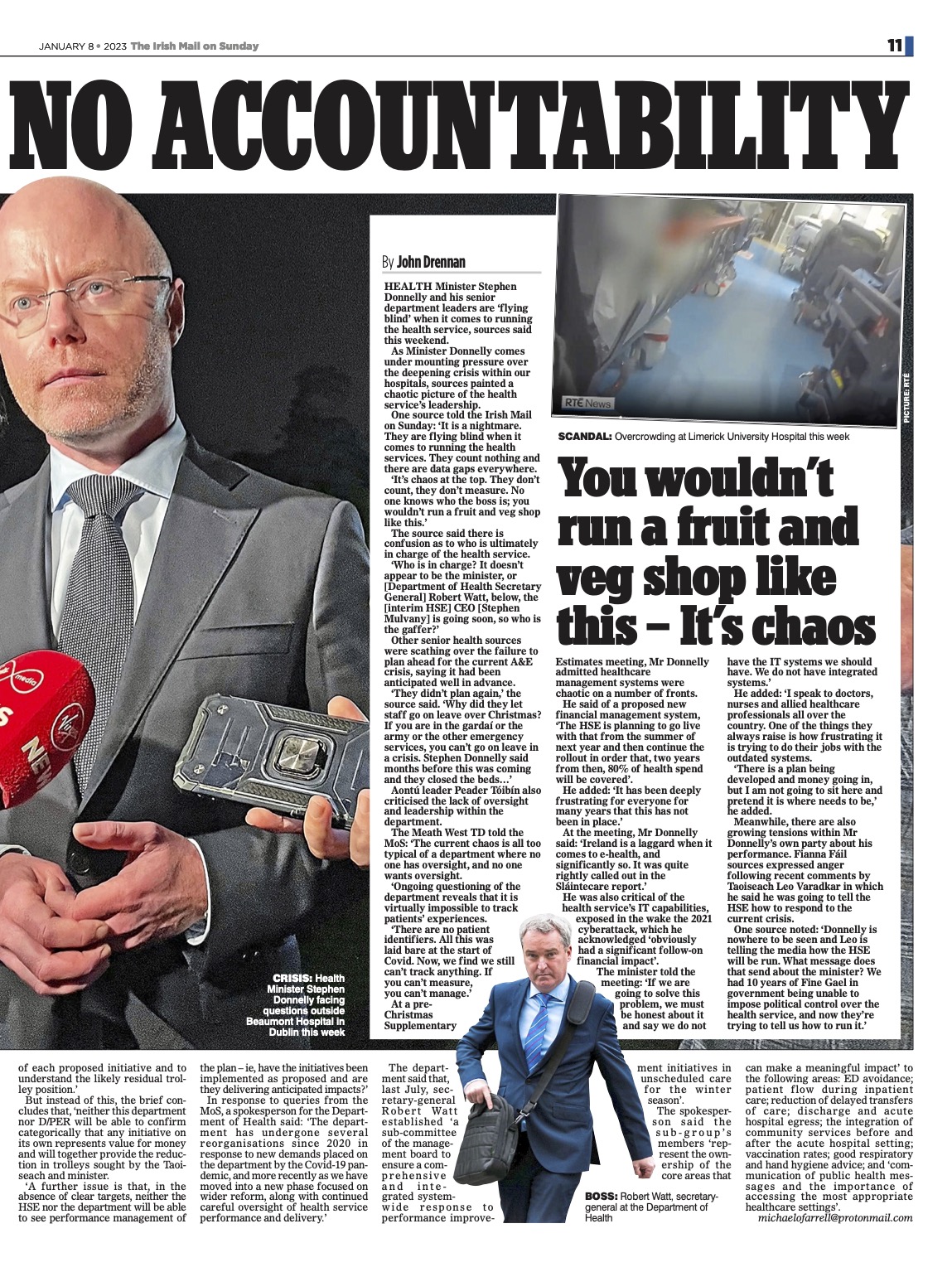
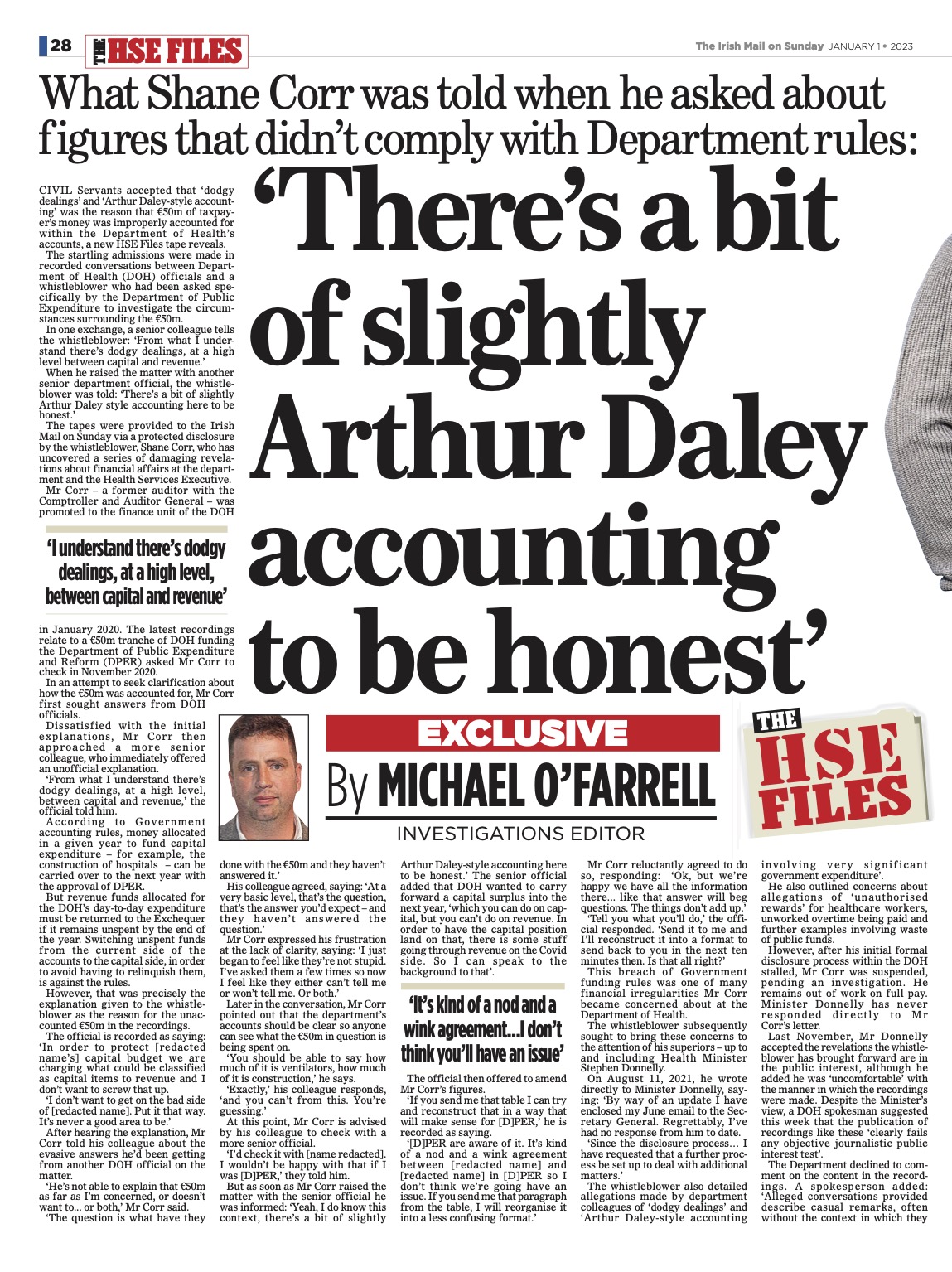
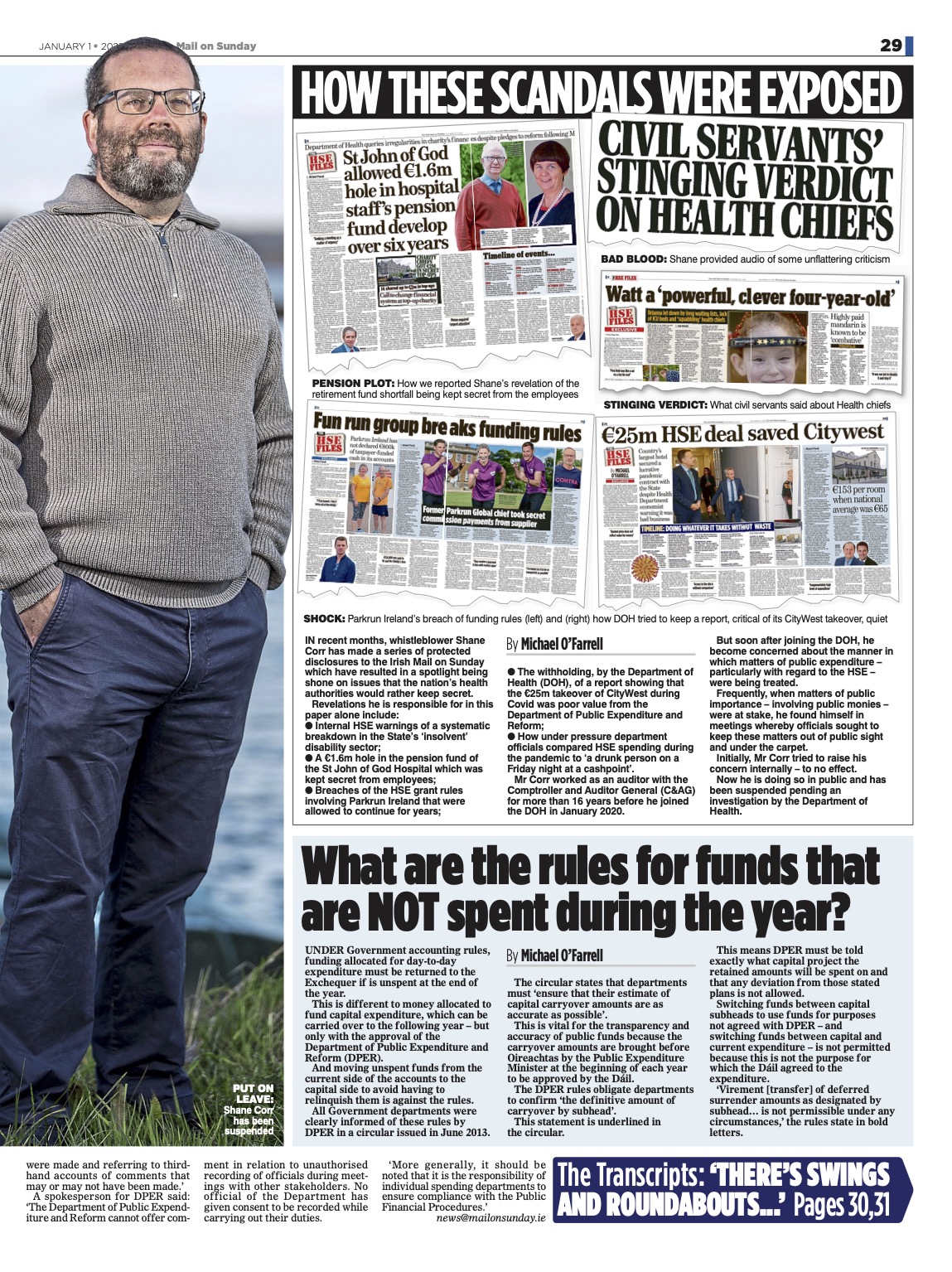
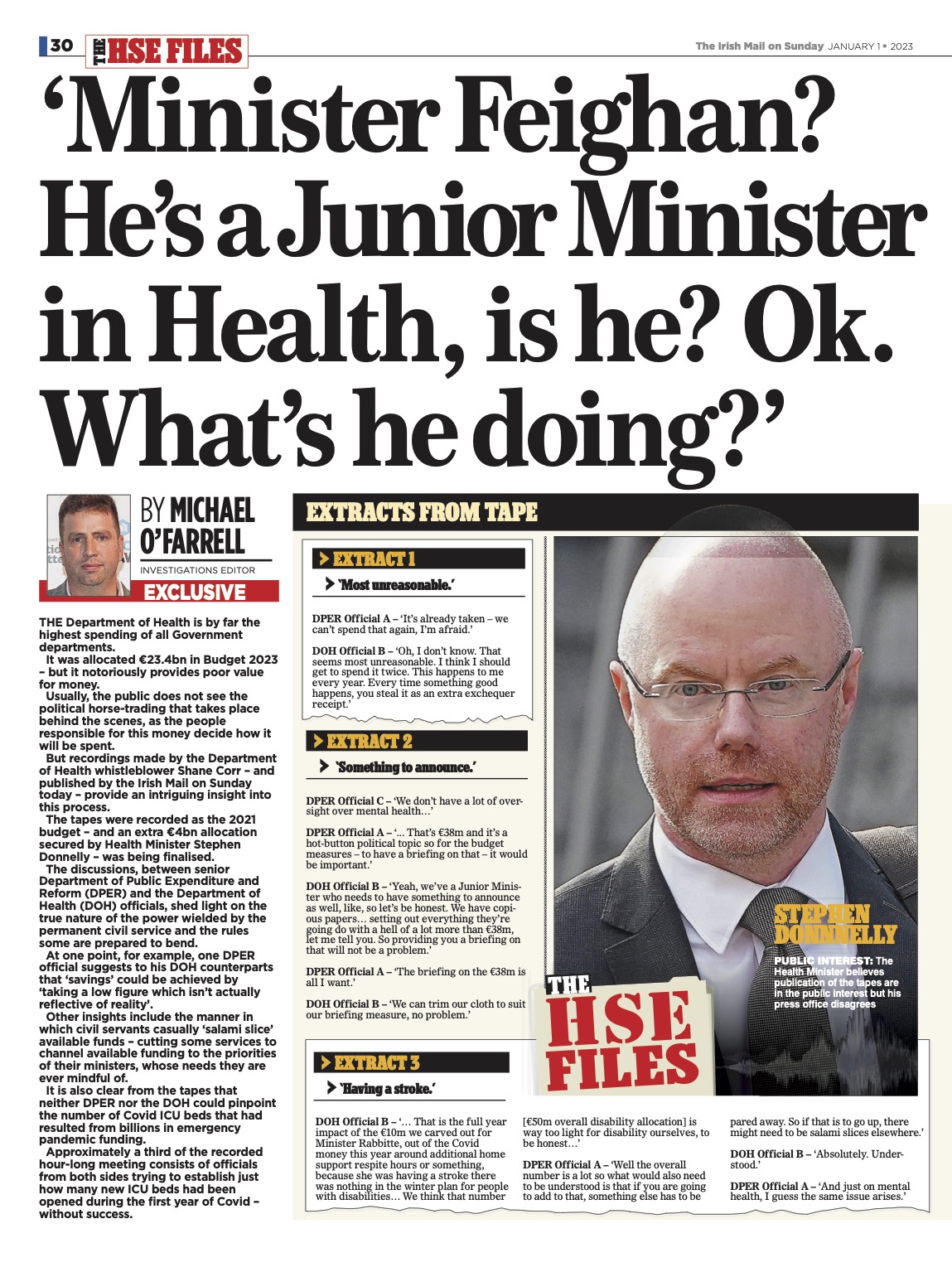
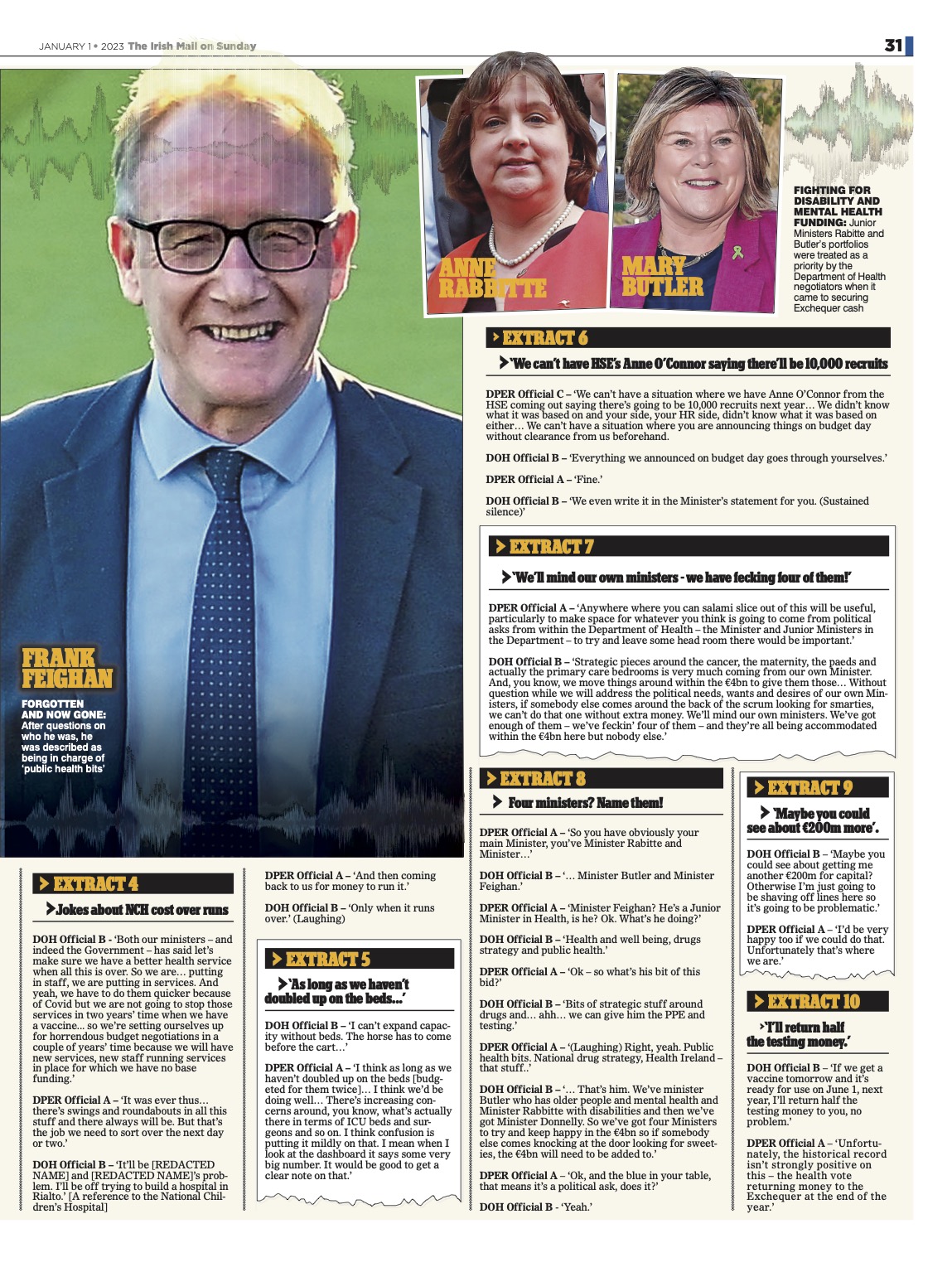
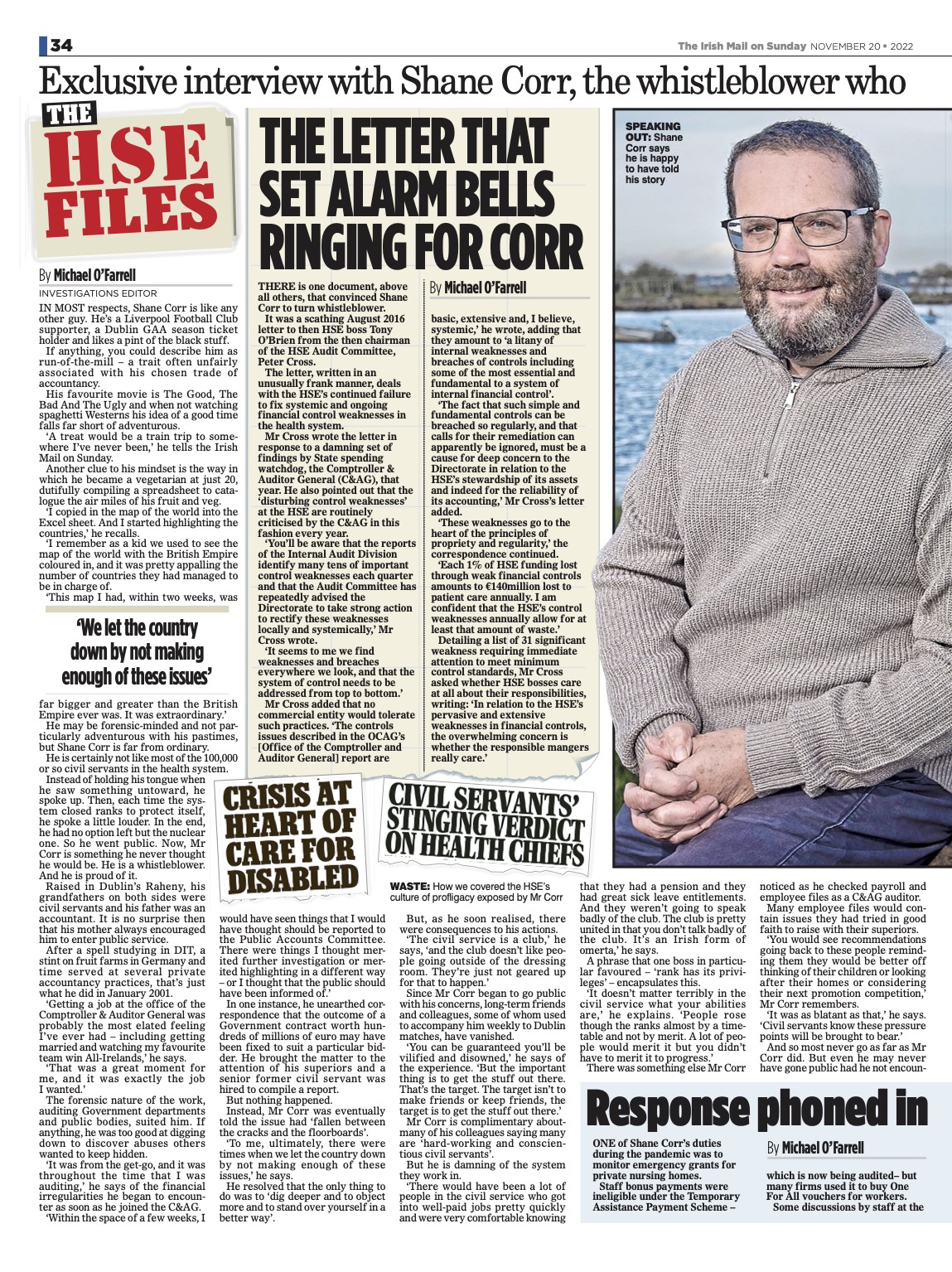
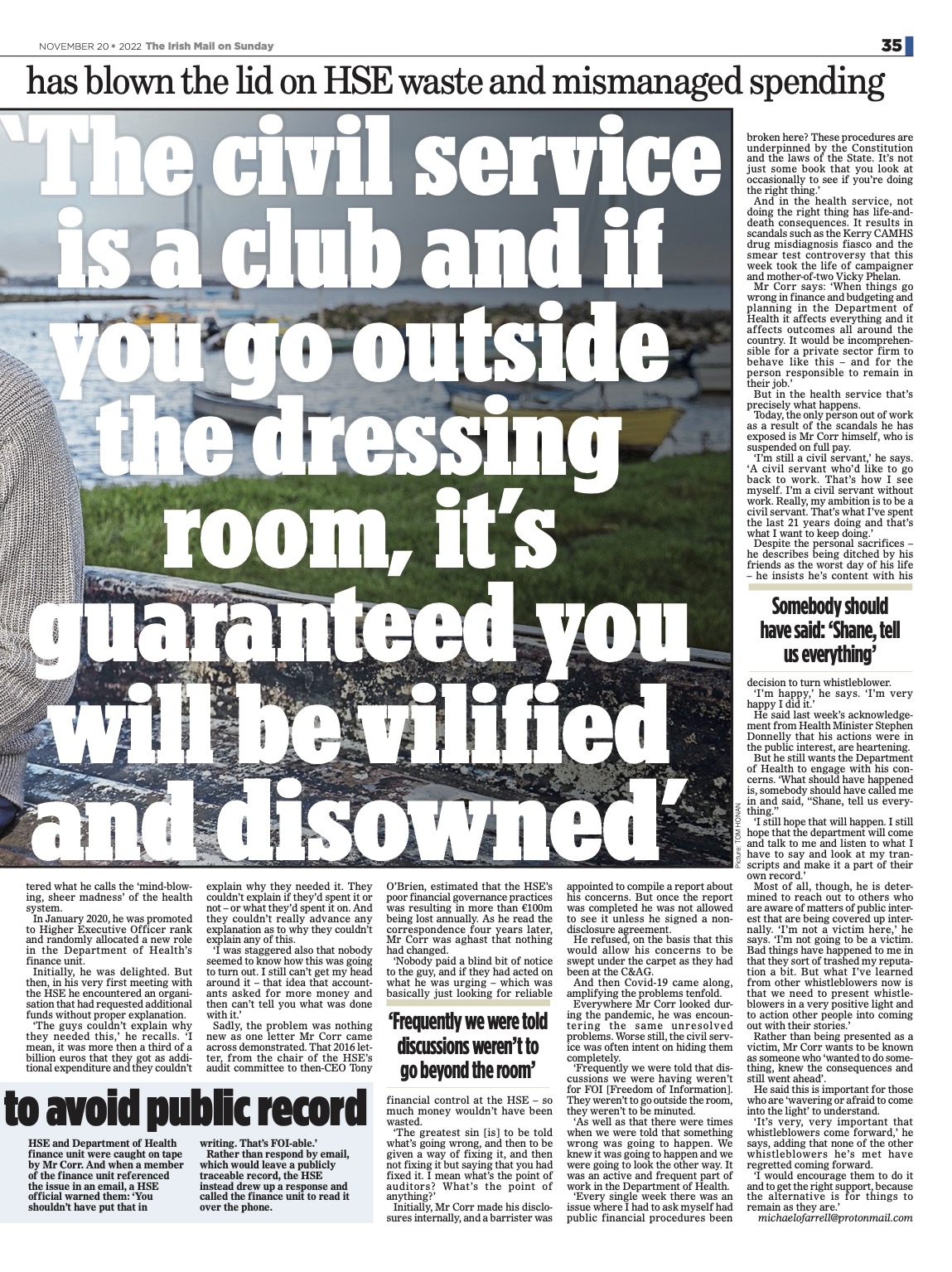
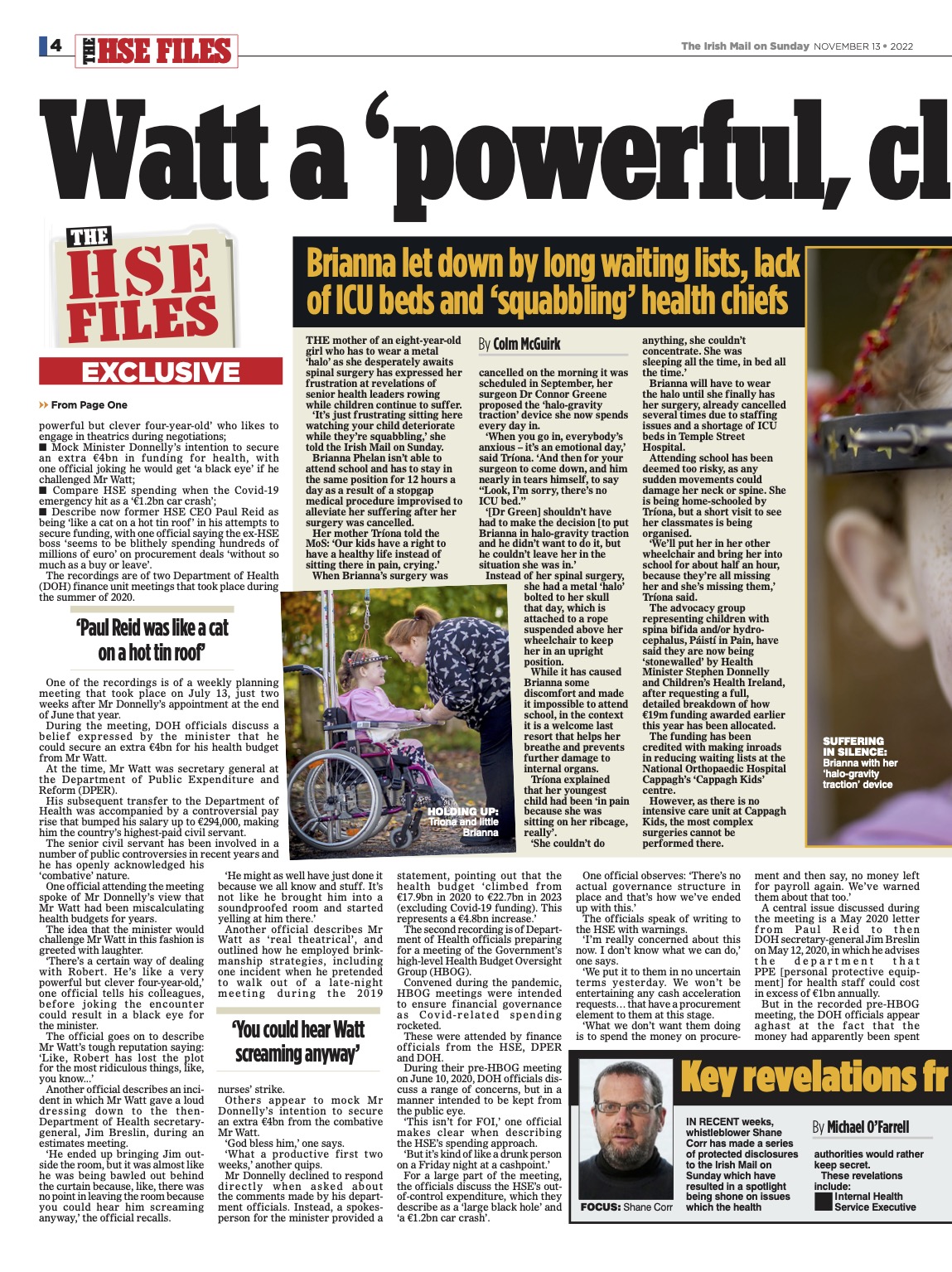
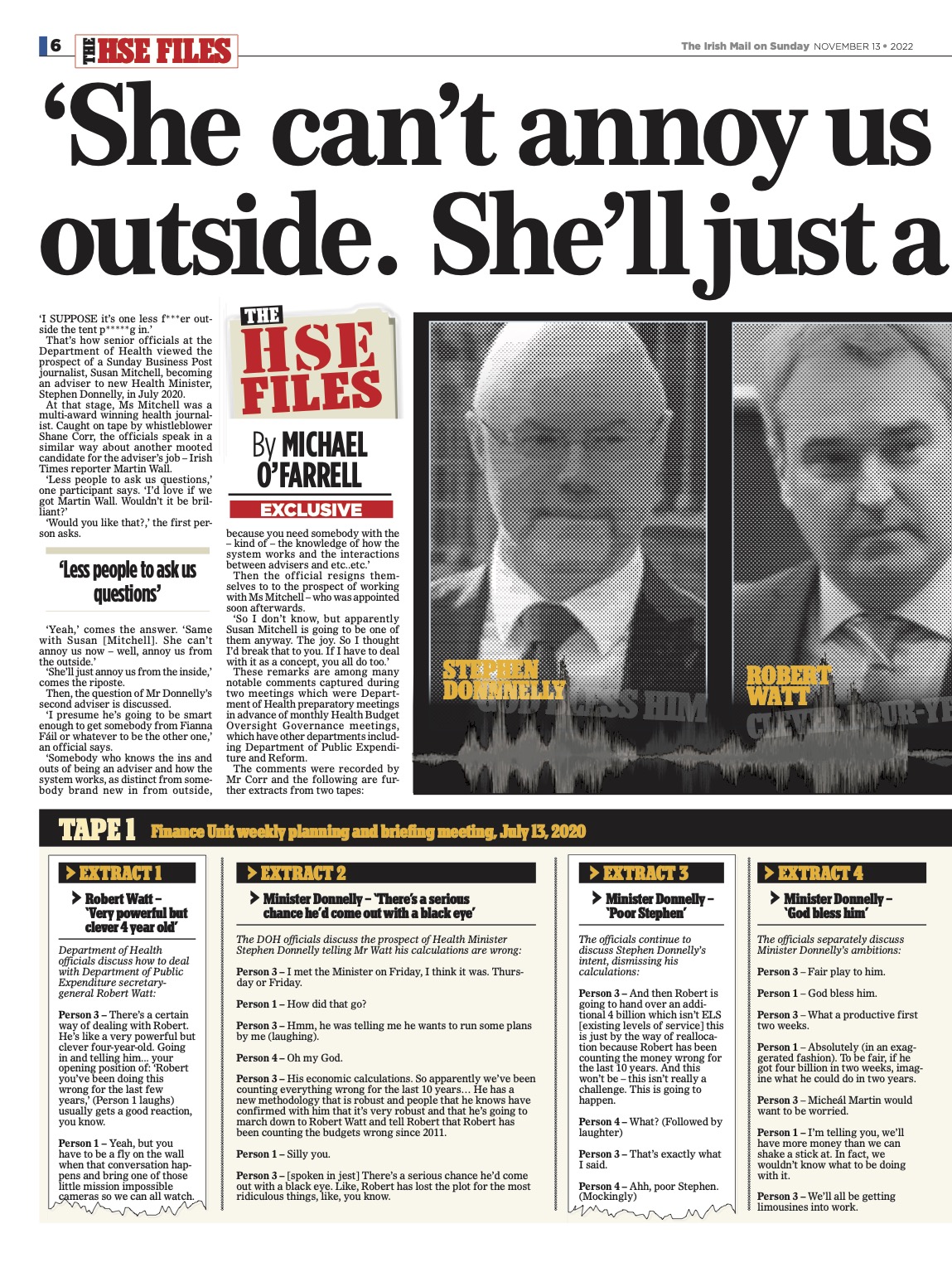
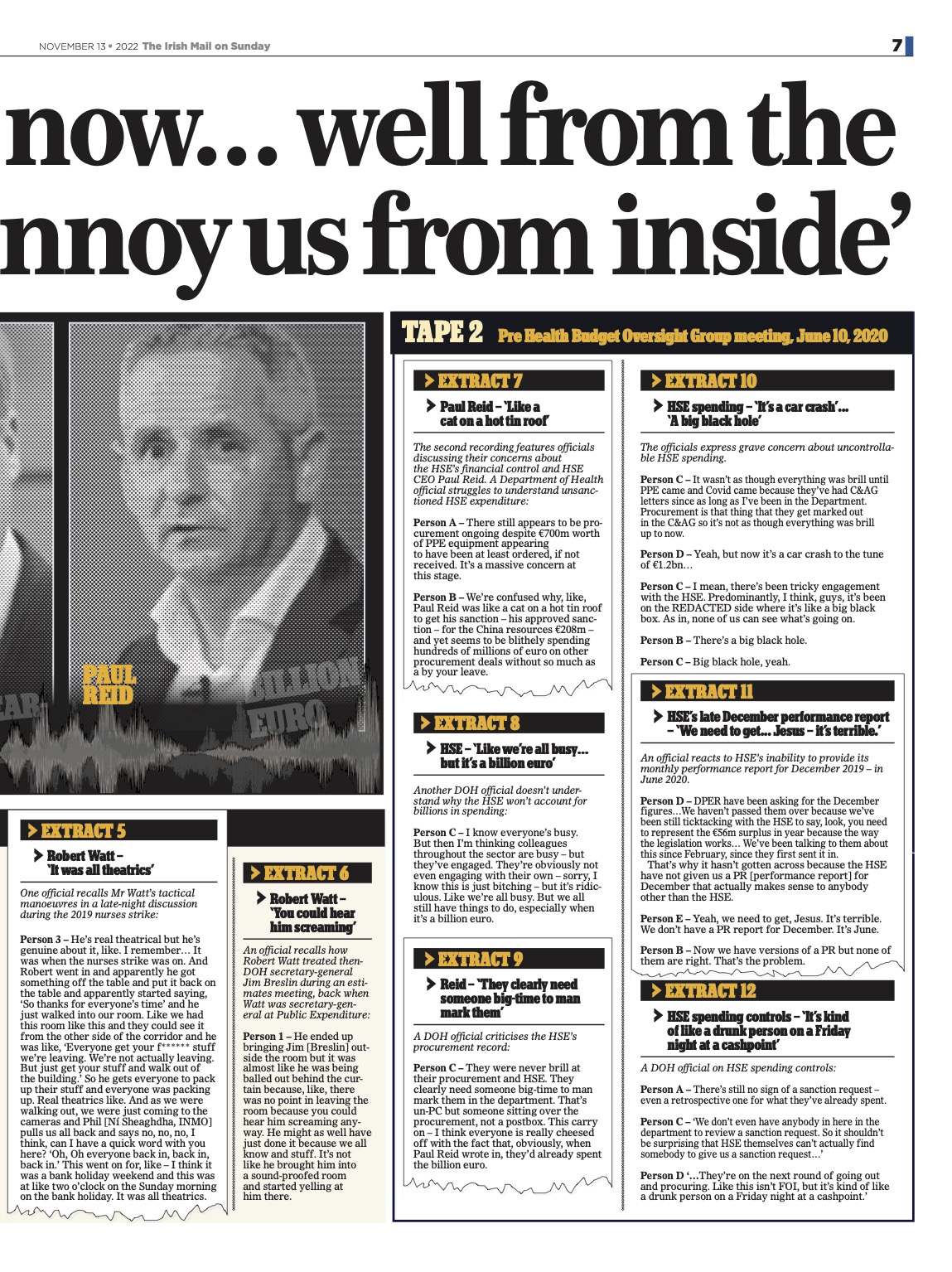
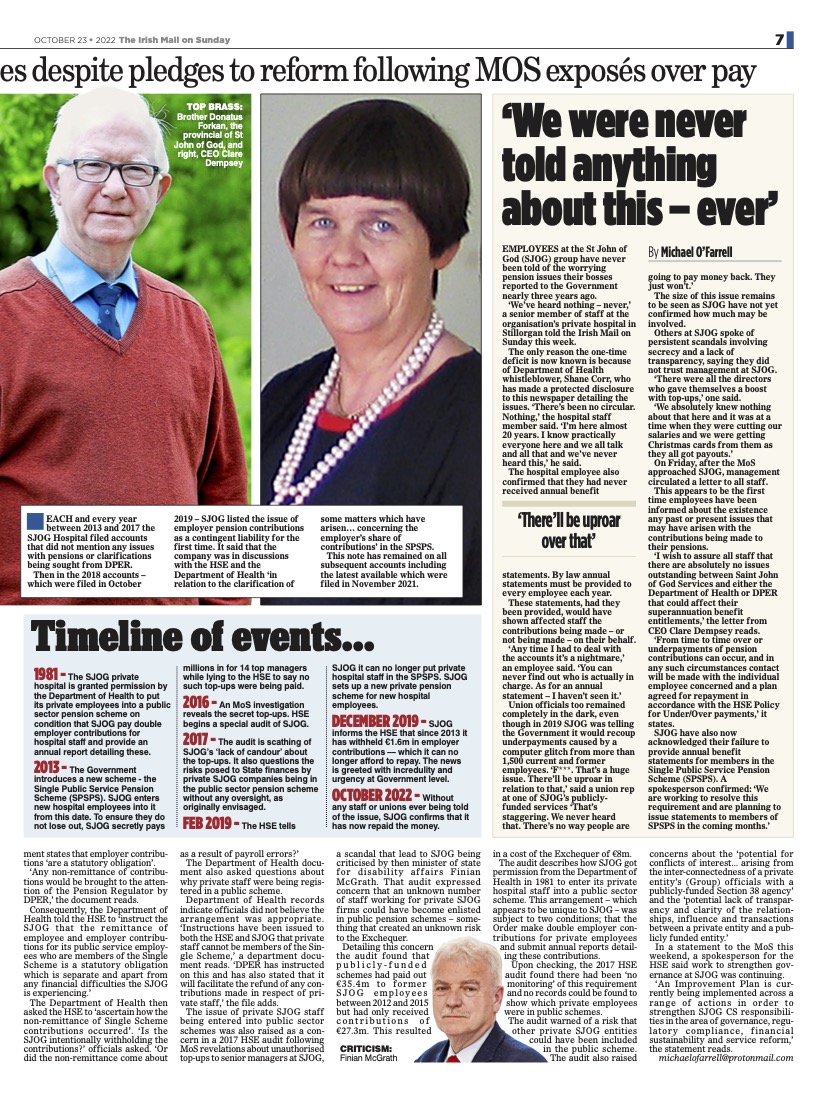
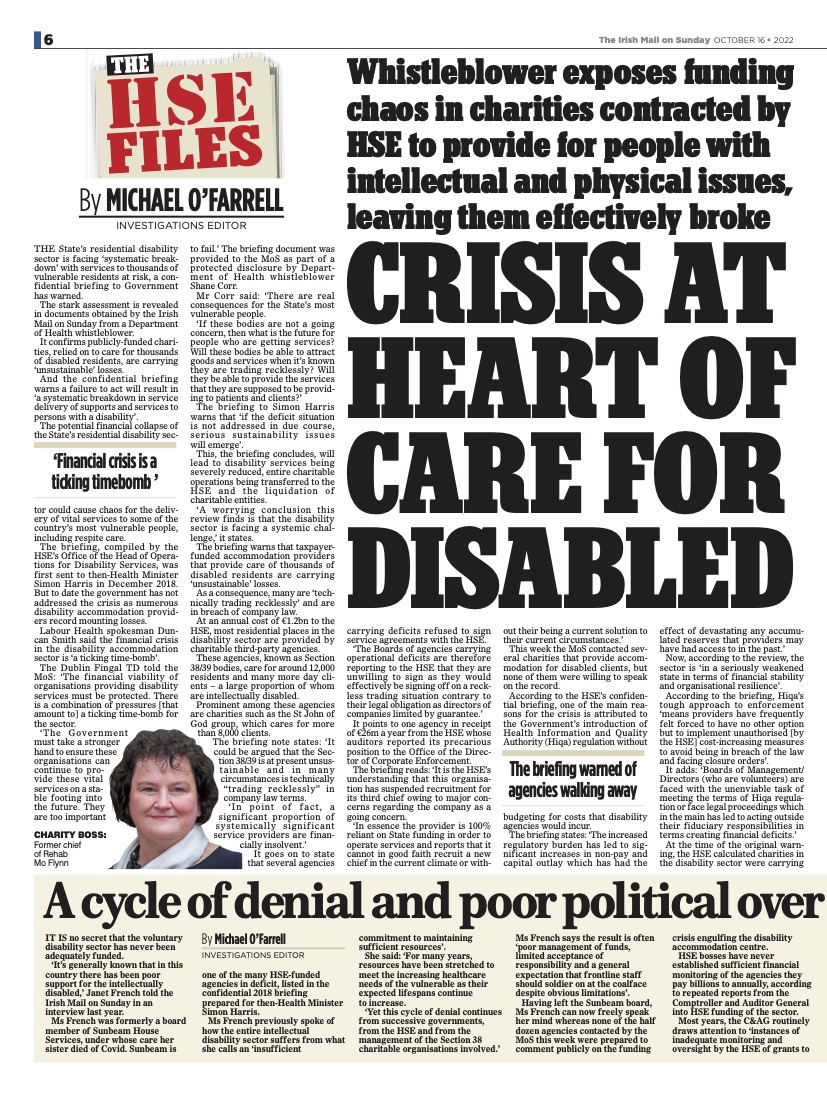
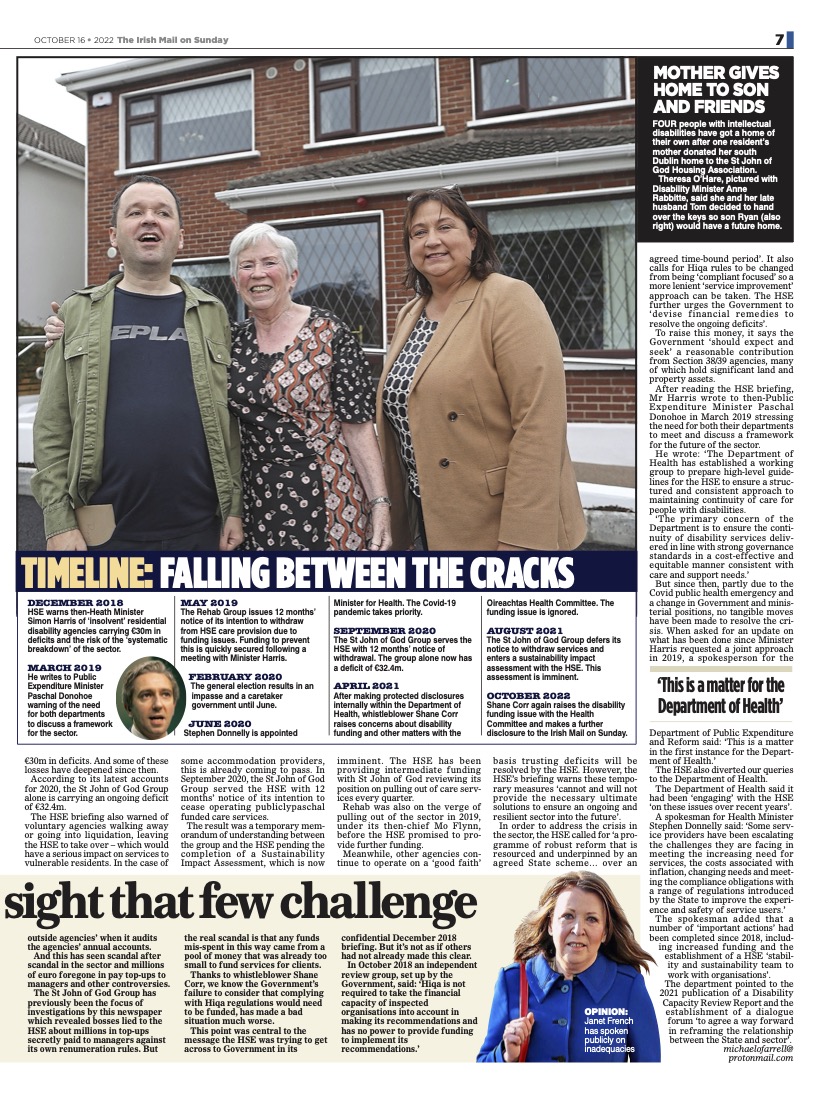
For four months – between October 2022 and February 2023 – the Irish Mail on Sunday collaborated with Department of Health whistleblower, Shane Corr, to reveal significant matters of public interest involving billions of euro belonging to Irish taxpayers. This coverage is detailed below.
We have been collaborating with whistleblowers in this fashion for more than two decades. If you know of any wrongdoing involving public funds please contact us in complete confidence. With your help we can – and we do – hold people to account.
Irish Mail on Sunday – February 12, 2023.Irish Mail on Sunday – February 5, 2023.Irish Mail on Sunday – February 5, 2023.
Irish Daily Mail – February 4, 2023.
Irish Daily Mail – January 31, 2023.
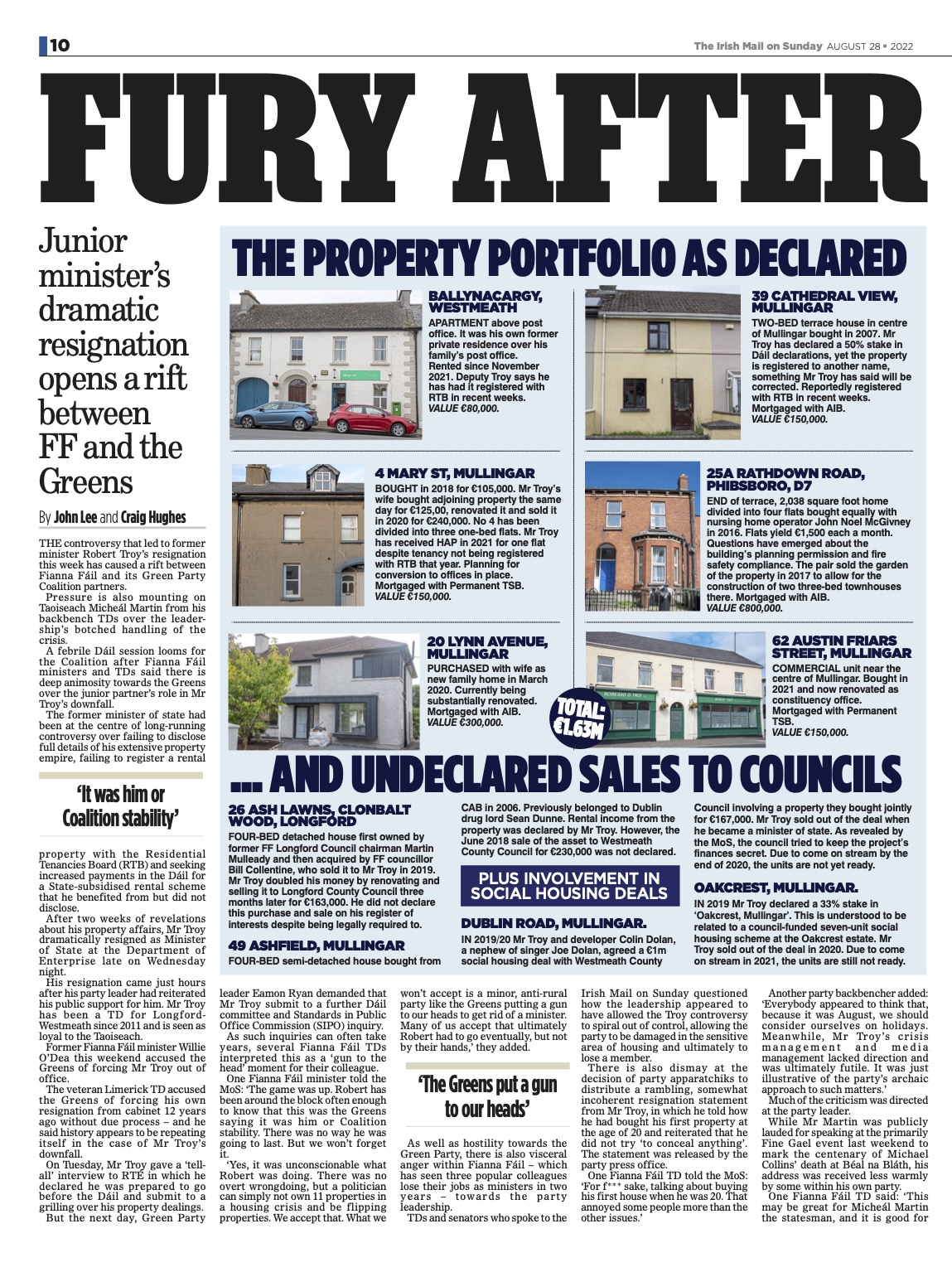
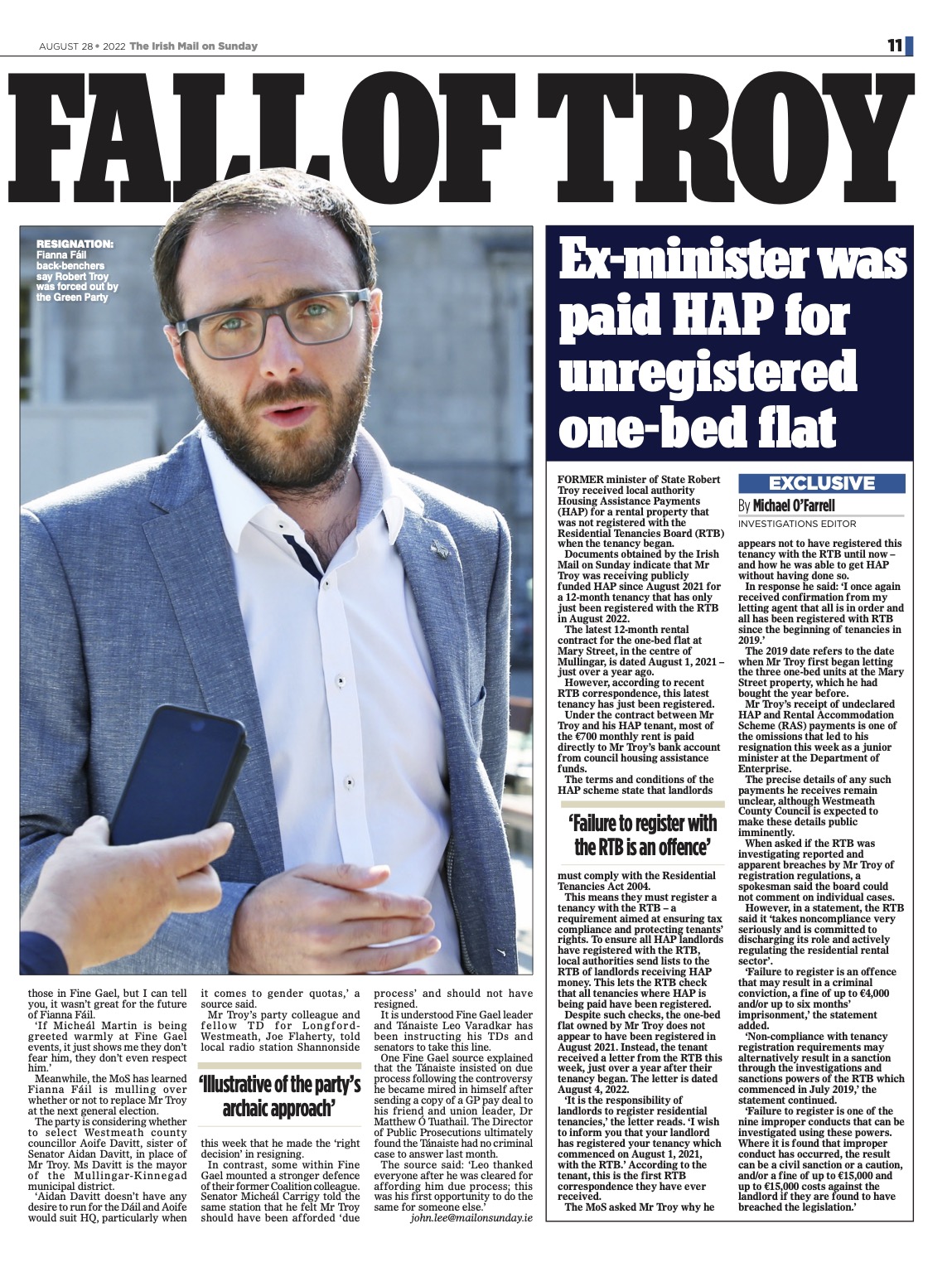
Irish Mail on Sunday – January 29, 2023.Irish Mail on Sunday – Jan 8, 2023. ‘No One in charge, No Accountability’ as A&E crisis deepens.Irish Mail on Sunday – Jan 1, 2023. ‘Arthur Daley-style accounting’ at the Department of Health – whistleblower Shane Corr reveals.Irish Mail on Sunday – Jan 1, 2023. Whistleblower tapes reveal Department of Health budget negotiations.Irish Mail on Sunday – Nov 20, 2022. Interview with Department of Health whistleblower Shane Corr.
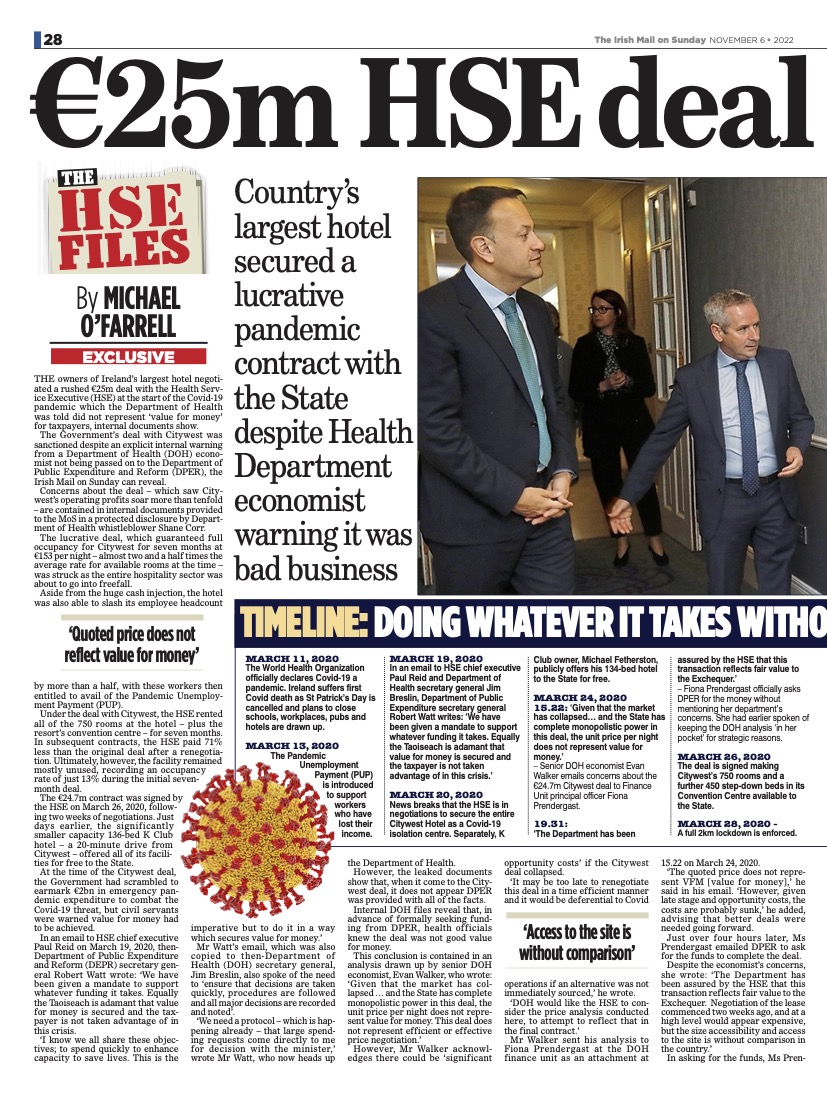
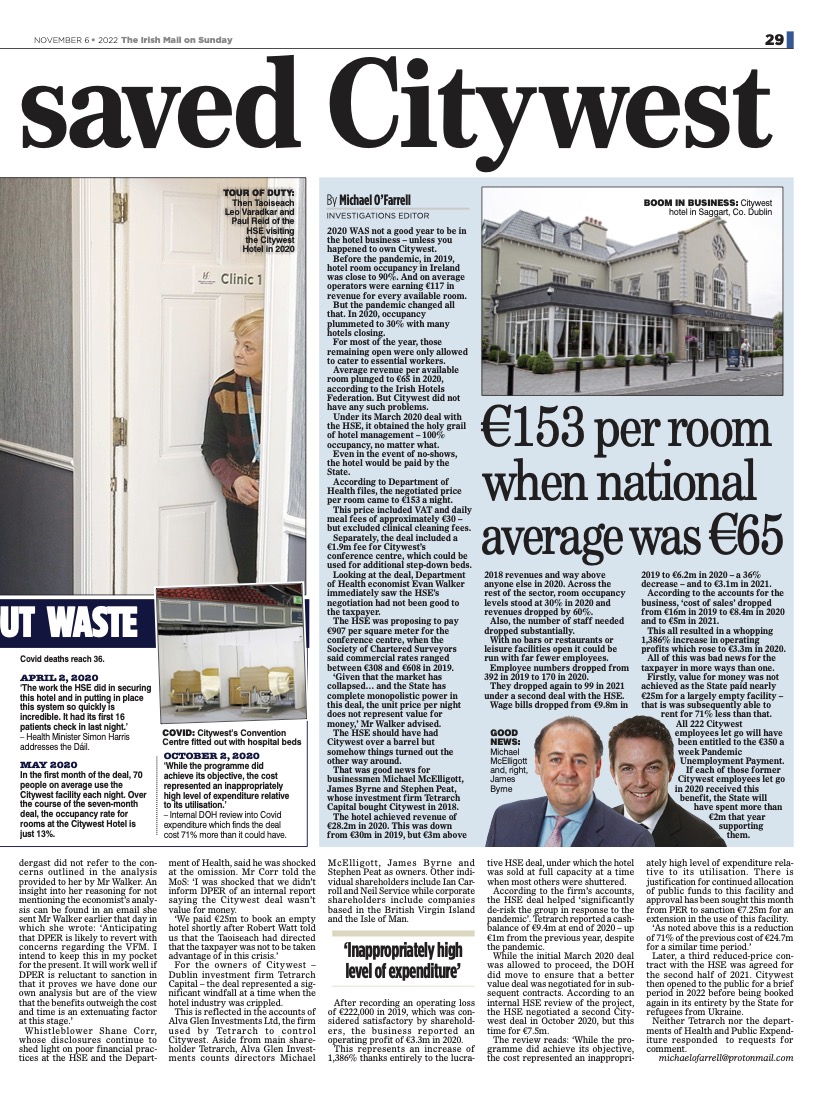
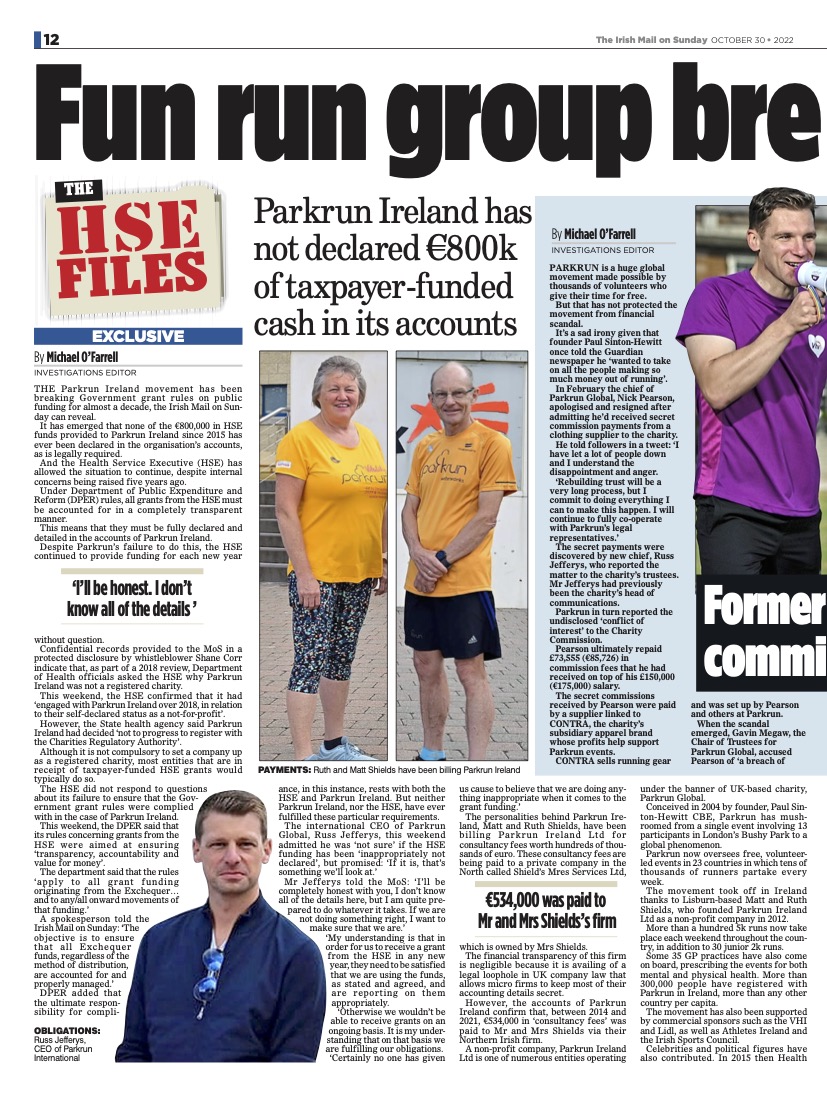
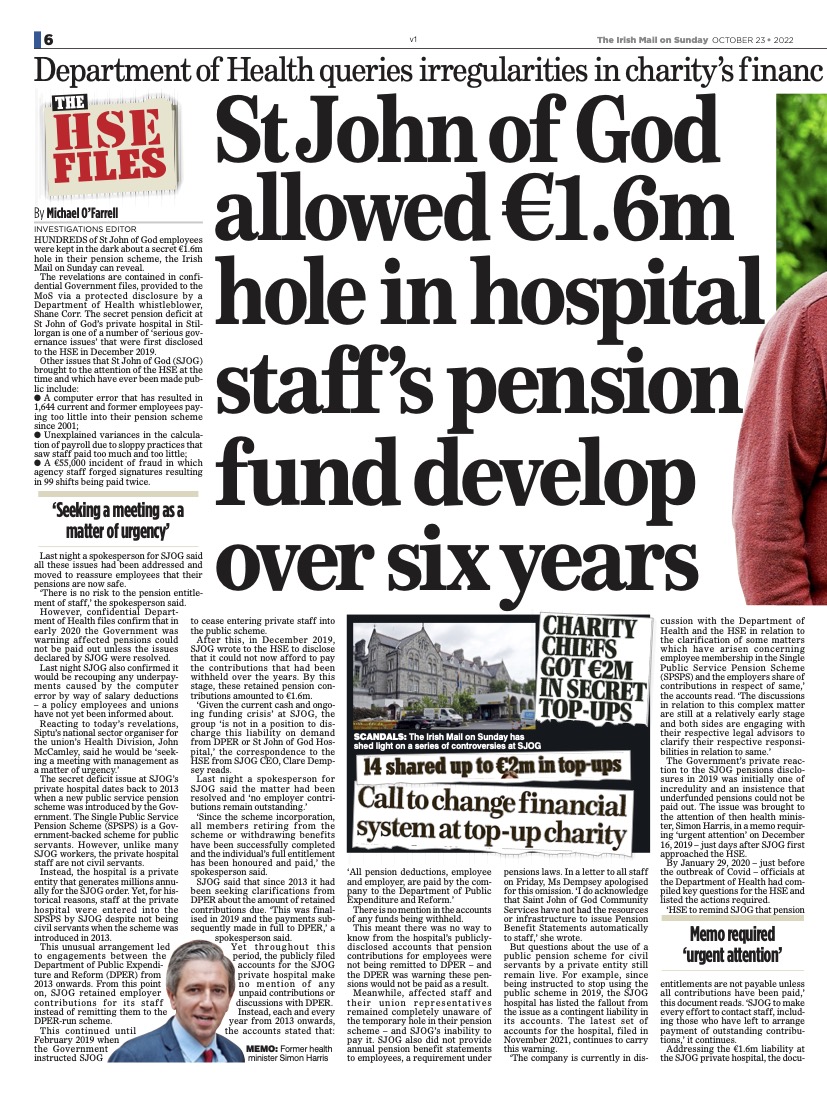
Irish Mail on Sunday – Nov 13, 2022. Civil Servents’ Stinging Verdict on Health Chiefs – Watt a ‘powerful, clever four-year-old’Irish Mail on Sunday – Nov 13, 2022. Extracts from Department of Health internal meetings recorded by whistleblower Shane Corr.Irish Mail on Sunday – November 6, 2022. €25m HSE Deal Saved City West. Irish Mail on Sunday – October 30, 2022. Fun Run Group Breaks Funding Rules. Parkrun Ireland has not declared 800k of taxpayer-funded casino its accounts.Irish Mail on Sunday – October 23, 2022. St John of God allowed €1.6m hole in hospital pension fund develop over six yearsIrish Mail on Sunday – October 16, 2022. CRISIS AT HEART OF CARE FOR DISABLED
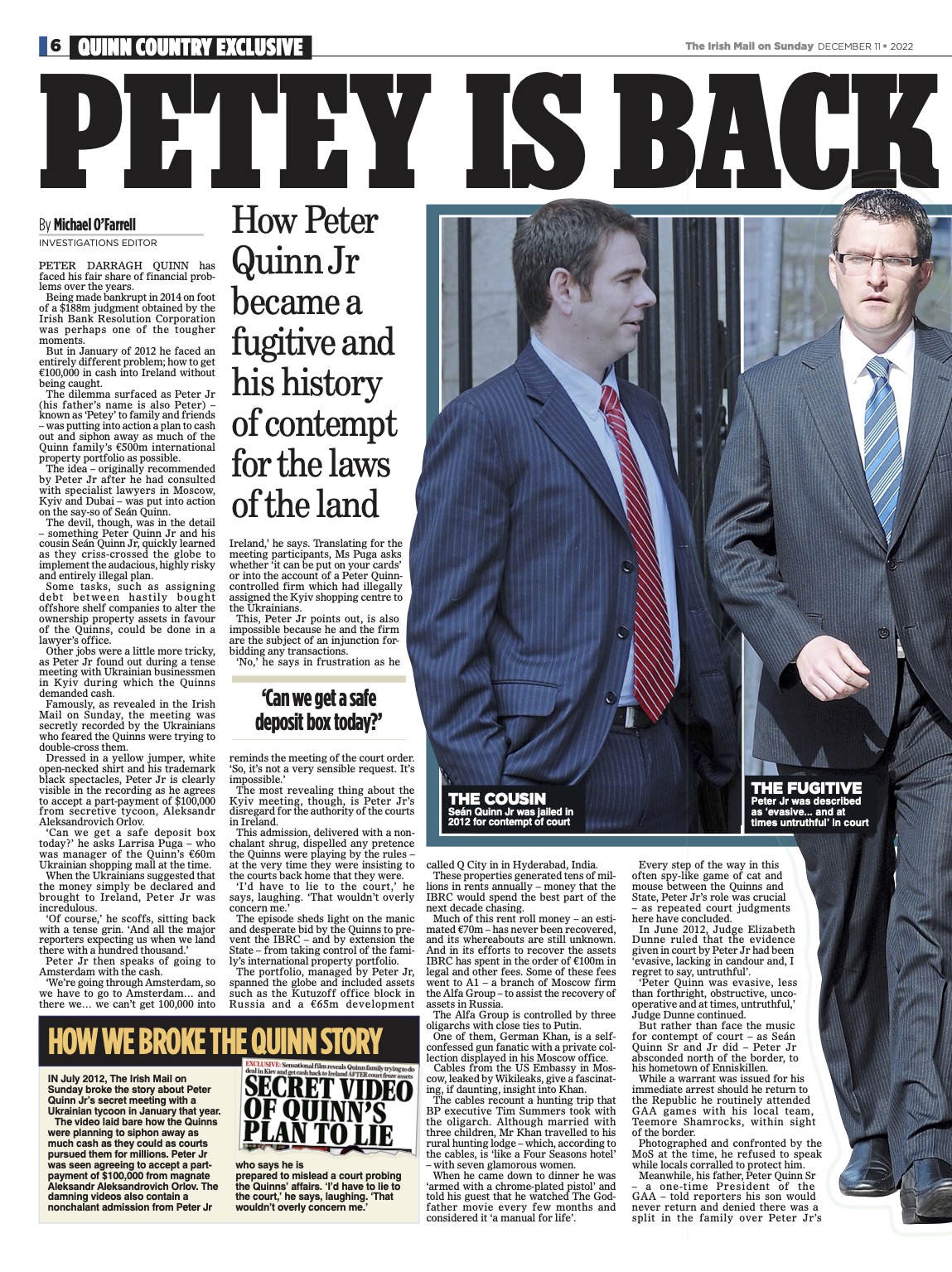
THE fugitive nephew of former billionaire industrialist Seán Quinn – who faces arrest if he ever returns to the Republic – now owns a Dublin company worth over a million, the Irish Mail on Sunday can reveal.
Peter Darragh Quinn went on the run in the summer of 2012 rather than be jailed for contempt of court after he helped the Quinn family to move their €500m global property portfolio beyond the reach of creditors.
Peter Jr was made bankrupt in 2014 after the special liquidators for the Irish Bank Resolution Corporation secured a judgment of $188m against him.
Now, despite remaining a fugitive, Peter Quinn Jr has exited bankruptcy with a clean slate and owns a new recruitment business called Eurotas, with companies on both sides of the border.
A senior security source told the MoS: ‘Even though the warrant was issued in 2012, it still exists. It would still be live and even though it’s 10 years later it’s still live. The warrant wouldn’t die.’
In doing so, he avoided the fate of his uncle and cousin, Seán Quinn Jr, who spent time in jail to purge their contempt.
This means that if he is apprehended south of the border, Peter Jr will be brought to the High Court to face the contempt charge – and likely be imprisoned in a similar fashion to his uncle and cousin.
However, this threat has not stopped Peter Jr from doing business in the Republic – something the authorities here were not aware of until informed by the MoS this week.
But although they are now aware of the fugitive’s new business interests in Dublin, the authorities remain powerless to act.
A source familiar with the process told the MoS: ‘It’s interesting that Peter Quinn Jr has set up a new business, but unfortunately the Irish State can do nothing to get anything back financially from him because he went bankrupt in the UK.’
Peter Jr’s new firm describes itself as ‘a UK and Ireland-based company which specialises in supplying manpower to our clients throughout UK, Ireland, Europe and the world.’
Eurotas (NI) Ltd was first incorporated in the North in late 2018 by Peter Quinn Sr – a loyal brother of Seán Quinn Sr and one-time President of the GAA.
At the same time, a sister company of the same name was incorporated in Dublin and now operates from an office on Sir John Rogerson’s Quay.
By August 2021, the Northern Irish firm, operating from an office in Belfast’s Ormeau Road, had available cash resources of £1.4m.
On the same date, the southern firm’s accounts posted cash at bank of €772,000 and debtors of €836,000 – meaning €1.6m in assets. It paid €661,000 in wages that year.
Although originally established by his father, ownership of these firms transferred to Peter Jr in September 2021.
This ownership is held via Beechmount Developments Ltd, the Enniskillen firm of Peter Quinn Sr, which has also now passed to Peter Jr.
As the owner of Beechmount, Peter Jr is now in control of its £2.6m in assets.
In January this year, Peter Jr also set up a new Dublin firm called Eurotas Engineering Ltd.
This firm has not yet posted any financial details, but Peter Jr’s southern recruitment operation is actively engaged in the Dublin market.
In July 2021, Revenue provided the Dublin firm with a letter confirming it had ‘a real and continuous link with one or more economic activities being carried on in the State’.
According to the Eurotas website, Dublin contracts have involved providing construction staff to Lidl supermarket developments and other projects around the city.
Eurotas lists Peter Jr’s work with various Quinn family assets abroad on its website to highlight its owner’s experience.
A development in Q City in Hyderabad, India, and the Kutuzoff tower in Moscow are represented as Eurotas projects on the company’s website and Facebook pages.
A decade ago, these properties formed part of the assetstripping scheme that Peter Jr assisted the Quinns to implement as they battled to keep millions from the State.
As revealed in court papers at the time, control of the Kutuzoff tower was vested in ‘men of straw’ – including an unemployed Russian rail worker – in order to hide the Quinn family’s stake.
The asset-stripping scheme was described in one court judgment as one of ‘mesmeric complexity’ that ‘reeks of dishonesty and sharp practice’.
Another ruling described the intent of the scheme as being ‘as far removed from the concept of honour and respectability as it is possible to be’.
His role in the scheme would result in Peter Jr becoming a fugitive but today he is using his experience of managing the Quinns’ global portfolio as an endorsement of his new recruitment firm.
‘Q City was a challenging project logistically due to its location in India,’ the Eurotas Facebook page reads.
‘We supplied Project Management who were heavily involved in the design and build.’
Various other former Quinn family properties are also used in this fashion by Eurotas, including the Belfry golf course, which was once a trophy asset of Seán Quinn’s.
Last week the MoS revealed how €440m owed by Seán Quinn’s five children to the Irish taxpayer remains unpaid.
A judgment of €88m was secured against each of Cavanbased Quinn’s five children, Seán Jr, Aoife, Brenda, Ciara and Colette, following a protracted legal battle between the family and the Irish Bank Resolution Corporation, formerly Anglo Irish Bank.
A source familiar with the process said the judgments would only be enforced ‘if one of them [Quinn children] comes into a windfall or if it transpires that any information they gave about assets was wrong’.
Even though the €440m owed to the State remains unpaid, Seán Quinn claimed in the three-part documentary series, Quinn Country, aired on RTÉ One last week, that he wanted to be remembered as ‘the man they tried to bury and they weren’t able to bury him’.
Green Acre Grange Upper Kilmacud road Goatstown
Pic Michael Chester
0878072295
info@chester.ie
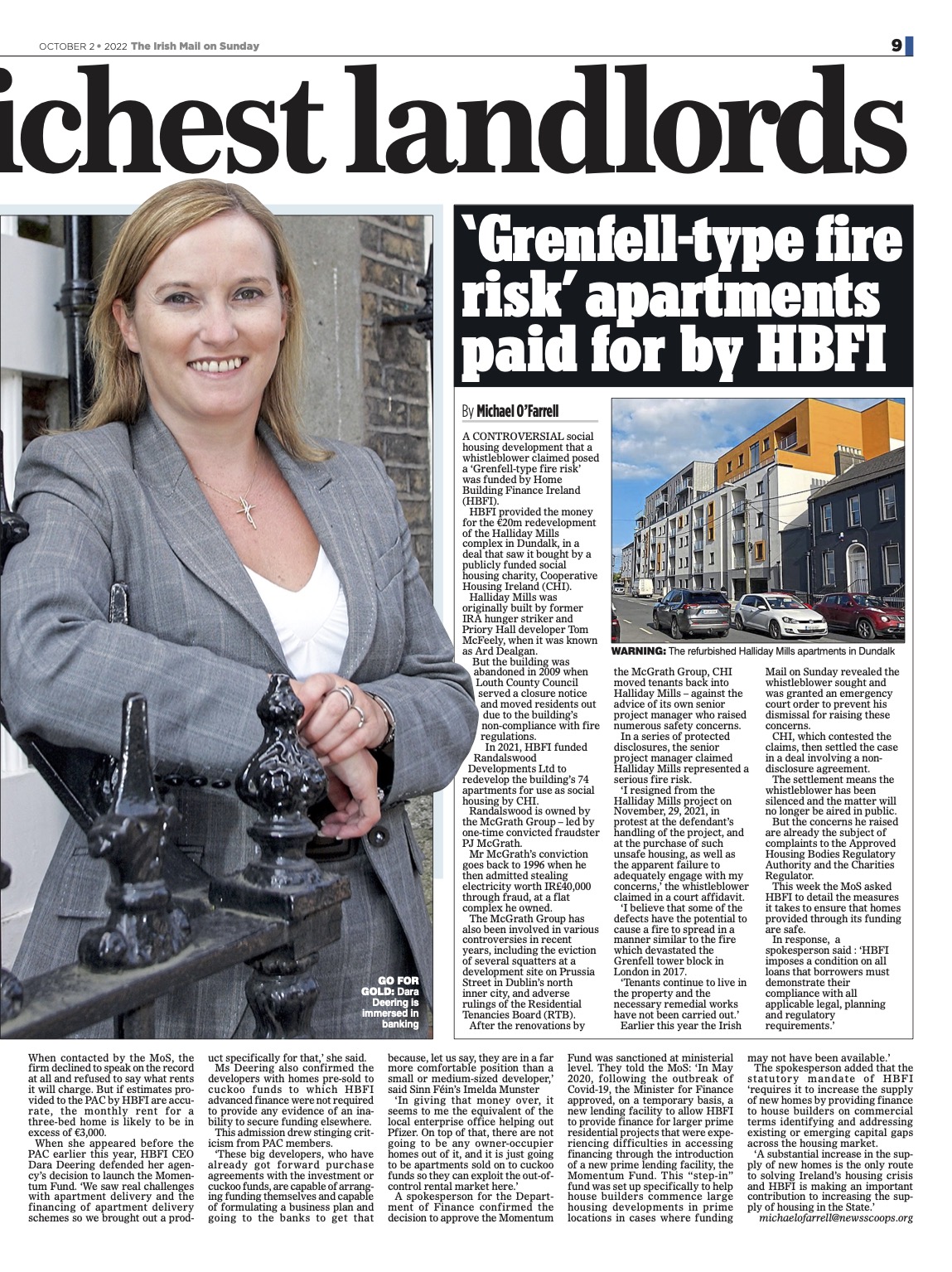
A GOVERNMENT quango set up to help small builders provide family homes has used taxpayer funds to finance hundreds of apartments being built for a controversial ‘cuckoo’ fund.
The construction of 211 apartments at the Windmill development in Clonsilla was funded entirely by loans from Home Building Finance Ireland (HBFI).
Due to be completed in the coming months, the development of three multistorey apartment blocks is being built by Kimpton Vale Ltd.
However, the entire scheme has been pre-sold to Urbeo – the cuckoo fund which first came to national prominence last year with its purchase of the Carton Grove estate in Maynooth.
An Irish Mail on Sunday investigation has found that finance for the Urbeo homes was provided by the taxpayer via HBFI.
According to contract and loan documents, the HBFI finance was provided on the basis of guarantees from Urbeo that it had agreed to purchase the Windmill project before construction began.
A spokesperson for Urbeo confirmed: ‘We entered into a forward purchase contract with Kimpton Vale which allowed them to secure funding from HBFI to build out the development.’
If you know of information relating to this public interest topic please contact michaelofarrell@protonmail.com in complete confidence.
Irish Mail on Sunday – October 2, 2022.
Once completed the one and two bed units will be rented by Urbeo.But Urbeo declined to comment on what the rental prices may be.
‘We’re not due to receive these units until this side of Christmas or next year,’ a spokesperson said.
‘Until we get closer to the time of completion that’s obviously when we go out and advertise to the market about rental levels. We haven’t opined on the rental levels for Windmill at the moment.’
The likelihood though – based on figures provided to the Public Accounts Committee (PAC) by HBFI – is that monthly rents average around €2,100 for a two-bed and €1,800 for a one room apartment.
One of the largest institutional landlords in Ireland, Urbeo controls approximately 2,000 housing units worth close to €2bn.
It is led by New York-based founding partner and executive chairman, Frank Kenny, who is a former non-executive director of Hibernia REIT.
‘In giving that money over, it seems to me the equivalent of the local enterprise office helping out Pfizer.’
Imelda Munster – Sinn Fein.
The Urbeo-owned development in Clonsilla is one of five projects that shared HBFI funding worth €274m.
These loans were provided via a contentious and temporary €300m HBFI fund, known as the Momentum Fund.
With Government restrictions during Covid, this fund deviated from the original HBFI purpose of helping small builders to construct homes.
Explaining the rational behind the establishment of the HBFI in 2018, then Minister of State at the Department of Finance, Michael D’Arcy, told the Dáil the aim was to help small builders in rural areas.
‘The problem of a shortage of access to supply of appropriate finance has been particularly acute for small development projects and those located outside the major urban areas,’ he said.
‘A unique feature of HBFI will be its ability to fund smaller developments or those outside the major urban centres.
These projects are currently underserved by the market where there is a clear preference for larger sites and those within the greater Dublin area.’
According to its last annual report, HBFI’s 31 staff members, who are all seconded from the National Treasury Management Agency (NTMA), cost the taxpayer €3.5m last year – an average of €113,000 each.
CEO Dara Deering – a former EBS and KBC banker – took home a pay package worth €314,000. In contrast, the current salary of the Taoiseach is €217,000 – almost €100,000 less.
Five years on from its inception, HBFI loans have resulted in a 715 homes being completed and sold with a further 1,783 contracted for sale or sale agreed.
Funding for more than 5,000 further homes in 20 counties has also been agreed. But the role the new quango has played in funding entire developments for cuckoo funds and institutional investors will surprise many.
Earlier this year HBFI told the Public Accounts Committee that some €242 million of the €274 million it lent under its Momentum Fund had gone to such large-scale private concerns. But when asked by the MoS this week to identify the five projects funded by the Momentum Fund, HBFI said the information was confidential.
‘HBFI is subject to similar legal obligations as other lenders, such as banks and credit units, that do not allow them to disclose confidential information relating to borrowers,’ a spokesperson said.
Yet details of the contracts and loan documents for the Urbeo deal – and other HBFI loans – are publicly-available in the Company Registrations Office.
Meanwhile, another recipient of Momentum Fund finance from the HBFI is entirely public about the matter.
‘The Marlet Group is pleased to have agreed a financing facility with Home Building Finance Ireland (HBFI) for €74m for a forthcoming residential development in Dundrum, which will deliver 253 homes,’ the group announced in October 2020.
The Marlet development is the Green Acre Grange project in Dundrum, which is advertising ‘amenities such as a concierge, creche, gym and cinema room, as well as landscaped areas and rooftop terraces’.
At the time of the HBFI loan it was anticipated that the development in its entirety would be bought by a cuckoo fund as part of a wider portfolio being put together by Marlet.
Institutional landlords and funds such as Kennedy Wilson and Blackstone were reported to be vying to snap up the hundreds of homes involved.
‘A substantial increase in the supply of new homes is the only route to solving Ireland’s housing crisis’
Department of Finance Spokesperson.
Kennedy Wilson, an American real estate investor, is already one of Ireland’s biggest private landlords, while Blackstone is the world’s biggest equity firm.
However, since then Marlet has changed tack and intends to rent the Green Acre Grange units itself.
When contacted by the MoS, the firm declined to speak on the record at all and refused to say what rents it will charge. But if estimates provided to the PAC by HBFI are accurate, the monthly rent for a three-bed home is likely to be in excess of €3,000.
When she appeared before the PAC earlier this year, HBFI CEO Dara Deering defended her agency’s decision to launch the Momentum Fund.
‘We saw real challenges with apartment delivery and the financing of apartment delivery schemes so we brought out a product specifically for that,’ she said.
Ms Deering also confirmed the developers with homes pre-sold to cuckoo funds to which HBFI advanced finance were not required to provide any evidence of an inability to secure funding elsewhere.
This admission drew stinging criticism from PAC members.
‘These big developers, who have already got forward purchase agreements with the investment or cuckoo funds, are capable of arranging funding themselves and capable of formulating a business plan and going to the banks to get that because, let us say, they are in a far more comfortable position than a small or medium-sized developer,’ said Sinn Féin’s Imelda Munster
‘In giving that money over, it seems to me the equivalent of the local enterprise office helping out Pfizer. On top of that, there are not going to be any owner-occupier homes out of it, and it is just going to be apartments sold on to cuckoo funds so they can exploit the out-ofcontrol rental market here.’
A spokesperson for the Department of Finance confirmed the decision to approve the Momentum Fund was sanctioned at ministerial level.
They told the MoS: ‘In May 2020, following the outbreak of Covid-19, the Minister for Finance approved, on a temporary basis, a new lending facility to allow HBFI to provide finance for larger prime residential projects that were experiencing difficulties in accessing financing through the introduction of a new prime lending facility, the Momentum Fund.
This “step-in” fund was set up specifically to help house builders commence large housing developments in prime locations in cases where funding may not have been available.’
The spokesperson added that the statutory mandate of HBFI ‘requires it to increase the supply of new homes by providing finance to house builders on commercial terms identifying and addressing existing or emerging capital gaps across the housing market.
‘A substantial increase in the supply of new homes is the only route to solving Ireland’s housing crisis and HBFI is making an important contribution to increasing the supply of housing in the State.’
‘Grenfell-type fire risk’ apartments paid for by HBFI
A CONTROVERSIAL social housing development that a whistleblower claimed posed a ‘Grenfell-type fire risk’ was funded by Home Building Finance Ireland (HBFI).
HBFI provided the money for the €20m redevelopment of the Halliday Mills complex in Dundalk, in a deal that saw it bought by a publicly funded social housing charity, Cooperative Housing Ireland (CHI).
Halliday Mills was originally built by former IRA hunger striker and Priory Hall developer Tom McFeely, when it was known as Ard Dealgan.
But the building was abandoned in 2009 when Louth County Council served a closure notice and moved residents out due to the building’s non-compliance with fire regulations.
In 2021, HBFI funded Randalswood Developments Ltd to redevelop the building’s 74 apartments for use as social housing by CHI.
Randalswood is owned by the McGrath Group – led by one-time convicted fraudster PJ McGrath.
Mr McGrath’s conviction goes back to 1996 when he then admitted stealing electricity worth IR£40,000 through fraud, at a flat complex he owned.
I believe that some of the defects have the potential to cause a fire to spread in a manner similar to the fire which devastated the Grenfell tower block in London in 2017.
CHI Whistleblower
The McGrath Group has also been involved in various controversies in recent years, including the eviction of several squatters at a development site on Prussia Street in Dublin’s north inner city, and adverse rulings of the Residential Tenancies Board (RTB).
After the renovations by the McGrath Group, CHI moved tenants back into Halliday Mills – against the advice of its own senior project manager who raised numerous safety concerns.
In a series of protected disclosures, the senior project manager claimed Halliday Mills represented a serious fire risk.
‘I resigned from the Halliday Mills project on November, 29, 2021, in protest at the defendant’s handling of the project, and at the purchase of such unsafe housing, as well as the apparent failure to adequately engage with my concerns,’ the whistleblower claimed in a court affidavit.
‘I believe that some of the defects have the potential to cause a fire to spread in a manner similar to the fire which devastated the Grenfell tower block in London in 2017.
Borrowers must demonstrate their compliance with all applicable legal, planning and regulatory requirements.
HBFI Spokesperson.
‘Tenants continue to live in the property and the necessary remedial works have not been carried out.’
Earlier this year the Irish Mail on Sunday revealed the whistleblower sought and was granted an emergency court order to prevent his dismissal for raising these concerns.
CHI, which contested the claims, then settled the case in a deal involving a nondisclosure agreement.
The settlement means the whistleblower has been silenced and the matter will no longer be aired in public.
But the concerns he raised are already the subject of complaints to the Approved Housing Bodies Regulatory Authority and the Charities Regulator.
This week the MoS asked HBFI to detail the measures it takes to ensure that homes provided through its funding are safe.
In response, a spokesperson said : ‘HBFI imposes a condition on all loans that borrowers must demonstrate their compliance with all applicable legal, planning and regulatory requirements.’
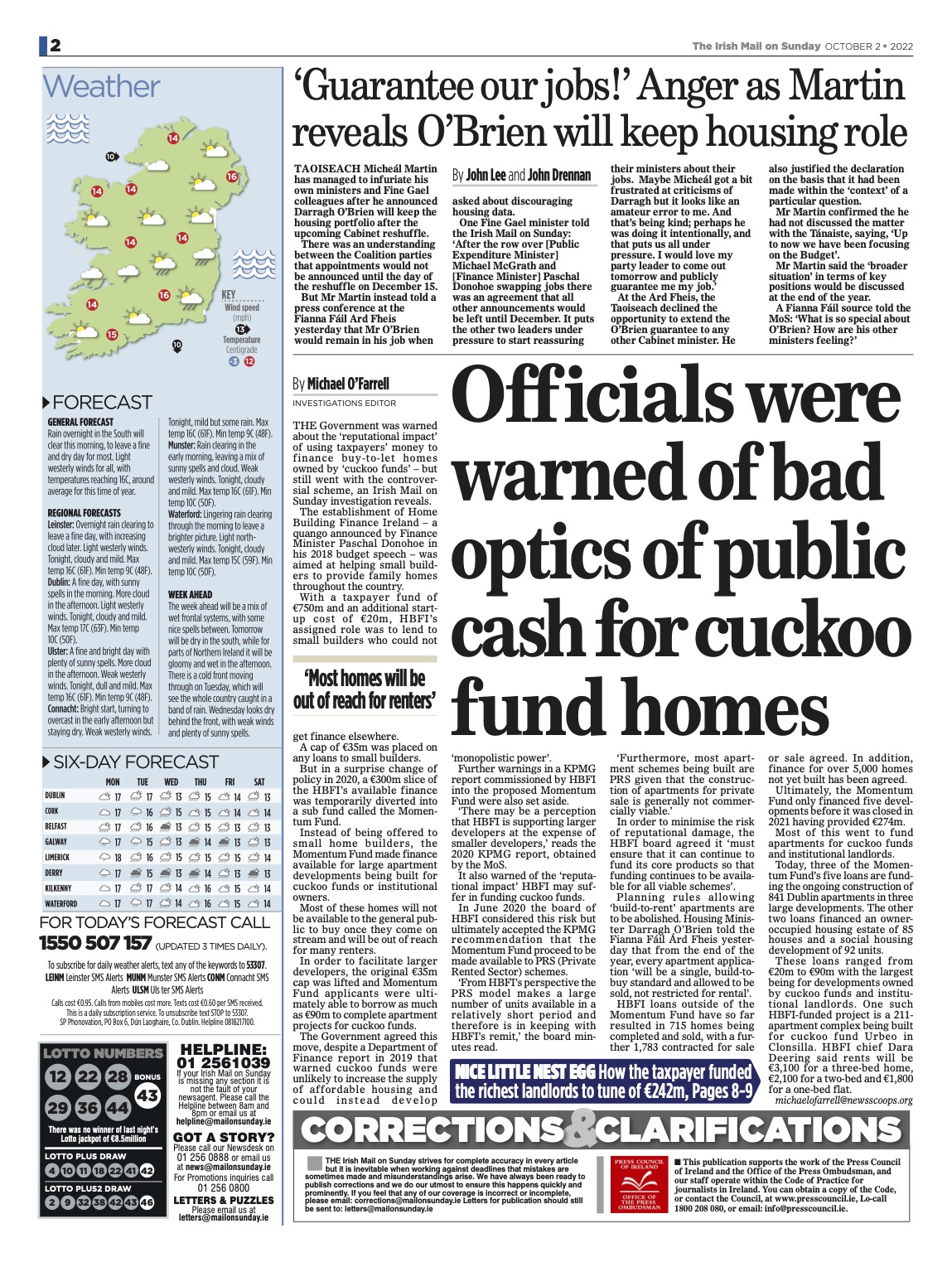
Officials were warned of bad optics of public cash for cuckoo fund homes
THE Government was warned about the ‘reputational impact’ of using taxpayers’ money to finance buy-to-let homes owned by ‘cuckoo funds’ – but still went with the controversial scheme, an Irish Mail on Sunday investigation reveals.
The establishment of Home Building Finance Ireland – a quango announced by Finance Minister Paschal Donohoe in his 2018 budget speech – was aimed at helping small builders to provide family homes throughout the country.
With a taxpayer fund of €750m and an additional startup cost of €20m, HBFI’s assigned role was to lend to small builders who could not get finance elsewhere.
There may be a perception that HBFI is supporting larger developers at the expense of smaller developers
A cap of €35m was placed on any loans to small builders. But in a surprise change of policy in 2020, a €300m slice of the HBFI’s available finance was temporarily diverted into a sub fund called the Momentum Fund.
Instead of being offered to small home builders, the Momentum Fund made finance available for large apartment developments being built for cuckoo funds or institutional owners.
Most of these homes will not be available to the general public to buy once they come on stream and will be out of reach for many renters.
Irish Mail on Sunday – October 2, 2022.
In order to facilitate larger developers, the original €35m cap was lifted and Momentum Fund applicants were ultimately able to borrow as much as €90m to complete apartment projects for cuckoo funds.
The Government agreed this move, despite a Department of Finance report in 2019 that warned cuckoo funds were unlikely to increase the supply of affordable housing and could instead develop ‘monopolistic power’.
Further warnings in a KPMG report commissioned by HBFI into the proposed Momentum Fund were also set aside.
‘There may be a perception that HBFI is supporting larger developers at the expense of smaller developers,’ reads the 2020 KPMG report, obtained by the MoS.
It also warned of the ‘reputational impact’ HBFI may suffer in funding cuckoo funds.
In June 2020 the board of HBFI considered this risk but ultimately accepted the KPMG recommendation that the Momentum Fund proceed to be made available to PRS (Private Rented Sector) schemes.
‘From HBFI’s perspective the PRS model makes a large number of units available in a relatively short period and therefore is in keeping with HBFI’s remit,’ the board minutes read.
‘Furthermore, most apartment schemes being built are PRS given that the construction of apartments for private sale is generally not commercially viable.’
In order to minimise the risk of reputational damage, the HBFI board agreed it ‘must ensure that it can continue to fund its core products so that funding continues to be available for all viable schemes’.
Planning rules allowing ‘build-to-rent’ apartments are to be abolished. Housing Minister Darragh O’Brien told the Fianna Fáil Árd Fheis yesterday that from the end of the year, every apartment application ‘will be a single, build-tobuy standard and allowed to be sold, not restricted for rental’.
HBFI loans outside of the Momentum Fund have so far resulted in 715 homes being completed and sold, with a further 1,783 contracted for sale or sale agreed. In addition, finance for over 5,000 homes not yet built has been agreed.
Ultimately, the Momentum Fund only financed five developments before it was closed in 2021 having provided €274m.
Most of this went to fund apartments for cuckoo funds and institutional landlords.
Today, three of the Momentum Fund’s five loans are funding the ongoing construction of 841 Dublin apartments in three large developments. The other two loans financed an owneroccupied housing estate of 85 houses and a social housing development of 92 units.
These loans ranged from €20m to €90m with the largest being for developments owned by cuckoo funds and institutional landlords. One such HBFI-funded project is a 211- apartment complex being built for cuckoo fund Urbeo in Clonsilla. HBFI chief Dara Deering said rents will be €3,100 for a three-bed home, €2,100 for a two-bed and €1,800 for a one-bed flat.
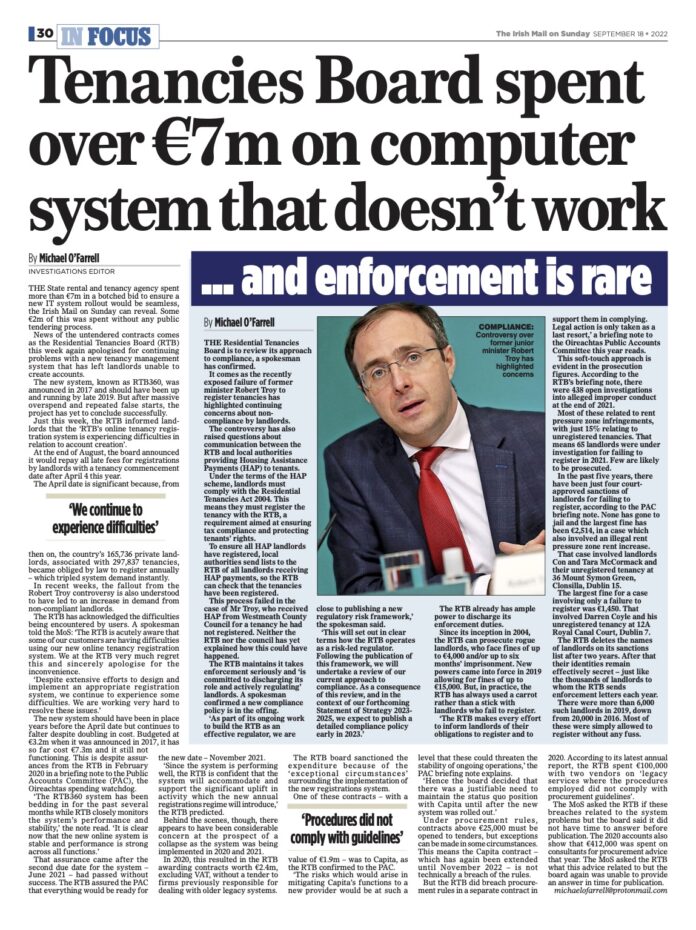
THE State rental and tenancy agency spent more than €7m in a botched bid to ensure a new IT system rollout would be seamless, the Irish Mail on Sunday can reveal. Some €2m of this was spent without any public tendering process.
News of the untendered contracts comes as the Residential Tenancies Board (RTB) this week again apologised for continuing problems with a new tenancy management system that has left landlords unable to create accounts.
The new system, known as RTB360, was announced in 2017 and should have been up and running by late 2019. But after massive overspend and repeated false starts, the project has yet to conclude successfully.
Just this week, the RTB informed landlords that the ‘RTB’s online tenancy registration system is experiencing difficulties in relation to account creation’.
At the end of August, the board announced it would repay all late fees for registrations by landlords with a tenancy commencement date after April 4 this year.
The April date is significant because, from then on, the country’s 165,736 private landlords, associated with 297,837 tenancies, became obliged by law to register annually – which tripled system demand instantly.
In recent weeks, the fallout from the Robert Troy controversy is also understood to have led to an increase in demand from non-compliant landlords.
The RTB is acutely aware that some of our customers are having difficulties
RTB Spokesperson.
The RTB has acknowledged the difficulties being encountered by users. A spokesman told the MoS: ‘The RTB is acutely aware that some of our customers are having difficulties using our new online tenancy registration system. We at the RTB very much regret this and sincerely apologise for the inconvenience. ‘Despite extensive efforts to design and implement an appropriate registration system, we continue to experience some difficulties. We are working very hard to resolve these issues.’
The new system should have been in place years before the April date but continues to falter despite doubling in cost. Budgeted at €3.2m when it was announced in 2017, it has so far cost €7.3m and it still not functioning. This is despite assurances from the RTB in February 2020 in a briefing note to the Public Accounts Committee (PAC), the Oireachtas spending watchdog.
‘The RTB360 system has been bedding in for the past several months while RTB closely monitors the system’s performance and stability,’ the note read. ‘It is clear now that the new online system is stable and performance is strong across all functions.’
That assurance came after the second due date for the system – June 2021 – had passed without success. The RTB assured the PAC that everything would be ready for the new date – November 2021.
‘Since the system is performing well, the RTB is confident that the system will accommodate and support the significant uplift in activity which the new annual registrations regime will introduce,’ the RTB predicted. Behind the scenes, though, there appears to have been considerable concern at the prospect of a collapse as the system was being implemented in 2020 and 2021.
In 2020, this resulted in the RTB awarding contracts worth €2.4m, excluding VAT, without a tender to firms previously responsible for dealing with older legacy systems.
If you have information about matters of public interest within the Residential Tenancies Board contact michaelofarrell@protonmail.com in complete confidence.
The RTB board sanctioned the expenditure because of the ‘exceptional circumstances’ surrounding the implementation of the new registrations system. One of these contracts – with a value of €1.9m – was to Capita, as the RTB confirmed to the PAC.
‘The risks which would arise in mitigating Capita’s functions to a new provider would be at such a level that these could threaten the stability of ongoing operations,’ the PAC briefing note explains.
‘Hence the board decided that there was a justifiable need to maintain the status quo position with Capita until after the new system was rolled out.’
Under procurement rules, contracts above €25,000 must be opened to tenders, but exceptions can be made in some circumstances. This means the Capita contract – which has again been extended until November 2022 – is not technically a breach of the rules.
But the RTB did breach procurement rules in a separate contract in 2020. According to its latest annual report, the RTB spent €100,000 with two vendors on ‘legacy services where the procedures employed did not comply with procurement guidelines’.
The MoS asked the RTB if these breaches related to the system problems but the board said it did not have time to answer before publication. The 2020 accounts also show that €412,000 was spent on consultants for procurement advice that year. The MoS asked the RTB what this advice related to but the board again was unable to provide an answer in time for publication.
… and enforcement is rare
THE Residential Tenancies Board is to review its approach to compliance, a spokesman has confirmed.
It comes as the recently exposed failure of former minister Robert Troy to register tenancies has highlighted continuing concerns about noncompliance by landlords.
The controversy has also raised questions about communication between the RTB and local authorities providing Housing Assistance Payments (HAP) to tenants.
Under the terms of the HAP scheme, landlords must comply with the Residential Tenancies Act 2004. This means they must register the tenancy with the RTB, a requirement aimed at ensuring tax compliance and protecting tenants’ rights.
To ensure all HAP landlords have registered, local authorities send lists to the RTB of all landlords receiving HAP payments, so the RTB can check that the tenancies have been registered.
As part of its ongoing work to build the RTB as an effective regulator, we are close to publishing a new regulatory risk framework
RTB Spokesperson.
This process failed in the case of Mr Troy, who received HAP from Westmeath County Council for a tenancy he had not registered. Neither the RTB nor the council has yet explained how this could have happened.
The RTB maintains it takes enforcement seriously and ‘is committed to discharging its role and actively regulating’ landlords. A spokesman confirmed a new compliance policy is in the offing.
‘As part of its ongoing work to build the RTB as an effective regulator, we are close to publishing a new regulatory risk framework,’ the spokesman said.
‘This will set out in clear terms how the RTB operates as a risk-led regulator. Following the publication of this framework, we will undertake a review of our current approach to compliance. As a consequence of this review, and in the context of our forthcoming Statement of Strategy 2023-2025, we expect to publish a detailed compliance policy early in 2023.’
The RTB already has ample power to discharge its enforcement duties.
Since its inception in 2004, the RTB can prosecute rogue landlords, who face fines of up to €4,000 and/or up to six months’ imprisonment. New powers came into force in 2019 allowing for fines of up to €15,000. But, in practice, the RTB has always used a carrot rather than a stick with landlords who fail to register.
‘The RTB makes every effort to inform landlords of their obligations to register and to support them in complying. Legal action is only taken as a last resort,’ a briefing note to the Oireachtas Public Accounts Committee this year reads.
This soft-touch approach is evident in the prosecution figures. According to the RTB’s briefing note, there were 438 open investigations into alleged improper conduct at the end of 2021.
If you have information about matters of public interest within the Residential Tenancies Board contact michaelofarrell@protonmail.com in complete confidence.
Most of these related to rent pressure zone infringements, with just 15% relating to unregistered tenancies. That means 65 landlords were under investigation for failing to register in 2021. Few are likely to be prosecuted.
In the past five years, there have been just four courtapproved sanctions of landlords for failing to register, according to the PAC briefing note. None has gone to jail and the largest fine has been €2,514, in a case which also involved an illegal rent pressure zone rent increase.
That case involved landlords Con and Tara McCormack and their unregistered tenancy at 36 Mount Symon Green, Clonsilla, Dublin 15.
The largest fine for a case involving only a failure to register was €1,450. That involved Darren Coyle and his unregistered tenancy at 12A Royal Canal Court, Dublin 7.
The RTB deletes the names of landlords on its sanctions list after two years. After that their identities remain effectively secret – just like the thousands of landlords to whom the RTB sends enforcement letters each year.
There were more than 6,000 such landlords in 2019, down from 20,000 in 2016. Most of these were simply allowed to register without any fuss.
THE ESB is refusing to confirm whether soaring profit levels will see top executives benefit from increased bonuses.
The refusal comes as the company announced a 300% increase in profits this week – a development that has appalled householders facing back-to-back price hikes.
The surge in profits at the ESB, where staff own 5% of the company and receive reducedcost power, will enrich many of those in charge of the semi-State.
Under Government rules, chief executive Paddy Hayes – who receives a salary of €318,000 and pension top-ups amounting to around €50,000 a year – is not entitled to a performance bonus.
However, other senior managers at the ESB do benefit from performance-related remuneration schemes operated by the company.
Together with the chief executive, these key managers shared pay and perks worth €4.3m last year.
If you have information about wrongdoing at energy companies contact michaelofarrell@protonmail in complete confidence.
According to the ESB’s most recent annual report, these managers are entitled to bonuses linked to the ‘achievement of financial and strategic objectives’.
This week, the MoS asked the ESB whether profit was one of the measures taken into account for bonus purposes.
We also asked the ESB to explain how any profit-related bonuses are apportioned among managers and to detail the amount now payable in bonuses in light of current profits.
Remuneration details in relation to employees of ESB is confidential
ESB Spokesperson.
In response, the company issued a statement that did not address any of these queries. Instead the statement simply said that ‘remuneration details in relation to employees of ESB is confidential’.
Speaking to the MoS, Dermott Jewell of the Consumers’ Association of Ireland said the high salaries of some energy executives would anger people struggling to pay their bills.
‘It has to be said that, under the current circumstances, these will probably hold a stronger resonance with consumers than ever before,’ he said.
An MoS tally of the salaries of those heading the main electricity firms in Ireland shows millions in wages and profit-linked bonuses going to CEOs, with profits often going to shareholders abroad.
SSE Group CEO Alistair Phillips-Davies, for example, earned £4.5m (€5m) last year for overseeing the group’s business, which included SSE Airtricity. Energia, meanwhile, is owned by a US private equity fund which ultimately channels profits through the Cayman Islands.
Speaking to the MoS this weekend, Mr Jewell said these high salaries and offshore structures contribute to a sentiment among consumers that the reasons for price increases are not transparent enough.
‘When you hear of elements within the structure of cost levels like that and match it with the difficulty the average customer is going through, there is a complete and total imbalance in it and it needs to be addressed,’ he said.
Mr Jewell said people need transparency so they can see ‘the reality of what is driving the prices into every household, putting very many of them into significant debt, in contrast to those who are providing the service, who have no qualms whatsoever in paying such significant levels of income to employees.
We have to focus on the transparency behind all the price increases that are coming from the energy providers in the context of the enormous profits that are being made
Dermott Jewell of the Consumers’ Association of Ireland
‘We have to focus on the transparency behind all the price increases that are coming from the energy providers in the context of the enormous profits that are being made,’ Mr Jewell added.
‘There is an unhealthy balance between the two and it needs to be clarified clinically to consumers. Otherwise they will naturally assume the worst.’
With the EU working on revenue cap and windfall tax proposals, and the Government preparing additional financial support for electricity customers, Mr Jewell said immediate action was required.
‘There’s very little that you or I can do about it. But there certainly is something that the Government can do about it. They facilitate licences and the ability for organisations to transact their business and that’s got to be at a fair and equitable rate in the context of the crisis that exists.’
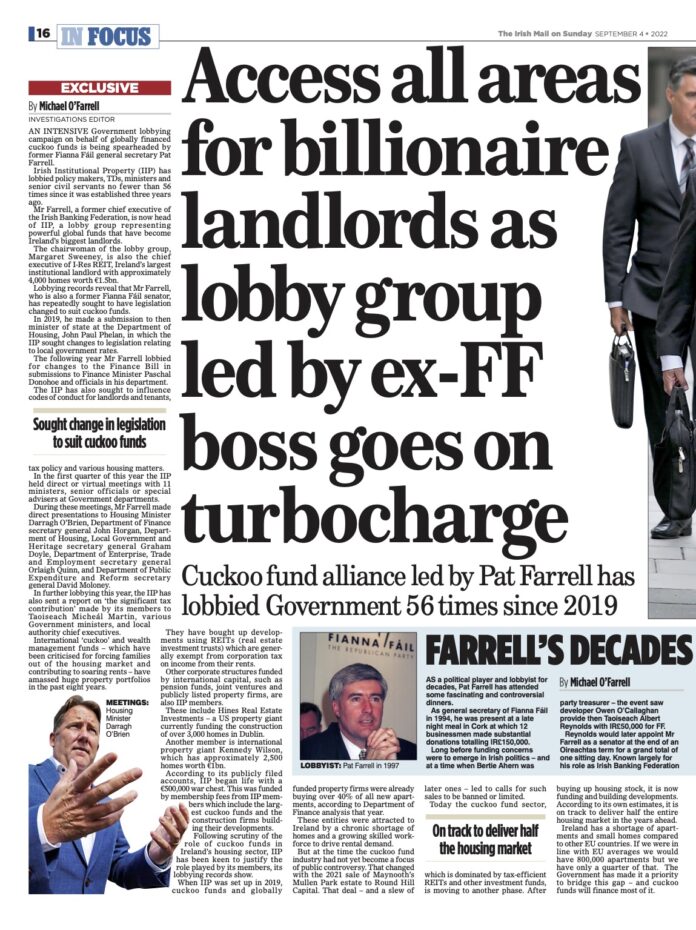
AN INTENSIVE Government lobbying campaign on behalf of globally financed cuckoo funds is being spearheaded by former Fianna Fáil general secretary Pat Farrell.
Irish Institutional Property (IIP) has lobbied policy makers, TDs, ministers and senior civil servants no fewer than 56 times since it was established three years ago.
Mr Farrell, a former chief executive of the Irish Banking Federation, is now head of IIP, a lobby group representing powerful global funds that have become Ireland’s biggest landlords.
The chairwoman of the lobby group, Margaret Sweeney, is also the chief executive of I-Res REIT, Ireland’s largest institutional landlord with approximately 4,000 homes worth €1.5bn.
Lobbying records reveal that Mr Farrell, who is also a former Fianna Fáil senator, has repeatedly sought to have legislation changed to suit cuckoo funds.
In 2019, he made a submission to then minister of state at the Department of Housing, John Paul Phelan, in which the IIP sought changes to legislation relating to local government rates.
The following year Mr Farrell lobbied for changes to the Finance Bill in submissions to Finance Minister Paschal Donohoe and officials in his department.
IIP began life with a €500,000 war chest funded by the largest cuckoo funds
The IIP has also sought to influence codes of conduct for landlords and tenants, tax policy and various housing matters.
In the first quarter of this year the IIP held direct or virtual meetings with 11 ministers, senior officials or special advisers at Government departments.
During these meetings, Mr Farrell made direct presentations to Housing Minister Darragh O’Brien, Department of Finance secretary general John Horgan, Department of Housing, Local Government and Heritage secretary general Graham Doyle, Department of Enterprise, Trade and Employment secretary general Orlaigh Quinn, and Department of Public Expenditure and Reform secretary general David Moloney.
In further lobbying this year, the IIP has also sent a report on ‘the significant tax contribution’ made by its members to Taoiseach Micheál Martin, various Government ministers, and local authority chief executives.
International ‘cuckoo’ and wealth management funds – which have been criticised for forcing families out of the housing market and contributing to soaring rents – have amassed huge property portfolios in the past eight years.
Irish Mail on Sunday – September 4, 2022.
They have bought up developments using REITs (real estate investment trusts) which are generally exempt from corporation tax on income from their rents.
Other corporate structures funded by international capital, such as pension funds, joint ventures and publicly listed property firms, are also IIP members.
These include Hines Real Estate Investments – a US property giant currently funding the construction of over 3,000 homes in Dublin.
Another member is international property giant Kennedy Wilson, which has approximately 2,500 homes worth €1bn.
According to its publicly filed accounts, IIP began life with a €500,000 war chest. This was funded by membership fees from IIP members which include the largest cuckoo funds and the construction firms building their developments.
Today the top ten funds own and rent almost 20,000 homes across the country. Over the coming decades they will own hundreds of thousands.
Following scrutiny of the role of cuckoo funds in Ireland’s housing sector, IIP has been keen to justify the role played by its members, its lobbying records show.
When IIP was set up in 2019, cuckoo funds and globally funded property firms were already buying over 40% of all new apartments, according to Department of Finance analysis that year.
These entities were attracted to Ireland by a chronic shortage of homes and a growing skilled workforce to drive rental demand.
But at the time the cuckoo fund industry had not yet become a focus of public controversy. That changed with the 2021 sale of Maynooth’s Mullen Park estate to Round Hill Capital.
That deal – and a slew of later ones – led to calls for such sales to be banned or limited.
Today the cuckoo fund sector, which is dominated by tax-efficient REITs and other investment funds, is moving to another phase. After buying up housing stock, it is now funding and building developments. According to its own estimates, it is on track to deliver half the entire housing market in the years ahead.
Ireland has a shortage of apartments and small homes compared to other EU countries. If we were in line with EU averages we would have 800,000 apartments but we have only a quarter of that. The Government has made it a priority to bridge this gap – and cuckoo funds will finance most of it.
The National Development Plan forecasts the population will grow by a million by 2040, which will require 550,000 new houses. These will have to be built at a rate of 30,000 to 50,000 a year – the equivalent of building a new Galway city every year.
To build this – and the accompanying infrastructure required – the Government is planning to spend €165bn up to 2030.
But private funds, using international capital, are planning to dwarf that amount. According to IIP, they will spend €312bn on homes and related infrastructure over the same period.
These funds – headed by financiers and executives who typically shun publicity – will have more impact on Ireland in the coming decades than almost any other actor, including the Government.
Today the top ten funds own and rent almost 20,000 homes across the country. Over the coming decades they will own hundreds of thousands.
Critics of the situation say that instead of owning their own homes, the next generation will likely pay rent to these institutional landlords for their entire lives.
If you have information about matters of public interest involving cuckoo funds, contact michaelofarrell@protonmail.com in complete confidence.
FARRELL’S DECADES AS A POLITICAL PLAYER
AS a political player and lobbyist for decades, Pat Farrell has attended some fascinating and controversial dinners.
As general secretary of Fianna Fáil in 1994, he was present at a late night meal in Cork at which 12 businessmen made substantial donations totalling IR£150,000.
Long before funding concerns were to emerge in Irish politics – and at a time when Bertie Ahern was party treasurer – the event saw developer Owen O’Callaghan provide then Taoiseach Albert Reynolds with IR£50,000 for FF.
It probably wasn’t the best decision I ever made
Pat Farrell on attending the 2008 farewell dinner for the Chairman of the Financial Regulator, Brian Patterson.
Reynolds would later appoint Mr Farrell as a senator at the end of an Oireachtas term for a grand total of one sitting day.
Known largely for his role as Irish Banking Federation (IBF) chief during the Celtic Tiger years, Mr Farrell’s most ill-timed dinner is the 2008 farewell for the Chairman of the Financial Regulator, Brian Patterson.
Dubbed the banker’s ‘last supper’ when the hush-hush event was unearthed by the press, the evening was attended by a flock of boom-time bankers.
‘Well, it probably wasn’t the best decision I ever made,’ he said when quizzed by the Oireachtas Joint Committee of Inquiry into the Banking Crisis. As IBF chief, it was Mr
Farrell who, at the behest of the banks, lobbied the Government for the banking guarantees that crippled a generation and paved the way for today’s housing crisis.
Afterwards, he took up a position as head of Communications and Government Relations at Bank of Ireland until 2019.
Now, as Irish Institutional Property chief, he is the chief lobbyist for the cuckoo fund industry at a time when they are poised to become the most serious property players and landlords the State has ever seen.
Cuckoo fund CEO needed retention for holiday home
THE head of the largest cuckoo fund operating in Ireland began building a 112 square metre addition to her holiday home before seeking planning permission, the Irish Mail on Sunday can reveal.
Planning files show that the addition to Margaret Sweeney’s home – a standalone two-bed unit with a games room – would have almost doubled the size of the original 125 square metre property.
In an indication of the scale of the extension, the average size of all homes in Ireland is 81 square metres.
The development for which retention and completion is being sought is currently half built on site.’
Donegal County Council Planning File.
According to planning records, Ms Sweeney, the chief of the I-RES REIT fund, sought permission to retain and complete the development in June 2010.
The application was also in the name of her husband, Paraic Lavelle, a long-serving member of the Defence Forces.
However, when council officials arrived to inspect the site at Derrylahan near the village of Kilcar, Co. Donegal, they found the extension half built.
It was ‘evident that works were ongoing on site’ they reported and ‘as a result ‘damage had occurred to the existing road’.
Planning officials noted: ‘The development for which retention and completion is being sought is currently half built on site.’
The applicant has not demonstrated that he has a housing need in the area or that there is justification for a holiday home.
Donegal County Council Planning File.
Plans for the unit, located in the garden behind the main house, involved a games room on the ground floor and a two-bed unit on the first floor. The living area was to be composed of two bedrooms, a kitchenette, a bathroom and sitting room.
The games room included space for a sitting area and a bathroom.
Refusing permission, council planners said ‘the principle of an additional second dwelling on the site of an existing dwelling is contentious’.
In particular they objected because it might breach waste water guidelines for the existing septic tank on the property.
‘The applicant has not demonstrated that he has a housing need in the area or that there is justification for a holiday home,’ the planners concluded.
The council also said to allow the development would ‘set an undesirable precedent for future development’.
Nevertheless, in November 2010 the council approved a revised plan in which the bedrooms and living area were omitted and replaced with a ‘storage room’ of the same size.
Ms Sweeney also increased her property holding in the area with the purchase of a thatched pub in the village of Kilcar on the Wild Atlantic way.
In need of refurbishment, the pub was bought for €40,000 in February 2021 and is controlled via Weepridge Ltd – a firm jointly owned by Ms Sweeney and her husband.
If you have information that is in the public interest relating to this story, contact michaelofarrell@protonmail.com in complete confidence.
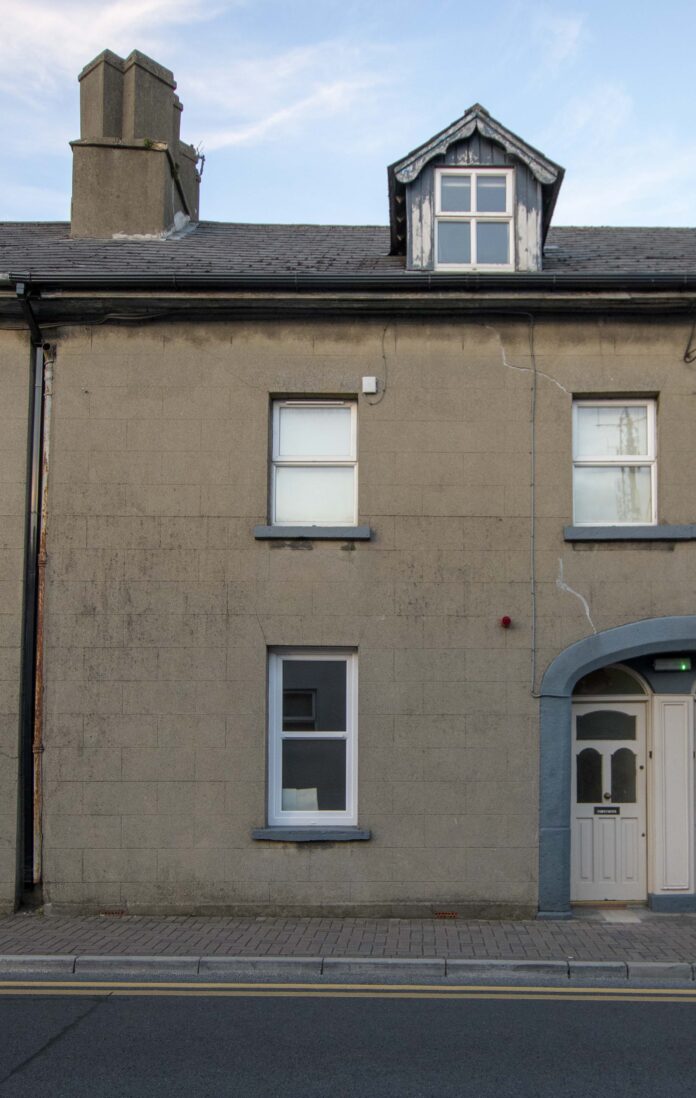
Priscilla Ryan in her flat in Mullingar, Co. Westmeath. ( Also a photo of the exterior of No.4 Mary Street, Mullingar)
Photo by Sean Dwyer 26/08//22
FORMER minister of State Robert Troy received local authority Housing Assistance Payments (HAP) for a rental property that was not registered with the Residential Tenancies Board (RTB) when the tenancy began.
Documents obtained by the Irish Mail on Sunday indicate that Mr Troy was receiving publicly funded HAP since August 2021 for a 12-month tenancy that has only just been registered with the RTB in August 2022.
The latest 12-month rental contract for the one-bed flat at Mary Street, in the centre of Mullingar, is dated August 1, 2021 – just over a year ago.
However, according to recent RTB correspondence, this latest tenancy has just been registered.
Under the contract between Mr Troy and his HAP tenant, most of the €700 monthly rent is paid directly to Mr Troy’s bank account from council housing assistance funds.
The terms and conditions of the HAP scheme state that landlords ‘Failure to register with the RTB is an offence’
This means they must register a tenancy with the RTB – a requirement aimed at ensuring tax compliance and protecting tenants’ rights. To ensure all HAP landlords have registered with the RTB, local authorities send lists to the RTB of landlords receiving HAP money. This lets the RTB check that all tenancies where HAP is being paid have been registered.
The RTB said it ‘takes noncompliance very seriously and is committed to discharging its role and actively regulating the residential rental sector’.
RTB Spokesperson.
Despite such checks, the one-bed flat owned by Mr Troy does not appear to have been registered in August 2021. Instead, the tenant received a letter from the RTB this week, just over a year after their tenancy began. The letter is dated August 4, 2022.
‘It is the responsibility of landlords to register residential tenancies,’ the letter reads. ‘I wish to inform you that your landlord has registered your tenancy which commenced on August 1, 2021, with the RTB.’ According to the tenant, this is the first RTB correspondence they have ever received.
The MoS asked Mr Troy why he appears not to have registered this tenancy with the RTB until now – and how he was able to get HAP without having done so.
In response he said: ‘I once again received confirmation from my letting agent that all is in order and all has been registered with RTB since the beginning of tenancies in 2019.’
The 2019 date refers to the date when Mr Troy first began letting the three one-bed units at the Mary Street property, which he had bought the year before.
Irish Mail on Sunday – August 28, 2022.
Mr Troy’s receipt of undeclared HAP and Rental Accommodation Scheme (RAS) payments is one of the omissions that led to his resignation this week as a junior minister at the Department of Enterprise.
The precise details of any such payments he receives remain unclear, although Westmeath County Council is expected to make these details public imminently.
When asked if the RTB was investigating reported and apparent breaches by Mr Troy of registration regulations, a spokesman said the board could not comment on individual cases.
However, in a statement, the RTB said it ‘takes noncompliance very seriously and is committed to discharging its role and actively regulating the residential rental sector’.
‘Failure to register is an offence that may result in a criminal conviction, a fine of up to €4,000 and/or up to six months’ imprisonment,’ the statement added.
‘Non-compliance with tenancy registration requirements may alternatively result in a sanction through the investigations and sanctions powers of the RTB which commenced in July 2019,’ the statement continued.
‘Failure to register is one of the nine improper conducts that can be investigated using these powers. Where it is found that improper conduct has occurred, the result can be a civil sanction or a caution, and/or a fine of up to €15,000 and up to €15,000 costs against the landlord if they are found to have breached the legislation.’
HARROWING video evidence has emerged in the case of a vulnerable child who was left living with an abusive stepfather by child protection authorities.
Details of the shocking child protection failure are outlined in a new historical case review by child protection agency Tusla obtained by the Irish Mail on Sunday.
Despite the emergence of a video from 1986, in which the then ten-year-old victim gives a contemporaneous account of being abused, the DPP has declined to prosecute.
The video was made by doctors at the Rotunda’s Sexual Assault Treatment Unit (SATU) when the victim was assessed after running away from home to seek help.
At the time, child sexual abuse experts concluded the child had ‘quite definitively’ been ‘extremely sexually abused by her adoptive father over a period of 2/3 years’.
But a 1986/87 investigation by gardaí failed to obtain the video and at the time the DPP concluded there was not enough evidence to seek a prosecution.
The video was only discovered by the victim in 2020 after she asked the Rotunda for it. She then provided it to a fresh cold-case Garda investigation.
Astonishingly, the video had remained undiscovered and forgotten about for nearly 35 years by all those responsible for the victim’s case until she found it herself.
‘That’s what victims have to do,’ the survivor told the MoS. ‘They don’t come and say; “here’s your files”. You have to fight for them. If I hadn’t done that I’d still be none the wiser.’
When the video was provided to the new Garda investigation in 2020, detectives viewed it as a significant evidential breakthrough.
To have credible, contemporaneous testimony from the past available in this fashion is almost unprecedented.
But in 2021 the DPP informed the victim it could still not go to trial.
The DPP said this was due to legal difficulties in a situation where the DPP had previously decided not to prosecute and because ‘no new significant evidence had come to light’.
However, this is flatly contradicted by investigating gardaí who had been confident the video was a vital breakthrough.
After the 2021 decision not to prosecute, the superintendent in charge of the investigation team confirmed in writing that the file sent to the DPP by his team had included the newly obtained video.
‘This investigation file included a video recording and notes taken by HSE social workers,’ he told the victim.
He also confirmed the ‘video and notes had not been included in the original investigation file in 1986/87’.
Last night the victim of the abuse, to whom Tusla have given the pseudonym ‘Karen’, questioned why the DPP and gardaí are saying two different things.
She said: ‘They are all contradicting each other. I think the DPP’s office have a lot of things to answer for in relation to the low rate of prosecution for these kinds of crimes in our country.’
She also criticised the child protection workers who failed to protect her and left vital evidence gathering dust for decades.
‘Every social worker involved with me got a promotion,’ she pointed out.
The failures of the child protection authorities in Karen’s case are outlined in a historical case review by Tusla.
The January 2022 report shows how Karen was left living at home with her abusing parent for nearly two years after she first disclosed being abused.
The confidential report also confirms five other children were left living in the home after Karen was removed.
Tusla’s report into these failures is one of 13 such reviews that have been completed by the agency’s Practice Assurance and Service
Monitoring (PASM) team in recent years. The report confirms Karen first reported being abused by a neighbour in 1984 when she was nine. This abuse was reported to gardaí and the neighbour was prosecuted and fined £75 under the laws in place at the time.
Despite the prosecution, child protection authorities never became aware of the Garda case and no help was offered to Karen.
Tusla’s review confirms: ‘The Midland Health Board and Longford Westmeath Community Care
Area (CCA) was not involved and there was no record of therapeutic intervention with Karen.’ This represented a missed opportunity to discover Karen had also been abused by her stepfather, a member of the Defence Forces, since she was eight.
Karen eventually disclosed this ongoing abuse to her mother in 1985.
After the family GP was consulted, Karen was temporarily sent to a local hospital.
The case files record the GP as saying: ‘It would be best to admit her for a few days in order to relieve the situation at home.’
According to Tusla’s review, this hospital stay was ‘short term’ and ‘there was no evidence of a medical report in the case notes’.
Afterwards, Karen was ‘discharged home and referred to a local Child Guidance Clinic.’
This was the equivalent of what is today known as a Child and Adolescence Mental Health Service (CAMHS).
But it appears the clinic did little to protect Karen, who was then subjected to further ongoing abuse when she was returned home.
This represents a second missed opportunity to protect Karen from further abuse at home.
The following year in 1996, when she was aged just ten, Karen made the last of several attempts to run away from home. She banged on the door of a country house in the rain and in the middle of the night to ask for help.
This time gardaí were notified about the abuse at home and Karen went to live temporarily with an elderly relative .
A file was prepared for the DPP. But in November 1986 the DPP decided against a prosecution. Evidence in the case file included the notes from Karen’s attendance at the Rotunda’s Sexual Assault Treatment Unit .
The files included details of medical examinations and clinical therapy undertaken which ‘validated’ Karen’s disclosure of abuse.
But, crucially, they did not include the video of Karen’s direct testimony .
The specialised doctors at the Rotunda’sunit concluded ‘quite definitively’ that Karen h’ been ‘extremely sexually abused by her adoptive father over a period of 2/3 years’.
The Rotunda’s experts also noted ‘Karen had developed ‘bed wetting’ and other associated issues (such as anxiety) relating to her alleged abuse and her experiences leading up to her admission into care’.
According to Tusla’s review, the SATU clinic ‘expressed concern about the safety of her half-siblings who remained in the family home.’
Tusla’s PASM review ‘could not find any consideration of the safeguarding arrangements for Karen’s half-siblings, who appear to have remained in the family home’.
Instead, the review found only ‘limited evidence of compliance’ with child protection guidelines on the part of the health boards.
Tusla’s review reads: ‘There was no reference to a case conference in the case file records reviewed .
‘Karen’s half-siblings appear to have remained in the family home, however, the safeguarding measures in this regard cannot be determined from the case file records we received.’
After running away and making her third disclosure, Karen was placed into a foster home and later moved to a residential institution in Dublin.
In its recent review, Tusla was unable to find evidence of what, if anything, the child protection authorities did to safeguard Karen and her siblings at the time.
Irish Mail on Sunday – July 17, 2022.
HARROWING VIDEO OF CHILD TELLING OF ABUSE AT HOME
THE little girl in the black and white video appears almost removed from herself as she details what her stepfather did to her.
But her awful story is clearly told and utterly believable as she describes how she was repeatedly abused at home.
‘Did your mum ever know this was happening?’ a female psychiatrist gently asks.
The professional, a member of staff at the Rotunda’s Sexual Assault Treatment Unit, is using dolls as an aid to help Karen explain things no child should have words for.
‘I told her two or three times,’ Karen says of her mum. ‘I told her once first. And then I told a relative and all my aunties. And then I told them again.’
‘Good girl,’ the doctor reassures Karen. ‘If you keep telling you’ll get there.’
‘Yeah,’ shrugs Karen, her elbow on the table, hand tucked under her chin.
‘It’s hard that we have to tell so often, isn’t it,’ the therapist adds.
Today, Karen is 48 and in the absence of justice she is still trying to tell her story.
Many of the details are simply too horrific to print.
As well as being abused by her stepfather, Karen was also abused by a neighbour who asked her to watch a baby for a while.
‘I went in and he made tea and cake and he asked me to cut the cake and I brought in the wrong knife and he lifted me back out and he said he’d throw me in the bath but he took me into the bedroom instead,’ she says when asked to explain what the neighbour did.
‘Was he cross with you or was he playing?’ the therapist asks.
‘He was playing,’ Karen answers. ‘He put me lying down in the bed facing him and he got down on top of me and he pulled down my pants,’ she says before detailing the precise abuse.
‘He was doing that for a few minutes and kissing me and everything and then he let me up and he told me not to tell anybody.’
But Karen did tell and the man was prosecuted. After the prosecution, her stepfather left her alone for a while. Inevitably, the abuse recommenced.
‘I was out in the kitchen one night making tea and mammy was in the sitting room and he had the door closed and he started with the fingers again and then it got back to what the next door neighbour did.’
Much of the recording is difficult to listen to.
In one segment the girl describes how her abuser forced himself on her orally.
She also speaks of being threatened by her stepfather.
‘When it started he said something awful would happen to me if I told anybody,’ she says .
‘Then when I told my mother when I came back from holidays, he told me that the marriage would break up and all the kids would be put into homes and everything. He got me that evening to tell her it was all a lie.
‘So did you say to your mum then that it was a lie?’ The psychiatrist asks.
‘Yeah I did.’
‘That was hard on you, wasn’t it? How old were you then?’
‘Ten,’ Karen answers.
She also speaks of being forced into abusive acts.
‘When I didn’t want to do it, he kind of forced me to do it.’
‘Did you ever ask him to stop?’ She is asked.
‘Yeah and I told him I didn’t want to do it and he said it would help me to stop wetting the bed but I kind of wet the bed more then.’
At some point Karen’s stepfather began rewarding her.
‘When he did it he used to give me a pound for myself but I only figured out now that was for doing that,’ she says .
‘When I started saying no then he’d force me to do it and he’d give me the money afterwards.’
She is then asked: ‘What’s the worst thing about it all for you, what’s the thing that upset you most about it?’
‘I don’t know really,’ Karen answers.
‘Did you feel any different to everybody else?’
‘Yeah,’ she responds. ‘But I didn’t know if it was happening to everybody else, but I don’t think it was. I always heard of stepfathers doing it, but I’ve never heard of fathers doing it to a child.
‘Then it really hit me when he said he wasn’t really my father. It just all fit together.’
‘You felt then that he was using you – which you didn’t really feel until then?’ the doctor asks.
‘No I didn’t – I thought it was for my own benefit.’
Gardaí have raided a major meat factory at the centre of an Irish Mail on Sunday investigation into the exploitation of migrant workers.
The operation this week – involving more than 40 officers from multiple agencies – identified substantial numbers of illegal workers as Garda
officers swooped and seized documents, computers and phones on site.
Several cars belonging to the workers were also impounded during the day-long operation on Wednesday.
Follow-up searches at other locations, including a nearby private residence, throughout Thursday and Friday also yielded fraudulent European identity documents and electronic devices.
The identities of more than 50 of the plant’s 150 workers whose immigration papers did not appear to be in order during the raid are now being checked and verified by Garda detectives.
The MoS has learned that, as a result of the raid, at least half a dozen workers who were detained proceeded to claim asylum in a bid to prevent their deportation. It is understood one worker has gone ‘underground’ and is now missing.
In a statement yesterday a Garda spokesman said Wednesday’s operation was focused on the ’employment of illegal immigrants and forms part of a wider investigation into human trafficking targeting those involved in facilitating illegal immigration into Ireland’.
Led by Detective Superintendent Michael Buckley of the Garda National Immigration Bureau, the operation involved more than 40 personnel, including interpreters, document examiners and officials from the Department of Social Protection and the Workplace Relations Commission.
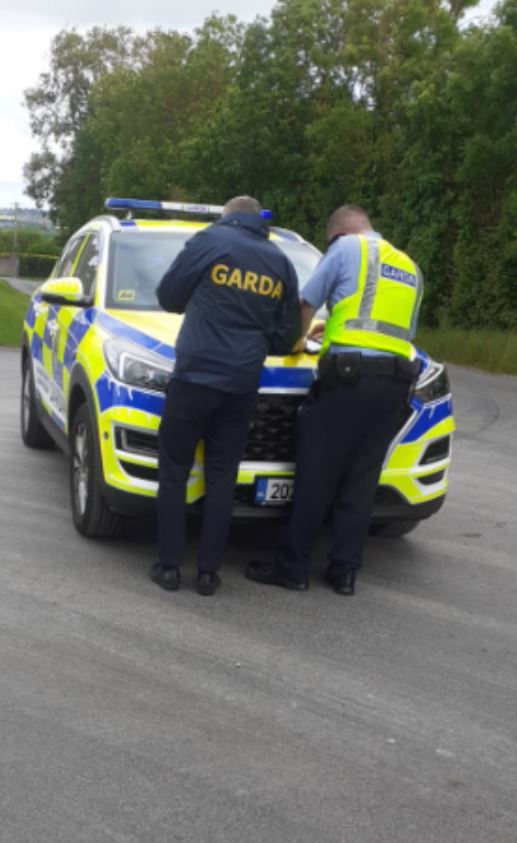
Gardai during this week’s meat plant raid.
Gardaí from the National Drugs Organised Crime Bureau, the National Protective Services Bureau, the National Economic Crime Bureau and the National Cyber Crime Bureau were all involved in the operation.
The raid follows an in-depth investigation by this newspaper into alleged illegal work practices.
Our investigation – published in April 2021 – exposed serious claims of irregularities at the same factory, including the alleged supply of fake papers to illegal workers by foreign criminal gangs.
The claims, outlined in a protected disclosure by an employee turned-whistleblower, were supported by HR records and testimonies from former workers.
In the wake of these claims, An Garda Síochána launched a criminal investigation into suspicions that workers were being illegally supplied to meat plant owners.
Under the Employment Permits Act 2003, employing someone without a valid permit carries a penalty of €250,000 and/or a prison sentence of up to 10 years.
Workers who do not possess a permit face fines of €3,000 and deportation if they are here illegally. This week’s raid was carried out on foot of a seven-day search warrant issued by a District Court judge.
This entitled officers to search the plant and seize company files, computers and phones.
Such evidence is vital in establishing what factory owners, company directors and managers may have known about any illegal employment practices.
Workers being processes by gardai during this week’s meat plant raid.
Under the Employment Permits Act, directors and managers can be prosecuted if an offence committed by their company was taking place with their ‘consent or connivance’.
The whistleblower whose disclosures to the MoS led to this week’s operation, claimed they had raised concerns with managers and owners at the plant.
But when the workers supplied suspicious papers, the whistleblower claimed factory managers told them: ‘We’re not here to check if they are fake or not… we are not immigration.’
The factory owner denied any wrongdoing when asked about illegal workers for our original investigation last year.
The owner, whose companies post large profits annually, conceded it was possible some workers may be ‘using the wrong ID’ but insisted he made all work permit applications in ‘good faith’.
‘Possibly there’s things go on that we wouldn’t be aware of,’ he said at the time. ‘If people are on false papers – if we find any information whatsoever – they’re dismissed of immediately.
‘We don’t know the people personally, we’re entitled to apply for permits as per the State regulations and if someone applies under a different name or something – if they come in through immigration, they’re all checked, they’re all licensed with the guards, everything is done correctly.’
Our investigation revealed how the recruitment system at some meat factories is controlled by ‘capo’-type figures who typically run the kill lines and the boning halls. These tight-knit teams
consist overwhelmingly of male workers, often from the same communities in Brazil, who speak little English and help each other to beat employment and immigration laws.
However, rather than helping migrant workers who are badly needed in sectors such as the meat industry, these practices force immigrants to pay capos for fake documents.
Because of their illegal status, such employees are then at risk of exploitation.
For example, they must maintain favour with their capos, powerful individuals who control their workplace and often make unreasonable demands.
Furthermore, they do not enjoy any of the protections afforded to legitimate workers.
In interviews with the MoS, several of these workers spoke candidly about their experiences of working illegally at the plant.
One worker claimed he had worked illegally for years until he was badly injured and let go.
Today, this individual is now illegally employed at a different meat plant – a feat he can achieve with little difficulty given the culture of the sector.
‘Many people in these places are illegal,’ another former worker at the plant told the MoS.
The fake documents used to gain employment are typically procured from criminal networks with links to Portugal and Italy.
National identity cards from these locations are considered easier to forge than passports and can be obtained directly by individual workers or through several online providers. These ID papers are ordered to match the names of existing Irish PPS numbers that have been bought or passed down from migrants no longer living in Ireland.
In one case, a nephew in his 20s appropriated the PPS number of a much older uncle who had returned to Brazil. He was then able to combine this with fake ID papers to work as a purported EU citizen.
In other cases, employees who previously worked illegally under assumed identities have successfully obtained work permits in their real names.
This allowed them to leave Ireland and re-enter the country legally on their work permit, with their service to the factory barely interrupted.
Tackling these illegal practices to protect workers in meat plants has been something migrant rights groups and trade unions have demanded for years.
Siptu manufacturing division organiser Greg Ennis said many workers in the wider meat industry are afraid to speak out about what he described as this ‘modern form of slavery’.
Mr Ennis said ‘exploitation of this kind in the meat industry is, unfortunately, all too frequent’ among a vital cohort of vulnerable workers.
He told the MoS: ‘During the pandemic we saw the wider consequences of this with widespread Covid outbreaks in meat plants and the resulting lockdown of three midland counties. The Government has repeatedly failed to protect workers’ rights in this sector.’
Mr Ennis also called for the living wage of €12.90 to become the new minimum wage since those, such as meat plant workers, on the present minimum wage of €10.50 are ‘struggling to survive due to current inflationary pressures’.