Home Blog Page 3

SECRET TAPE REVEALS HOW AMBULANCE SERVICE LIED TO HEALTH

Dublin Fire Brigade ambulance seen near the Custom House in Dublin during Level 5 Covid-19 lockdown. On Friday, February 5, 2021, in Dublin, Ireland. (Photo by Artur Widak/NurPhoto via Getty Images)

BOSSES at the National Ambulance Service (NAS) lied to the Government for years about the existence of ‘zombie jobs’, a secretly recorded meeting reveals.

The revelation comes amid continuing concerns about governance standards at the controversy-plagued ambulance service and the fatal consequences of lengthy waiting times during emergency call-outs.

The deception about posts that should no longer exist is one of a number of shocking governance breaches candidly discussed by senior NAS managers on the tape.

During the recording, provided to the Irish Mail on Sunday by a whistleblower, executives discuss:

  • Manipulating recruitment processes to ensure favoured colleagues get promoted;
  • Providing staffing figures they know to be inaccurate to the Department of Health,which ultimately funds the NAS;
  • And how planning at the ambulance service is hopelessly flawed and without logic.

The Health Service Executive (HSE) this weekend confirmed it has commissioned an ‘external examination’ into ‘issues’ emerging from the recording.

Today’s revelations come as the NAS, its management and its €231m budget remain the focus of ongoing controversy. Last month, the death of Ian McCarthy in Roscrea was raised at council meetings in north Tipperary.

Mr McCarthy, 29, died of an asthma attack last August as his family waited two hours for an ambulance. After the wait, two ambulances arrived at the same time, but it was too late to save the father of three. Mr McCarthy’s father Karl said at the time: ‘Until someone tells me different, he died needlessly last night, leaving three beautiful children fatherless and a family and wife broken-hearted.’

At last month’s meeting, angry councillors described a state of crisis at the NAS and spoke of frontline staff being at breaking point.

The NAS responds to more than 400,000 calls every year, employs 2,400 staff at 100 locations and operates a fleet of 675 vehicles. But the service is desperately underfunded and understaffed. This has been openly acknowledged by NAS Director Robert Morton, who has spoken of ‘a significant mismatch between demand for services and available capacity’. Mr Morton is not one of the executives who features in the recording obtained by the MoS.

The management figures who do take part in the meeting never discuss or consider the real lifeand-death consequences of the failures in the service they are responsible for running.

The recording was made during a scheduled meeting between six NAS executives in July, 2021. At the beginning of the meeting, a senior executive explains the purpose of the gathering.

‘Today we want to look at workforce planning on the grounds we have to have one – on the grounds that we need certain pieces for the service plan for 2022,’ they tell the other managers.

‘The 2022 service plan was confirmed yesterday and has to be off our desk and in the Department [of Health] on 27th July.’

This leads to an in-depth discussion about problems establishing correct staffing numbers, and the manner in which some posts have been deceptively retained.

One attendee freely admits: ‘There are some posts in there where it says when the person dies the post should be gone. And some of those are not gone since 2017. We know that.’

This appears to relate to various rolling moratoriums on recruitment at the HSE that prohibited new recruitment and promotions into more senior grades when staff retired or passed away.

Deceiving the department in this way means funding for the vacated post would continue – allowing the money to be diverted elsewhere or facilitating the unauthorised promotion of a favoured manager to a higher grade.

The meeting continues to discuss how the NAS has been deceiving the Department of Health about these ‘zombie posts’. One executive says: ‘More importantly, I’d be trying to tell the department either a lie on it or a way that it has been done since whenever it is? and that’s the difficulty in going to the department.’

At another point, a senior executive points to the urgent requirement for correct staffing and recruitment figures.

‘I need to go to Government on Wednesday? with a draft service plan. I need figures,’ they said.

This prompted a discussion on the difficulty in getting accurate staff figures. Others who were not present were blamed for the problem.

Eventually, it is decided to proceed with inaccurate data.

One manager says: ‘What I can do is send? what I have. I cannot stand over it.’

Another executive replies: ‘I have no issue with that, because what they’re getting on Wednesday is the same difference.’

A third manager adds dryly: ‘No change there then.’

Despite the admission that their numbers are incorrect, the team then pours scorn on a plan by their director to hire consultants Grant Thornton to establish correct figures.

After discussing their weekend drinking plans, one executive jokingly refers to Grant Thornton as ‘Gin Tonic’.

‘What will they do?’ asks one executive .

‘We will give them all the information? and they will present it quite nicely on a written page and charge us a fortune for it.’,’ answers another .

At one point, one executive complains, with apparently genuine frustration, about the way the service is being managed.

‘It’s like catching f***ing butterflies,’ they said.

‘there’s no logic. And I’ve struggled with, I was really struggling with this last year because I thought, “Okay, I’ll wait and see. I’ll sit down.” But there’s no logic attached to the process of how we manage.’ In response, another manager agrees, saying: ‘I know, there isn’t.’

The first executive then adds in exasperation: ‘All this f***ing s***e to prove your bodies on seats – with no plan.’

Once the main meeting has concluded, the same person then discusses how to rig recruitment processes so their own team memb e r s can advance .

‘Whether you’ve done it or not, put it on your CV.’,’ one attendee is advised. ‘I mean, I’m quite happy to promote my own team and f*** them all. I don’t give a f*** anymore. I’m at that stage now. I think you deserve it. I think you’ve worked f***ing hard.’

The MoS understands that several of the managers recorded at the meeting were subsequently promoted.

the ambulance service managers also denigrate and mock several named fellow colleagues who are not present at the meeting.

Vulgar slurs are used as the personal and private details of some of their colleagues are discussed .

The attendees also discuss a series of anonymous , AI-generated WhatsApp videos that were circulated among NAS employees.

The messages depict management figures singing different songs, the lyrics of which portray how they’re viewed by employees.

One of those attending the meeting plays one of the videos they are discussing.

One executivesays of the videos: ‘Professionally, they were shocking because it just tells you the type of culture there is in the organisation. From a management perspective , you think, “f*** it, they’re so close to the bone that they weren’t funny. “

‘You’d have to stand back and laugh at yourself , but you couldn’t be seen to be laughing at management level. You just couldn’t. You know.’

The recordings emerged amid ongoing concerns and criticism about ambulance response times.

figures made public last summer show that 864 seriously ill or injured patients endured a wait of at least an hour for an ambulance during the second half of 2023. One ambulance took three hours and 15 minutes to get to a high-priority call in Carlow.

The worst-affected county was Cork, where 118 calls were not responded to within an hour.

Wexford was the second-worst affected with 96 separate emergency calls unattended for more than an hour, followed by Donegal, Mayo, Tipperary and Waterford.

An audit of the service released under Freedom of Information legislation in December was critical of management and governance issues.

The report concluded it could only provide ‘limited’ reassurance about the appropriateness of risk management and internal control systems in place for the NAS fleet. It warned: ‘There are weaknesses in the system. of governance, risk management and controls which create a significant risk that the system. will fail to meet its objectives.

Action is required to improve the adequacy and/or effectiveness of the system.’

The report found some ambulances are being used beyond their recommended lifespan and highlighted concern over the lack of a complete record of ambulance breakdowns and an incomplete listing of all service vehicles.

In response to queries from the MoS, the HSE said it is ‘aware of the matters you outline’ and confirmed the health authorities have ‘commissioned an ‘external examination’ of a number of these issues’ .

They added: ‘It’s important having regard to the rights of everyone involved, that this process is allowed continue in private. the National Ambulance Service provides high-quality, safe and patient-centred services as part of an integrated health system. In 2025 we will continue to build on the significant previous investment in NAS and focus on improving access to care.’

The HSE said discussions with unions are underway through the Workplace Relations Commission on a new agreement for many frontline roles that will ‘enhance remuneration arrangements, improve retention and enable the implementation of a new strategy for NAS’.

The department.’ of Health said: ‘Due to the ongoing internal HSE investigation, the Department of Healthcannot comment.’

Share This:

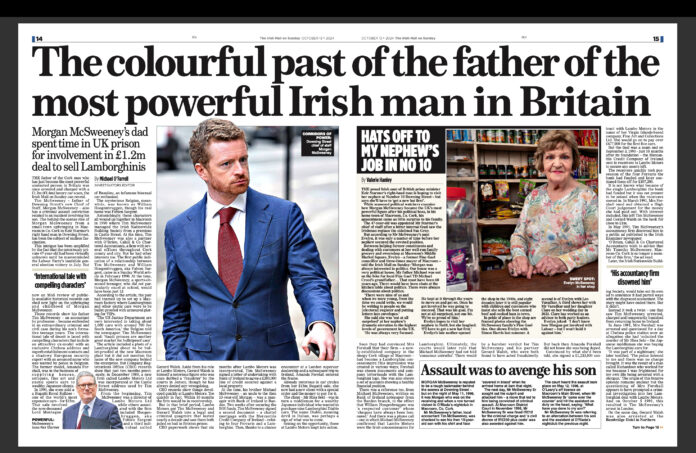
The colourful past of the father of the most powerful Irish man in Britain

Screenshot

THE father of the Cork man who has just become the most powerful unelected person in Britain was once arrested and charged with a £1.2m (€1.4m) luxury car scam, the Irish Mail on Sunday can reveal.

Tim McSweeney – father of Downing Street’s new Chief of Staff, Morgan McSweeney – also has a criminal assault conviction related to an incident involving his son.

The behind-the-scenes rise of Morgan McSweeney from a small-town upbringing in Macroom in Co. Cork to Keir Starmer’s right hand man in Downing Street, has been the subject of endless fascination.

This intrigue has been amplified by the fact that the notoriously private 47-year-old had been virtually unknown until he masterminded the Labour Party’s landslide general election victory in July.

But now an MoS review of publicly-available historical records can shed new light on the upbringing and childhood of Morgan McSweeney.

Those records show his father Tim McSweeney – an accountant by profession – became embroiled in an extraordinary criminal and civil case during his son’s formative teenage years.

The international tale of deceit is laced with compelling characters that include an attractive ex-model with an exclusive Chelsea address and superb establishment contacts and a shadowy European security expert with an assumed name who was wanted by police in Belgium.

The former model, Amanda Forshall, was in the business of supplying houses, antiques, fine art and exotic sports cars to wealthy Japanese clients.

In 1990, she even sold a a Bugatti Royal Kellner – one of the world’s most expensive cars – for $15m. That sale involved the now-deceased Lord Montague of Beaulieu, an infamous bisexual car enthusiast.

The mysterious Belgian, meanwhile, was known as William Hoogenbruggen, though his real name was Fabien Sargent.

Astonishingly, these characters all wound up together in Macroom in 1990 where Tim McSweeney managed the Irish Nationwide Building Society from a premises in Castle Street.

At the time, Tim McSweeney was also a partner with O’Brien, Cahill & Co Chartered Accountants, a firm with several offices throughout Cork county and city.

But he had other interests too. The first public indication of a relationship between Tim McSweeney and William Hoogenbruggen, aka Fabien Sargent, came in a Sunday World article in February 1990.

At the time, Morgan McSweeney, a sports-obsessed teenager, who did not particularly excel at school, would have been just 13.

According to the article, the pair had teamed up to set up a Macroom factory where Lamborghinis and other exotic cars were to be bullet-proofed with armoured plating for VIPs.

‘The US Justice Department are very interested in taking about 1,000 cars with around 700 for South America,’ the Belgian told the newspaper.

Tim McSweeney said: ‘Saudi princes are another great market for bulletproof cars’.

The article included a photo of a Lamborghini about to be bullet-proofed at the new Macroom plant but it did not mention the name of the new company behind the enterprise. But Company Registrations Office (CRO) records show that just two months previously, in December 1989, a new firm called Lambo Motors Ltd was incorporated at the Castle Street address used by Tim McSweeney.

From the beginning, Tim McSweeney was a director of Lambo Motors Ltd while others associated with the firm included Hoogenbruggen, aka Fabien Sargent and a third individual called Gerard Walsh.

Aside from his role at Lambo Motors, Gerard Walsh is himself a notorious figure who was once dubbed a ‘fraudster’ by the courts in Jersey, though he has always denied any wrongdoing.

CRO records show things developed quickly at Lambo Motors. Too quickly in fact. Within 10 months the firm would be in receivership.

But in that brief period, Lambo Motors got Tim McSweeney and Gerard Walsh into a legal and criminal quagmire that lasted nearly a decade and saw them both jailed on bail in Brixton prison.

CRO paperwork shows that six months after Lambo Motors was incorporated, Tim McSweeney signed a letter of undertaking with Bank of Ireland to agree a £200,000 line of credit secured against a local property.

At the time, his brother Michael McSweeney – an uncle to the then 13-year-old Morgan – was a manager with Bank of Ireland in Bandon.

Two weeks after securing the BOI funds, Tim McSweeney signed a second document – a chattel mortgage with the Mercantile Credit Company of Ireland – relating to four Ferraris and a Lamborghini.

Then, thanks to a chance encounter at a London supercar dealership and a subsequent trip to Ireland, Amanda Forstall entered the frame.

Already notorious in car circles from her $15m Bugatti sale, she now had a new client with a special order and the money to pay for it.

The client – Mr Hisa Seki – was in turn a middleman for a wealthy Japanese individual who wanted to purchase nine Lamborghini Diablo cars. The name Diablo, meaning devil in Italian, was perhaps a sign of what was to come.

Seizing on the opportunity, those at Lambo Motors leapt into action.

Soon they had convinced Mrs Forshall that their firm – a newly-established company in the sleepy Cork village of Macroom – had become a Lamborghini concessionaire.

This impression was created in various ways; Forshall was shown documents and company letterheads with the Lamborghini logo. She was also shown a set of accounts showing a healthy financial position.

There was a reference too, from Michael McSweeney, written on Bank of Ireland notepaper from the Bandon branch, to the effect that William Hoogenbruggenwas ‘a respected customer’ whose ‘cheques have always been honoured.’

And there was a phone call – one in which Michael McSweeney confirmed that Lambo Motors were the Irish concessionaires for Lamborghini.

Ultimately, the courts would later rule that Michael McSweeney – ad not told ‘conscious untruths’.

There would be a harsher verdict for Tim McSweeney and his partner Gerard Walsh, who were both found to have acted fraudulently.

But back then Amanda Forshall did not know she was being duped.

Convinced by what she’d been told, she signed a £1,233,000 contract with Lambo Motors in the name of her Virgin Islands-based company, Fine Art and Collections Ltd. She would go on to pay over £677,000 for the first five cars – .

But the deal was a scam and on September 3, 1990 – just 10 months after its foundation – the Mercantile Credit Company of Ireland – sent in receivers to Lambo Motors to secure any assets left.

The receivers quickly took possession of the four Ferraris the bank had funded and later auctioned them off for £107,200.

It is not known what became of the single Lamborghini the bank had funded but it was not present to be seized when the receivers moved in. In March 1991, Mrs Forshall sued and obtained a High Court judgement for the money she had paid out.

With interest included, this left Tim McSweeney and Gerard Walsh on the hook for close to £1m.

In May 1991, Tim McSweeney’s accountancy firm disowned him in a public ad published in the Irish Examiner newspaper.

‘O’Brien, Cahill & Co Chartered Accountantswish to advise that Mr Timothy McSweeney, Macroom Co. Cork is no longer a member of this firm,’ the ad read.

Later, the Irish Nationwide Building Society, would take out its own ad to announce it had parted ways with the disgraced accountant.

The story might have ended there. But it didn’t .

Instead it took a twist – one that saw Tim McSweeney arrested, charged and temporarily banished from returning home to Ireland.

In June 1991, Mrs Forshall was arrested and questioned for a day at Chelsea police station over an allegation she had ‘solicited the murder of Mr Hisa Seki – the Japanese middleman she was buying the Lamborghini cars for .

‘It was part of a nightmare,’ she later testified. ‘The police listened to me and there was no charge brought. It was the result of a man called Richardson who worked for me because I was frightened for my own life being arrested with a shotgun.’

The origin of this bizarre episode remains unclear but the questioning of Mrs Forshall appears to have prompted a criminal investigation into her Lamborghini deal with Lambo Motors.

And on October 5 1991, this resulted in Tim McSweeney’s arrest in London.

On the same day, Gerard Walsh was also arrested at the Bambridge Hotel in Northern

Ireland when he attended to meet Mrs Forshall. The meeting had been due to occur at a Dublin hotel but in an apparent ruse to secure an arrest the meeting was switched at the last minute to the North.

Both men were immediately charged with conspiring with William Hoogenbruggen to dishonestly obtain £1,233,000 in cash by deception from Mrs Forshall.

As Scotland Yard hunted around the world for Hoogenbruggen, Tim McSweeney and Gerard Walsh were both remanded in Brixton prison until they could raise enough funds for bail.

By early December 1991, they had both been released on strict conditions which included handing over their passports, remaining in the UK and signing on at a police station several times a week.

By now, with his father an accused criminal on bail in London, a young Morgan McSweeney, would have been approaching the age of 15.

In March 1992, Tim McSweeney and his co-accused were allowed to return to Ireland, pending further hearings. Later that year magistrates ruled there was a prima facia criminal case to answer.

However, various delays ensued and the fraud trial did not commence until 1994 – the same year a 17-year-old Morgan McSweeney boarded a bus to emigrate to a new life in London.

Tim McSweeney, though, failed to show up for his trial and the court was informed he was ill.

But it subsequently emerged that the day after the trial began he flew to Malaga – via London – as warrants for his arrest were being issued but had not yet been served in Ireland.

Mr McSweeney returned from Spain a few days later when the arrest warrants were withdrawn and ultimately the trial was dropped by the prosecution in March 1994.

But Tim McSweeney’s family were still punished for his failure to attend. In April 1994 the courts ruled that the £25,000 bail money his brother Dennis had paid would be forfeited.

Meanwhile, back in Ireland the civil judgement against Tim McSweeney and Gerard Walsh was contested to the Supreme Court which, in 1998, upheld the original High Court ruling.

Even after the Lamborghini case concluded, Tim McSweeney still occupied a life that sailed perilously close to controversy.

In 1999 he surfaced in the midst of what was then dubbed Sunderland’s biggest financial scandal when financial consultant Anthony Heald fled owing £30m to investors.

In pursuing Heald, investors traced him to Cork where Tim McSweeney, who was Heald’s accountant, acted as a go-between.

Neither Tim McSweeney, nor his son Morgan responded to queries from the MOS about this article this weekend.

Share This:

Stout’s iron curtain: Did Heineken plot to  replace Guinness in Russia with Irish help?

Guinness recommends Black Sheep stout - the cheeky ad campaign created for Heineken Russia.

HEINEKEN Ireland helped to develop a new stout in Russia when Guinness pulled out of the territory following the invasion of Ukraine, a whistleblower claims.

Named Black Sheep Irish Stout, the new product filled the void left by the withdrawal of Guinness and helped Heineken Russia increase profits as war raged in Ukraine.

Speaking to the Irish Mail on Sunday, the whistleblower said the Irish wing of the company directly helped Heineken ‘to develop a copycat version of Guinness’.

In a statement to the MoS this weekend, Heineken confirmed some ‘very limited and remote technical support’ had been provided to its Russian arm.

But the global beer giant denied its Irish team shared the recipe for stout and insisted no ‘brand or marketing support’ was provided.

The Heineken Europe whistleblower said they were shocked to discover Heineken Ireland had been involved in helping to develop Black Sheep stout in Russia.

They told the MoS: ‘At some point I found out it wasn’t only the Amsterdam HQ but also the Irish organisation that actively participated in this, by directly helping Heineken Russia to develop a copycat version of Guinness after Diageo left Russia. I believe the Irish public and employees of Heineken Ireland have the right to know about this.’

Black Sheep Irish Stout was developed in record time by Heineken following the invasion of Ukraine on February 24, 2022.

Dutch King, Willem Alexander (bottom left) and President Putin in the Holland Heineken House at the 2014 Sochi Olympics.

According to leading brewing insiders who spoke with the MoS this week, it would typically take up to two years to develop and bring a new stout to market.

This was the case when Heineken launched its now discontinued Island’s Edge stout in recent years.

But in Russia, Heineken was able to roll out its Black Sheep stout within a few months of the outbreak of the war.

Diageo, the owners of Guinness, paused its Russian operations on March 7, 2022, and in June 2022 pulled out of Russia completely in a move costing €172m, including €15.3m for redundancies.

But Heineken, which had been brewing Guinness in Russia under licence, took a different approach.

At the outbreak of war, Heineken announced it was halting ‘investments and exports’ to Russia, and ending ‘the production, sale and advertising of the Heineken brand’.

The company declared at the time: ‘We will not accept any net financial benefits or profit from our business in Russia.’

In late March 2022, Heineken announced its decision to ringfence its Russian arm until a buyer was found, saying in a statement: ‘We aim for an orderly transfer to a new owner in full compliance with international and local laws.

‘To ensure the ongoing safety and wellbeing of our employees and to minimise the risk of nationalisation, we concluded it is essential that we continue with the recently reduced operations during this transition period.’

After releasing the statement, the company quickly launched dozens of new products in Russia using non-Heineken brand names.

This new drive led to increased profits and market share until a new buyer was found for the Russian operation 18 months later, in August 2023.

According to the Heineken Russia accounts from 2022, this increased turnover by 14% to €470m (42bn rubles), while profits tripled to almost €30m (2.6bn rubles).

The Russian accounts also show the company sold 720,000 hectolitres more beverages than in the previous year.

As a result, President Vladimir Putin’s regime was boosted by millions in extra taxes which Heineken Russia contributed to the Russian war economy.

The array of new products on offer included the newly developed Black Sheep Irish Stout, widely advertised as ‘the Taste of Ireland’ with many Russian reviewers directly referring to it as a replacement for Guinness.

Calling the new stout ‘Russian Guinness’, one local reviewer, Igor Samsonovich, concluded: ‘This is truly a dry Irish stout style beer. It’s different from Guinness Draft, but it’s as close to Guinness as you can get.’

Heineken even commissioned a video and billboard ad featuring a smiling Russian citizen by the name of ‘Arman Armenovich Guinness’.

‘Guinness recommends Black Sheep,’ the tongue-incheek ad slogan blared as Mr Guinness downed a velvety black pint in a Russian bar.

Heineken’s delight at the success of Black Sheep was evident in a report posted on its Russian website in late 2022:


‘This launch deserves a special page in our history,’ said the now-deleted update. ‘In a few months, Heineken Brewery and the Production Department of the Central Office created a unique product that easily replaced a brand which is 263 years old!

‘And thanks to colleagues from the Marketing and Sales Departments, this drink is sold in 900 outlets just a few months after launch. This is an amazing result that we can rightfully be proud of.’

This web page was deleted after Dutch investigative outlet, Follow the Money, published it last year.

The whistleblower this week spoke of their disappointment when the Dutch story first emerged.

‘As a Heineken employee, like many of my colleagues, I was very disappointed to see how my employer misled the public and employees about its withdrawal from Russia in 2022. This happened despite the company’s proclaimed values and purpose of “brewing a better world”.’

According to the whistleblower, Heineken Ireland was asked to help with the development of the new Black Sheep stout.

They claimed this request was made by Ruud Van den Eijnden, the company’s European managing director, who allegedly acted as a go-between when the Russian arm requested help from Ireland.

At the time, the Russian arm was led by Boudewijn Haarsma, now general manager of Heineken UK.

Contacted by the MoS this week, Mr Van den Eijnden replied he did not remember making a request to the Irish operations in relation to the new stout. ‘I don’t remember that at all,’ he said. ‘I know I never spoke to Boudewijn about it.’

Asked what role Ireland played in development of Black Sheep stout for Russia, Mr Van den Eijnden said: ‘I genuinely don’t know.’

He then referred our queries elsewhere, saying ‘these kinds of questions go through our corporate communications department’.

Boudewijn Haarsma, who was in charge of Heineken Russia when the Ukraine invasion took place and who is an old school friend of Mr Van den Eijnden, replied to our queries by text to say: ‘I was not the MD in Russia at the time of Black Sheep launch and left Russia in May 2022.’

Mr Haarsma did not respond further when we pointed out he was in place in the lead-up to the launch.

Another executive in Russia at the time of the Black sheep launch was Radina Shkutova, who previously spent time serving as Heineken’s marketing director in Ireland.

When asked about the role the company’s Irish operation played in the development of Black Sheep stout, she said: ‘I cannot comment on this.’

Another Heineken executive, Thijs Derksen, also declined to answer questions when we spoke to him about Irish involvement, saying: ‘I didn’t work on a Russian product – not at all, and I’m not going to comment further on this.’

At the time of the Russian stout launch, Mr Derksen was Heineken’s Irish supply chain manager, a position he now occupies in Serbia. This Irish job placed him in charge of Heineken’s only stout brewery in Europe, the Murphy’s Brewery in Cork.

None of the executives replied to a question asking if they felt morally comfortable with the way Heineken dealt with its Russian arm after the invasion of Ukraine.

After we contacted the above executives and others at Heineken, the company’s global communications director, Joris Evers, went on to issue a statement saying that Heineken was one of the ‘few companies that has actually fully exited Russia’.

Mr Evers added the ring-fenced Russian arm had been tasked with ‘replacing lost volume’ to replace the halted sale of Heineken branded products in Russia.

He said this was necessary to avoid bankruptcy, to protect the livelihoods of employees and to assure continuity until a company sale could be achieved.

Mr Evers confirmed that these efforts, led by the local Russia team, had received ‘very limited and remote technical support’.

Asked to clarify precisely what remote support anyone in Ireland had provided, Mr Evers did not elaborate further.

The ‘Guinness recommends Black Sheep’ ad campaign run by Heineken in Russia.

Dutch beer giant capitalised on Diageo exit as war raged

IN AUGUST 2023, Heineken announced it had found a buyer for its Russian business, as the Arnest Group took over 100% of Heineken Russia’s shares for a token fee of €1.

Announcing the deal, Heineken said it was writing off Russian assets worth €300m. But it had also secured a guarantee that Heineken would be repaid €100m in inter-company debt by the new Russian owners.

The deal – and promised €100m payback to Heineken – was made possible, in part, because of the profits generated by Heineken’s successful seizure of a Russian stout market formerly dominated by Diageo’s Guinness.

This and the launch of other new products helped Heineken’s profits to soar in Russia in advance of the deal as the war in Ukraine raged.

Earlier this year, Heineken apologised for creating ‘ambiguity’ over its initial promise to leave Russia – made when the Ukraine war had commenced a year previously.

After the war began, Heineken stopped selling its namesake beer but developed Black Sheep Irish Stout to seize a gap in the Russian Guinness market.

This was just one of 61 new products launched by Heineken in Russia as Vladimir Putin’s forces bombarded Ukraine.

‘We recognise that we should’ve been clearer earlier about the need to introduce new products, and the questions raised about this are understandable,’ Heineken said in March last year.

‘We realise this has created ambiguity and doubt about our promise to leave Russia. For this we apologise.’

This week Heineken told the MoS it was ‘one of the few companies that has actually fully exited Russia’.

The company insisted it had remained firm to its principles by caring for its employees, avoiding bankruptcy until a sale could take place, and ensuring the company was not nationalised.

Heineken also said it would receive ‘no financial gain – no proceeds, royalties or fees from Russia nor profit on exit’. A spokesman said: ‘We held to these principles and exited responsibly in August 2023, also removing our key global brands. At the same time, many other multinationals continue to operate in Russia today.’


The Black Sheep Brewery in North Yorkshire.

When there’s more than one Black Sheep in the flock..

ON May 27, 2022, Heineken’s United Brewery in St Petersburg submitted application no. 2022734538 to the Federal Institute of Industrial Property (FIPS) in Moscow to trademark the Black Sheep name.

With the war in Ukraine just three months old, Heineken wanted to secure the name, with the company poised to roll out a newly developed Irish stout to fill the void left by the departure of Guinness from Russia.

The move represented a turnaround for Heineken, which prior to the war had been brewing Guinness under licence in St Petersburg. In fact, on February 2, Heineken had even launched a new product for Guinness, called Guinness Smooth.

But when FIPS received Heineken’s application to trademark the Black Sheep name, there was a problem – it was already in use in Russia by the UK’s Black Sheep Brewery, which first exported there in 2016.

At the beginning of the war in Ukraine, the UK brewer removed its Black Sheep Imperial Russian Stout and Black Sheep Vodka from sale, saying in a statement: ‘We do not feel selling these products is appropriate at this moment in time.’

The North Yorkshire brewery has since renamed products as Imperial Yorkshire Stout and Imperial Yorkshire Vodka, but does not sell them to Russia.

But FIPS nevertheless refused Heineken the right to trademark the Black Sheep name, ruling that it would cause confusion. Heineken appealed and lost, but proceeded regardless – such is business in Russia.

This leaves the door open for the UK’s Black Sheep to object to the use of its name on Heineken products. But this week executive director Jo Theakston declined to say if the company would do so.

‘The Russian trade market remains complex as a result of the ongoing war in Ukraine,’ he told the Irish Mail on Sunday.

‘As such, we don’t feel it’s appropriate to comment on any potential appropriation of the “Black Sheep” name.

‘At Black Sheep Brewery, we remain committed to our stance regarding trading in Russian markets, upholding our decision to cease trading with the nation until the current situation is resolved,’ Mr Theakston added.


Share This:

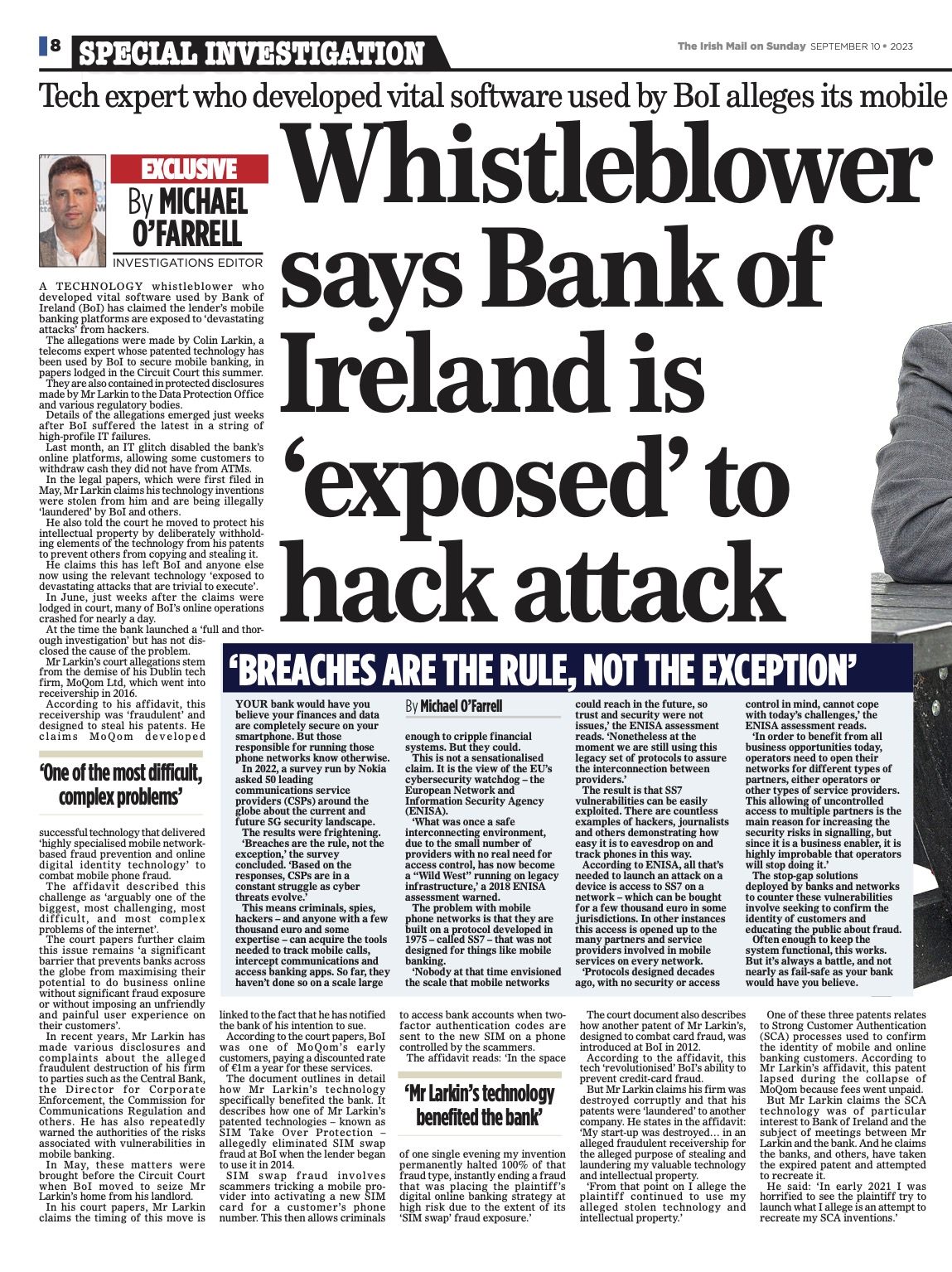
Whistleblower says Bank of Ireland is ‘exposed’ to hack attack

Colin Larkin, 2023 Michael Chester Phone 0878072295 info@chester.ie from www.chester.ie

A TECHNOLOGY whistleblower who developed vital software used by Bank of Ireland (BoI) has claimed the lender’s mobile banking platforms are exposed to ‘devastating attacks’ from hackers.

The allegations were made by Colin Larkin, a telecoms expert whose patented technology has been used by BoI to secure mobile banking, in papers lodged in the Circuit Court this summer.

They are also contained in protected disclosures made by Mr Larkin to the Data Protection Office and various regulatory bodies.

Details of the allegations emerged just weeks after BoI suffered the latest in a string of high-profile IT failures.

Last month, an IT glitch disabled the bank’s online platforms, allowing some customers to withdraw cash they did not have from ATMs.

In the legal papers, which were first filed in May, Mr Larkin claims his technology inventions were stolen from him and are being illegally ‘laundered’ by BoI and others.

He also told the court he moved to protect his intellectual property by deliberately withholding elements of the technology from his patents to prevent others from copying and stealing it.

He claims this has left BoI and anyone else now using the relevant technology ‘exposed to devastating attacks that are trivial to execute’.

In June, just weeks after the claims were lodged in court, many of BoI’s online operations crashed for nearly a day.

At the time the bank launched a ‘full and thorough investigation’ but has not disclosed the cause of the problem.

Mr Larkin’s court allegations stem from the demise of his Dublin tech firm, MoQom Ltd, which went into receivership in 2016.

According to his affidavit, this receivership was ‘fraudulent’ and designed to steal his patents. He claims MoQom developed successful technology that delivered ‘highly specialised mobile networkbased fraud prevention and online digital identity technology’ to combat mobile phone fraud.


The affidavit described this challenge as ‘arguably one of the biggest, most challenging, most difficult, and most complex problems of the internet’.

The court papers further claim this issue remains ‘a significant barrier that prevents banks across the globe from maximising their potential to do business online without significant fraud exposure or without imposing an unfriendly and painful user experience on their customers’.

In recent years, Mr Larkin has made various disclosures and complaints about the alleged fraudulent destruction of his firm to parties such as the Central Bank, the Director for Corporate Enforcement, the Commission for Communications Regulation and others. He has also repeatedly warned the authorities of the risks associated with vulnerabilities in mobile banking.

In May, these matters were brought before the Circuit Court when BoI moved to seize Mr Larkin’s home from his landlord.

In his court papers, Mr Larkin claims the timing of this move is linked to the fact that he has notified the bank of his intention to sue.

According to the court papers, BoI was one of MoQom’s early customers, paying a discounted rate of €1m a year for these services.

The document outlines in detail how Mr Larkin’s technology specifically benefited the bank. It describes how one of Mr Larkin’s patented technologies – known as SIM Take Over Protection – allegedly eliminated SIM swap fraud at BoI when the lender began to use it in 2014.

SIM swap fraud involves scammers tricking a mobile provider into activating a new SIM card for a customer’s phone number. This then allows criminals to access bank accounts when twofactor authentication codes are sent to the new SIM on a phone controlled by the scammers.

The affidavit reads: ‘In the space of one single evening my invention permanently halted 100% of that fraud type, instantly ending a fraud that was placing the plaintiff’s digital online banking strategy at high risk due to the extent of its ‘SIM swap’ fraud exposure.’

The court document also describes how another patent of Mr Larkin’s, designed to combat card fraud, was introduced at BoI in 2012.

According to the affidavit, this tech ‘revolutionised’ BoI’s ability to prevent credit-card fraud.

But Mr Larkin claims his firm was destroyed corruptly and that his patents were ‘laundered’ to another company. He states in the affidavit: ‘My start-up was destroyed? in an alleged fraudulent receivership for the alleged purpose of stealing and laundering my valuable technology and intellectual property.

‘From that point on I allege the plaintiff continued to use my alleged stolen technology and intellectual property.’

One of these three patents relates to Strong Customer Authentication (SCA) processes used to confirm the identity of mobile and online banking customers. According to Mr Larkin’s affidavit, this patent lapsed during the collapse of MoQom because fees went unpaid.

But Mr Larkin claims the SCA technology was of particular interest to Bank of Ireland and the subject of meetings between Mr

Larkin and the bank. And he claims the banks, and others, have taken the expired patent and attempted to recreate it.

He said: ‘In early 2021 I was horrified to see the plaintiff try to launch what I allege is an attempt to recreate my SCA inventions.’

In the court documents, Mr Larkin alleges the technology had a hidden back door that he deliberately left in place.

But he added: ‘Neither the investors nor the plaintiff knew I had protected my decades of SCA intellectual property research from alleged fraudulent theft by withholding critical parts of my inventions, meaning any bank trying to copy my technology is exposed to devastating attacks that are trivial to execute.’

The affidavit then alleges BoI suffered sustained attacks once it tried to launch the SCA system.

‘Within weeks of launching what I allege the plaintiff believed was a genuine copy of my full SCA invention, the plaintiff came under a sustained cyberattack that continues today with fraudsters exploiting what I allege are trivial mobile network vulnerabilities that fully defeat the plaintiff’s insecure SCA mobile banking app.’

This deliberately withheld weakness is why BoI and some other financial institutions continue to suffer ‘historic levels of unrelenting online banking and card payment fraud’, Mr Larkin alleges.

‘It is also why I allege over 90% of Irish mobile users continue to be targeted by fraudulent smishing texts and phishing phone calls,’ the affidavit reads.

The affidavit then details how the bank allegedly contacted Mr Larkin in an attempt to fix the technology.

‘In the face of historic uncontrollable levels of fraud, and after a year where the plaintiff struggled to learn how hackers were defeating their alleged copy of my incomplete SCA invention? I was contacted by a telecoms consultant working with the plaintiff’s development team who asked to meet me on December 11, 2021,’

the affidavit reads. ‘As this telecoms consultant was keen to understand the mobile network vulnerabilities I had left in my alleged stolen SCA inventions to protect my intellectual property, I described some easy ways to fully defeat an insecure copy of my alleged stolen SCA invention using basic smishing and mobile network signalling hacking techniques,’ the document continues.

Mr Larkin claims that the details provided by the bank’s consultant led him to believe that ‘the plaintiff was indeed allegedly laundering my alleged stolen SCA technology and intellectual property as described’.

Asked to respond to Mr Larkin’s comments, a spokesman for Bank of Ireland said: ‘These allegations and claims are baseless and without foundation.

‘In the event there are legal proceedings issued, the bank’s position will be robustly defended,’ the spokesman added.

The company that now holds the patents declined to comment when contacted by the MoS.


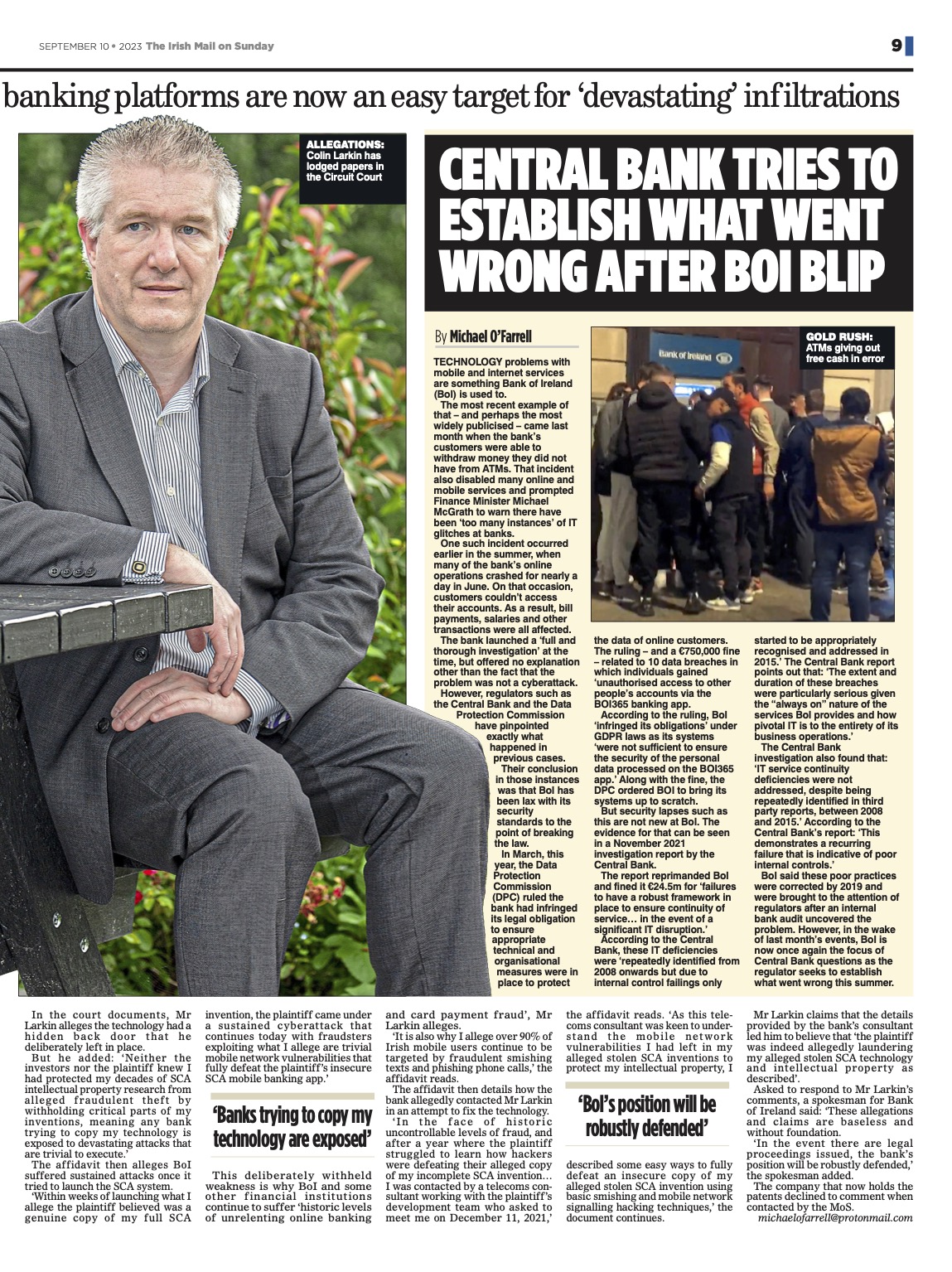
CENTRAL BANK TRIES TO ESTABLISH WHAT WENT WRONG AFTER BOI BLIP


TECHNOLOGY problems with mobile and internet services are something Bank of Ireland (BoI) is used to.

The most recent example of that – and perhaps the most widely publicised – came last month when the bank’s customers were able to withdraw money they did not have from ATMs. That incident also disabled many online and mobile services and prompted Finance Minister Michael McGrath to warn there have been ‘too many instances’ of IT glitches at banks.

One such incident occurred earlier in the summer, when many of the bank’s online operations crashed for nearly a day in June. On that occasion, customers couldn’t access their accounts. As a result, bill payments, salaries and other transactions were all affected.

The bank launched a ‘full and thorough investigation’ at the time, but offered no explanation other than the fact that the problem was not a cyberattack.

However, regulators such as the Central Bank and the Data Protection Commission have pinpointed exactly what happened in previous cases.

Their conclusion in those instances was that BoI has been lax with its security standards to the point of breaking the law.

In March, this year, the Data Protection Commission (DPC) ruled the bank had infringed its legal obligation to ensure appropriate technical and organisational measures were in place to protect the data of online customers. The ruling – and a €750,000 fine – related to 10 data breaches in which individuals gained ‘unauthorised access to other people’s accounts via the BOI365 banking app.

According to the ruling, BoI ‘infringed its obligations’ under GDPR laws as its systems ‘were not sufficient to ensure the security of the personal data processed on the BOI365 app.’ Along with the fine, the DPC ordered BOI to bring its systems up to scratch.

But security lapses such as this are not new at BoI. The evidence for that can be seen in a November 2021 investigation report by the Central Bank.

The report reprimanded BoI and fined it €24.5m for ‘failures to have a robust framework in place to ensure continuity of service… in the event of a significant IT disruption.’

According to the Central Bank, these IT deficiencies were ‘repeatedly identified from 2008 onwards but due to internal control failings only started to be appropriately recognised and addressed in 2015.’ The Central Bank report points out that: ‘The extent and duration of these breaches were particularly serious given the “always on” nature of the services BoI provides and how pivotal IT is to the entirety of its business operations.’

The Central Bank investigation also found that: ‘IT service continuity deficiencies were not addressed, despite being repeatedly identified in third party reports, between 2008 and 2015.’ According to the Central Bank’s report: ‘This demonstrates a recurring failure that is indicative of poor internal controls.’

BoI said these poor practices were corrected by 2019 and were brought to the attention of regulators after an internal bank audit uncovered the problem. However, in the wake of last month’s events, BoI is now once again the focus of Central Bank questions as the regulator seeks to establish what went wrong this summer.


BREACHES ARE THE RULE, NOT THE EXCEPTION


YOUR bank would have you believe your finances and data are completely secure on your smartphone. But those responsible for running those phone networks know otherwise.

In 2022, a survey run by Nokia asked 50 leading communications service providers (CSPs) around the globe about the current and future 5G security landscape.

The results were frightening.

‘Breaches are the rule, not the exception,’ the survey concluded. ‘Based on the responses, CSPs are in a constant struggle as cyber threats evolve.’ (See full report at base)

This means criminals, spies, hackers – and anyone with a few thousand euro and some expertise – can acquire the tools needed to track mobile calls, intercept communications and access banking apps. So far, they haven’t done so on a scale large enough to cripple financial systems. But they could.

This is not a sensationalised claim. It is the view of the EU’s cybersecurity watchdog – the European Network and Information Security Agency (ENISA).

‘What was once a safe interconnecting environment, due to the small number of providers with no real need for access control, has now become a “Wild West” running on legacy infrastructure,’ a 2018 ENISA assessment warned. (See full report at base)

The problem with mobile phone networks is that they are built on a protocol developed in 1975 – called SS7 – that was not designed for things like mobile banking.

‘Nobody at that time envisioned the scale that mobile networks could reach in the future, so trust and security were not issues,’ the ENISA assessment reads. ‘Nonetheless at the moment we are still using this legacy set of protocols to assure the interconnection between providers.’

The result is that SS7 vulnerabilities can be easily exploited. There are countless examples of hackers, journalists and others demonstrating how easy it is to eavesdrop on and track phones in this way.

According to ENISA, all that’s needed to launch an attack on a device is access to SS7 on a network – which can be bought for a few thousand euro in some jurisdictions. In other instances this access is opened up to the many partners and service providers involved in mobile services on every network.

‘Protocols designed decades ago, with no security or access control in mind, cannot cope with today’s challenges,’ the ENISA assessment reads.

‘In order to benefit from all business opportunities today, operators need to open their networks for different types of partners, either operators or other types of service providers. This allowing of uncontrolled access to multiple partners is the main reason for increasing the security risks in signalling, but since it is a business enabler, it is highly improbable that operators will stop doing it.’

The stop-gap solutions deployed by banks and networks to counter these vulnerabilities involve seeking to confirm the identity of customers and educating the public about fraud.

Often enough to keep the system functional, this works. But it’s always a battle, and not nearly as fail-safe as your bank would have you believe.


Share This:

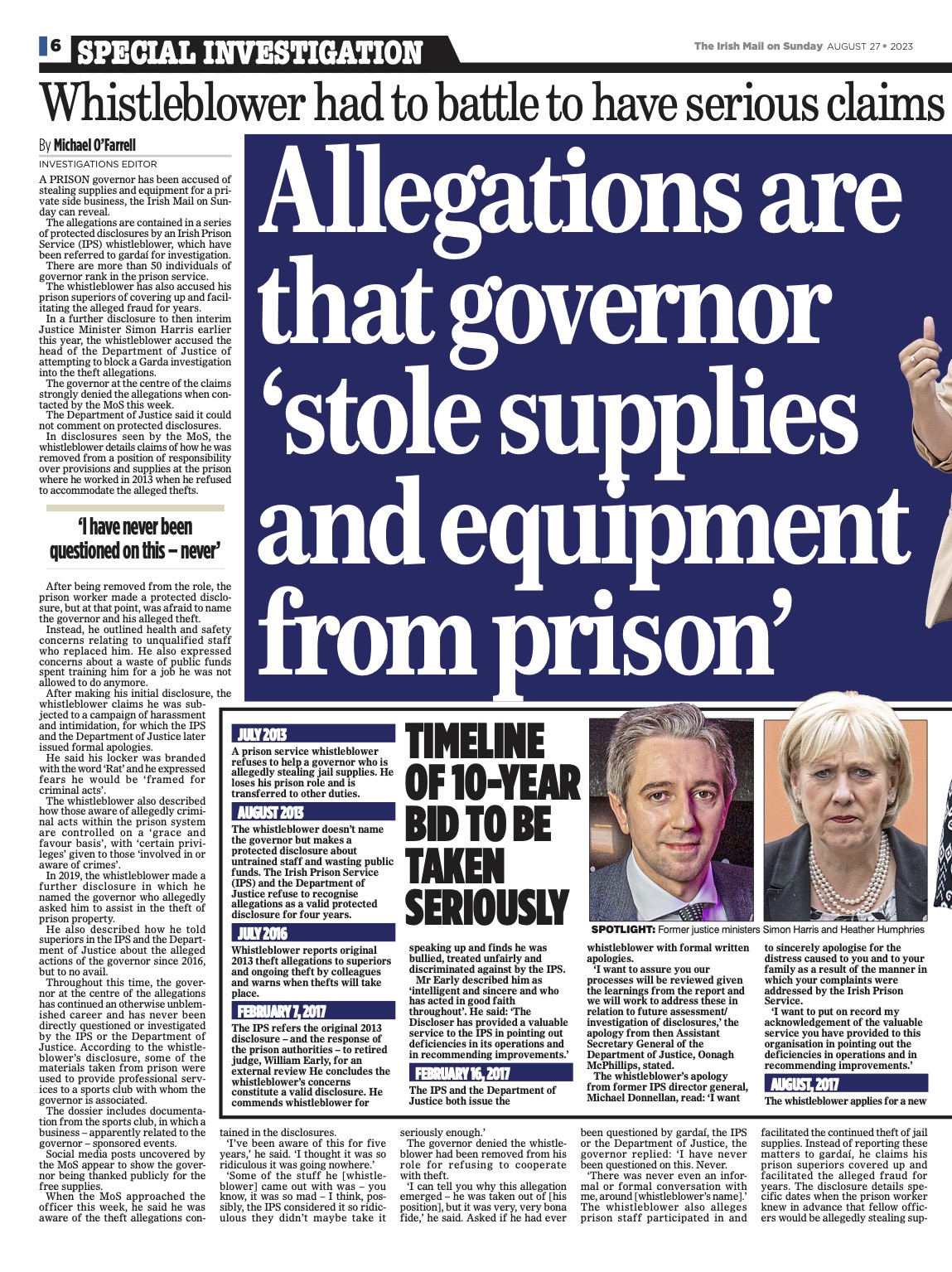
Allegations are that governor ‘stole supplies and equipment from prison’

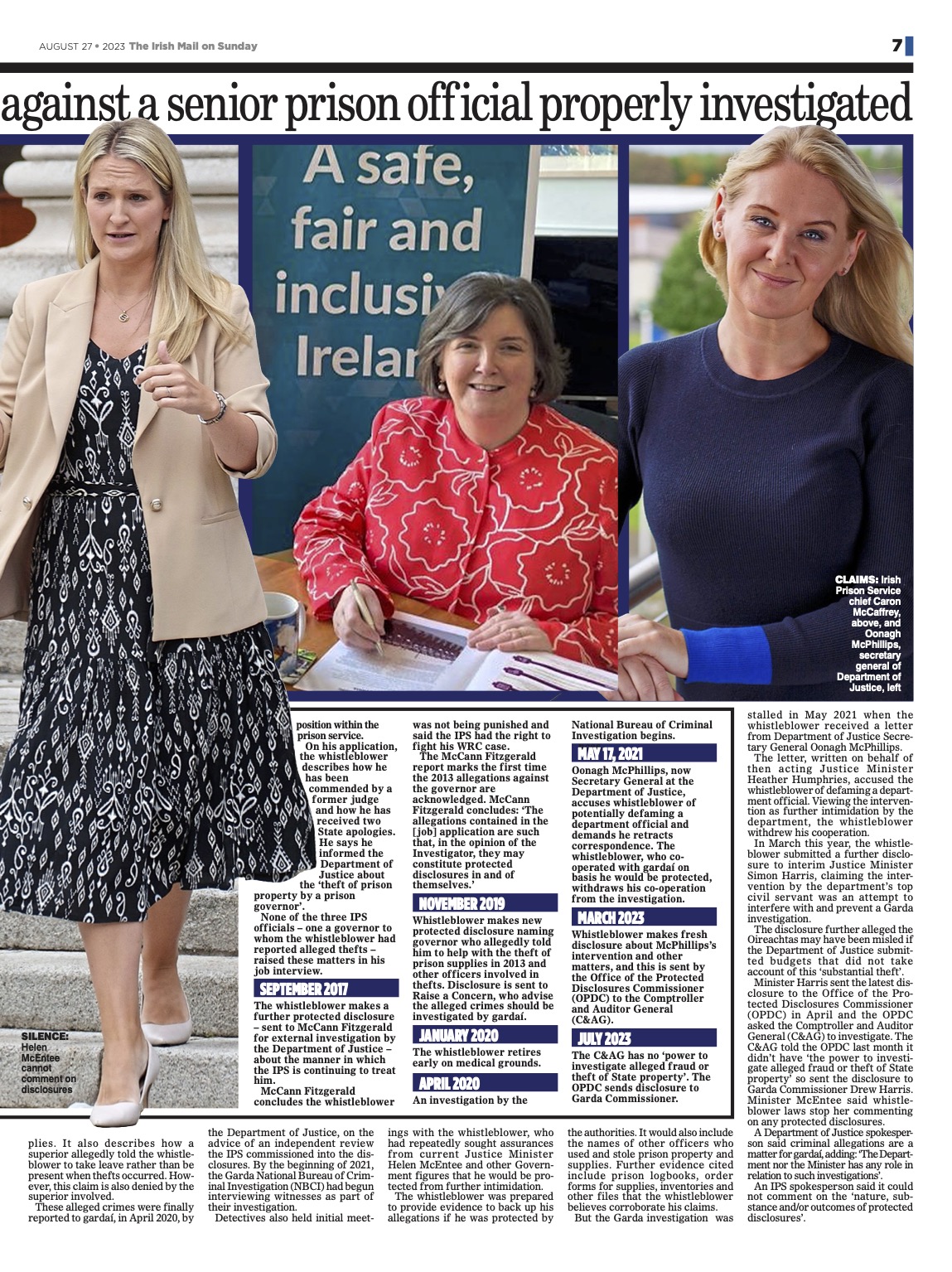
A PRISON governor has been accused of stealing supplies and equipment for a private side business, the Irish Mail on Sunday can reveal.

The allegations are contained in a series of protected disclosures by an Irish Prison Service (IPS) whistleblower, which have been referred to gardaí for investigation.

There are more than 50 individuals of governor rank in the prison service.

The whistleblower has also accused his prison superiors of covering up and facilitating the alleged fraud for years.

In a further disclosure to then interim Justice Minister Simon Harris earlier this year, the whistleblower accused the head of the Department of Justice of attempting to block a Garda investigation into the theft allegations.

The governor at the centre of the claims strongly denied the allegations when contacted by the MoS this week.

The Department of Justice said it could not comment on protected disclosures.

In disclosures seen by the MoS, the whistleblower details claims of how he was removed from a position of responsibility over provisions and supplies at the prison where he worked in 2013 when he refused to accommodate the alleged thefts.

After being removed from the role, the prison worker made a protected disclosure, but at that point, was afraid to name the governor and his alleged theft.


Instead, he outlined health and safety concerns relating to unqualified staff who replaced him. He also expressed concerns about a waste of public funds spent training him for a job he was not allowed to do anymore.

After making his initial disclosure, the claims he was subjected to a campaign of harassment and intimidation, for which the IPS and the Department of Justice later issued formal apologies.

He said his locker was branded with the word ‘Rat’ and he expressed fears he would be ‘framed for criminal acts’.

The whistleblower also described how those aware of allegedly criminal acts within the prison system are controlled on a ‘grace and favour basis’, with ‘certain privileges’ given to those ‘involved in or aware of crimes’.

In 2019, the whistleblower made a further disclosure in which he named the governor who allegedly asked him to assist in the theft of prison property.

He also described how he told superiors in the IPS and the Department of Justice about the alleged actions of the governor since 2016, but to no avail.

Throughout this time, the governor at the centre of the allegations has continued an otherwise unblemished career and has never been directly questioned or investigated by the IPS or the Department of Justice. According to the whistleblower’s disclosure, some of the materials taken from prison were used to provide professional services to a sports club with whom the governor is associated.

The dossier includes documentation from the sports club, in which a business – apparently related to the governor – sponsored events.

Social media posts uncovered by the MoS appear to show the governor being thanked publicly for the free supplies.

When the MoS approached the officer this week, he said he was aware of the theft allegations con- tained in the disclosures.

‘I’ve been aware of this for five years,’ he said. ‘I thought it was so ridiculous it was going nowhere.’

‘Some of the stuff he [whistleblower] came out with was – you know, it was so mad – I think, possibly, the IPS considered it so ridiculous they didn’t maybe take it seriously enough.’

The governor denied the whistleblower had been removed from his role for refusing to cooperate with theft.

‘I can tell you why this allegation emerged – he was taken out of [his position], but it was very, very bona fide,’ he said. Asked if he had ever been questioned by gardaí, the IPS or the Department of Justice, the governor replied: ‘I have never been questioned on this. Never.

‘There was never even an informal or formal conversation with me, around [whistleblower’s name].’ The whistleblower also alleges prison staff participated in and facilitated the continued theft of jail supplies. Instead of reporting these matters to gardaí, he claims his prison superiors covered up and facilitated the alleged fraud for years. The disclosure details specific dates when the prison worker knew in advance that fellow officers would be allegedly stealing supwhistleblower plies. It also describes how a superior allegedly told the whistleblower to take leave rather than be present when thefts occurred. However, this claim is also denied by the superior involved.

These alleged crimes were finally reported to gardaí, in April 2020, by the Department of Justice, on the advice of an independent review the IPS commissioned into the disclosures. By the beginning of 2021, the Garda National Bureau of Criminal

Investigation (NBCI) had begun interviewing witnesses as part of their investigation.

Detectives also held initial meetings with the whistleblower, who had repeatedly sought assurances from current Justice Minister Helen McEntee and other Government figures that he would be protected from further intimidation.

The whistleblower was prepared to provide evidence to back up his allegations if he was protected by the authorities. It would also include the names of other officers who used and stole prison property and supplies. Further evidence cited include prison logbooks, order forms for supplies, inventories and other files that the whistleblower believes corroborate his claims.

But the Garda investigation was stalled in May 2021 when the whistleblower received a letter from Department of Justice Secretary General Oonagh McPhillips.

The letter, written on behalf of then acting Justice Minister Heather Humphries, accused the whistleblower of defaming a department official. Viewing the intervention as further intimidation by the department, the whistleblower withdrew his cooperation.

In March this year, the whistleblower submitted a further disclosure to interim Justice Minister Simon Harris, claiming the intervention by the department’s top civil servant was an attempt to interfere with and prevent a Garda investigation.

The disclosure further alleged the Oireachtas may have been misled if the Department of Justice submitted budgets that did not take account of this ‘substantial theft’.

Minister Harris sent the latest disclosure to the Office of the Protected Disclosures Commissioner (OPDC) in April and the OPDC asked the Comptroller and Auditor General (C&AG) to investigate. The C&AG told the OPDC last month it didn’t have ‘the power to investigate alleged fraud or theft of State property’ so sent the disclosure to Garda Commissioner Drew Harris. Minister McEntee said whistleblower laws stop her commenting on any protected disclosures.

A Department of Justice spokesperson said criminal allegations are a matter for gardaí, adding: ‘The Department nor the Minister has any role in relation to such investigations’.

An IPS spokesperson said it could not comment on the ‘nature, substance and/or outcomes of protected disclosures’.

Share This:

STATE IGNORING FARM ‘VAT SCAM’ WORTH MILLIONS

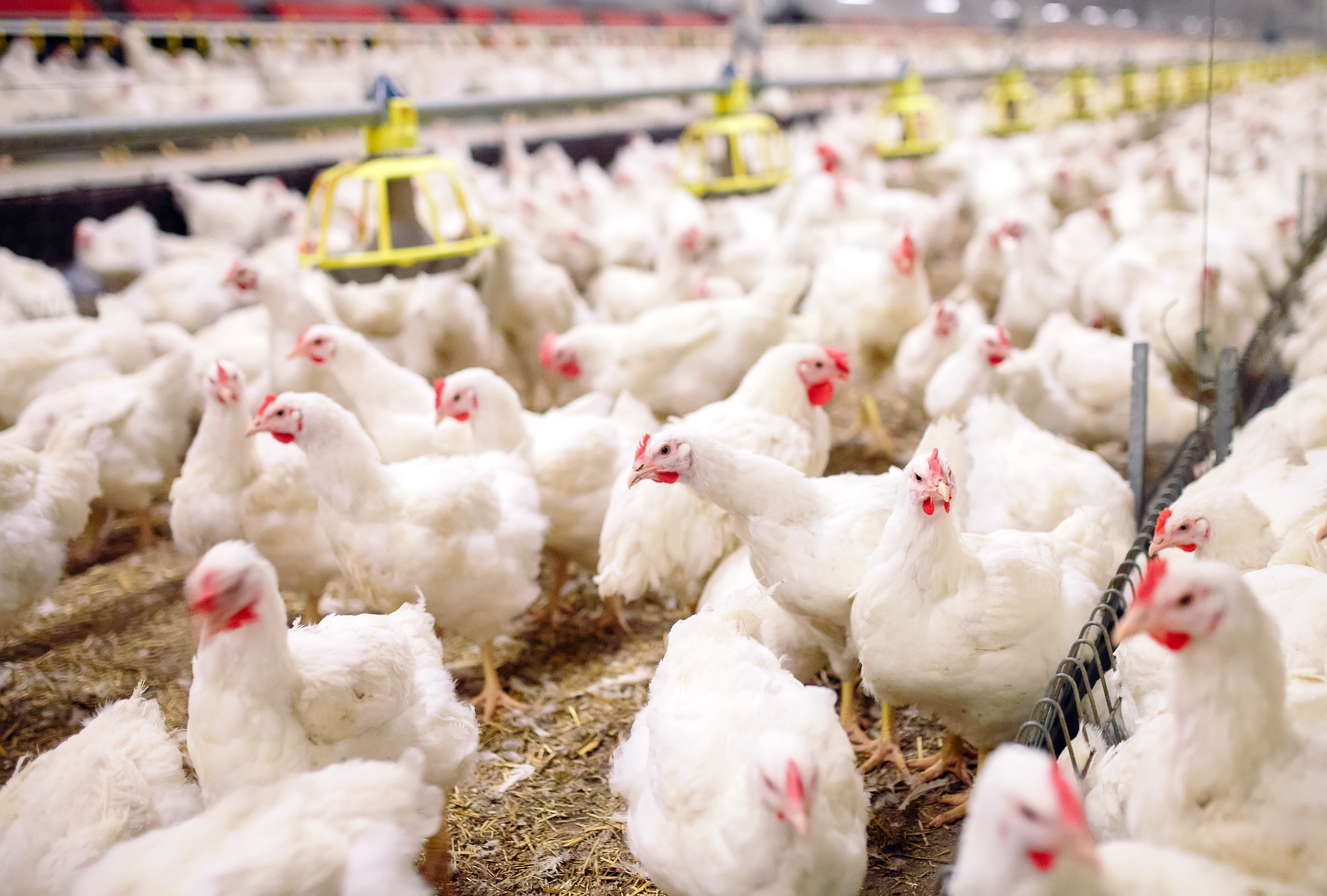
Indoors chicken farm, chicken feeding; Shutterstock ID 730269505; Purchase Order: -

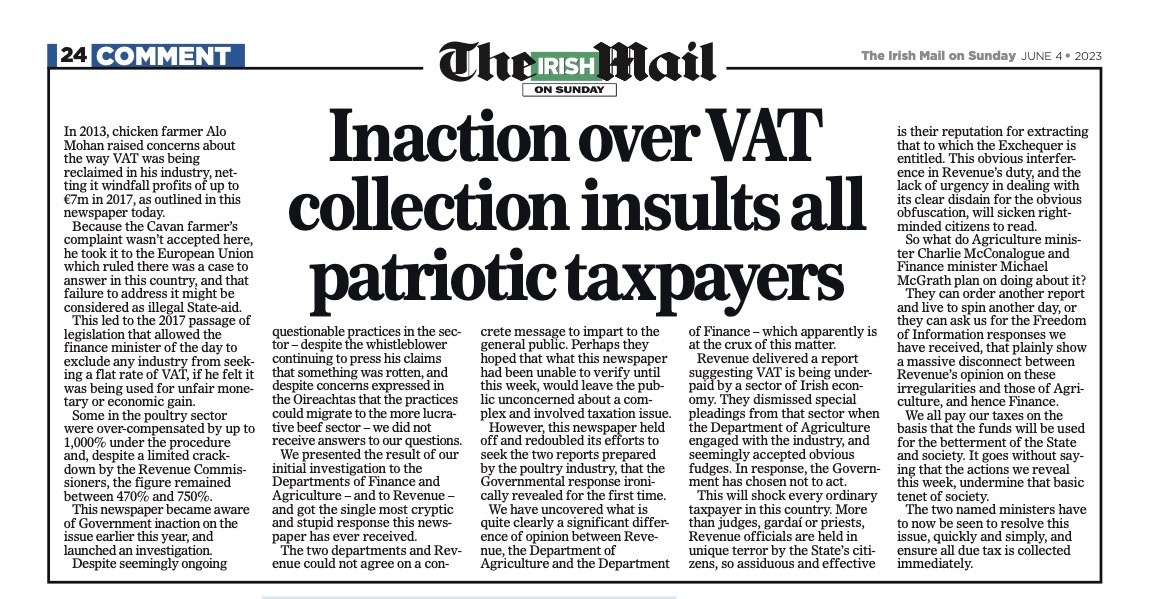
THE Government has allowed a massive farming tax scam that has cost taxpayers tens of millions of euro to continue despite repeated warnings from Revenue, an Irish Mail on Sunday investigation reveals.

The tax abuse – which enables some chicken farmers to recoup as much 1,000% more VAT than they are entitled to – was first identified to the authorities in 2013 by a whistleblower.

Despite this, the Government has never shut down the scam, even though it passed a law more than six years ago to allow the finance minister to do with a single stroke of a pen.

Now this failure to act could result ireland being investigated and fined the European Commission if it is found that the Government allowed breaches EU VAT rules to continue.

Under EU directives, no business can claim more in VAT than it pays.

However, Irish poultry producers were able to earn multiples more than they paid by manipulating rules intended to make VAT administration simple for farmers.

This exploitation of what farmers call the ‘flat-rate allowance’ allowed the sector to secretly harvest unjustified VAT returns from the Exchequer.

According to a never-before published Revenue review – seen by the MoS – this tax abuse earned the poultry sector €7m more in 2017 alone, an average of €35,000 per farmer.

An MoS analysis of the underlying figures revealed in the review suggests the scam could have cost the State more than €20m in recent years.

A second element to the abuse involved VAT being harvested on the double via farming co-ops. When Revenue ordered this practice to halt in August 2017, the amount of VAT overcompensation dropped, from 1,000% to 750%.

In turn, this Exchequer funding benefited the sector’s largest processors and their multi-millionaire owners, as well as the farmers.

When the MoS first asked the Government about the widespread VAT abuse in the sector a month ago, the Department of Finance and Revenue issued a joint response.

The cryptically worded statement gave no indication of Revenue’s continuing concern over the Government’s failure to act against the tax abuses.

However, internal files obtained by the MoS under the Freedom of Information Act reveal Revenue warned the Government the tax abuse could escalate and spread to the beef sector, with far more costly consequences for taxpayers.

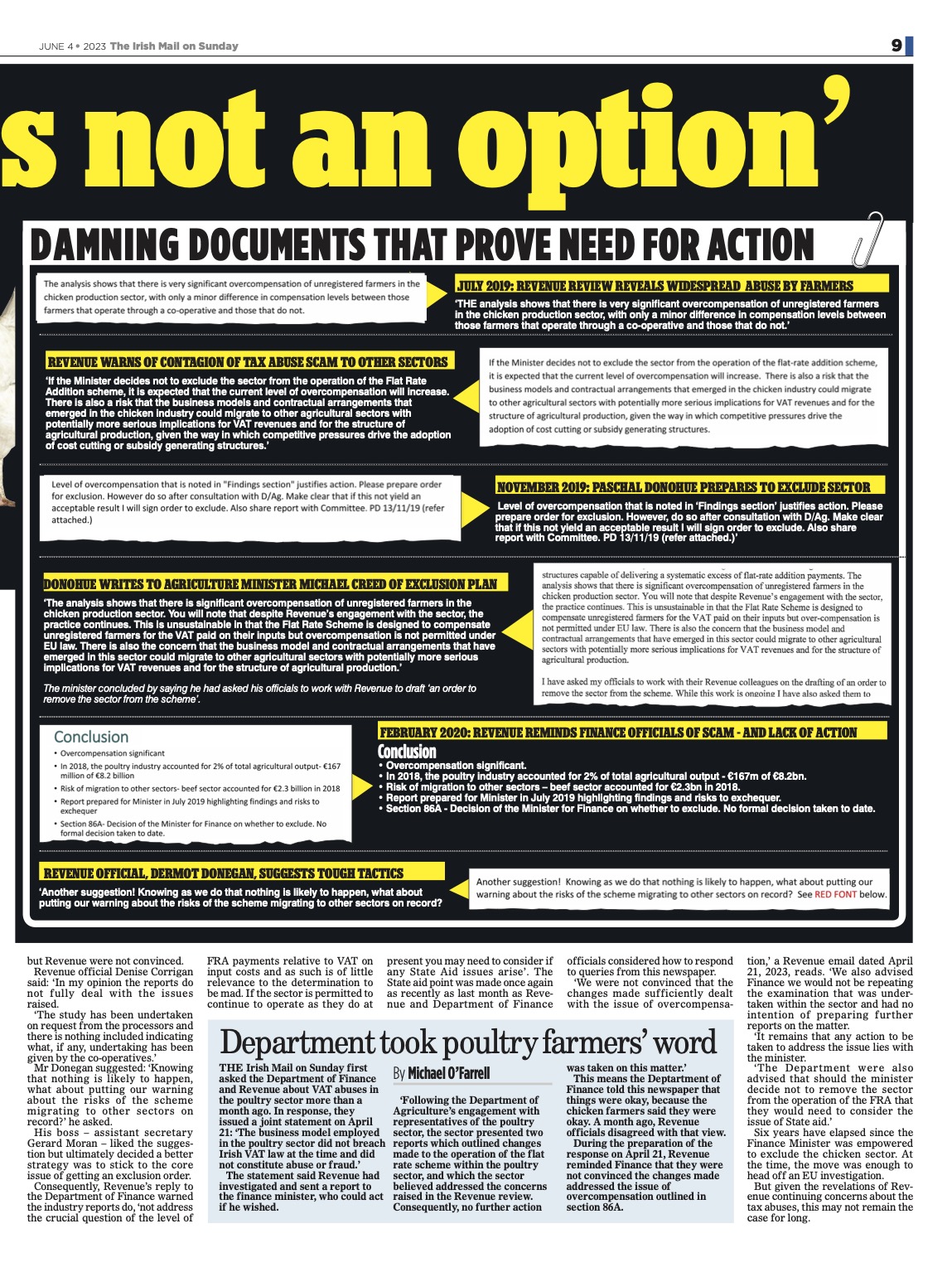
These concerns were reflected in correspondence between former finance minister Paschal Donohoe, now Public Expenditure Minister, to the minister for Agriculture.

Mr Donohoe wrote: ‘There is significant overcompensation of unregistered farmers in the chicken production sector.

‘Despite Revenue’s engagement with the sector, the practice continues. This is unsustainable in that the flat-rate scheme is designed to compensate unregistered farmers for the VAT paid on their inputs but overcompensation is not permitted under EU law.’

Mr Donohoe added: ‘There is also a concern that the business model and contractual arrangements that have emerged in this sector could migrate to other agricultural sectors with potentially more serious implications for VAT revenues.’

The documents also show Revenue told the Government that the millions earned via the scam likely amounted to illegal State aid.

One Revenue official noted in internal correspondence prompted by our original query a month ago, ‘The Department were also advised that should the Minister decide not to remove the sector from the op- eration of the flat-rate addition that they would need to consider the issue of State Aid’.

The files also lay bare the frustration of senior Revenue officials as their warnings went unheeded.

One Revenue official criticised the Department of Agriculture for allowing the poultry sector to ‘engineer an opportunity to stall the process and walk us into a merry go round’.

The same official also expressed frustration at the failure of the Department of Finance to act to shut down the VAT scam.

He wrote: ‘We have presented a report to the Department of Finance; it is up to the Minister to act or not.’

Another official was so frustrated at the lack of response from the department he suggested putting Revenue’s concerns on the record. He wrote: ‘Knowing as we do that nothing is likely to happen, what about putting our warning about the risks of the scheme migrating to other sectors on record?’

According to records seen by the MoS, Revenue was aware of these abuses from at least 2013, when Cavan chicken farmer Alo Mohan, a supplier to Manor Farm, raised the issue with a succession of tax officials.

Along with Mayo-based Western Brand and Cork-based Shannon Vale Foods, Manor Farm is one of the top three chicken processing firms in Ireland. Of the three, Shannon Vale Foods was the only one in which farmers did not operate a co-op.

However, the three firms have jointly made representations to the Department of Agriculture in a bid to ensure the sector is not excluded from the flat-rate allowance because of the abuse.

Mr Mohan raised his concerns after his accountant, Frank Lynch & Co, advised him that to engage in the scam would amount to VAT fraud.

A second opinion, from former Revenue Commissioner and tax adviser Eugene Dolan, also advised the practices would amount to, ‘a clear misuse/abuse of the VAT input credit regime and indeed of the VAT system in general’.

Despite these concerns, a number of Revenue officials were unable to clarify for Mr Mohan if the schemes were illegal.

Refusing to partake in the abuse on moral grounds, Mr Mohan ultimately lost his business. He is currently seeking to sue the Revenue for malfeasance.

In recent years, Mr Moran has also been joined in his campaign by Raymond O’Hanlon, former managing director of Cappoquin Chickens, which went bust as rivals abused the tax system to gain an advantage.

Internal Revenue and Department of Finance records confirm that, from at least 2015, the Government knew these practices were a likely breach of EU rules.

The records describe the abuse as ‘an anti-avoidance issue’ and as being ‘against the spirit and purpose of the EU VAT directive’.

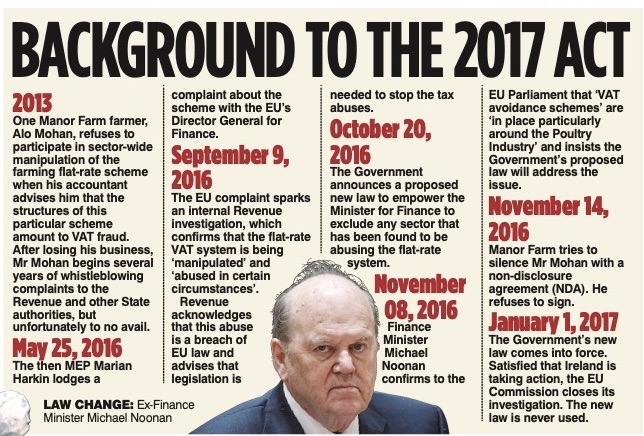
In 2016, then MEP Marian Harkin made an official complaint about the practice to the EU’s director general for finance.

Briefing notes prepared for then finance minister Michael Noonan explained that ‘models are established in some sectors which result in a much higher level of flat-rate addition payments in the sector than would otherwise be available’.

Mr Noonan’s briefing notes also warned: ‘This would have implications for VAT neutrality and possibly competitiveness within the sector and within the agriculture industry generally.’

However, any EU concerns about the VAT abuses were satisfied when Ireland passed legislation to address the issue in January 2017.

The new law gave the finance minister the authority to exclude an agricultural sector from the flat-rate system completely if it was found to be abusing the rules.

Satisfied with this, the EU closed the investigation it had opened on foot of Ms Harkin’s complaint.

However, neither Mr Noonan nor his successors as ministers for finance have used this power to shut down the VAT abuses.

In September 2019, Mr Mohan and his accountant wrote a letter to Minister Donohoe, in which they said the Government had ‘failed to address or seek redress in any meaningful way’.

The letter reads: ‘What your predecessor [Mr Noonan] actually allowed for was a situation where one industry? claims more flat-rate VAT than it is entitled to compared to VAT-registered enterprises.

‘An example of this has been occurring in the large beef feed lots whereby the VAT claimed by these industrial farmers is far in excess of the inputs actually incurred and gives them an unfair competitive advantage against their farming neighbours.’

However, like his predecessor, Mr Donohoe did not use his power to ban the poultry sector from the flat rate allowance.

Mr Donohue did ask for an exclusion order to be prepared, but he never signed it after the Department of Agriculture became involved.

Asked about the VAT abuse when he appeared before the Dáil spending watchdog in November 2019, Revenue chairman Niall Cody admitted, ‘There is no doubt that, within the poultry sector, the pricing structure allowed for an overcompensation of the VAT for some people who are in that trade’.

When asked what solution was available to the finance minister, Mr Cody replied, ‘To remove the flat-rate compensation for the sector’.

Mr Cody added Revenue had conducted a detailed report ‘to establish if there was overcompensation in the poultry sector’ for the finance minister.

‘We have sent our report to the Minister for Finance. It is now with the minister and he has to consider,’ he said at the time.

He also acknowledged concerns the issue could have spread into the beef sector, saying Revenue would be ‘keeping an eye on it’.

When Aontú leader Peadar Tòibín raised the tax abuses in the Dáil in 2021, he questioned Agriculture Minister Charlie McConalogue about what he described as the ‘VAT fraud’ and ‘illegal State aid’.

However, Mr McConalogue refused to engage with Mr Tòibín, saying it was not ‘appropriate’ to raise the matter ‘on the floor of the House [Dáil]’.


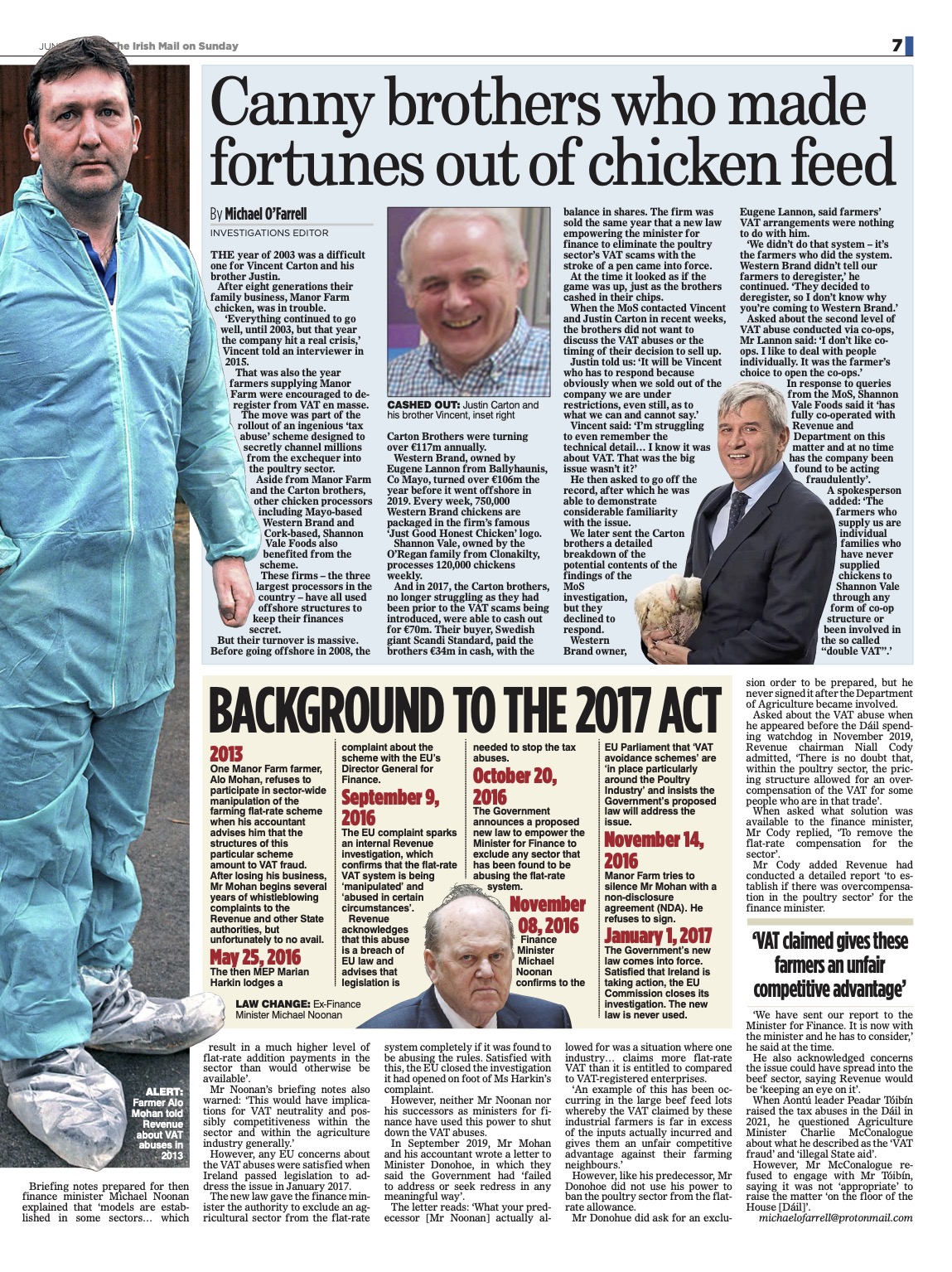
Canny brothers who made fortunes out of chicken feed

THE year of 2003 was a difficult one for Vincent Carton and his brother Justin.

After eight generations their family business, Manor Farm chicken, was in trouble.

‘Everything continued to go well, until 2003, but that year the company hit a real crisis,’ Vincent told an interviewer in 2015.

That was also the year farmers supplying Manor Farm were encouraged to deregister from VAT en masse.

The move was part of the rollout of an ingenious ‘tax abuse’ scheme designed to secretly channel millions from the exchequer into the poultry sector.

Aside from Manor Farm and the Carton brothers, other chicken processors including Mayo-based Western Brand and Cork-based, Shannon Vale Foods also benefited from the scheme.

These firms – the three largest processors in the country – have all used offshore structures to keep their finances secret.

But their turnover is massive. Before going offshore in 2008, the Carton Brothers were turning over €117m annually.

Western Brand, owned by Eugene Lannon from Ballyhaunis, Co Mayo, turned over €106m the year before it went offshore in 2019.

Every week, 750,000 Western Brand chickens are packaged in the firm’s famous ‘Just Good Honest Chicken’ logo.

Shannon Vale, owned by the O’Regan family from Clonakilty, processes 120,000 chickens weekly.

And in 2017, the Carton brothers, no longer struggling as they had been prior to the VAT scams being introduced, were able to cash out for €70m.

Their buyer, Swedish giant Scandi Standard, paid the brothers €34m in cash, with the balance in shares.

The firm was sold the same year that a new law empowering the minister for finance to eliminate the poultry sector’s VAT scams with the stroke of a pen came into force.

At the time it looked as if the game was up, just as the brothers cashed in their chips.

When the MoS contacted Vincent and Justin Carton in recent weeks, the brothers did not want to discuss the VAT abuses or the timing of their decision to sell up.

Justin told us: ‘It will be Vincent who has to respond because obviously when we sold out of the company we are under restrictions, even still, as to what we can and cannot say.’

Vincent said: ‘I’m struggling to even remember the technical detail. I know it was about VAT. That was the big issue wasn’t it?’

He then asked to go off the record, after which he was able to demonstrate considerable familiarity with the issue.

We later sent the Carton brothers a detailed breakdown of the potential contents of the findings of the MoS investigation, but they declined to respond.

Western Brand owner, Eugene Lannon, said farmers’ VAT arrangements were nothing to do with him.

‘We didn’t do that system – it’s the farmers who did the system. Western Brand didn’t tell our farmers to deregister,’ he continued. ‘They decided to deregister, so I don’t know why you’re coming to Western Brand.’

Asked about the second level of VAT abuse conducted via co-ops, Mr Lannon said: ‘I don’t like co-ops. I like to deal with people individually. It was the farmer’s choice to open the co-ops.’

In response to queries from the MoS, Shannon Vale Foods said it ‘has fully co-operated with Revenue and Department on this matter and at no time has the company been found to be acting fraudulently’.

A spokesperson added: ‘The farmers who supply us are individual families who have never supplied chickens to Shannon Vale through any form of co-op structure or been involved in the so called “double VAT”.’


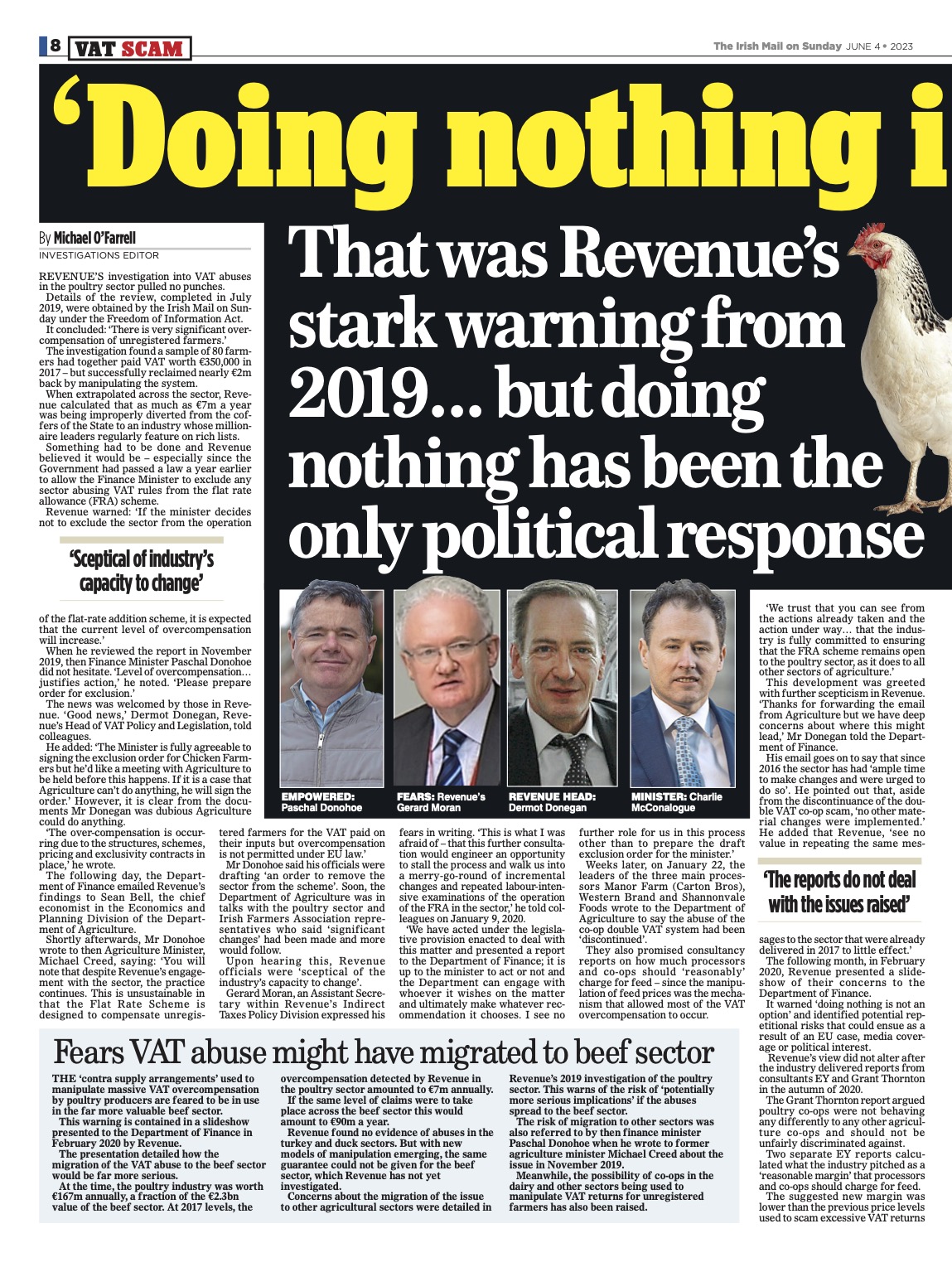
‘Doing nothing is not an option’. That was Revenue’s stark warning from 2019… but doing nothing has been the only political response

REVENUE’S investigation into VAT abuses in the poultry sector pulled no punches.

Details of the review, completed in July 2019, were obtained by the Irish Mail on Sunday under the Freedom of Information Act.

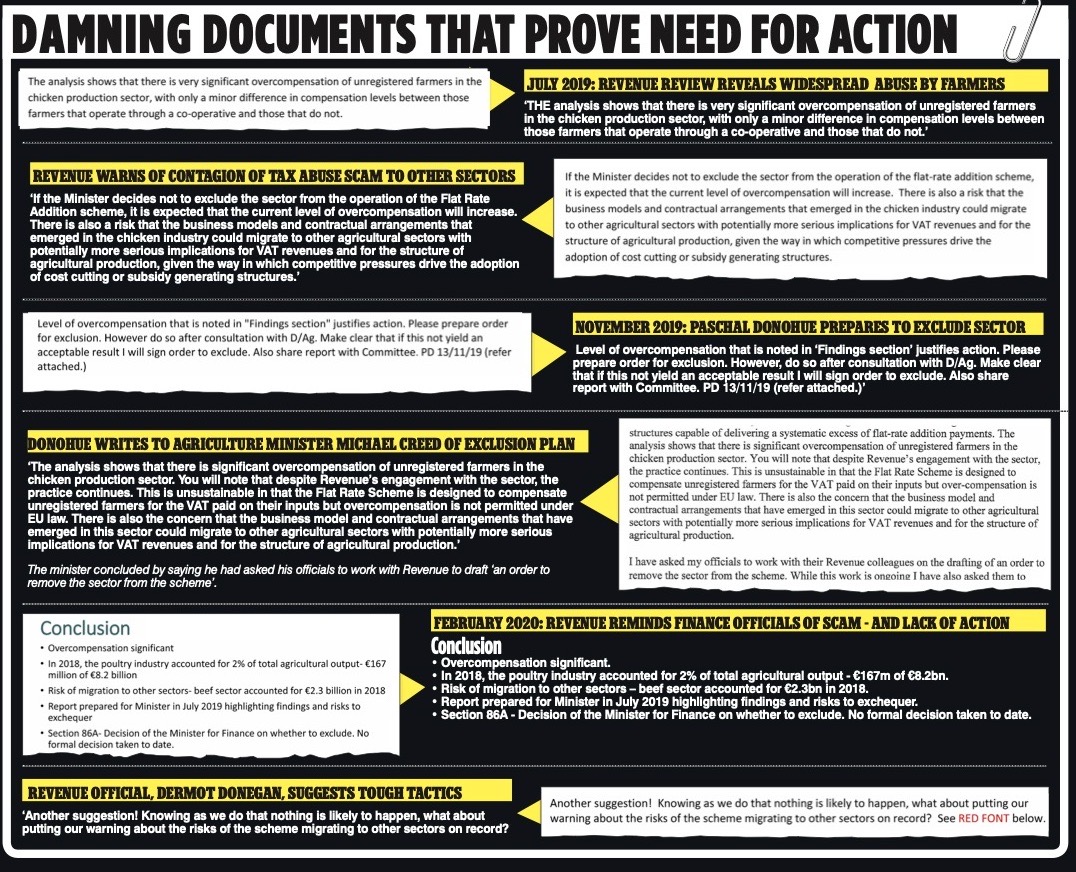
It concluded: ‘There is very significant overcompensation of unregistered farmers.’

The investigation found a sample of 80 farmers had together paid VAT worth €350,000 in 2017 – but successfully reclaimed nearly €2m back by manipulating the system.

When extrapolated across the sector, Revenue calculated that as much as €7m a year was being improperly diverted from the coffers of the State to an industry whose millionaire leaders regularly feature on rich lists.

Something had to be done and Revenue believed it would be – especially since the Government had passed a law a year earlier to allow the Finance Minister to exclude any sector abusing VAT rules from the flat rate allowance (FRA) scheme.

Revenue warned: ‘If the minister decides not to exclude the sector from the operation of the flat-rate addition scheme, it is expected that the current level of overcompensation will increase.’

When he reviewed the report in November 2019, then Finance Minister Paschal Donohoe did not hesitate. ‘Level of overcompensation? justifies action,’ he noted. ‘Please prepare order for exclusion.’

The news was welcomed by those in Revenue. ‘Good news,’ Dermot Donegan, Revenue’s Head of VAT Policy and Legislation, told colleagues.

He added: ‘The Minister is fully agreeable to signing the exclusion order for Chicken Farmers but he’d like a meeting with Agriculture to be held before this happens. If it is a case that Agriculture can’t do anything, he will sign the order.’ However, it is clear from the documents Mr Donegan was dubious Agriculture could do anything.

‘The over-compensation is occurring due to the structures, schemes, pricing and exclusivity contracts in place,’ he wrote.

The following day, the Department of Finance emailed Revenue’s findings to Sean Bell, the chief economist in the Economics and Planning Division of the Department of Agriculture.

Shortly afterwards, Mr Donohoe wrote to then Agriculture Minister, Michael Creed, saying: ‘You will note that despite Revenue’s engagement with the sector, the practice continues. This is unsustainable in that the Flat Rate Scheme is designed to compensate unregisfearstered farmers for the VAT paid on their inputs but overcompensation is not permitted under EU law.’

Mr Donohoe said his officials were drafting ‘an order to remove the sector from the scheme’.

Soon, the Department of Agriculture was in talks with the poultry sector and Irish Farmers Association representatives who said ‘significant changes’ had been made and more would follow.

Upon hearing this, Revenue officials were ‘sceptical of the industry’s capacity to change’.

Gerard Moran, an Assistant Secretary within Revenue’s Indirect Taxes Policy Division expressed his in writing.

‘This is what I was afraid of – that this further consultation would engineer an opportunity to stall the process and walk us into a merry-go-round of incremental changes and repeated labour-intensive examinations of the operation of the FRA in the sector,’ he told colleagues on January 9, 2020.

‘We have acted under the legislative provision enacted to deal with this matter and presented a report to the Department of Finance; it is up to the minister to act or not and the Department can engage with whoever it wishes on the matter and ultimately make whatever recommendation it chooses. I see no further role for us in this process other than to prepare the draft exclusion order for the minister.’

Weeks later, on January 22, the leaders of the three main processors Manor Farm (Carton Bros), Western Brand and Shannonvale Foods wrote to the Department of Agriculture to say the abuse of the co-op double VAT system had been ‘discontinued’.

They also promised consultancy reports on how much processors and co-ops should ‘reasonably’ charge for feed – since the manipulation of feed prices was the mechanism that allowed most of the VAT overcompensation to occur.

‘We trust that you can see from the actions already taken and the action under way that the industry is fully committed to ensuring that the FRA scheme remains open to the poultry sector, as it does to all other sectors of agriculture.’

This development was greeted with further scepticism in Revenue.

‘Thanks for forwarding the email from Agriculture but we have deep concerns about where this might lead,’ Mr Donegan told the Department of Finance.

His email goes on to say that since 2016 the sector has had ‘ample time to make changes and were urged to do so’.

He pointed out that, aside from the discontinuance of the double VAT co-op scam, ‘no other material changes were implemented.’

He added that Revenue, ‘see no value in repeating the same messages to the sector that were already delivered in 2017 to little effect.’

The following month, in February 2020, Revenue presented a slideshow of their concerns to the Department of Finance.

It warned ‘doing nothing is not an option’ and identified potential repetitional risks that could ensue as a result of an EU case, media coverage or political interest.

Revenue’s view did not alter after the industry delivered reports from consultants EY and Grant Thornton in the autumn of 2020.

The Grant Thornton report argued poultry co-ops were not behaving any differently to any other agriculture co-ops and should not be unfairly discriminated against.

Two separate EY reports calculated what the industry pitched as a ‘reasonable margin’ that processors and co-ops should charge for feed.

The suggested new margin was lower than the previous price levels used to scam excessive VAT returns but Revenue were not convinced.

Revenue official Denise Corrigan said: ‘In my opinion the reports do not fully deal with the issues raised.

‘The study has been undertaken on request from the processors and there is nothing included indicating what, if any, undertaking has been given by the co-operatives.’

Mr Donegan suggested: ‘Knowing that nothing is likely to happen, what about putting our warning about the risks of the scheme migrating to other sectors on record?’ he asked.

His boss – assistant secretary Gerard Moran – liked the suggestion but ultimately decided a better strategy was to stick to the core issue of getting an exclusion order.

Consequently, Revenue’s reply to the Department of Finance warned the industry reports do, ‘not address the crucial question of the level of FRA payments relative to VAT on input costs and as such is of little relevance to the determination to be mad. If the sector is permitted to continue to operate as they do at present you may need to consider if any State Aid issues arise’.

The State aid point was made once again as recently as last month as Revenue and Department of Finance officials considered how to respond to queries from this newspaper.

‘We were not convinced that the changes made sufficiently dealt with the issue of overcompensation,’ a Revenue email dated April 21, 2023, reads.

‘We also advised Finance we would not be repeating the examination that was undertaken within the sector and had no intention of preparing further reports on the matter.

‘It remains that any action to be taken to address the issue lies with the minister.

‘The Department were also advised that should the minister decide not to remove the sector from the operation of the FRA that they would need to consider the issue of State aid.’

Six years have elapsed since the Finance Minister was empowered to exclude the chicken sector. At the time, the move was enough to head off an EU investigation.

But given the revelations of Revenue continuing concerns about the tax abuses, this may not remain the case for long.


Department took poultry farmers’ word

THE Irish Mail on Sunday first asked the Department of Finance and Revenue about VAT abuses in the poultry sector more than a month ago.

In response, they issued a joint statement on April 21: ‘The business model employed in the poultry sector did not breach Irish VAT law at the time and did not constitute abuse or fraud.’

The statement said Revenue had investigated and sent a report to the finance minister, who could act if he wished.

‘Following the Department of Agriculture’s engagement with representatives of the poultry sector, the sector presented two reports which outlined changes made to the operation of the flat rate scheme within the poultry sector, and which the sector believed addressed the concerns raised in the Revenue review. Consequently, no further action was taken on this matter.’

This means the Deptartment of Finance told this newspaper that things were okay, because the chicken farmers said they were okay. A month ago, Revenue officials disagreed with that view.

During the preparation of the response on April 21, Revenue reminded Finance that they were not convinced the changes made addressed the issue of overcompensation outlined in section 86A.


Share This:

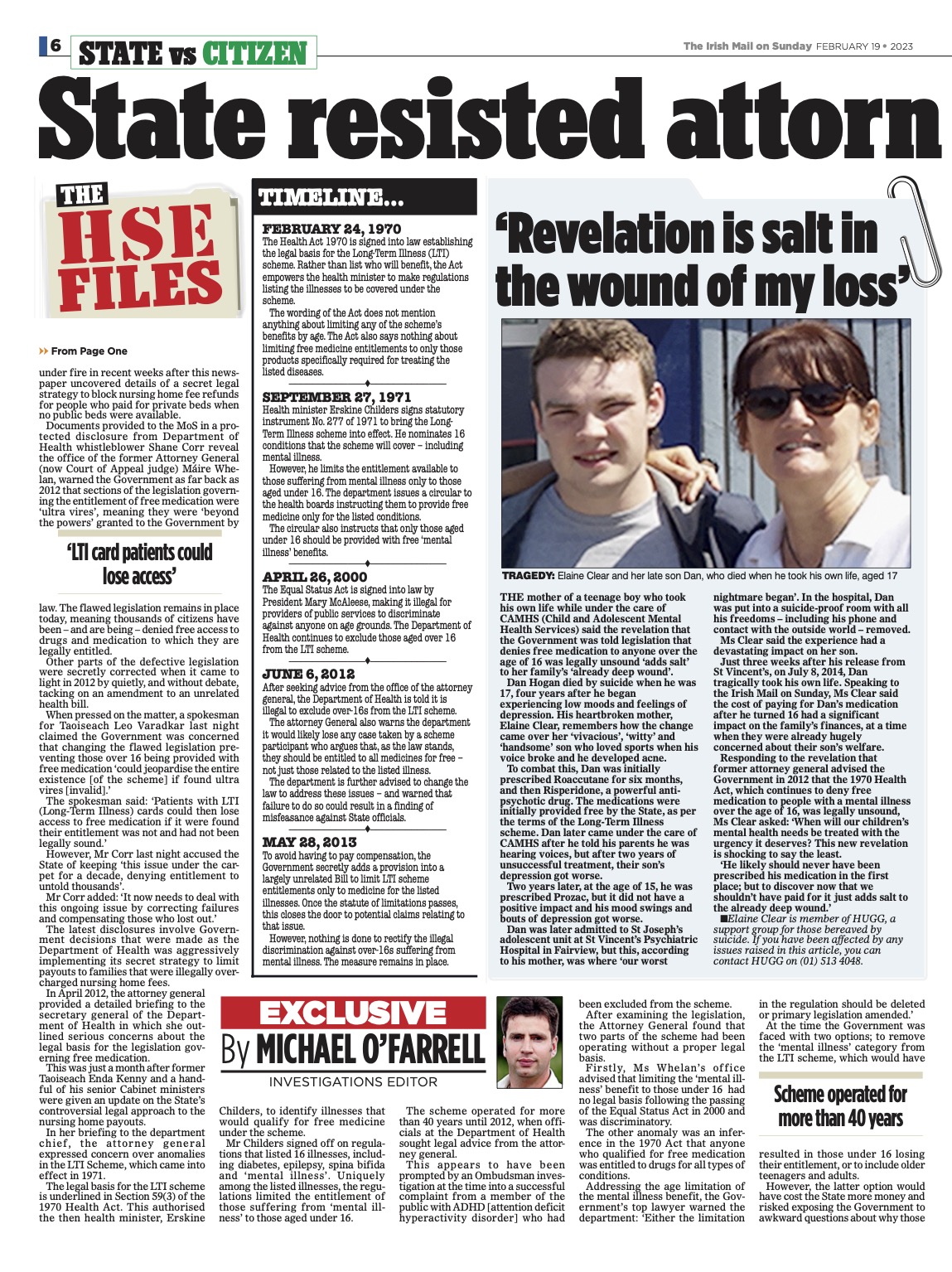
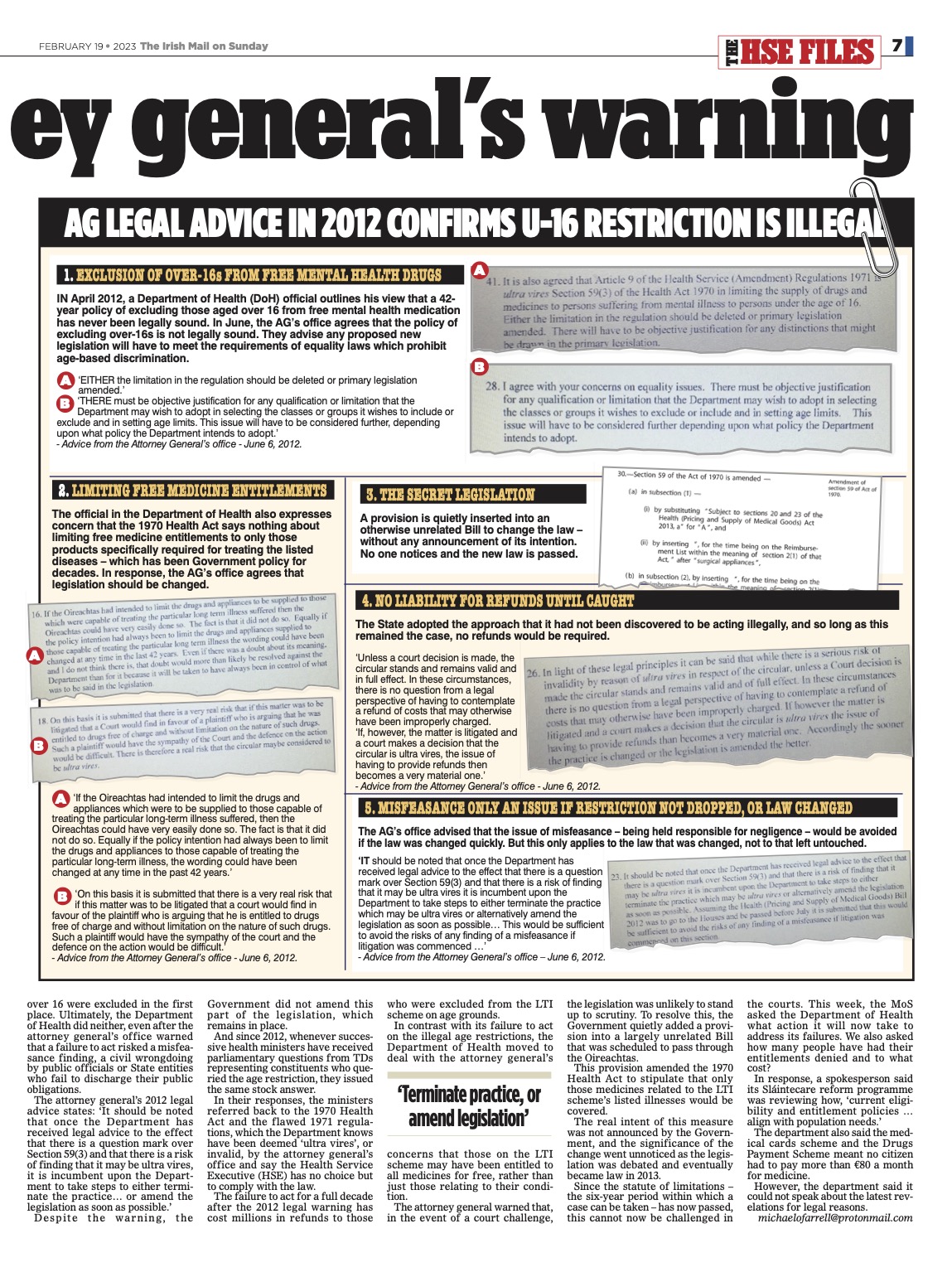
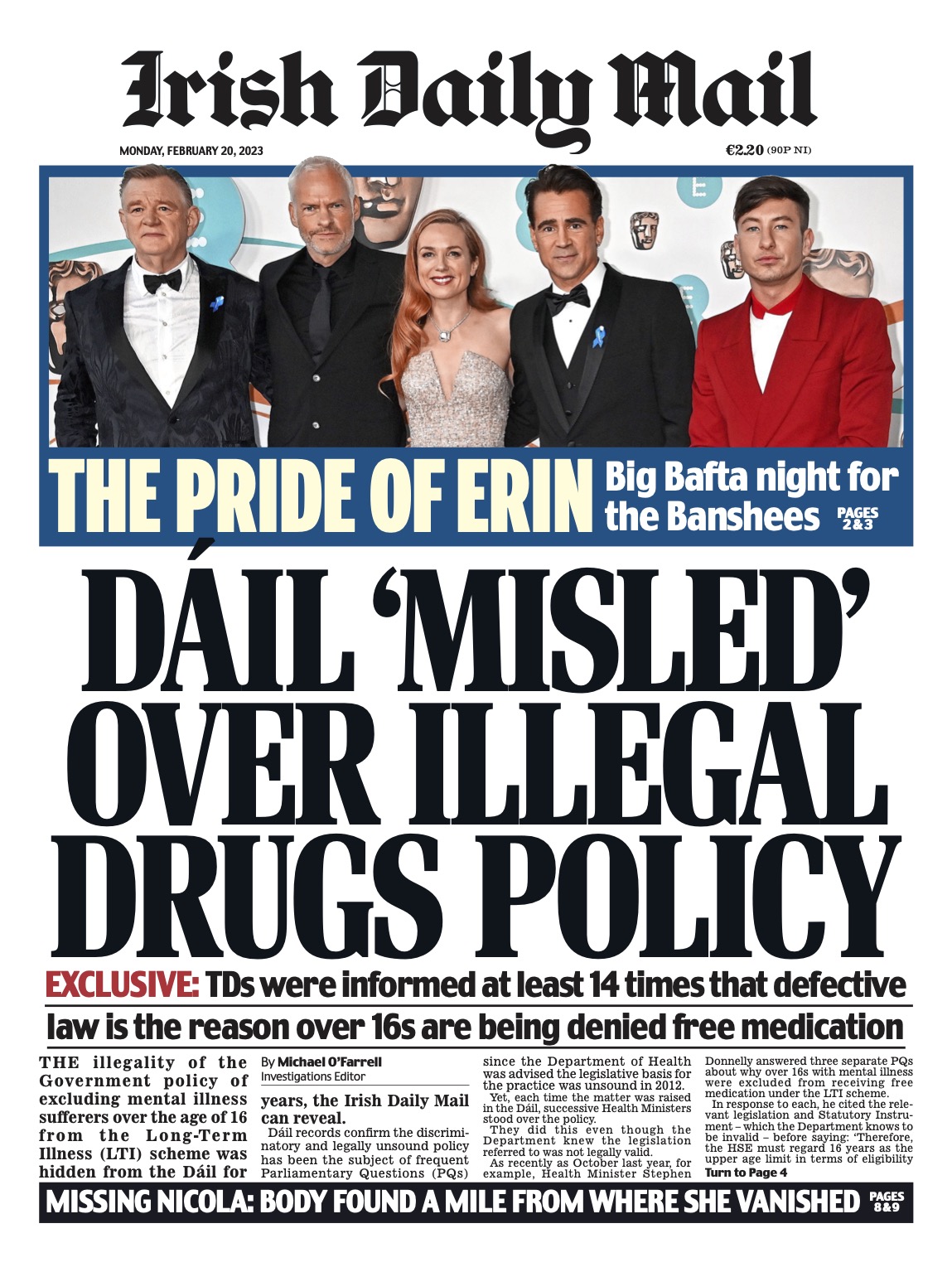
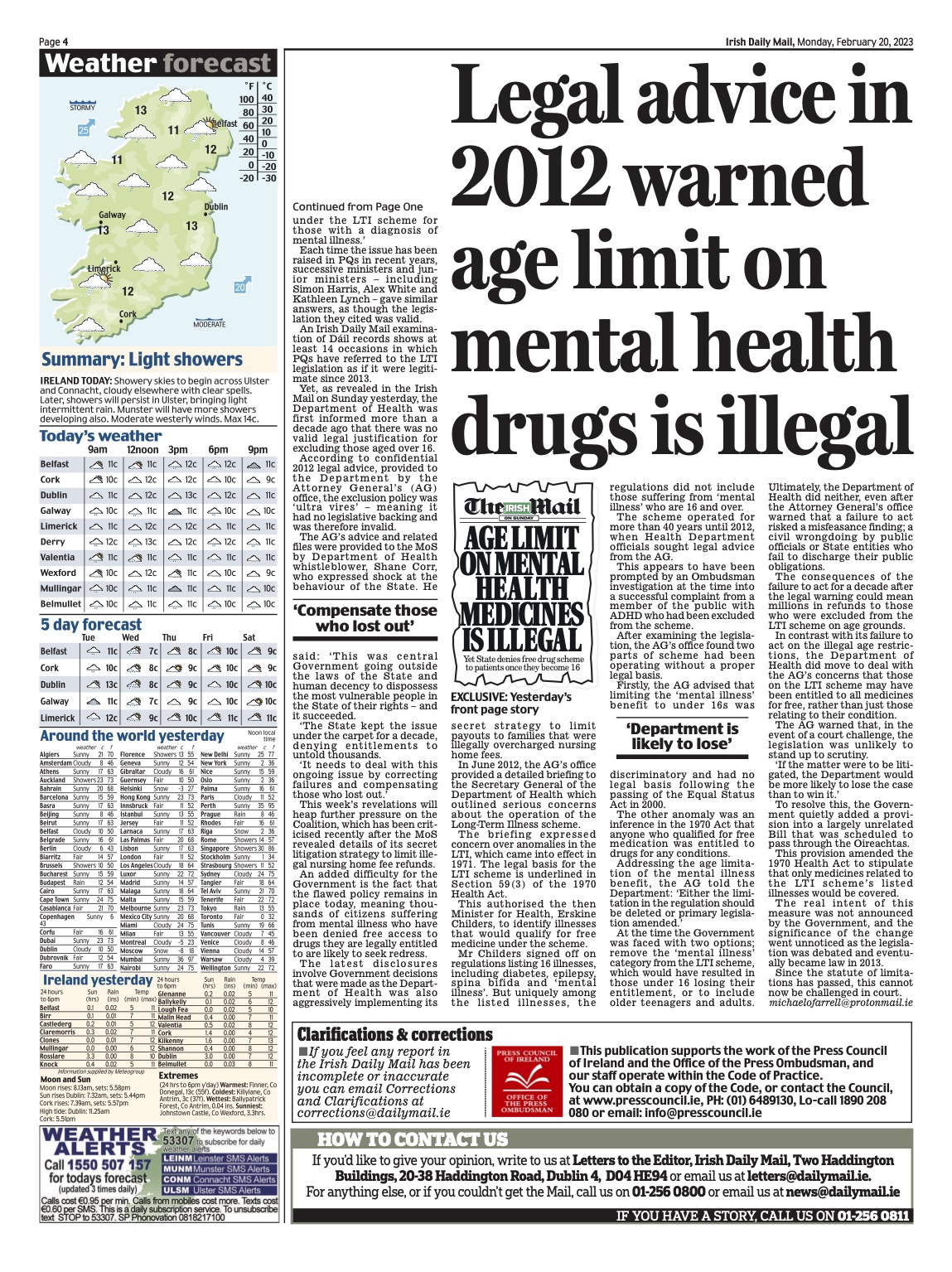
AGE LIMIT ON MENTAL HEALTH MEDICINES IS ILLEGAL

TEENAGERS over the age of 16 and adults with mental illnesses are being denied free medication because the State has refused to correct defective legislation, confidential documents reveal.
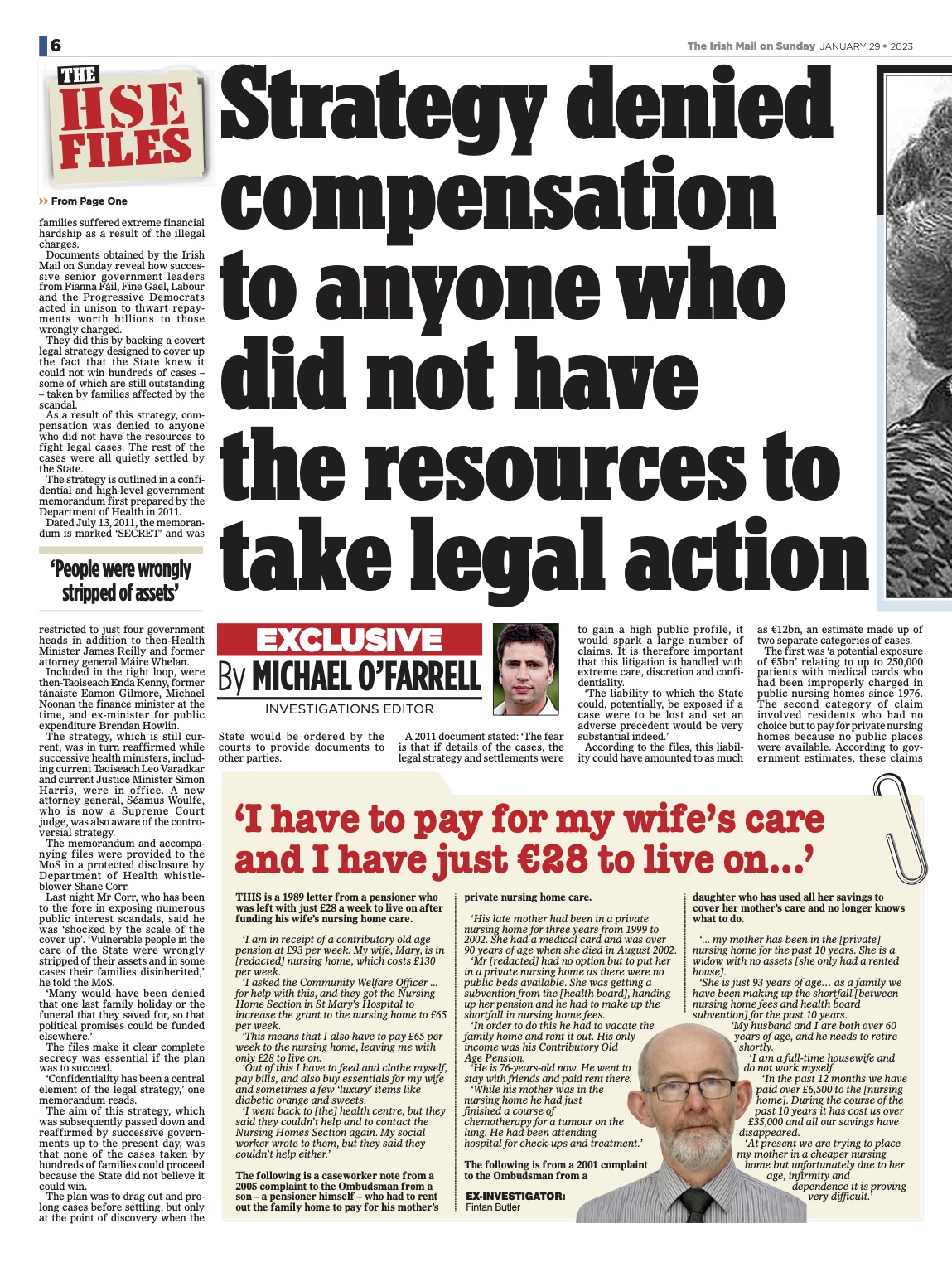
Leaked documents obtained by the Irish Mail on Sunday show the Government has known that legislation – under which only those under 16 with a mental illness are entitled to free medication – is discriminatory and legally unsound for more than a decade.

The revelation will heap further pressure on the Coalition, which has come under fire in recent weeks after this newspaper uncovered details of a secret legal strategy to block nursing home fee refunds for people who paid for private beds when no public beds were available.

Documents provided to the MoS in a protected disclosure from Department of Health whistleblower Shane Corr reveal the office of the former Attorney General (now Court of Appeal judge) Máire Whelan, warned the Government as far back as 2012 that sections of the legislation governing the entitlement of free medication were ‘ultra vires’, meaning they were ‘beyond the powers’ granted to the Government by law.


The flawed legislation remains in place today, meaning thousands of citizens have been – and are being – denied free access to drugs and medication to which they are legally entitled.

Other parts of the defective legislation were secretly corrected when it came to light in 2012 by quietly, and without debate, tacking on an amendment to an unrelated health bill.

When pressed on the matter, a spokesman for Taoiseach Leo Varadkar last night claimed the Government was concerned that changing the flawed legislation preventing those over 16 being provided with free medication ‘could jeopardise the entire existence [of the scheme] if found ultra vires [invalid].’

The spokesman said: ‘Patients with LTI (Long-Term Illness) cards could then lose access to free medication if it were found their entitlement was not and had not been legally sound.’

However, Mr Corr last night accused the State of keeping ‘this issue under the carpet for a decade, denying entitlement to untold thousands’.

Mr Corr added: ‘It now needs to deal with this ongoing issue by correcting failures and compensating those who lost out.’

The latest disclosures involve Government decisions that were made as the Department of Health was aggressively implementing its secret strategy to limit payouts to families that were illegally overcharged nursing home fees.

In April 2012, the attorney general provided a detailed briefing to the secretary general of the Department of Health in which she outlined serious concerns about the legal basis for the legislation governing free medication.

This was just a month after former Taoiseach Enda Kenny and a handful of his senior Cabinet ministers were given an update on the State’s controversial legal approach to the nursing home payouts.


In her briefing to the department chief, the attorney general expressed concern over anomalies in the LTI Scheme, which came into effect in 1971.

The legal basis for the LTI scheme is underlined in Section 59(3) of the 1970 Health Act. This authorised the then health minister, Erskine Childers, to identify illnesses that would qualify for free medicine under the scheme.

Mr Childers signed off on regulations that listed 16 illnesses, including diabetes, epilepsy, spina bifida and ‘mental illness’. Uniquely among the listed illnesses, the regulations limited the entitlement of those suffering from ‘mental illness’ to those aged under 16.

The scheme operated for more than 40 years until 2012, when officials at the Department of Health sought legal advice from the attorney general.

This appears to have been prompted by an Ombudsman investigation at the time into a successful complaint from a member of the public with ADHD [attention deficit hyperactivity disorder] who had been excluded from the scheme.

After examining the legislation, the Attorney General found that two parts of the scheme had been operating without a proper legal basis.

Firstly, Ms Whelan’s office advised that limiting the ‘mental illness’ benefit to those under 16 had no legal basis following the passing of the Equal Status Act in 2000 and was discriminatory.

The other anomaly was an inference in the 1970 Act that anyone who qualified for free medication was entitled to drugs for all types of conditions.

Addressing the age limitation of the mental illness benefit, the Government’s top lawyer warned the department: ‘Either the limitation in the regulation should be deleted or primary legislation amended.’

At the time the Government was faced with two options; to remove the ‘mental illness’ category from the LTI scheme, which would have resulted in those under 16 losing their entitlement, or to include older teenagers and adults.

However, the latter option would have cost the State more money and risked exposing the Government to awkward questions about why those over 16 were excluded in the first place.

Ultimately, the Department of Health did neither, even after the attorney general’s office warned that a failure to act risked a misfeasance finding, a civil wrongdoing by public officials or State entities who fail to discharge their public obligations.

The attorney general’s 2012 legal advice states: ‘It should be noted that once the Department has received legal advice to the effect that there is a question mark over Section 59(3) and that there is a risk of finding that it may be ultra vires, it is incumbent upon the Department to take steps to either terminate the practice- or amend the legislation as soon as possible.’

Despite the warning, the Government did not amend this part of the legislation, which remains in place.

And since 2012, whenever successive health ministers have received parliamentary questions from TDs representing constituents who queried the age restriction, they issued the same stock answer.

In their responses, the ministers referred back to the 1970 Health Act and the flawed 1971 regulations, which the Department knows have been deemed ‘ultra vires’, or invalid, by the attorney general’s office and say the Health Service Executive (HSE) has no choice but to comply with the law.


The failure to act for a full decade after the 2012 legal warning has cost millions in refunds to those who were excluded from the LTI scheme on age grounds.

In contrast with its failure to act on the illegal age restrictions, the Department of Health moved to deal with the attorney general’s concerns that those on the LTI scheme may have been entitled to all medicines for free, rather than just those relating to their condition.

The attorney general warned that, in the event of a court challenge, the legislation was unlikely to stand up to scrutiny. To resolve this, the Government quietly added a provision into a largely unrelated Bill that was scheduled to pass through the Oireachtas.

This provision amended the 1970 Health Act to stipulate that only those medicines related to the LTI scheme’s listed illnesses would be covered.

The real intent of this measure was not announced by the Government, and the significance of the change went unnoticed as the legislation was debated and eventually became law in 2013.

Since the statute of limitations – the six-year period within which a case can be taken – has now passed, this cannot now be challenged in the courts. This week, the MoS asked the Department of Health what action it will now take to address its failures. We also asked how many people have had their entitlements denied and to what cost?

In response, a spokesperson said its Sláintecare reform programme was reviewing how, ‘current eligibility and entitlement policies – align with population needs.’

The department also said the medical cards scheme and the Drugs Payment Scheme meant no citizen had to pay more than €80 a month for medicine.

However, the department said it could not speak about the latest revelations for legal reasons.


Share This:

VARADKAR’S PLAN TO CUT HEP C PAYMENTS

WHEN Leo Varadkar was health minister in 2015 he brought a memo to Cabinet proposing to secretly remove redress entitlements of family members affected by the hepatitis C scandal.

The revelation – contained in leaked confidential documents obtained by the Irish Mail on Sunday – will heap further pressure on the Taoiseach as the Government comes under fire over its continuing litigation strategy that pits the firepower of the State against some of its most vulnerable citizens.

According to a leaked Government document, Mr Varadkar proposed making savings of between €260m and €1bn from a draft law that would have made a series of cuts to Hepatitis C compensation measures in May 2015 when he was minister for health.

Six months earlier, in November 2014, Mr Varadkar told the Irish Times that his department had no plans to make any changes to the Hepatitis C Compensation scheme.

The proposed cuts outlined in the May 2015 memo involved legislative changes to limit various entitlements and to exclude dependent relatives of those infected completely from the scheme in the future.

To ensure that news of the planned measures did not spark a new wave of claims from dependants, the Memorandum for Government stressed the proposal must remain secret until the Bill was published – and then proposed that the publication date of the Bill would be the new deadline for receipt of claims.

It states: ‘The Minister for Health considers it important that the drafting of the legislation remains secret to protect the financial interests of the State.’

Echoing the controversial litigation strategy pursued by the State to limit refunds to people who were illegally charged nursing home fees – first revealed by the MoS last week – the document warns: ‘Public knowledge of possible changes to the compensation arrangements could encourage early compensation claims.’

Ultimately, however, the plans did not proceed, and the terms of the compensation tribunal remain unaffected.


The latest revelations come as the current Attorney General prepares a report on the State’s continuing controversial litigation strategy for the Cabinet on Tuesday. The issue will also be debated in the Dáil.

Senior Cabinet sources who spoke to the MoS about the deepening controversy this weekend said Government leaders plan to ‘tough it out’ in the hope public anger will dissipate with time.

Explaining the thinking, one minister said: ‘The issue does not have a public face. Cervical cancer had Vicki Phelan. Hepatitis C had Brigid McCole.

‘This does not have a public face that can be put on the Six One News,’ they said.

Another senior Government source added: ‘It is not pretty, it looks terrible but the plan is to hang tough and see it out. The public will forget.’

However, these sources were speaking without knowledge of the latest revelation.

The Taoiseach has defended the approach to litigation aimed at limiting the State’s potential liability on private nursing home charges, describing it as, ‘a legitimate legal strategy by the Government’.

However, Department of Health whistleblower Shane Corr – whose protected disclosures to the MoS have lifted the lid on the State’s legal strategy – has challenged the Government to explain why none of the private home care litigation cases ever came to court.

Instead, these cases were all settled at the point of discovery, when the State would have been obliged to hand over documents. ‘This comes down to the issue of discovery. What were they afraid of in discovery?’ Mr Corr asked.

Mr Corr was speaking after it emerged on Friday that two members of the current Cabinet, Simon Harris and Helen McEntee, gave the green light to the continued ‘deny, delay, and settle before discovery’ strategy following a review in 2017.

Separate documents show the State’s legal strategy was founded on a distinct fear that ‘a number of problematic documents’ relating to the 1993 nursing home subvention could be released under any discovery order that might be granted by a court.

Another leaked document shows how a desperate Department of Health agreed to offer nearly 100% of a claim in a contested case because it had missed a discovery deadline.

In response to queries from the MoS, a spokesman for the Taoiseach this weekend confirmed Mr Varadkar’s proposal to change the terms of the Hepatitis C and HIV Compensation Tribunal was considered by Cabinet members at the time.


The spokesman stressed the proposal was ‘considered in 2014 and 2015 when health budgets were being cut due to the deep recession the country was enduring at the time’.

They added: ‘Ireland was in a bailout, the IMF was monitoring public finances and very difficult decisions were being taken monthly.

‘The then Minister for Health had a duty to consider all options for savings that would not adversely affect patients in need of medical care.

‘This was one of those decisions. It would have not affected the entitlement to compensation of anyone infected with Hepatitis C or HIV.’

Mr Varadkar’s spokesman said resources at the time ‘were focused on patients, including the provision of direct-acting anti-viral drugs for Hepatitis C patients with the greatest clinical need, such as the life-saving Sovaldi medication’.

He added: ‘The Minister ultimately decided not to proceed with the proposal. He discussed it with senior Cabinet colleagues who agreed with him that the proposal should not proceed and there was no Cabinet decision.’

Ireland exited the three-year IMF bailout programme on December 15, 2013.

The Department of Health’s budget was not cut in 2014 or in 2015.

Conversely, the expenditure on health rose from €13.4bn in 2013, to €13.7bn in 2014, to 14.3bn in 2015, according to Government figures.

Asked about the secret nature of the proposal to make the date of the publication of the Bill the final deadline for accepting compensation claims for Hepatitis C families, a Department of Health spokesman said that it was ‘normal practice’ for Government memos ‘to be prepared on a confidential/ secret basis’.`


Share This:

Secret plan to block refunds as repayment of illegal nursing home charges hindered by State

Successive taoisigh and health ministers – including current Cabinet members – agreed a secret plan to hide the true scale of the State’s liability for illegal nursing home charges to prevent massive payouts, confidential Government records reveal.

The top-secret files confirm the State faced the prospect of a €12bn liability in compensation for hundreds of thousands of families who were wrongly charged for the care of their loved ones over a 30-year period. In many cases, vulnerable families suffered extreme financial hardship as a result of the illegal charges.

Documents obtained reveal how successive senior government leaders from Fianna Fáil, Fine Gael, Labour and the Progressive Democrats acted in unison to thwart repayments worth billions to those wrongly charged.

They did this by backing a covert legal strategy designed to cover up the fact that the State knew it could not win hundreds of cases – some of which are still outstanding – taken by families affected by the scandal.

As a result of this strategy, compensation was denied to anyone who did not have the resources to fight legal cases. The rest of the cases were all quietly settled by the State.

The strategy is outlined in a confidential and high-level government memorandum first prepared by the Department of Health in 2011.

Dated July 13, 2011, the memorandum is marked ‘SECRET’ and was restricted to just four government heads in addition to then-Health Minister James Reilly and former attorney general Máire Whelan.

Included in the tight loop, were then-Taoiseach Enda Kenny, former tánaiste Eamon Gilmore, Michael Noonan the finance minister at the time, and ex-minister for public expenditure Brendan Howlin.

The strategy, which is still current, was in turn reaffirmed while successive health ministers, including current Taoiseach Leo Varadkar and current Justice Minister Simon Harris, were in office. A new attorney general, Séamus Woulfe, who is now a Supreme Court judge, was also aware of the controversial strategy.

The memorandum and accompanying files were provided in a protected disclosure by Department of Health whistleblower Shane Corr.

On Saturday Mr Corr, who has been to the fore in exposing numerous public interest scandals, said he was ‘shocked by the scale of the cover up’. ‘Vulnerable people in the care of the State were wrongly stripped of their assets and in some cases their families disinherited,’ he said.

The memorandum and accompanying files were provided in a protected disclosure by Department of Health whistleblower Shane Corr. Pic: RTE

‘Many would have been denied that one last family holiday or the funeral that they saved for, so that political promises could be funded elsewhere.’

The files make it clear complete secrecy was essential if the plan was to succeed.

‘Confidentiality has been a central element of the legal strategy,’ one memorandum reads.

The aim of this strategy, which was subsequently passed down and reaffirmed by successive governments up to the present day, was that none of the cases taken by hundreds of families could proceed because the State did not believe it could win.

The plan was to drag out and prolong cases before settling, but only at the point of discovery when the State would be ordered by the courts to provide documents to other parties.

A 2011 document stated: ‘The fear is that if details of the cases, the legal strategy and settlements were to gain a high public profile, it would spark a large number of claims. It is therefore important that this litigation is handled with extreme care, discretion and confidentiality.

‘The liability to which the State could, potentially, be exposed if a case were to be lost and set an adverse precedent would be very substantial indeed.’

According to the files, this liability could have amounted to as much as €12bn, an estimate made up of two separate categories of cases.

The first was ‘a potential exposure of €5bn’ relating to up to 250,000 patients with medical cards who had been improperly charged in public nursing homes since 1976.

The second category of claim involved residents who had no choice but to pay for private nursing homes because no public places were available. According to government estimates, these claims represented ‘a potential exposure of approximately €7bn in respect of existing and potential private cases’.

Several examples of both categories of cases have been documented in more than 1,000 complaints to the Ombudsman over the years.

In 2010, the Ombudsman published a report entitled ‘Who Cares?’ into the illegal charging scandal. The report reads: ‘We now know that the department and the health boards were in no real doubt as to what the law provided and that they persisted with an illegal charging regime because of, amongst other things, the need to maintain an important source of funding.’

The report goes on to conclude that the ‘State agencies concerned have displayed intransigence, lack of transparency and accountability as well as a very poor sense of the public interest’.

‘At the administrative and institutional level, the continuation over such a long period of such unacceptable practices suggests inflexibility, non-responsiveness and a reluctance to face reality. It also suggests, at times, a disregard for the law.’

According to the files obtained by the MoS, the government agreed its secret containment strategy just a year after the critical Ombudsman report. They also reveal how the government ensured the cost of any settlements – and the size of the potential liability it faced – would not be publicly reported by its spending watchdog. To achieve this, agreement had to be reached with the Comptroller & Auditor General (C&AG). Any mention of the matter in C&AG reports to the Oireachtas could have alerted the wider public to the matter and results in a flood of new cases. ‘Ultimately it proved possible to agree a form of wording which complied with government accounting requirements without jeopardising the confidentiality of the State’s strategy in defending this litigation,’ the memorandum states.

Irish Mail on Sunday – January 29, 2023.

Further confidential files confirm successive administrations continued the containment policy, monitoring developments closely as some cases were quietly settled, while others were discontinued.

By 2012, a confidential briefing for Minister Reilly showed that, of the 510 cases launched against the State, just 340 remained active.

The document warned: ‘There has been a marked increase in activity levels relating to existing cases over recent months.’

It also reported: ‘The overall increase in activity gives rise to some concern regarding the possible emergence of further cases.’

In May 2016, as Leo Varadkar was succeeded by Simon Harris as health minister, a brief prepared within the Department of Health confirmed the number of live cases had dropped to 233, with none launched since 2013.

‘The number of cases each year has steadily decreased which would indicate that the litigation is being successfully managed,’ it reads.

The brief also confirms the government’s policy remained one of settling cases, at the point of discovery, for between 40% to 60% of the claim value. It also showed the Government was able to successfully have a number of cases discontinued by simply writing to the solicitors concerned with a request that the litigation be dropped.

In April 2017, a further update was provided for then-Health Minister Simon Harris and Helen McEntee who was minister of state for mental health and older people. At this point, 220 live cases remained unresolved and – with no new cases emerging – the strategy remained one of slowly settling.

‘Discovery would carry very significant risks and should therefore be avoided,’ the 2017 brief reads.

The document adds the original 2011 approach, ‘has to date been successful in resolving cases including 80 settlements [and 21 discontinuations] since 2013.’

By 2017 these settlements had reached at least €2.6m, the briefing reveals.


‘The current approach is working well… litigation is being managed successfully,’ it adds.

Fintan Butler, a former senior investigator for the Ombudsman’s office, said families who did not have recourse to legal resources were ignored as a result of the secret strategy.

Mr Butler said: ‘The consequence of the department’s strategy is that only those people who initiate legal action, and who have the patience and the resolve to pursue the case, will get any level of compensation.’

Before retiring, Mr Butler was centrally involved in investigating and compiling the 2010 Ombudsman’s report into the legal charges scandal. He was later an adviser to the European Ombudsman in Strasbourg from 2013 before he retired in October 2018.

He said: ‘Only a small minority of people, and their families, have the knowledge, the confidence and the legal support to initiate court action. The vast majority of the people adversely affected have not, and will not, take court action.  They will not get any compensation. Clearly, the department’s strategy of containment does work.’

Mr Butler added that the practice of secretly settling cases with public resources, ‘suggests a huge failure in governmental transparency and accountability’.

‘From the documents acquired by the Mail on Sunday, we now know that 80 cases were settled between 2013 and 2016 at a cost of €2.6m. But this kind of information is not being published. It seems that the Dáil and Seanad are not being informed… and that questions raised at Oireachtas committees are not answered.’ When contacted in relation to the State’s legal strategy, the Departments of the Taoiseach, Finance, Public Expenditure and Reform and the Office of the Attorney General all directed our queries to the Department of Health. The Department of Health said: ‘The department does not comment on matters pertaining to litigation.’


Political leaders condemned illegal nursing home charges — and then devised secret strategy

Enda Kenny and James Reilly were not unfamiliar with the hardship and suffering caused by the illegal long-stay charges issue when they received a top-secret Government memorandum on Wednesday, July 13, 2011.

The memorandum detailed the State’s secret strategy of dragging out cases for as long as possible before settling quietly.

The strategy was adopted because the State knew it could not win, and billions were at stake.

Details of this strategy may have been new to Mr Kenny and Mr Reilly in July 2011 – but it was not the first time they had come across the litigation.

In fact both politicians, while previously in opposition, had railed against the possibility of the State engaging in such a tactic.

Just eight months prior to receiving the secret memo, Fine Gael were in opposition when a landmark report into the issue was published.

The ‘Who Cares?’ report by then Ombudsman Emily O’Reilly was based on more than 1,200 complaints spanning decades. During her investigation, the Ombudsman clashed with then health minister Mary Harney as her department refused to allow sight of the litigation details.

The Ombudsman’s report in November 2010, directly questioned the State’s motivation in defending hundreds of cases taken by families from whom money had been illegally taken.

The Ombudsman also noticed cases seemed to be inevitably settled just at the point of discovery. ‘The question certainly arises as to whether the State side becomes amenable to settlement in situations in which an order of discovery has become likely,’ the report states.

It also pointed out that, if indeed this was the case, it would be an unjustifiable repeat of the behaviour of the health boards – with the backing of the Department of Health – for decades.

‘The practice then was to ensure no case actually came to hearing before the courts thus avoiding a judgment which would have wider implications,’ the Ombudsman wrote.

‘In effect, the practice then was one of “buying off” the individual patient, by way of a settlement, while continuing with the practice generally.’

In opposition at the time, Mr Reilly was sufficiently concerned about the State’s behaviour to table a Dáil motion to discuss the Ombudsman’s report.

He told the Dáil at the time: ‘Knowing what one’s entitlements from the State are – and being able to count on being given one’s entitlements – is a basic right, a right that is more important in the case of vulnerable groups such as older people.


‘Fine Gael believes the law should be clear and that the State agencies should implement the law as it is, rather than as they would wish it to be… if resources to meet statutory duties are not available, the legislation should be amended to reflect practice.’

Mr Reilly also addressed the litigation being taken by those seeking their rights.

‘At present, the State is defending in the High Court more than 300 legal actions taken by or on behalf of people who claim that their right to long-stay nursing home care has not been honoured,’ he told the Dáil. ‘To date, none of these cases has gone to hearing and judgment in the High Court.

‘The Ombudsman points out that this is surprising since many of the cases were commenced more than five years ago.’

Mr Reilly then raised a vital question: ‘Why, if the State maintained the cases had no merit, were they being settled? One can only wonder why, in these circumstances, the State is paying public money to people whose claims it believes to be without foundation,’ he asked Ms Harney.

‘Fine Gael believes the minister must clearly point out why and on what basis these cases were settled. Does the State consider that settling individual cases by way of compensation is less costly than the case going to a hearing in court? What about the hundreds of outstanding cases?’

Eight months later, now on the other side of the fence in government, Mr Reilly got his answer – and quickly changed his tune. Enda Kenny underwent a similar conversion. He too, in opposition, had been damning of the Fianna Fáil/Progressive Democrats’ handling of the legal cases. In February 2006, he told the Dáil that the government could not have it both ways – by privately defending cases for compensation before the courts, while publicly moving to legislate to make the previously unauthorised charges legal. At the time, Mr Kenny accused the Government of engaging in a ‘dishonest defence’.

‘In that defence, the Tánaiste [Ms Harney] and her co-defendants deny any liability,’ he said. ‘They deny the illegality of charges and deny that monies were taken. They deny the entitlement to restitution.’ But once in office – and privy to the secret strategy – he backed the approach, as successive governments have done since.

Several more Fine Gael TDs also took part in the debate that day. Fine Gael TD Seymour Crawford told the house: ‘I will never forget the case in which a relatively young woman in her early 70s and her more elderly husband, both diagnosed with Alzheimer’s disease, had to be put into a private nursing home as no other accommodation was made available for them.

Irish Mail on Sunday – January 29, 2023.

‘All their family members were married with their own family structures to maintain, leaving them in an extremely difficult position as the cost of care came to €900 a week for each parent.’

And he spoke of a ‘close friend’ who was placed by the health authorities in a private nursing home ‘because no other bed was available’. ‘Her old-age pension was part of the funding to that home. Her neighbour who went into a public nursing home later, however, received a refund under the refund scheme. No wonder there are legal cases,’ he added.

Cork Fine Gael TD, Michael Creed, also spoke: ‘Insofar as we on this side of the house may have been implicated in the denial of those rights, I wish to apologise personally to people who were adversely affected. The Ombudsman’s report clearly states that there was a denial of entitlement.’

Mayo TD Michael Ring spoke out on behalf of the people who, he said, had been ‘badly let down’ by the State. ‘People have been hard done by and there are many cases in the Four Courts awaiting adjudication. I cannot understand why these have not been adjudicated on by now. Some cases have been settled and we should know what ones have been settled and why. Many feel injustice was done.’

However, perhaps the best summation delivered in the Dáil over the years came from Ms Harney. It was delivered in 2005 – five years before she clashed with the Ombudsman and refused to supply details about settlements in longstay cases.

‘Over 300,000 people were charged illegally during 28 years,’ she said.

‘This was entirely wrong. They were old, they were poor, they suffered from mental illness, they had intellectual disabilities, they were physically disabled. As vulnerable people, they were especially entitled to the protection of the law and to legal clarity about their situation… We are a society ruled by law. No one and no organisation can dispense with or alter a law.

‘If one long-term bed occupant had a lawyer who could help him or her to take a case, he or she would no longer be charged while somebody not so fortunate in the bed beside him or her was charged in all those years,’ she told her fellow TDs.

‘Besides the legal issues involved here, there are significant inequality issues that are unacceptable.’


Irish Daily Mail – January 31, 2023.

Timeline of State’s 50-year care-charging scandal

  • 1970 The Health Act 1970 is passed, entitling all to free long-stay care services in public institutions.
  • 1975 A High Court judgment finds a patient had been unjustly charged. This prompts the Department of Health to consider ways of maintaining charges as an important source of income.
  • 1976 The Department makes new ministerial regulations, and issues circular to health boards telling them they
  • REPORT: Former Ombudsman O’Reilly can continue to charge.
  • 1978 The Eastern Health Board provides the Department with legal opinions showing that the charges are not legally sound. The Department continues to advise health boards to settle out of court when individuals challenge charges. This becomes the default position for decades.
  • 1979 The legal adviser to the Department again expresses the view that charges are not legally sound and new legislation will be required. His advice is ignored.
  • 1982 A Department review finds there is ‘no legal basis’ for charges. No action is taken.
  • 1987 The Fianna Fáil government drafts a Bill which would have made charges legal. The proposed law is dropped.
  • 1989 The Commission on Health Funding urges that the law be revised. No such change occurs.
  • 1991 Minister for Health, Mary O’Rourke, announces a review of charges which recommends new legislation to achieve legal clarity regarding charges. Nothing happens.
  • 1994 Health minister Brendan Howlin publishes a new health strategy which recognises the longstay charges legislation as ‘inadequate’. New legislation is promised. This does not materialise.
  • 2001 The Ombudsman highlights how successive governments have failed to rectify the basis for illegal charges. Health Minister Micheál Martin extends free medical cards by legislation to all over-70s. Because more people are now entitled to free care – and because illegal charges continue regardless – this exacerbates the problem.
  • 2002 The South Eastern Health Board, facing a number of cases, forwards legal advice from senior counsel to the effect that charges remain unjustifiable. A draft Bill to address the issue is prepared but does not proceed.
  • 2003 A Human Rights Commission report once again details the inadequate legal grounds upon which charges are being levied.
  • 2004 Mary Harney becomes health minister and requests advice from the attorney general about the validity of charges. She then quickly passes a Bill to retrospectively make the historical charges legal, thereby preventing anyone from suing for recompense. President Mary McAleese refuses to sign the Bill which is referred to the Supreme Court.
  • 2005 The Supreme Court rules that people who had paid unlawful charges – or their descendants – were entitled to recover monies. A report into the charging scandal, commissioned by Mary Harney, is published.
  • The report highlights ‘systemic corporate failure within the Department of Health for almost 30 years’.
  • 2006 The Health Repayment Scheme is established to compensate those medical card patients still living and the estates of those who had died on or after December 9, 1988.
  • Patients forced into funding their own private care for the lack of a public place were also excluded.
  • Hundreds of thousands of families affected are excluded by these limitations as €477m is paid out to 20,000 families.
  • 2009 The Fair Deal Scheme – which finally put charges on a legal basis – becomes law.
  • 2010 Hundreds of families, excluded from the compensation scheme, seek to sue the State.
  • Ombudsman Emily O’Reilly publishes a damning report based on more than 1,000 complaints from those improperly charged.
  • 2011 Faced with a potential liability of €12bn, new Health Minister James Reilly circulates a top secret memorandum.
  • Based on advice from
  • Attorney General Máire Whelan, the government, knowing it cannot win any case, adopts a confidential containment policy of secretly settling cases to prevent more claimants coming forward. The policy is successful and cases begin to dwindle.
  • 2016 The secret strategy continues as Health Minister Leo Varadkar is replaced by Simon Harris.
  • 2017 Health minister Simon Harris and Junior Health Minister Helen McEntee receive a confidential update. With no new cases emerging, the containment strategy is reaffirmed again. ‘The current approach is working well…litigation is being managed successfully,’ the brief reads.

FURTHER COVERAGE;


Irish Daily Mail – February 4, 2023.


Irish Mail on Sunday – February 5, 2023.


5, 2023.Irish Mail on Sunday – February


Irish Mail on Sunday – February 12, 2023.

Irish Mail on Sunday – February 12, 2023.

Share This: