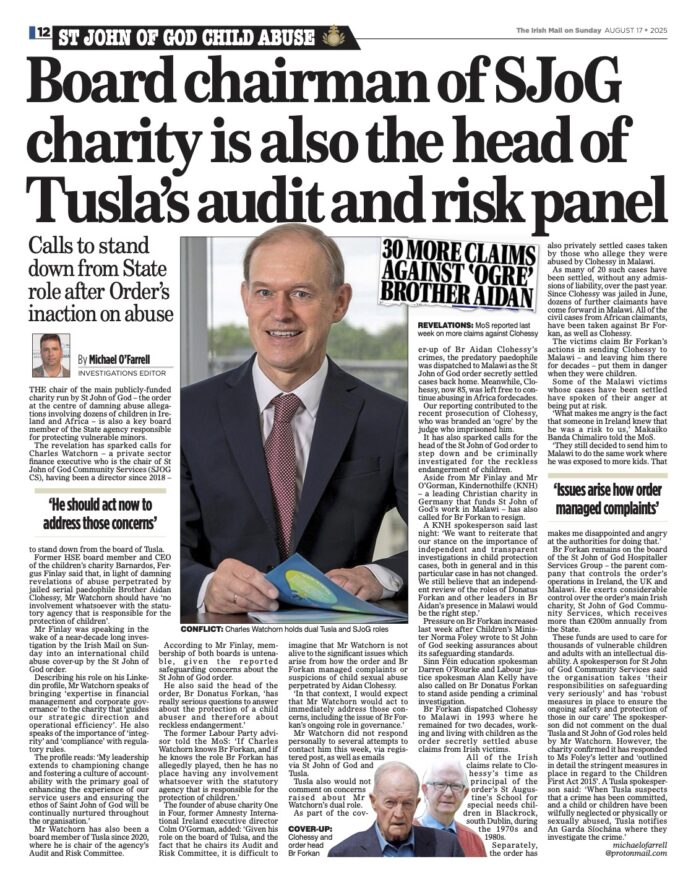
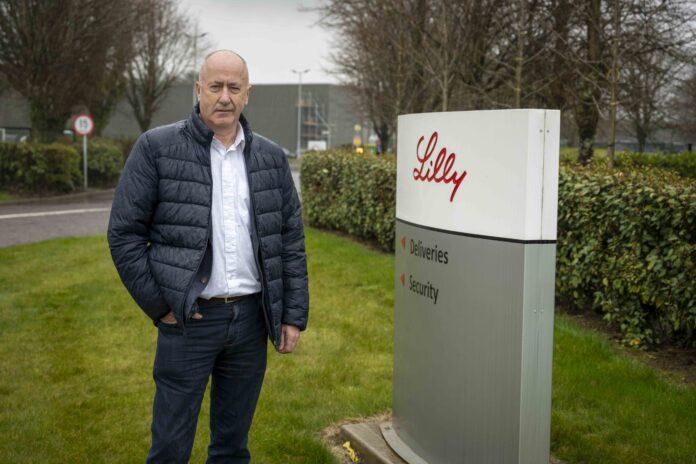
THE chair of the main publicly-funded charity run by St John of God – the order at the centre of damning abuse allegations involving dozens of children in Ireland and Africa – is also a key board member of the State agency responsible for protecting vulnerable minors.
The revelation has sparked calls for Charles Watchorn – a private sector finance executive who is the chair of St John of God Community Services (SJOG CS), having been a director since 2018 – to stand down from the board of Tusla.
Former HSE board member and CEO of the children’s charity Barnardos, Fergus Finlay said that, in light of damning revelations of abuse perpetrated by jailed serial paedophile Brother Aidan Clohessy, Mr Watchorn should have ‘no involvement whatsoever with the statutory agency that is responsible for the protection of children’.
Mr Finlay was speaking in the wake of a near-decade long investigation by the Irish Mail on Sunday into an international child abuse cover-up by the St John of God order.
Describing his role on his Linkedin profile, Mr Watchorn speaks of bringing ‘expertise in financial management and corporate governance’ to the charity that ‘guides our strategic direction and operational efficiency’. He also speaks of the importance of ‘integrity’ and ‘compliance’ with regulatory rules.
The profile reads: ‘My leadership extends to championing change and fostering a culture of accountability with the primary goal of enhancing the experience of our service users and ensuring the ethos of Saint John of God will be continually nurtured throughout the organisation.’
Mr Watchorn has also been a board member of Tusla since 2020, where he is chair of the agency’s Audit and Risk Committee.
According to Mr Finlay, membership of both boards is untenable, given the reported safeguarding concerns about the St John of God order.
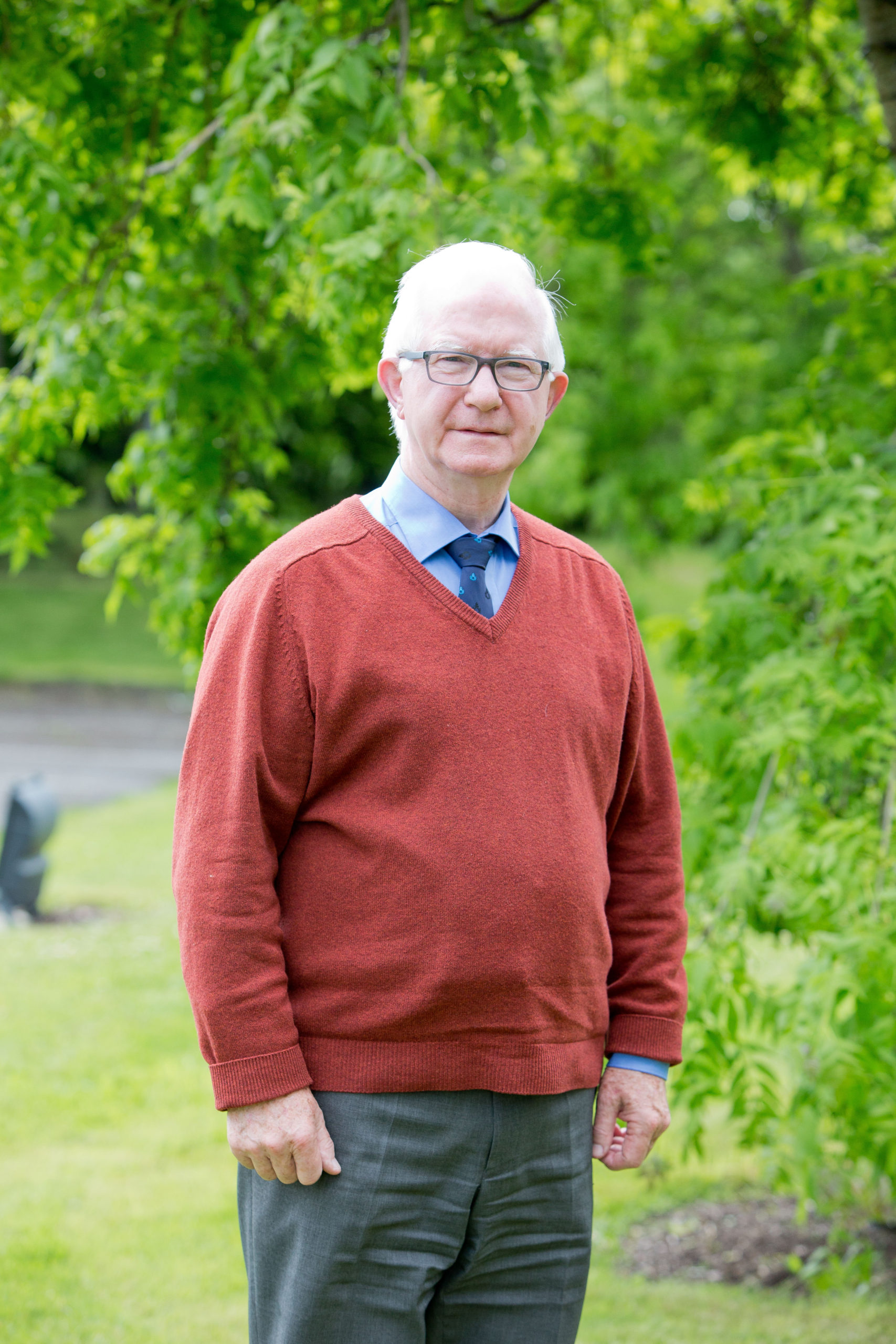
He also said the head of the order, Br Donatus Forkan, ‘has really serious questions to answer about the protection of a child abuser and therefore about reckless endangerment.’
Brother Donatus Forkan, St John of God Provincial in Dublin in 2016. (Photo Tom Honan)
The former Labour Party advisor told the MoS: ‘If Charles Watchorn knows Br Forkan, and if he knows the role Br Forkan has allegedly played, then he has no place having any involvement whatsoever with the statutory agency that is responsible for the protection of children.’
The founder of abuse charity One in Four, former Amnesty International Ireland executive director Colm O’Gorman, added: ‘Given his role on the board of Tulsa, and the fact that he chairs its Audit and Risk Committee, it is difficult to imagine that Mr Watchorn is not alive to the significant issues which arise from how the order and Br Forkan managed complaints or suspicions of child sexual abuse perpetrated by Aidan Clohessy.
‘In that context, I would expect that Mr Watchorn would act to immediately address those concerns, including the issue of Br Forkan’s ongoing role in governance.’
Mr Watchorn did not respond personally to several attempts to contact him this week, via registered post, as well as emails via St John of God and Tusla.
Tusla also would not comment on concerns raised about Mr Watchorn’s dual role.
As part of the cover-up of Br Aidan Clohessy’s crimes, the predatory paedophile was dispatched to Malawi as the St John of God order secretly settled cases back home. Meanwhile, Clohessy, now 85, was left free to continue abusing in Africa fordecades.
Our reporting contributed to the recent prosecution of Clohessy, who was branded an ‘ogre’ by the judge who imprisoned him.
It has also sparked calls for the head of the St John of God order to step down and be criminally investigated for the reckless endangerment of children.
Aside from Mr Finlay and Mr O’Gorman, Kindernothilfe (KNH) – a leading Christian charity in Germany that funds St John of God’s work in Malawi – has also called for Br Forkan to resign.
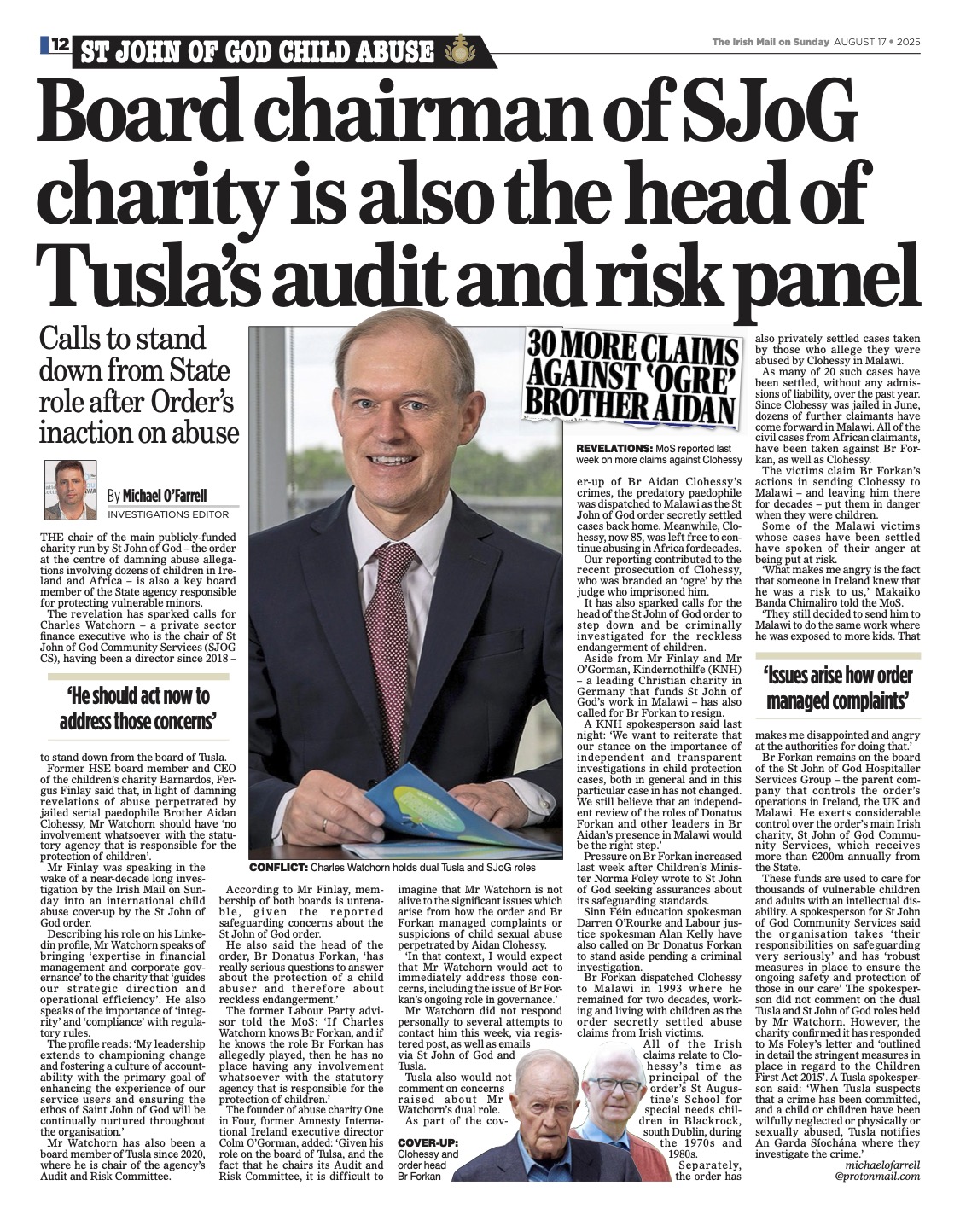
The Irish Mail on Sunday – August 17, 2025.
A KNH spokesperson said last night: ‘We want to reiterate that our stance on the importance of independent and transparent investigations in child protection cases, both in general and in this particular case in has not changed. We still believe that an independent review of the roles of Donatus Forkan and other leaders in Br Aidan’s presence in Malawi would be the right step.’
Pressure on Br Forkan increased last week after Children’s Minister Norma Foley wrote to St John of God seeking assurances about its safeguarding standards.
Sinn Féin education spokesman Darren O’Rourke and Labour justice spokesman Alan Kelly have also called on Br Donatus Forkan to stand aside pending a criminal investigation.
Br Forkan dispatched Clohessy to Malawi in 1993 where he remained for two decades, working and living with children as the order secretly settled abuse claims from Irish victims.
All of the Irish claims relate to Clohessy’s time as principal of the order’s St Augustine’s School for special needs children in Blackrock, south Dublin, during the 1970s and 1980s.
Separately, the order has also privately settled cases taken by those who allege they were abused by Clohessy in Malawi.
As many of 20 such cases have been settled, without any admissions of liability, over the past year. Since Clohessy was jailed in June, dozens of further claimants have come forward in Malawi. All of the civil cases from African claimants, have been taken against Br Forkan, as well as Clohessy.
The victims claim Br Forkan’s actions in sending Clohessy to Malawi – and leaving him there for decades – put them in danger when they were children.
Some of the Malawi victims whose cases have been settled have spoken of their anger at being put at risk.
‘What makes me angry is the fact that someone in Ireland knew that he was a risk to us,’ Makaiko Banda Chimaliro told the MoS.
‘They still decided to send him to Malawi to do the same work where he was exposed to more kids. That makes me disappointed and angry at the authorities for doing that.’
Br Forkan remains on the board of the St John of God Hospitaller Services Group – the parent company that controls the order’s operations in Ireland, the UK and Malawi. He exerts considerable control over the order’s main Irish charity, St John of God Community Services, which receives more than €200m annually from the State.
These funds are used to care for thousands of vulnerable children and adults with an intellectual disability.
A spokesperson for St John of God Community Services said the organisation takes ‘their responsibilities on safeguarding very seriously’ and has ‘robust measures in place to ensure the ongoing safety and protection of those in our care’
The spokesperson did not comment on the dual Tusla and St John of God roles held by Mr Watchorn. However, the charity confirmed it has responded to Ms Foley’s letter and ‘outlined in detail the stringent measures in place in regard to the Children First Act 2015’.
A Tusla spokesperson said: ‘When Tusla suspects that a crime has been committed, and a child or children have been wilfully neglected or physically or sexually abused, Tusla notifies An Garda Síochána where they investigate the crime.’
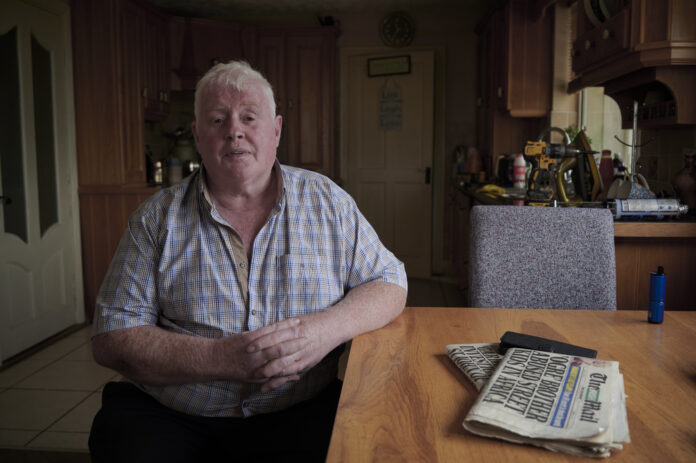
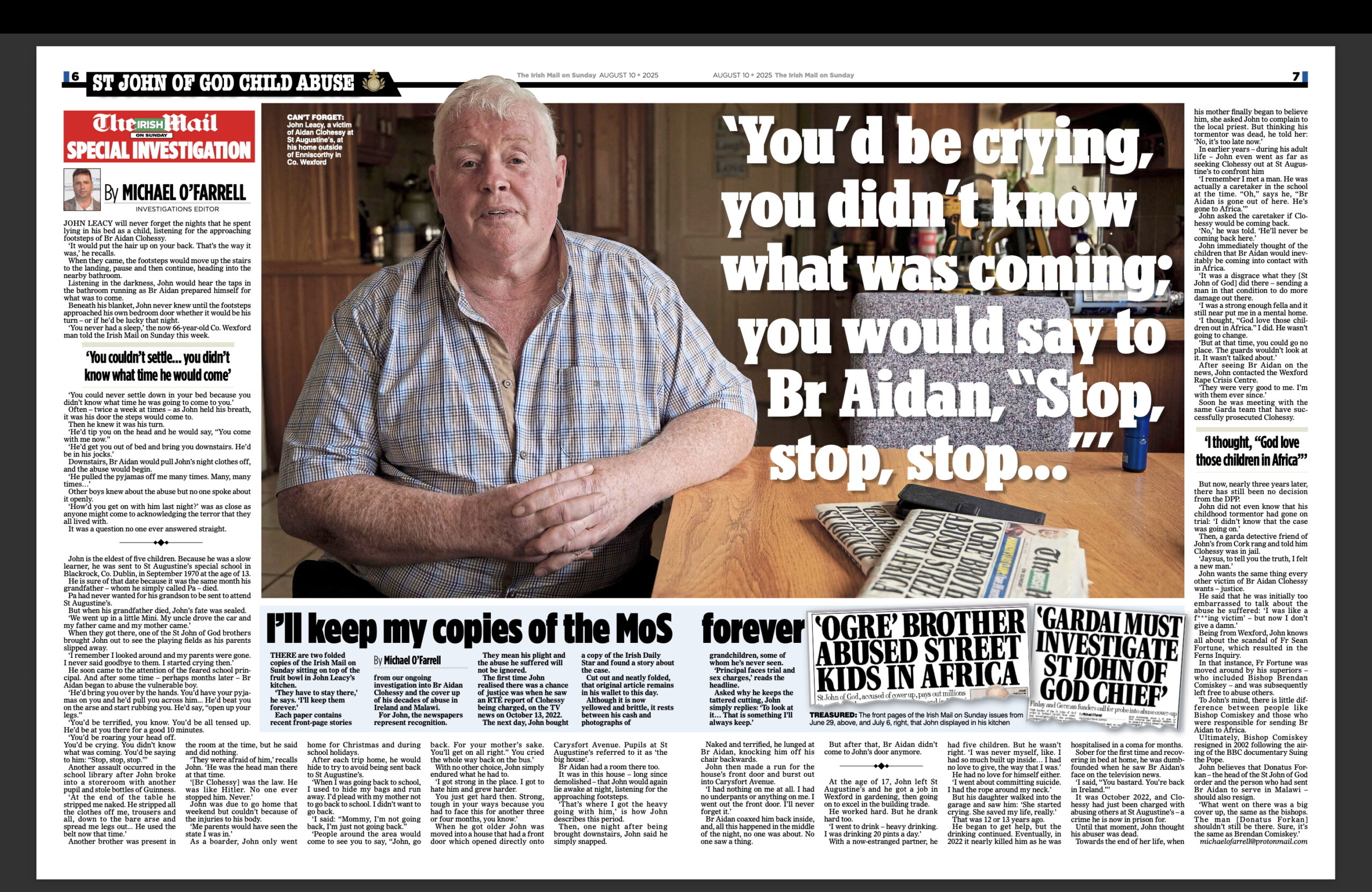
John Leacy at his home near Enniscorthy, Co. Wexford. (Photo Sean Dwyer)
JOHN LEACY will never forget the nights that he spent lying in his bed as a child, listening for the approaching footsteps of Br Aidan Clohessy.
‘It would put the hair up on your back. That’s the way it was,’ he recalls.
When they came, the footsteps would move up the stairs to the landing, pause and then continue, heading into the nearby bathroom.
Listening in the darkness, John would hear the taps in the bathroom running as Br Aidan prepared himself for what was to come.
Beneath his blanket, John never knew until the footsteps approached his own bedroom door whether it would be his turn – or if he’d be lucky that night.
‘You never had a sleep,’ the now 66-year-old Co. Wexford man told the Irish Mail on Sunday this week.
‘You’d be roaring your head off and you’d be all tensed up’
‘You could never settle down in your bed because you didn’t know what time he was going to come to you.’
Often – twice a week at times – as John held his breath, it was his door the steps would come to.
Then he knew it was his turn. ‘He’d tip you on the head and he would say, “You come with me now.”
The Irish Mail On Sunday – August 10, 2025.
‘He’d get you out of bed and bring you downstairs. He’d be in his jocks.’
Downstairs, Br Aidan would pull John’s night clothes off, and the abuse would begin.
‘He pulled the pyjamas off me many times. Many, many times’
Other boys knew about the abuse but no one spoke about it openly.
‘How’d you get on with him last night?’ was as close as anyone might come to acknowledging the terror that they all lived with.
It was a question no one ever answered straight. John is the eldest of five children. Because he was a slow learner, he was sent to St Augustine’s special school in Blackrock, Co. Dublin, in September 1970 at the age of 13.
He is sure of that date because it was the same month his grandfather – whom he simply called Pa – died.
Pa had never wanted for his grandson to be sent to attend St Augustine’s.
But when his grandfather died, John’s fate was sealed. ‘We went up in a little Mini. My uncle drove the car and my father came and my mother came.’
When they got there, one of the St John of God brothers brought John out to see the playing fields as his parents slipped away.
‘I remember I looked around and my parents were gone. I never said goodbye to them. I started crying then.’
He soon came to the attention of the feared school principal. And after some time – perhaps months later – Br Aidan began to abuse the vulnerable boy.
‘He’d bring you over by the hands. You’d have your pyjamas on you and he’d pull you across him… He’d beat you on the arse and start rubbing you. He’d say, “open up your legs.”
‘You’d be terrified, you know. You’d be all tensed up. He’d be at you there for a good 10 minutes.
‘You’d be roaring your head off. You’d be crying. You didn’t know what was coming. You’d be saying to him: “Stop, stop, stop.”‘ Another assault occurred in the school library after John broke into a storeroom with another pupil and stole bottles of Guinness.
‘At the end of the table he stripped me naked. He stripped all the clothes off me, trousers and all, down to the bare arse and spread me legs out… He used the belt now that time.’
Another brother was present in the room at the time, but he said and did nothing.
‘They were afraid of him,’ recalls John. ‘He was the head man there at that time.
‘[Br Clohessy] was the law… No one ever stopped him. Never.’
John was due to go home that weekend but couldn’t because of the injuries to his body.
‘Me parents would have seen the state I was in.’
As a boarder, John only went home for Christmas and during school holidays.
After each trip home, he would hide to try to avoid being sent back to St Augustine’s.
‘When I was going back to school, I used to hide my bags and run away. I’d plead with my mother not to go back to school. I didn’t want to go back.
‘I said: “Mommy, I’m not going back, I’m just not going back.”
‘People around the area would come to see you to say, “John, go back. For your mother’s sake. You’ll get on all right.” You cried the whole way back on the bus.’
With no other choice, John simply endured what he had to.
‘I got strong in the place. I got to hate him and grew harder.
You just get hard then. Strong, tough in your ways because you had to face this for another three or four months, you know.’
When he got older John was moved into a house that had a front door which opened directly onto Carysfort Avenue. Pupils at St Augustine’s referred to it as ‘the big house’.
Br Aidan had a room there too. It was in this house – long since demolished – that John would again lie awake at night, listening for the approaching footsteps.
‘That’s where I got the heavy going with him,’ is how John describes this period.
Then, one night after being brought downstairs, John said he simply snapped.
Naked and terrified, he lunged at Br Aidan, knocking him off his chair backwards.
John then made a run for the house’s front door and burst out into Carysfort Avenue.
‘I had nothing on me at all. I had no underpants or anything on me. I went out the front door. I’ll never forget it.’
Br Aidan coaxed him back inside, and, all this happened in the middle of the night, no one was about. No one saw a thing.
But after that, Br Aidan didn’t come to John’s door anymore.
At the age of 17, John left St Augustine’s and he got a job in Wexford in gardening, then going on to excel in the building trade.
He worked hard. But he drank hard too.
‘I went to drink – heavy drinking. I was drinking 20 pints a day.’
With a now-estranged partner, he had five children. But he wasn’t right. ‘I was never myself, like. I had so much built up inside I had no love to give, the way that I was.’
He had no love for himself either. ‘I went about committing suicide. I had the rope around my neck.’
But his daughter walked into the garage and saw him: ‘She started crying. She saved my life, really.’
That was 12 or 13 years ago. He began to get help, but the drinking continued. Eventually, in 2022 it nearly killed him as he was hospitalised in a coma for months.
Sober for the first time and recovering in bed at home, he was dumbfounded when he saw Br Aidan’s face on the television news.
‘I said, “You bastard. You’re back in Ireland.”‘
It was October 2022, and Clohessy had just been charged with abusing others at St Augustine’s – a crime he is now in prison for.
Until that moment, John thought his abuser was dead.
Towards the end of her life, when his mother finally began to believe him, she asked John to complain to the local priest. But thinking his tormentor was dead, he told her: ‘No, it’s too late now.’
In earlier years – during his adult life – John even went as far as seeking Clohessy out at St Augustine’s to confront him ‘I remember I met a man. He was actually a caretaker in the school at the time. “Oh,” says he, “Br Aidan is gone out of here. He’s gone to Africa.”‘ John asked the caretaker if Clohessy would be coming back.
‘No,’ he was told. ‘He’ll never be coming back here.’
John immediately thought of the children that Br Aidan would inevitably be coming into contact with in Africa.
‘It was a disgrace what they [St John of God] did there – sending a man in that condition to do more damage out there.
‘I was a strong enough fella and it still near put me in a mental home.
‘I thought, “God love those children out in Africa.” I did. He wasn’t going to change.
‘But at that time, you could go no place. The guards wouldn’t look at it. It wasn’t talked about.’
After seeing Br Aidan on the news, John contacted the Wexford Rape Crisis Centre.
‘They were very good to me. I’m with them ever since.’
Soon he was meeting with the same Garda team that have successfully prosecuted Clohessy.
But now, nearly three years later, there has still been no decision from the DPP.
John did not even know that his childhood tormentor had gone on trial: ‘I didn’t know that the case was going on.’
Then, a garda detective friend of John’s from Cork rang and told him Clohessy was in jail.
‘Jaysus, to tell you the truth, I felt a new man.’
John wants the same thing every other victim of Br Aidan Clohessy wants – justice.
He said that he was initially too embarrassed to talk about the abuse he suffered: ‘I was like a f***ing victim’ – but now I don’t give a damn.’
Being from Wexford, John knows all about the scandal of Fr Sean Fortune, which resulted in the Ferns Inquiry.
In that instance, Fr Fortune was moved around by his superiors – who included Bishop Brendan Comiskey – and was subsequently left free to abuse others.
To John’s mind, there is little difference between people like Bishop Comiskey and those who were responsible for sending Br Aidan to Africa.
Ultimately, Bishop Comiskey resigned in 2002 following the airing of the BBC documentary Suing the Pope.
John believes that Donatus Forkan – the head of the St John of God order and the person who had sent Br Aidan to serve in Malawi – should also resign.
‘What went on there was a big cover up, the same as the bishops. The man [Donatus Forkan] shouldn’t still be there. Sure, it’s the same as Brendan Comiskey.’
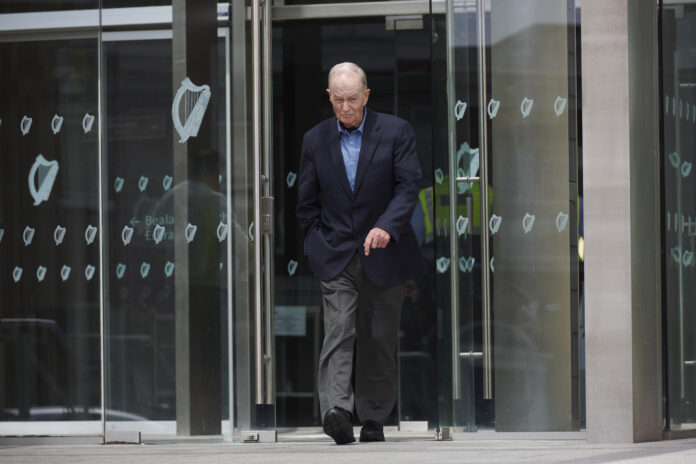
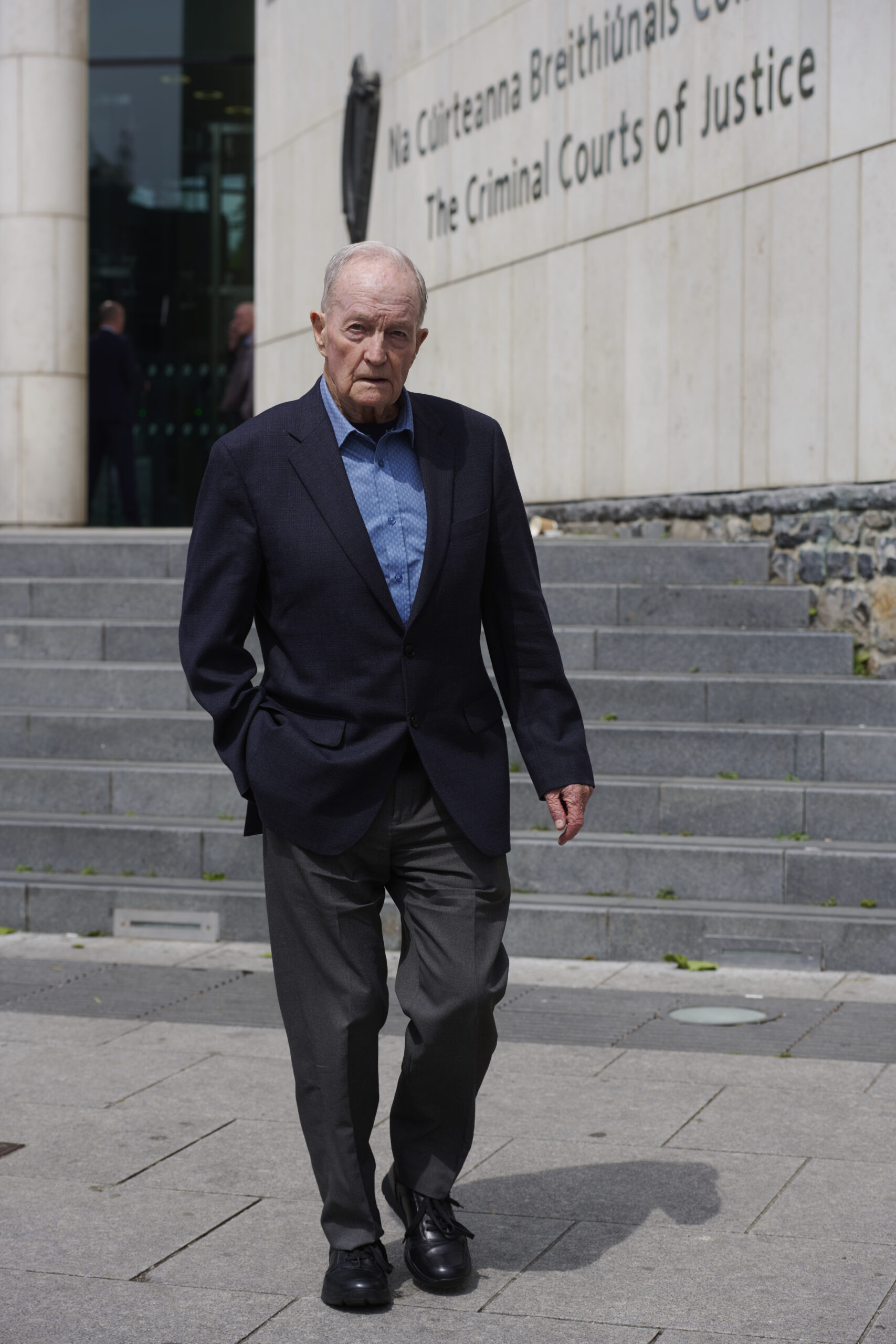
Brother Aidan Clohessy leaving the Court of Criminal Justice, Park Gate Street, Dublin.
Photos by Seán Dwyer 20/05/25
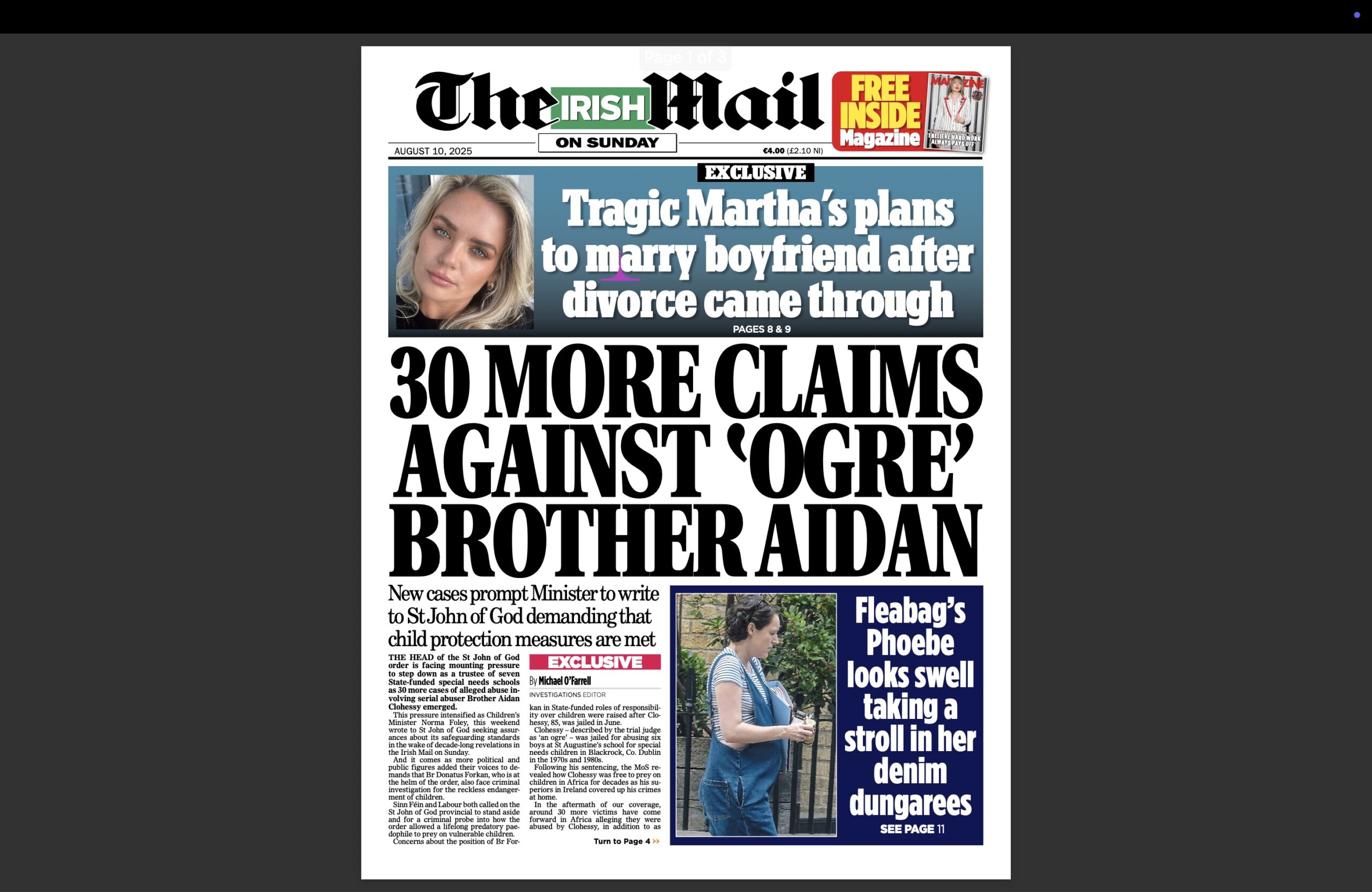
THE HEAD of the St John of God order is facing mounting pressure to step down as a trustee of seven State-funded special needs schools as 30 more cases of alleged abuse involving serial abuser Brother Aidan Clohessy emerged.
This pressure intensified as Children’s Minister Norma Foley, this weekend wrote to St John of God seeking assurances about its safeguarding standards in the wake of decade-long revelations in the Irish Mail on Sunday.
And it comes as more political and public figures added their voices to demands that Br Donatus Forkan, who is at the helm of the order, also face criminal investigation for the alleged reckless endangerment of children.
Sinn Féin and Labour both called on the St John of God provincial to stand aside and for a criminal probe into how the order allowed a lifelong predatory paedophile to prey on vulnerable children.
Concerns about the position of Br Forkan in State-funded roles of responsibility over children were raised after Clohessy, 85, was jailed in June.
Clohessy – described by the trial judge as ‘an ogre’ – was jailed for abusing six boys at St Augustine’s school for special needs children in Blackrock, Co. Dublin in the 1970s and 1980s.
Following his sentencing, the MOS revealed how Clohessy was free to prey on children in Africa for decades as his superiors in Ireland covered up his crimes at home.
In the aftermath of our coverage, around 30 more victims have come forward in Africa alleging they were abused by Clohessy, in addition to as 20 civil cases from there that have already been settled.
The St John of God order has privately settled these African cases in the Irish courts without any admission of liability.
Together with recent settlements to Irish victims, the part-taxpayer-funded order has spent more than €3m on civil cases in the past year.
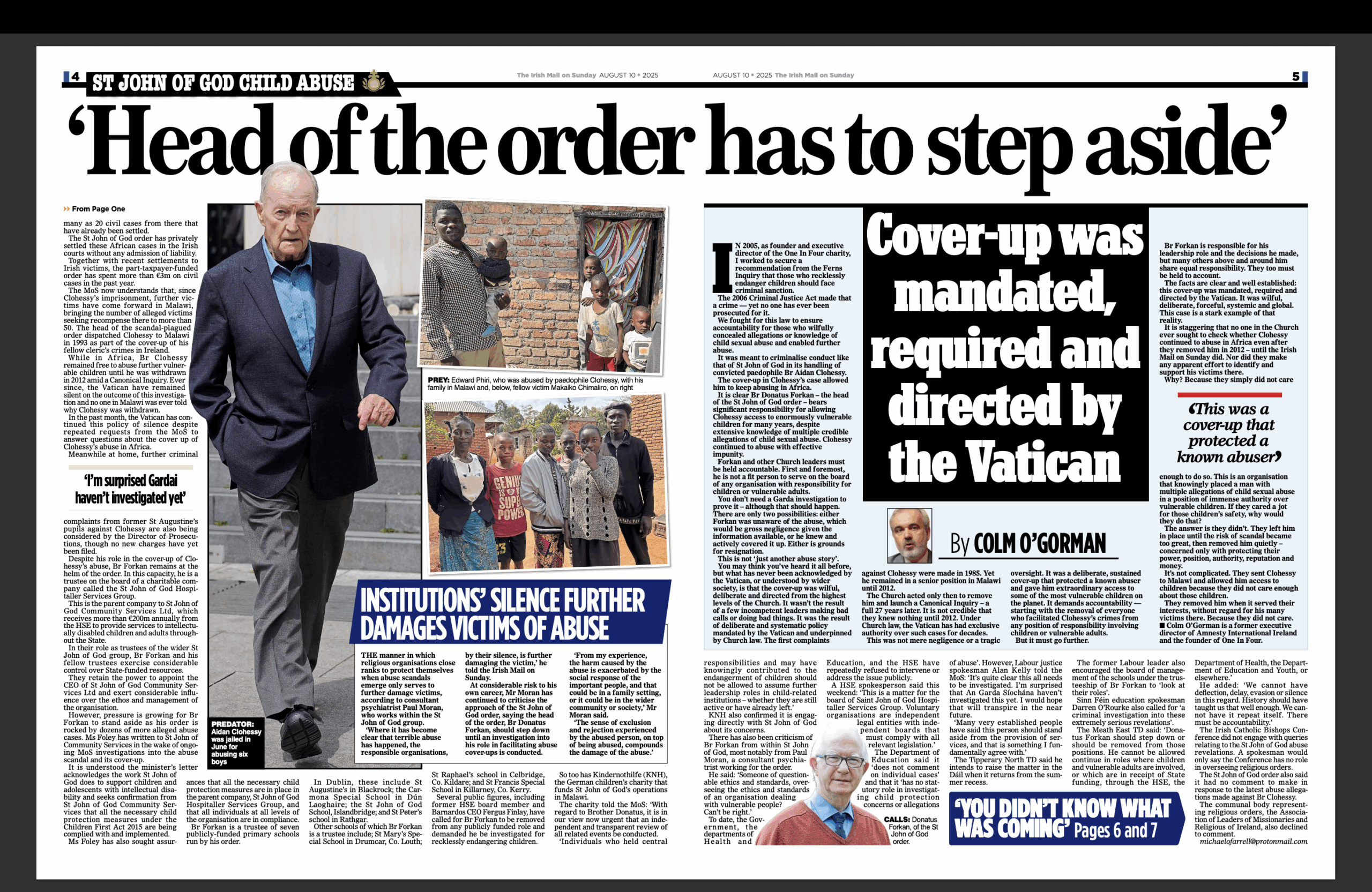
The Irish Mail on Sunday – August 10, 2025.
The MoS now understands that, since Clohessy’s imprisonment, further victims have come forward in Malawi, bringing the number of alleged victims seeking recompense there to more than 50.
The head of the scandal-plagued order dispatched Clohessy to Malawi in 1993 as part of the cover-up of his fellow cleric’s crimes in Ireland.
While in Africa, Clohessy remained free to abuse more vulnerable children until he was withdrawn in 2012 amid a Canonical Inquiry. Ever since, the Vatican has remained silent on the outcome of this investigation and no one in Malawi was ever told why Clohessy was withdrawn.
In the past month, the Vatican has continued this policy of silence despite repeated requests from the MoS to answer questions about the cover-up of Clohessy’s abuse in Africa.
Meanwhile at home, further criminal complaints from former St Augustine’s pupils against Clohessy are also being ?? From Page One many as 20 civil cases from there that have already been settled.
The St John of God order has privately settled these African cases in the Irish courts without any admission of liability.
Together with recent settlements to Irish victims, the part-taxpayer-funded order has spent more than €3m on civil cases in the past year.
The MoS now understands that, since Clohessy’s imprisonment, further victims have come forward in Malawi, bringing the number of alleged victims seeking recompense there to more than 50.
The head of the scandal-plagued order – Br Donatus Forkan – dispatched Clohessy to Malawi in 1993 as part of the cover-up of his fellow cleric’s crimes in Ireland.
While in Africa, Clohessy remained free to abuse more vulnerable children until he was withdrawn in 2012 amid a Canonical Inquiry. Ever since, the Vatican has remained silent on the outcome of this investigation and no one in Malawi was ever told why Clohessy was withdrawn.
The Irish Mail on Sunday – August 10, 2025.
In the past month, the Vatican has continued this policy of silence despite repeated requests from the MoS to answer questions about the cover-up of Clohessy’s abuse in Africa.
Meanwhile at home, further criminal complaints from former St Augustine’s pupils against Clohessy are also being considered. by the Director of Public Prosecutions (DPP) though no new charges have yet been filed.
Despite his role in the cover-up of Clohessy’s abuse, Br Forkan remains at the helm of the order. In this capacity, he is a trustee on the board of a charitable company called the St John of God Hospitaller Services Group.
This is the parent company to St John of God Community Services Ltd, which receives more than €200m annually from the HSE to provide services to intellectually disabled children and adults throughout the State.
In their role as trustees of the wider St John of God group, Br Forkan and his fellow trustees exercise considerable control over State-funded resources.
They retain the power to appoint the CEO of St John of God Community Services Ltd and exert considerable influence over the ethos and management of the organisation.
However, pressure is growing for Br Forkan to stand aside as his order is rocked by dozens more alleged abuse cases.
Ms Foley has written to St John of Community Services in the wake of ongoing MoS investigations into the abuse scandal and its cover-up.
It is understood the minister’s letter acknowledges the work St John of God does to support children and adolescents with intellectual disability and seeks confirmation from St John of God Community Services that all the necessary child protection measures under the Children First Act 2015 are being complied with and implemented.
Ms Foley has also sought assurances that all the necessary child protection measures are in place in the parent company, St John of God Hospitaller Services Group, and that all individuals at all levels of the organisation are in compliance.
Br Forkan is a trustee of seven publicly funded primary schools run by his order.
Four of these are in Dublin – St Augustine’s in Blackrock, the Carmona Special School in Dún Laoghaire, the St John of God School, Islandbridge, and St Peter’s school in Rathgar.
The other schools of which Br Forkan is a trustee are St Mary’s Special School in Drumcar, Co. Louth; St Raphael’s school in Celbridge, Co. Kildare; and St Francis Special School in Killarney, Co. Kerry.
Several public figures, including former HSE board member and Barnardos CEO Fergus Finlay, have called for Br Forkan to be removed from any publicly funded role and demanded he be investigated for recklessly endangering children.
So too has Kindernothilfe (KNH), the German children’s charity that funds St John of God’s operations in Malawi.
The charity told the MoS: ‘With regard to Brother Donatus, it is in our view now urgent that an independent and transparent review of all related events be conducted.
‘Individuals who held central responsibilities and may have knowingly contributed to the endangerment of children should not be allowed to assume further leadership roles in child-related institutions – whether they are still active or have already left.’
KNH also confirmed it is engaging directly with St John of God about its concerns.
There has also been criticism of Br Forkan from within St John of God, most notably from Paul Moran, a consultant psychiatrist working for the order.
He said: ‘Someone of questionable ethics and standards, overseeing the ethics and standards of an organisation dealing with vulnerable people? Can’t be right.’
To date, the Government, the departments of Health and Education and the HSE have repeatedly refused to intervene or address the issue publicly.
A HSE spokesman said this weekend: ‘This is a matter for the board of Saint John of God Hospitaller Services Group. Voluntary organisations are independent legal entities with independent boards that must comply with all relevant legislation.’
The Department of Education said it ‘does not comment on individual cases’ and ‘has no statutory role in investigating child protection concerns or allegations of abuse’.
However, Labour Justice spokesman Alan Kelly told the MoS: ‘It’s quite clear this all needs to be investigated. I’m surprised that An Garda Síochána haven’t investigated this yet. I would hope that will transpire in the near future.
‘Many very established people have said this person should stand aside from the provision of services, and that is something I fundamentally agree with.’
The Tipperary North TD said he intends to raise the matter in the Dáil when it returns from the summer recess.
The former Labour Party leader also encouraged the board of management of the schools under the trusteeship of Br Forkan to ‘look at their roles’.
Sinn Féin Education spokesman Darren O’Rourke also called for ‘a criminal investigation into these extremely serious revelations’.
The Meath East TD said: ‘Donatus Forkan should step down or should be removed from those positions. He cannot be allowed continue in roles where children and vulnerable adults are involved, or which are in receipt of State funding, through the HSE, the Department of Health, the Department of Education and Youth, or elsewhere.’
Mr O’Rourke added: ‘We cannot have deflection, delay, evasion or silence in this regard. History should have taught us that well enough. We cannot have it repeat itself. There must be accountability.’
The Irish Catholic Bishops Conference did not engage with queries relating to the St John of God abuse revelations. A spokesman would only say the conference has no role in overseeing religious orders.
The St John of God order also said it had no comment to make in response to the latest abuse allegations made against Clohessy.
The communal body representing religious orders, the Association of Leaders of Missionaries and Religious of Ireland, also declined to comment.
Contact the author on michaelofarrell@protonmail.com
‘Cover-up was mandated, required and directed by the Vatican’ – Colm O’Gorman.
IN 2005, as founder and executive director of the One In Four charity, I worked to secure a recommendation from the Ferns Inquiry that those who recklessly endanger children should face criminal sanction.
The 2006 Criminal Justice Act made that a crime – yet no one has ever been prosecuted for it.
We fought for this law to ensure accountability for those who wilfully conceal allegations or knowledge of child sexual abuse and enabled further abuse.
It was meant to criminalise conduct like that of St John of God in its handling of convicted paedophile Br Aidan Clohessy.
The cover-up in Clohessy’s case allowed him to keep abusing in Africa.
It is clear Br Donatus Forkan – the head of the St John of God order – bears significant responsibility for allowing Clohessy access to enormously vulnerable children for many years, despite extensive knowledge of multiple credible allegations of child sexual abuse. Clohessy continued to abuse with effective impunity.
Br Forkan and other Church leaders must be held accountable. First and foremost, he is not a fit person to serve on the board of any organisation with responsibility for children or vulnerable adults. You don’t need a Garda investigation to prove it – although that should happen.
There are only two possibilities: either Br Forkan was unaware of the abuse, which would be gross negligence given the information available, or he knew and actively covered it up. Either is grounds for resignation.
This is not ‘just another abuse story’. You may think you’ve heard it all before, but what has never been acknowledged by the Vatican, or understood by wider society, is that the cover-up was wilful, deliberate and directed from the highest levels of the Church.
It wasn’t the result of a few incompetent leaders making bad calls or doing bad things.
It was the result of deliberate and systematic policy mandated by the Vatican and underpinned by Church law.
The first complaints against Clohessy were made in 1985. Yet he remained in a senior position in Malawi until 2012.
The Church acted only then to remove him and launch a Canonical Inquiry – a full 27 years later.
It is not credible that they knew nothing until 2012. Under Church law, the Vatican has had exclusive authority over such cases for decades.
This was not mere negligence or a tragic oversight. It was a deliberate, sustained cover-up that protected a known abuser and gave him extraordinary access to some of the most vulnerable children on the planet.
It demands accountability – starting with the removal of everyone who facilitated Clohessy’s crimes from any position of responsibility involving children or vulnerable adults.
But it must go further.
Br Forkan is responsible for his leadership role and the decisions he made, but many others above and around him share equal responsibility. They too must be held to account.
The facts are clear and well-established: this cover-up was mandated, required and directed by the Vatican. It was wilful, deliberate, forceful, systemic and global. This case is a stark example of that reality.
It is staggering that no one in the Church ever sought to check whether Clohessy continued to abuse in Africa even after they removed him in 2012 – until the Irish Mail on Sunday did. Nor did they make any apparent effort to identify and support his victims there.
Why? Because they simply did not care enough. This is an organisation that knowingly placed a man with multiple allegations of child sexual abuse in a position of immense authority over vulnerable children. If they cared a jot for those children’s safety, why would they do that?
The answer is they didn’t. They left him in place until the risk of scandal became too great, then removed him quietly – concerned only with protecting their power, position, authority, reputation and money.
It’s not complicated. They sent Clohessy to Malawi and allowed him access to children because they did not care enough about those children.
They removed him when it served their interests, without regard for his many victims there. Because they did not care.
Colm O’Gorman is a former executive director of Amnesty International Ireland and the founder of One In Four
THE leader of the St John of God order in Ireland should face criminal investigation for the reckless endangerment of children who were abused by a notorious paedophile, internal and external critics believe.
Speaking to the Irish Mail on Sunday this weekend, former HSE board member Fergus Finlay said this newspaper’s revelations about a St John of God cover-up that allowed children to be abused in Africa should be criminally investigated.
‘Gardaí should be investigating that with the view to bringing charges of reckless endangerment,’ he said.
Mr Finlay is just one of the growing ranks of critics of the order’s response to the revelations in the MoS last weekend.
These include international funders of the order Kindernothilfe (KNH), a senior medical consultant Paul Moran who works for the order, and victims of St John of God Brother Aidan Clohessy.
Together, they have demanded that Donatus Forkan, the Provincial of the St John of God order, resign or be removed from any service provision role pending the outcome of any criminal inquiry.
KNH is one of Europe’s largest children’s charities and a vital funder to St John of God’s operations in Africa.
But when the main Irish funder of St John of God (SJoG) – the HSE – was asked for its view on our revelations and Br Forkan’s position, they instead directed our questions back to the order.
The MoS last week published harrowing stories of child abuse victims from Malawi who had been abused by serial paedophile Clohessy, who was sent into their midst by Br Forkan in 1993 until his removal from public ministry in 2012.
On June 23 and 24, Clohessy was sentenced to more than five years in prison for the historical abuse of six children at St Augustine’s, a school for the intellectually disabled in south Co. Dublin where Clohessy was a teacher and then principal between 1969 and 1993.
Our reporting revealed that while in Malawi, Clohessy continued to abuse as his superiors oversaw secret settlements to victims back home and told the authorities he had no access to children.
Knowingly placing children in danger has been a crime in Ireland since the enactment of the Criminal Justice Act 2006.
By law, a person can be prosecuted for recklessly endangering a child ‘by causing or permitting any child to be placed or left in a situation which creates a substantial risk to the child being a victim of serious harm or sexual abuse.’
Mr Finlay – a former CEO of children’s charity, Barnardos – said that, in his experience of the St John of God order, ‘money matters to them almost more than anything else.’
He called on Br Forkan to step down immediately from any role involving services to vulnerable children and adults.
As Provincial of his order, Br Forkan remains a long-standing board member of the St John of God Hospitaller Services Group.
This entity is a parent company to St John of God Community Services, a charity for intellectually disabled children and adults, funded entirely by the HSE to the tune of hundreds of millions annually.
Mr Finlay told the MoS: ‘I strongly believe – strongly believe – that he should step down or step aside from or be removed from every position of authority in relation to the provision of services.
‘What the order does is entirely a matter for the order, as far as I’m concerned, but the service provision end of it, the publicly funded companies that are involved in providing services, he should not be a Clohessy was a teacher and then principal between 1969 and 1993.
Asked if the HSE should insist Br Forkan be removed, Mr Finlay replied: ‘If necessary yes, but I think the board, in the first instance, should address that, if they have the wherewithal to do that.’
However, as of last night, both the board of the St John of God Hospitaller Services Group and the HSE were refusing to address the issue. When asked about Br Forkan’s position, the HSE said we should redirect our questions to St John of God itself. St John of God, meanwhile, had no comment to make about Br Forkan’s position.
This silence is in stark contrast to the willingness of international funders and senior medical staff within the St John of God group to speak up – even at some risk to themselves.
Paul Moran, a consultant psychiatrist employed by St John of God, told the MoS: ‘I am aware that in coming forward, I may be putting myself at risk, professionally, but in light of the inadequate response from the organisation, I feel I must speak out and ask questions.
‘I am anxious not to scare current service users and want to reassure them that the service safeguards are better now than they were, but we have a situation where, in the shadows, we have this order which sits above the management of these services and has power and control and is basically under the under the direction of one of the main guys who allowed this to happen.
So, while the service is committed to protecting people, the people they report to have a record of not doing so, and that raises a question as to who is in a position to guarantee that the required standards are met.’
Mr Moran questioned whether Br Forkan should be allowed to have a role in governing services.
‘In light of what has been revealed and what has been proven in court, his role needs to be investigated. And until such time as these investigations are concluded should he be allowed an active role in governing services for vulnerable people?’
Mr Moran also criticised the manner in which the St John of God order had spent millions on private settlements with Clohessy’s victims in Malawi and Ireland.
He said the order ‘appears more committed to looking after the interest and reputation of the order ahead of everything else, including the rights and safety of victims’.
He added: ‘Paying off of victims to prevent court cases happening is not consistent with any of the policies or safeguarding guidelines, or the stated values of the order.’
One of the order’s main international funders – German children’s charity KNH – last night welcomed Clohessy’s prosecution. ‘It is crucial that cases of sexual abuse are consistently pursued through legal channels and that perpetrators are held accountable, regardless of when or where the offences were committed,’ a spokesperson said. ‘Our deepest sympathies go out to the victims. Their voices deserve to be heard, justice must be served, and their protection ensured. Protecting children must always be the highest priority in any society and institution.’
KHN also called for Br Forkan to be investigated for recklessly endangering children.
‘With regard to Brother Donatus, it is in our view now urgent that an independent and transparent review of all related events be conducted,’ a KNH spokesperson told the MoS. ‘We think an independent tecting children must always be the highest priority in any society and institution.’
KHN also called for Br Forkan to be investigated for recklessly endangering children.
‘With regard to Brother Donatus, it is in our view now urgent that an independent and transparent review of all related events be conducted,’ a KNH spokesperson told the MoS. ‘We think an independent investigation into Donatus Forkan’s role in sending and tolerating Brother Aidan’s presence in Malawi is a necessary step after the court ruling. This is essential not only to clarify responsibility but also to draw structural consequences and improve systems for child protection,’ the charity said.
KNH added: ‘Religious institutions, like all other institutions, must never evade responsibility or remain silent. Instead, they must implement effective child protection systems. All known abuse cases must be fully investigated and published, regardless of the perpetrator’s position or rank.
‘Those who have failed – whether through active cover-up or neglect – must be held accountable. Abuse must never be dealt with internally. External, independent bodies are needed to investigate and monitor incidents.’
Clohessy’s victims this weekend said more investigations and prosecutions are required.
Abuse survivor Joe Devine said Clohessy should be prosecuted for the abuse he committed in Malawi.
‘There should be a trial, the same way there was a trial here in Ireland,’ he said. Mr Devine’s wife Sally also said Br Forkan should be investigated. ‘Although I know he wasn’t actually carrying out the abuse, he was complicit in allowing it to go on.’
Another survivor, Patsy Carville, criticised the Church authorities.
‘It’s the Catholic Church you have to blame,’ he said. He [Clohessy] was told not to go near children and he was there for 20 years. It’s a disgrace nobody checked up on him,’ he said.
Victim Wayne Farrell said the abuse of children in Africa was ‘horrendous’.
‘I think justice should be done for them here and I’d like to hear something from the Irish Government on it,’ he said.
Another victim, Gerry Quinn, said the role of Br Forkan needed to be exposed.
‘He needs to be exposed and the people who backed him, they need to be exposed as well. That monster [Clohessy] was left roam free over there.’
The State child and family agency Tusla said it could not comment on any individual case.
However, a spokesperson said:’Organisations who are providing services to children have a statutory responsibility under the Children First Act 2015 to keep children safe from harm while availing of those services, carry out a risk assessment, prepare and publish a Child Safeguarding Statement and to refer any concern regarding a child to Tusla.
‘When Tusla suspects that a crime has been committed, and a child or children have been wilfully neglected or physically or sexually abused, Tusla notifies An Garda Síochána where they investigate the crime.’
The MoS also contacted the Department of Health, whose spokesperson advised that the Department of Children should be contacted for comment. However, that department did not respond.
A spokesperson for the Association of Leaders of Missionaries & Religious of Ireland declined to comment last night – but confirmed that the matter would be referred to the next meeting of the executive.
Last week, the SJoG order refused to comment on its role in the cover-up of Clohessy’s crimes in Ireland and Africa.
Instead, Br Forkan posted a brief statement on the St John of God website. He said in the statement: ‘I apologise to anyone who has experienced hurt in our services in the past.
‘As a community, we unequivocally condemn any action that harms or diminishes others.
‘These recent times have reflected pain for so many and brought emotional turmoil for all affected. We think especially of those who came forward to report hurt that they had experienced, we acknowledge their bravery and courage and we think of their families and loved ones.’
This week, a spokesperson for St John of God declined to specifically address queries about the role of Br Forkan.
‘The order encourages anyone who has experienced hurt to seek support and talk with the authorities,’ he said, before providing abuse helpline phone numbers.
29/04/2025
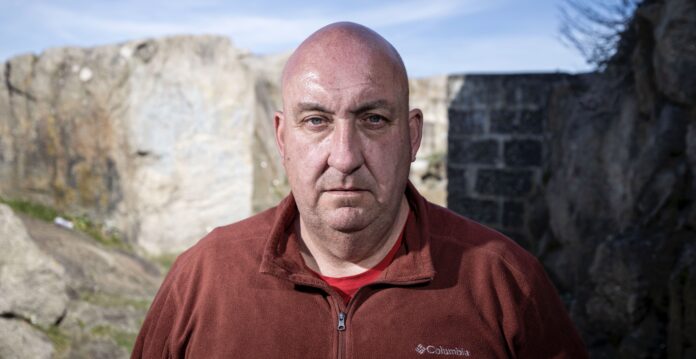
Wayne Farrell photographed in Bullock Harbour ,Dalkey,Co Dublin for Journalist Michael O'Farrell Feature.
Photographs to be only used with Michael O'Farrell copy and clearance.
Pic Tom Honan
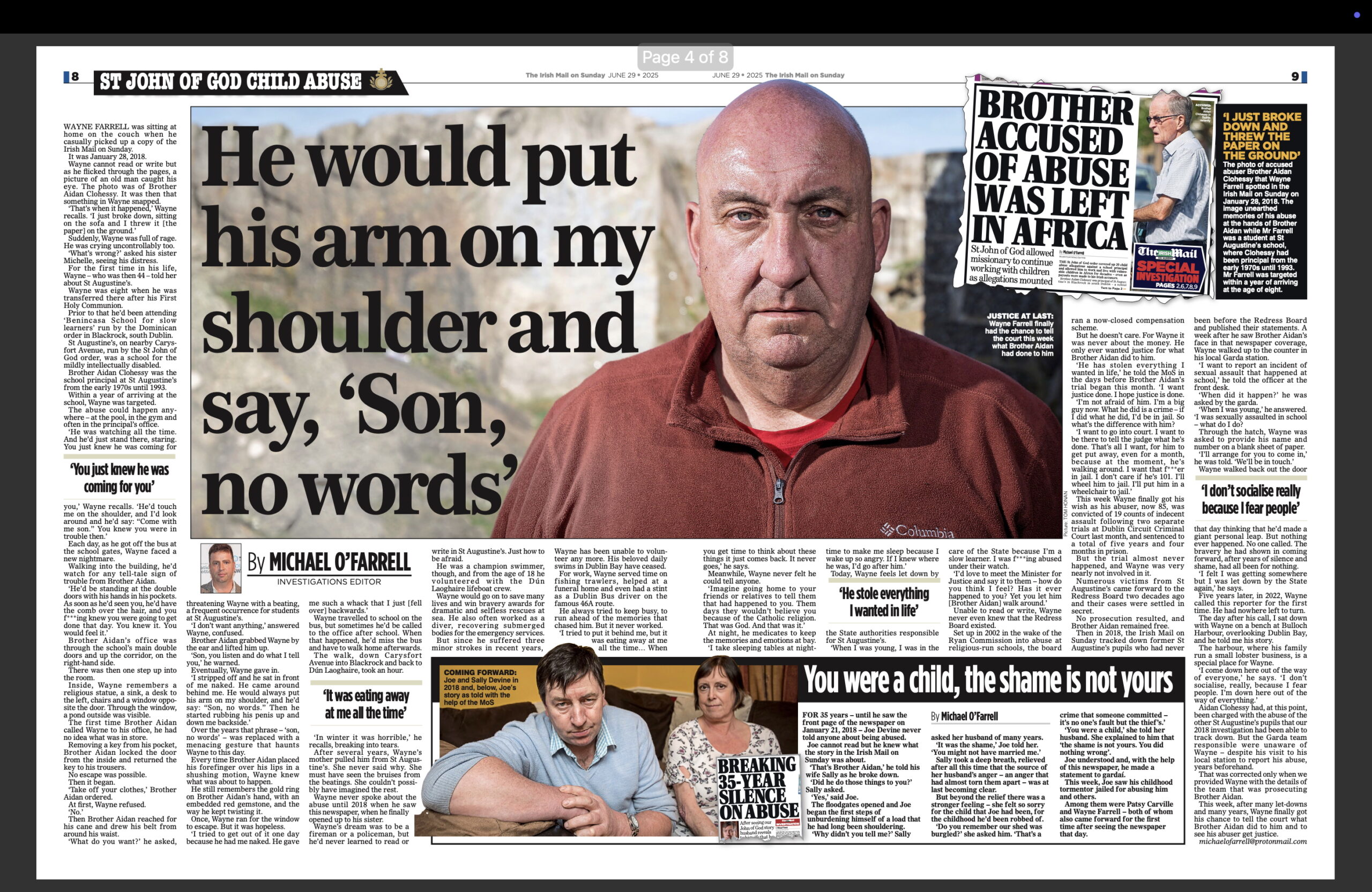
WAYNE FARRELL was sitting at home on the couch when he casually picked up a copy of the Irish Mail on Sunday.
It was January 28, 2018. Wayne cannot read or write but as he flicked through the pages, a picture of an old man caught his eye. The photo was of Brother Aidan Clohessy. It was then that something in Wayne snapped.
‘That’s when it happened,’ Wayne recalls. ‘I just broke down, sitting on the sofa and I threw it [the paper] on the ground.’
Suddenly, Wayne was full of rage. He was crying uncontrollably too.
‘What’s wrong?’ asked his sister Michelle, seeing his distress.
For the first time in his life, Wayne – who was then 44 – told her about St Augustine’s.
Wayne was eight when he was transferred there after his First Holy Communion.
Prior to that he’d been attending ‘Benincasa School for slow learners’ run by the Dominican order in Blackrock, south Dublin.
St Augustine’s, on nearby Carysfort Avenue, run by the St John of God order, was a school for the mildly intellectually disabled.
Brother Aidan Clohessy was the school principal at St Augustine’s from the early 1970s until 1993.
Within a year of arriving at the school, Wayne was targeted.
The abuse could happen anywhere – at the pool, in the gym and often in the principal’s office.
‘He was watching all the time.
And he’d just stand there, staring.
You just knew he was coming for ‘You just knew he was coming for you’
you,’ Wayne recalls. ‘He’d touch me on the shoulder, and I’d look around and he’d say: “Come with me son.” You knew you were in trouble then.’
Each day, as he got off the bus at the school gates, Wayne faced a new nightmare.
Walking into the building, he’d watch for any tell-tale sign of trouble from Brother Aidan.
‘He’d be standing at the double doors with his hands in his pockets. As soon as he’d seen you, he’d have the comb over the hair, and you f***ing knew you were going to get done that day. You knew it. You would feel it.’
Brother Aidan’s office was through the school’s main double doors and up the corridor, on the right-hand side.
There was then one step up into the room.
Inside, Wayne remembers a religious statue, a sink, a desk to the left, chairs and a window opposite the door. Through the window, a pond outside was visible.
The first time Brother Aidan called Wayne to his office, he had no idea what was in store.
Removing a key from his pocket, Brother Aidan locked the door from the inside and returned the key to his trousers.
No escape was possible. Then it began.
‘Take off your clothes,’ Brother Aidan ordered.
At first, Wayne refused. ‘No.’
Then Brother Aidan reached for his cane and drew his belt from around his waist.
‘What do you want?’ he asked, threatening Wayne with a beating, a frequent occurrence for students at St Augustine’s.
Brother Aidan grabbed Wayne by the ear and lifted him up.
‘Son, you listen and do what I tell you,’ he warned.
Eventually, Wayne gave in. ‘I stripped off and he sat in front of me naked. He came around behind me. He would always put his arm on my shoulder, and he’d say: “Son, no words.” Then he started rubbing his penis up and down me backside.’
Over the years that phrase – ‘son, no words’ – was replaced with a menacing gesture that haunts Wayne to this day.
Every time Brother Aidan placed his forefinger over his lips in a shushing motion, Wayne knew what was about to happen.
He still remembers the gold ring on Brother Aidan’s hand, with an embedded red gemstone, and the way he kept twisting it.
Once, Wayne ran for the window to escape. But it was hopeless.
‘I tried to get out of it one day because he had me naked. He gave me such a whack that I just [fell over] backwards.’
Wayne travelled to school on the bus, but sometimes he’d be called to the office after school. When that happened, he’d miss the bus and have to walk home afterwards.
The walk, down Carysfort Avenue into Blackrock and back to Dún Laoghaire, took an hour.
‘It was eating away at me all the time’
‘In winter it was horrible,’ he recalls, breaking into tears.
After several years, Wayne’s mother pulled him from St Augustine’s. She never said why. She must have seen the bruises from the beatings. She couldn’t possibly have imagined the rest.
Wayne never spoke about the abuse until 2018 when he saw this newspaper, when he finally opened up to his sister.
Wayne’s dream was to be a fireman or a policeman, but he’d never learned to read or write in St Augustine’s. Just how to be afraid.
He was a champion swimmer, though, and from the age of 18 he volunteered with the Dún Laoghaire lifeboat crew.
Wayne would go on to save many lives and win bravery awards for dramatic and selfless rescues at sea. He also often worked as a diver, recovering submerged bodies for the emergency services.
But since he suffered three minor strokes in recent years,
Wayne has been unable to volunteer any more. His beloved daily swims in Dublin Bay have ceased.
For work, Wayne served time on fishing trawlers, helped at a funeral home and even had a stint as a Dublin Bus driver on the famous 46A route.
He always tried to keep busy, to run ahead of the memories that chased him. But it never worked.
‘I tried to put it behind me, but it was eating away at me all the time When you get time to think about these things it just comes back. It never goes,’ he says.
Meanwhile, Wayne never felt he could tell anyone.
‘Imagine going home to your friends or relatives to tell them that had happened to you. Them days they wouldn’t believe you because of the Catholic religion. That was God. And that was it.’
At night, he medicates to keep the memories and emotions at bay.
‘I take sleeping tables at nighttime to make me sleep because I wake up so angry. If I knew where he was, I’d go after him.’
Today, Wayne feels let down by ‘He stole everything I wanted in life’
the State authorities responsible for St Augustine’s.
‘When I was young, I was in the care of the State because I’m a slow learner. I was f***ing abused under their watch.
‘I’d love to meet the Minister for Justice and say it to them – how do you think I feel? Has it ever happened to you? Yet you let him [Brother Aidan] walk around.’
Unable to read or write, Wayne never even knew that the Redress Board existed.
Set up in 2002 in the wake of the Ryan Commission into abuse at religious-run schools, the board ran a now-closed compensation scheme.
But he doesn’t care. For Wayne it was never about the money. He only ever wanted justice for what Brother Aidan did to him.
‘He has stolen everything I wanted in life,’ he told the MoS in the days before Brother Aidan’s trial began this month. ‘I want justice done. I hope justice is done.
‘I’m not afraid of him. I’m a big guy now. What he did is a crime – if I did what he did, I’d be in jail. So what’s the difference with him?
‘I want to go into court. I want to be there to tell the judge what he’s done. That’s all I want, for him to get put away, even for a month, because at the moment, he’s walking around. I want that f***er in jail. I don’t care if he’s 101. I’ll wheel him to jail. I’ll put him in a wheelchair to jail.’
This week Wayne finally got his wish as his abuser, now 85, was convicted of 19 counts of indecent assault following two separate trials at Dublin Circuit Criminal Court last month, and sentenced to a total of five years and four months in prison.
But the trial almost never happened, and Wayne was very nearly not involved in it.
Numerous victims from St Augustine’s came forward to the Redress Board two decades ago and their cases were settled in secret.
No prosecution resulted, and Brother Aidan remained free.
Then in 2018, the Irish Mail on Sunday tracked down former St Augustine’s pupils who had never been before the Redress Board and published their statements. A week after he saw Brother Aidan’s face in that newspaper coverage, Wayne walked up to the counter in his local Garda station.
‘I want to report an incident of sexual assault that happened at school,’ he told the officer at the front desk.
‘When did it happen?’ he was asked by the garda.
‘When I was young,’ he answered. ‘I was sexually assaulted in school – what do I do?
Through the hatch, Wayne was asked to provide his name and number on a blank sheet of paper.
‘I’ll arrange for you to come in,’
he was told. ‘We’ll be in touch.’
Wayne walked back out the door ‘I don’t socialise really because I fear people’
that day thinking that he’d made a giant personal leap. But nothing ever happened. No one called. The bravery he had shown in coming forward, after years of silence and shame, had all been for nothing.
‘I felt I was getting somewhere but I was let down by the State again,’ he says.
Five years later, in 2022, Wayne called this reporter for the first time. He had nowhere left to turn.
The day after his call, I sat down with Wayne on a bench at Bulloch Harbour, overlooking Dublin Bay, and he told me his story.
The harbour, where his family run a small lobster business, is a special place for Wayne.
‘I come down here out of the way of everyone,’ he says. ‘I don’t socialise, really, because I fear people. I’m down here out of the way of everything.’
Aidan Clohessy had, at this point, been charged with the abuse of the other St Augustine’s pupils that our 2018 investigation had been able to track down. But the Garda team responsible were unaware of Wayne – despite his visit to his local station to report his abuse, years beforehand.
That was corrected only when we provided Wayne with the details of the team that was prosecuting Brother Aidan.
This week, after many let-downs and many years, Wayne finally got his chance to tell the court what Brother Aidan did to him and to see his abuser get justice.
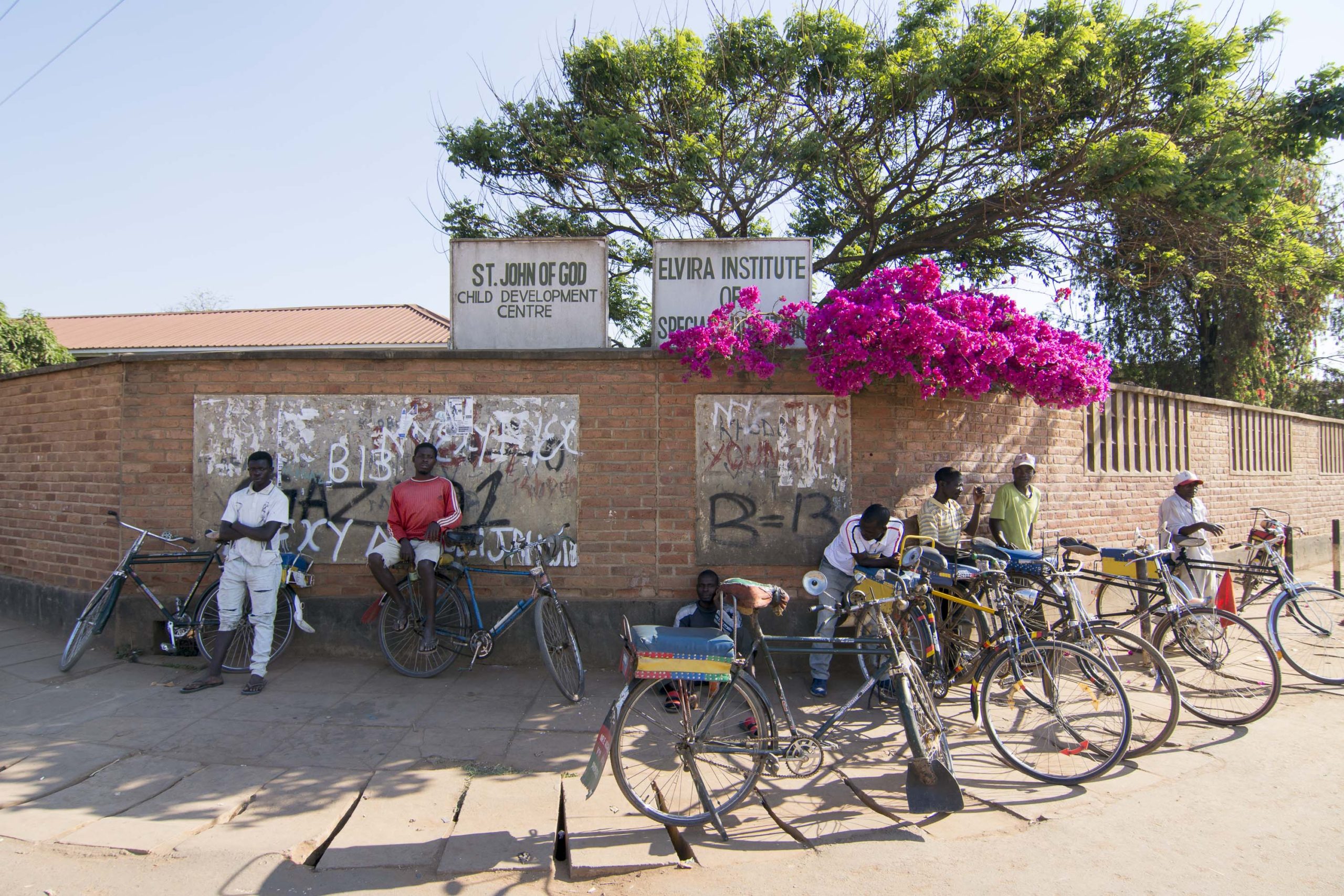
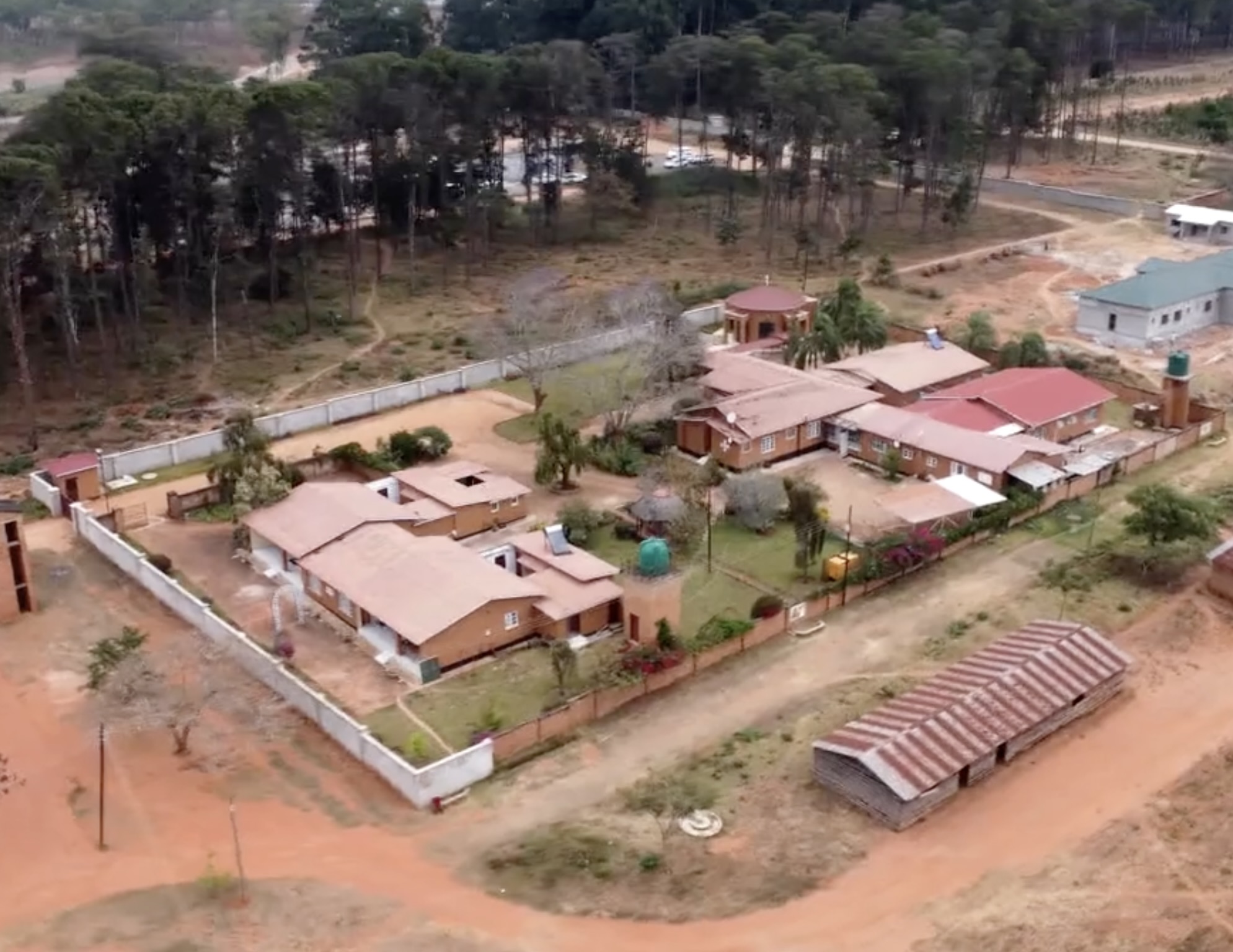
A St John of God childcare facility in Mzuzu, Malawi - Photos by Sean Dwyer.
A LIFELONG predatory paedophile was left free to prey on children in Africa for decades as his superiors in Ireland covered up his crimes back home, an Irish Mail on Sunday investigation reveals.
Brother Aidan Clohessy, 85, was described by a judge this week as ‘an ogre’ who ‘secretly carried out atrocities’ in Ireland while being sentenced to more than five years in prison.
In mitigation, lawyers for the former school principal told Dublin Central Criminal Court that Clohessy led a mission in Malawi to develop ‘mental health services’.
However, the MOS can reveal that, in the lead-up to his prosecution, Clohessy’s superiors in the St John of God order spent more than €3million on settling civil cases.
These cases involve ex-pupils of Clohessy in Dublin and former street children in Malawi in southeastern Africa.
Up to 20 cases from Malawi have been settled and a similar amount are pending. All settlements were made without any admission of liability.
Some of those who received civil compensation from the St John of God order still had to go through the trauma of testifying in court because Clohessy pleaded not guilty.
Clohessy, who was the principal of St Augustine’s in Blackrock, Co. Dublin, from the early 1970s until 1993, was jailed for a total of five years and four months this week after he convicted of sexually abusing six Irish boys at the special needs school between 1969 and 1989.
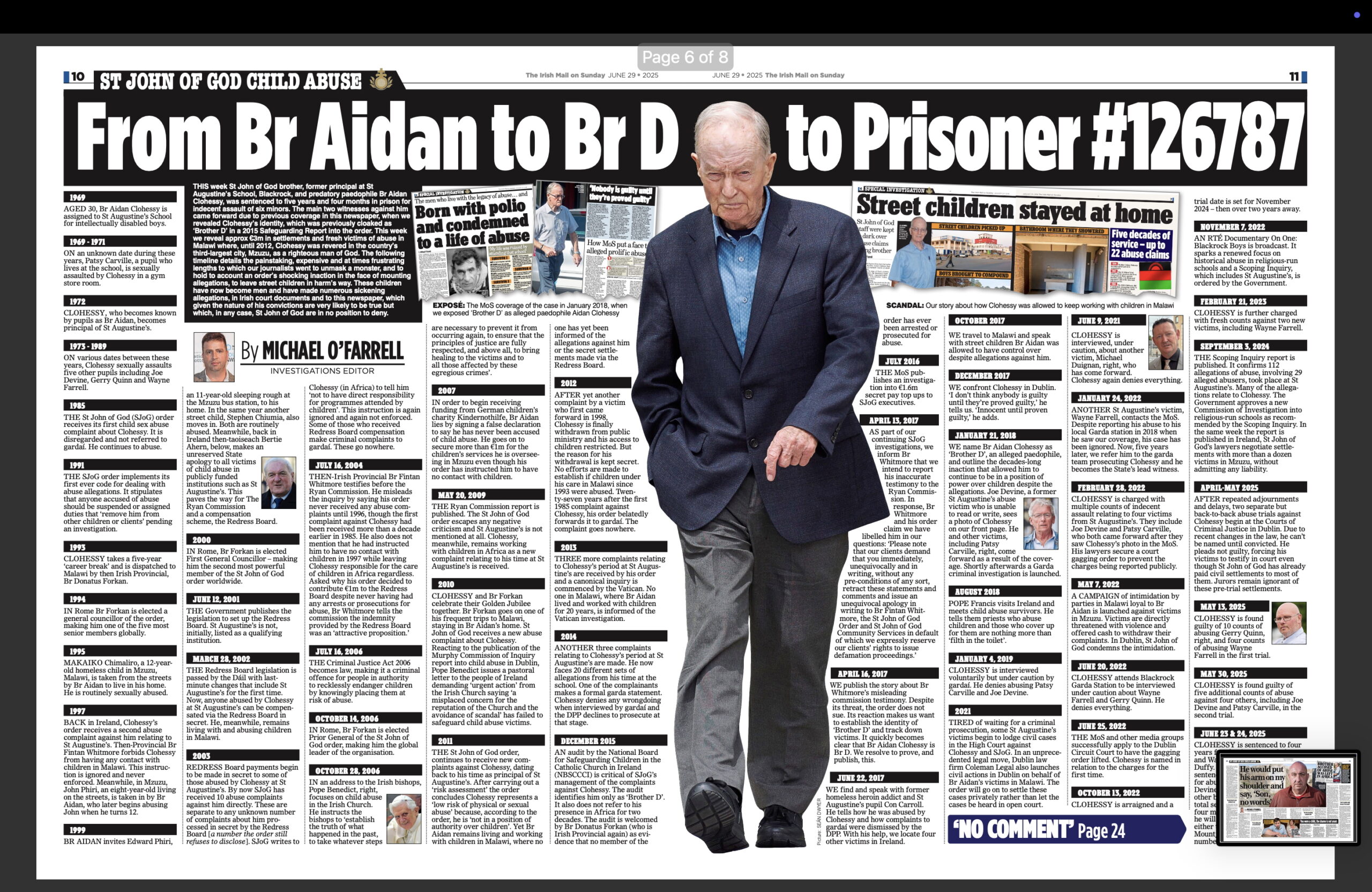
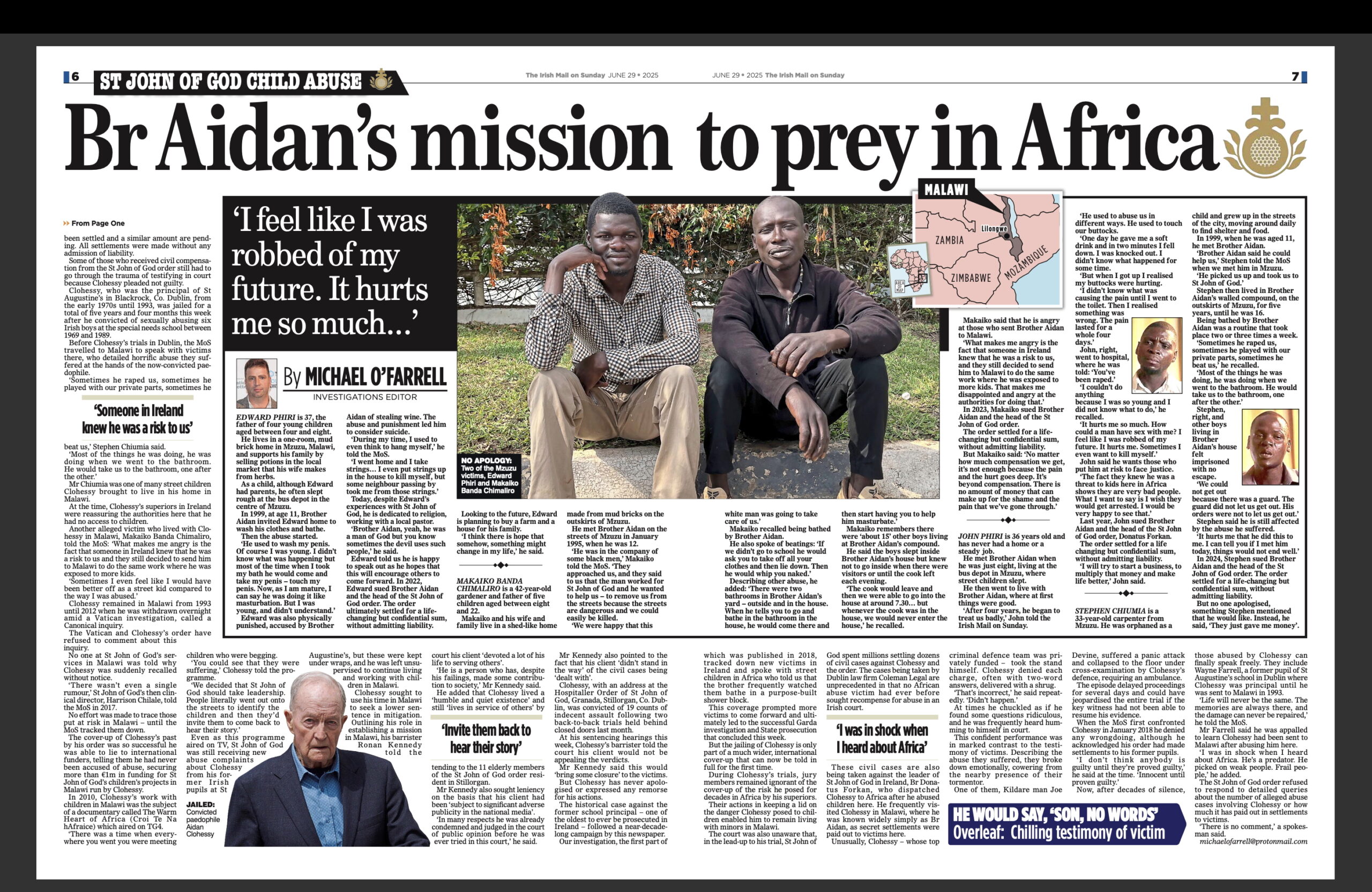
Irish Mail on Sunday – June 29, 2025
Before Clohessy’s trials in Dublin, the MoS travelled to Malawi to speak with victims there, who detailed horrific abuse they suffered at the hands of the now-convicted paedophile.
‘Sometimes he raped us, sometimes he played with our private parts, sometimes he beat us,’ Stephen Chiumia said.
‘Most of the things he was doing, he was doing when we went to the bathroom. He would take us to the bathroom, one after the other.’
Mr Chiumia was one of many street children Clohessy brought to live in his home in Malawi.
At the time, Clohessy’s superiors in Ireland were reassuring the authorities here that he had no access to children.
The St John of God compound in Mzuzu, Malawi where Br Aidan Clohessy lived with children.
Another alleged victim who lived with Clohessy in Malawi, Makaiko Banda Chimaliro, told the MoS: ‘What makes me angry is the fact that someone in Ireland knew that he was a risk to us and they still decided to send him to Malawi to do the same work where he was exposed to more kids.
‘Sometimes I even feel like I would have been better off as a street kid compared to the way I was abused.’
Clohessy remained in Malawi from 1993 until 2012 when he was withdrawn overnight amid a Vatican investigation, called a Canonical inquiry.
The Vatican and Clohessy’s order have refused to comment about this inquiry.
Irish Mail on Sunday – June 29, 2025.
No one at St John of God’s services in Malawi was told why Clohessy was suddenly recalled without notice.
‘There wasn’t even a single rumour,’ St John of God’s then clinical director, Harrison Chilale, told the MoS in 2017.
No effort was made to trace those put at risk in Malawi – until the MoS tracked them down.
The cover-up of Clohessy’s past by his order was so successful he was able to lie to international funders, telling them he had never been accused of abuse, securing more than €1m in funding for St John of God’s children’s projects in Malawi run by Clohessy.
In 2010, Clohessy’s work with children in Malawi was the subject of a documentary called The Warm Heart of Africa (Croi Te Na hAfraice) which aired on TG4.
‘There was a time when everywhere you went you were meeting children who were begging.
Irish Mail on Sunday – June 29, 2025.
You could see that they were suffering,’ Clohessy told the programme.
‘We decided that St John of God should take leadership. People literally went out onto the streets to identify the children and then they’d invite them to come back to hear their story.’
Even as this programme aired on TV, St John of God was still receiving new abuse complaints about Clohessy from his former Irish pupils at St Augustine’s, but these were kept under wraps, and he was left unsupervised to continue living and working with children in Malawi.
Clohessy sought to use his time in Malawi to seek a lower sentence in mitigation.
Outlining his role in establishing a mission in Malawi, his barrister Ronan Kennedy told the court his client ‘devoted a lot of his life to serving others’.
‘He is a person who has, despite his failings, made some contribution to society,’ Mr Kennedy said.
He added that Clohessy lived a ‘humble and quiet existence’ and still ‘lives in service of others’ by tending to the 11 elderly members of the St John of God order resident in Stillorgan.
Mr Kennedy also sought leniency on the basis that his client had been ‘subject to significant adverse publicity in the national media’.
‘In many respects he was already condemned and judged in the court of public opinion before he was ever tried in this court,’ he said.
Mr Kennedy also pointed to the fact that his client ‘didn’t stand in the way’ of the civil cases being ‘dealt with’.
Clohessy, with an address at the Hospitaller Order of St John of God, Granada, Stillorgan, Co. Dublin, was convicted of 19 counts of indecent assault following two back-to-back trials held behind closed doors last month.
Brother Aidan Clohessy leaving the Court of Criminal Justice, Park Gate Street, Dublin during his trial. Photo by Seán Dwyer 20/05/25.
At his sentencing hearings this week, Clohessy’s barrister told the court his client would not be appealing the verdicts.
Mr Kennedy said this would ‘bring some closure’ to the victims.
But Clohessy has never apologised or expressed any remorse for his actions.
The historical case against the former school principal – one of the oldest to ever be prosecuted in Ireland – followed a near-decadelong campaign by this newspaper.
Our investigation, the first part of which was published in 2018, tracked down new victims in Ireland and spoke with street children in Africa who told us that the brother frequently watched them bathe in a purpose-built shower block.
This coverage prompted more victims to come forward and ultimately led to the successful Garda investigation and State prosecution that concluded this week.
But the jailing of Clohessy is only part of a much wider, international cover-up that can now be told in full for the first time.
During Clohessy’s trials, jury members remained ignorant of the cover-up of the risk he posed for decades in Africa by his superiors.
Their actions in keeping a lid on the danger Clohessy posed to children enabled him to remain living with minors in Malawi.
The court was also unaware that, in the lead-up to his trial, St John of God spent millions settling dozens of civil cases against Clohessy and the order.
The cases being taken by Dublin law firm Coleman Legal are unprecedented in that no African abuse victim had ever before sought recompense for abuse in an Irish court.
These civil cases are also being taken against the leader of St John of God in Ireland, Br Donatus Forkan, who dispatched Clohessy to Africa after he abused children here.
He frequently visited Clohessy in Malawi, where he was known widely simply as BrAidan, as secret settlements were paid out to victims here.
Brother Donatus Forkan, St John of God Provincial in Dublin in 2016. (Photo Tom Honan)
Unusually, Clohessy – whose top criminal defence team was privately funded – took the stand himself. Clohessy denied each charge, often with two-word answers, delivered with a shrug.
‘That’s incorrect,’ he said repeatedly. ‘Didn’t happen.’
At times he chuckled as if he found some questions ridiculous, and he was frequently heard humming to himself in court.
This confident performance was in marked contrast to the testimony of victims. Describing the abuse they suffered, they broke down emotionally, cowering from the nearby presence of their tormentor.
One of them, Kildare man Joe Devine, suffered a panic attack and collapsed to the floor under cross-examination by Clohessy’s defence, requiring an ambulance.
The episode delayed proceedings for several days and could have jeopardised the entire trial if the key witness had not been able to resume his evidence.
When the MoS first confronted Clohessy in January 2018 he denied any wrongdoing, although he acknowledged his order had made settlements to his former pupils.
‘I don’t think anybody is guilty until they’re proved guilty,’ he said at the time. ‘Innocent until proven guilty.’
Now, after decades of silence, those abused by Clohessy can finally speak freely. They include Wayne Farrell, a former pupil of St Augustine’s school in Dublin where Clohessy was principal until he was sent to Malawi in 1993.
‘Life will never be the same. The memories are always there, and the damage can never be repaired,’ he told the MoS.
Mr Farrell said he was appalled to learn Clohessy had been sent to Malawi after abusing him here.
‘I was in shock when I heard about Africa. He’s a predator. He picked on weak people. Frail people,’ he added.
The St John of God order refused to respond to detailed queries about the number of alleged abuse cases involving Clohessy or how much it has paid out in settlements to victims.
‘There is no comment,’ a spokesman said.
Contact the author on michaelofarrell@protonmail.com
‘I feel like I was robbed of my future. It hurts me so much…’
Edward Phiri and Makaiko Banda Chamaliro in Mzuzu, Malawi in September 2024. (Photo Michael O’Farrell)
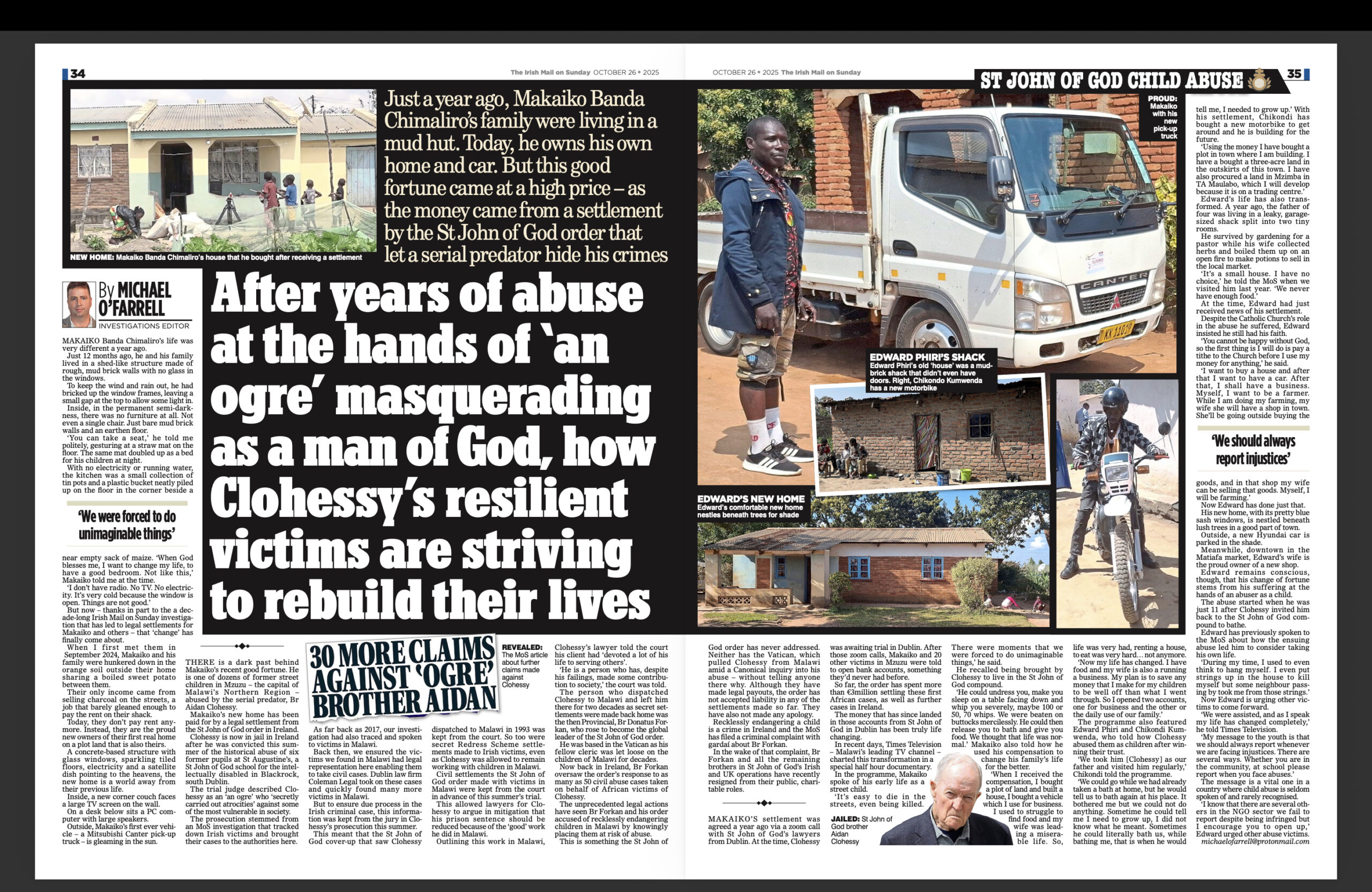
EDWARD PHIRI is 37, He is a father of four young children aged between four and eight.
He lives in a one-room, mud brick home in Mzuzu, Malawi, and supports his family by selling potions in the local market that his wife makes from herbs.
As a child, although Edward had parents, he often slept rough at the bus depot in the centre of Mzuzu.
In 1999, at age 11, Brother Aidan invited Edward home to wash his clothes and bathe.
Then the abuse started.
‘He used to wash my penis. Of course I was young. I didn’t know what was happening but most of the time when I took my bath he would come and take my penis – – touch my penis. Now, as I am mature, I can say he was doing it like masturbation. But I was young, and didn’t understand.’
Edward was also physically punished, accused by Brother Aidan of stealing wine. The abuse and punishment led him to consider suicide.
‘During my time, I used to even think to hang myself,’ he told the MoS.
Edward Phiri and his family at their home in Mzuzu, Malawi in September 2024. (Photo Michael O’Farrell)
‘I went home and I take strings. I even put strings up in the house to kill myself, but some neighbour passing by took me from those strings.’
Today, despite Edward’s experiences with St John of God, he is dedicated to religion, working with a local pastor.
‘Brother Aidan, yeah, he was a man of God but you know sometimes the devil uses such people,’ he said.
Edward told us he is happy to speak out as he hopes that this will encourage others to come forward. In 2022, Edward sued Brother Aidan and the head of the St John of God order. The order ultimately settled for a lifechanging but confidential sum, without admitting liability.
Looking to the future, Edward is planning to buy a farm and a house for his family.
‘I think there is hope that somehow, something might change in my life,’ he said.
Makaiko Banda Chimaliro and his family at their home in Mzuzu, Malawi in September 2024. (Photo Michael O’Farrell)
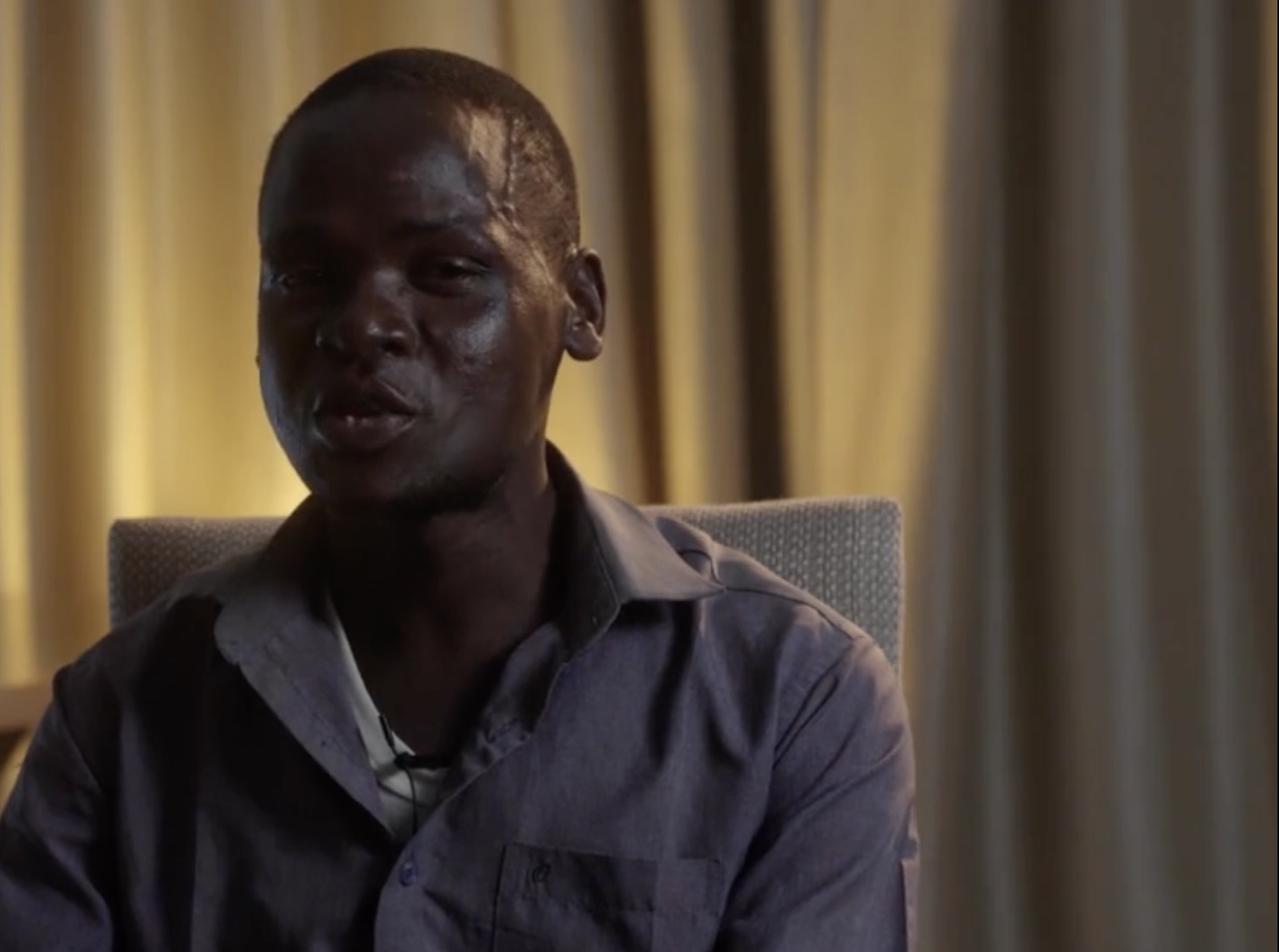
MAKAIKO BANDA CHIMALIRO is a 42-year-old gardener and father of five children aged between eight and 22.
Makaiko and his wife and family live in a shed-like home made from mud bricks on the outskirts of Mzuzu.
He met Brother Aidan on the streets of Mzuzu in January 1995, when he was 12.
‘He was in the company of some black men,’ Makaiko told the MoS. ‘They approached us, and they said to us that the man worked for St John of God and he wanted to help us – – to remove us from the streets because the streets are dangerous and we could easily be killed.
‘We were happy that this white man was going to take care of us.’
Makaiko recalled being bathed by Brother Aidan.
He also spoke of beatings: ‘If we didn’t go to school he would ask you to take off all your clothes and then lie down. Then he would whip you naked.’
Describing other abuse, he added: ‘There were two bathrooms in Brother Aidan’s yard – – outside and in the house. When he tells you to go and bathe in the bathroom in the house, he would come there and then start having you to help him masturbate.’
Makaiko remembers there were ‘about 15’ other boys living at Brother Aidan’s compound.
He said the boys slept inside Brother Aidan’s house but knew not to go inside when there were visitors or until the cook left each evening.
‘The cook would leave and then we were able to go into the house at around 7.30 but whenever the cook was in the house, we would never enter the house,’ he recalled.
Makaiko said that he is angry at those who sent Brother Aidan to Malawi.
‘What makes me angry is the fact that someone in Ireland knew that he was a risk to us, and they still decided to send him to Malawi to do the same work where he was exposed to more kids. That makes me disappointed and angry at the authorities for doing that.’
In 2023, Makaiko sued Brother Aidan and the head of the St John of God order.
The order settled for a lifechanging but confidential sum, without admitting liability.
But Makaiko said: ‘No matter how much compensation we get, it’s not enough because the pain and the hurt goes deep. It’s beyond compensation. There is no amount of money that can make up for the shame and the pain that we’ve gone through.’
John Phiri.
JOHN PHIRI is 36 years old and has never had a home or a steady job.
He met Brother Aidan when he was just eight, living at the bus depot in Mzuzu, where street children slept.
He then went to live with Brother Aidan, where at first things were good.
‘After four years, he began to treat us badly,’ John told the Irish Mail on Sunday.
‘He used to abuse us in different ways. He used to touch our buttocks.
‘One day he gave me a soft drink and in two minutes I fell down. I was knocked out. I didn’t know what happened for some time.
‘But when I got up I realised my buttocks were hurting.
‘I didn’t know what was causing the pain until I went to the toilet. Then I realised something was wrong. The pain lasted for a whole four days.’
John went to hospital, where he was told: ‘You’ve been raped.’
‘I couldn’t do anything because I was so young and I did not know what to do,’ he recalled.
‘It hurts me so much. How could a man have sex with me? I feel like I was robbed of my future. It hurts me. Sometimes I even want to kill myself.’
John said he wants those who put him at risk to face justice.
‘The fact they knew he was a threat to kids here in Africa shows they are very bad people. What I want to say is I wish they would get arrested. I would be very happy to see that.’
Last year, John sued Brother Aidan and the head of the St John of God order, Donatus Forkan.
The order settled for a lifechanging but confidential sum, without admitting liability.
‘I will try to start a business, to multiply that money and make life better,’ John said.
Stephen Chiumia.
STEPHEN CHIUMIA is a 33-year-old carpenter from Mzuzu. He was orphaned as a child and grew up in the streets of the city, moving around daily to find shelter and food.
In 1999, when he was aged 11, he met Brother Aidan.
‘Brother Aidan said he could help us,’ Stephen told the MoS when we met him in Mzuzu.
‘He picked us up and took us to St John of God.’
Stephen then lived in Brother Aidan’s walled compound, on the outskirts of Mzuzu, for five years, until he was 16.
Being bathed by Brother Aidan was a routine that took place two or three times a week.
‘Sometimes he raped us, sometimes he played with our private parts, sometimes he beat us,’ he recalled.
‘Most of the things he was doing, he was doing when we went to the bathroom. He would take us to the bathroom, one after the other.’
Stephen, right, and other boys living in Brother Aidan’s house felt imprisoned with no escape.
‘We could not get out because there was a guard. The guard did not let us get out. His orders were not to let us get out.’
Stephen said he is still affected by the abuse he suffered.
‘It hurts me that he did this to me. I can tell you if I met him today, things would not end well.’
In 2024, Stephen sued Brother Aidan and the head of the St John of God order. The order settled for a life-changing but confidential sum, without admitting liability.
But no one apologised, something Stephen mentioned that he would like. Instead, he said, ‘They just gave me money’.
Irish Mail on Sunday – October 26, 2025.
PDFS OF THIS ENTIRE, NEAR DECADE-LONG INVESTIGATION AS IT ORIGINALLY APPEARED IN THE IRISH MAIL ON SUNDAY ARE AVAILABLE FOR DOWNLOAD BELOW.
That chilling line is just one from the latest poison pen letter in a series of hundreds sent to Susan and Dave Plower – and many others linked to them – for over half a decade now.
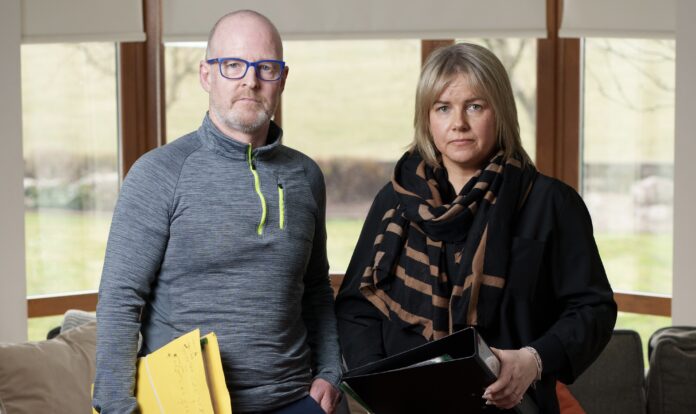
But the letter is actually addressed to Joe Duffy, and was sent on March 20, in the days after the Plowers and family members went on RTÉ’s Liveline to tell of the nightmarish campaign of abuse by a sinister letter writer –or writers – who has targeted them and their family in the rural town of Loughrea.
Our sister newspaper the Irish Daily Mail also published a story about the Plowers that week.
People might assume publicity would scare away the perpetrator, but in fact it regularly provokes a letter in response. So much so, that the Plowers are aware that this article may also engender a letter. But despite more than 500 poison pen letters, a five-year Garda investigation has led to no one having been arrested.
‘There are no suspects. There’s been nothing confirmed by the guards. This is an ongoing case and we’re as much in the dark as anyone else,’ Susan Plower told the Irish Mail on Sunday this week.
Dave Plower added: ‘We are victims, and there are other victims, and I suppose the case has not been taken seriously enough.’
The MoS spoke with Garda sources to get a direct insight into where the investigation was. And we can reveal that gardaí have reached an impasse – with their investigations having only served to clear one local person who was considered to be in the frame.
And another person named locally as the perpetrator was never considered to be a real suspect. As such, Garda sources admit that the best hope of a breakthrough is that a mistake will result in a forensic breakthrough that will lead to whoever is responsible.
It’s a situation the letter writer seems wise to, adding in the March 20 letter: ‘No DNA on anything. We know how this game works!’
A single-page letter sent on February 26, which starts with the foulest of personal abuse, was sent along with a zip lock plastic bag containing an apparently used condom complete with a sticky, oozy substance inside. Identical letters, also with condoms inside, arrived on the same day to the home of Dave’s twin brother and a close friend of Susan’s. It is not uncommon for others to receive letters like this.
‘We are aware of other people outside of our family, completely unassociated with us, that have received letters who binned them because this person has written to so many people,’ Dave Plower said. Accompanying the condoms in each envelope is a thin slip of cut paper containing the printed words: ‘Suck on that you gobby, no neck, buck teeth, ugly hippo of a ****.’
Previous letters of this type have been examined for DNA and fingerprints by gardaí. Nothing was found. The perpetrator wore gloves and had used liquid hand soap to mimic the appearance of semen. It is clear by now that considerable planning and effort has been expended in this campaign of hatred.
But who would do such a thing, and why? This simple questions led this newspaper to engage with the Plowers, and a variety of experts in an attempt to unearth any clue or signpost that could help identify the writers. The MoS sent samples of the letters to forensic handwriting experts in the US and the UK.
We also sent the material to a renowned New York-based criminal profiler. Those samples included the very first 32 handwritten letters from five years ago – and 30 more recent typed letters.
The experts all agreed on one thing. That a handwriting comparison was impossible because of the lack of suitable writing to compare them to. Another one thing was also clear, however.
‘There are several different personalities writing these awful letters,’ Barbara Weaver, a handwriting analyst with the Cambridge School of Graphology concluded.
That could mean two things; either more than one person is involved – or a single writer is mimicking different personalities and writing styles to disguise themselves. This is the view of Meredith DeKalb Miller, a former forensic document examiner with the FBI Laboratory in Quantico, Virginia.
Now in private practice, DeKalb Miller has also worked with the United Nations Office on Drugs and Crime and George Washington University. She told the MoS: ‘The questioned letters are disguised… they do not contain naturally prepared writing.
‘The writer has disguised in different ways with the handwriting style, slant, etc.’
This means the writing cannot be easily compared – if at all – with handwriting samples from suspects.
‘Unfortunately, this type of writing is not suitable for comparison,’ Ms DeKalb Miller concluded.
But this does not mean that the handwritten letters may not contain other forensic clues. These could include invisible indented impressions left behind on pages from something written on a page above them.
Gardaí, using the services of Forensic Science Ireland, did try this – but to no avail so far.
It has never before been reported before, but gardaí also raided multiple premises in the Galway area and spoke with potential suspects.
A Garda source confirmed that, in one instance in 2022, a warrant was obtained to raid the home and workplace of a long-term acquaintance of Ms Plower.
Computers, printers, paperwork and other materials were seized during the operation.
But after a thorough forensic examination, the suspect was then ruled out as innocent and all materials returned.
In the early days, the Plowers and others in the area were asked to provide multiple samples of their handwriting. But this too led to nothing. Whoever is responsible has also deliberately dropped decoys into their letters that point to others, not caring how this will affect those who may be vulnerable or fragile.
As a result, lifelong friendships have been irrevocably damaged, and completely innocent parties have been recklessly outed on social media as the culprit.
‘This person, whoever they are, they’re thriving on people’s pain and are also jealous of people’s success,’ Dave Plower told the MoS.
‘When they get an opportunity, if something significant happens in somebody’s life, that’s a happy occasion, they lambast it. They comment on it, you know, be it a communion, be it a wedding.’
Meanwhile, for the Plowers a sense of paranoia follows them everywhere. Someone who knows them intimately is watching them with malice and sinister intent.
Photos of Dave in his garden – perhaps obtained via the use of a drone – have been secretly taken and included in the letters.
Details from inside the Plower household have been casually referenced. So too are frequent descriptions of them going about their daily lives. Private trips to the hospital, nights out in the local pub, weddings, golf games, funerals and other events are all seized on by someone close enough to have this kind of access.
Their photos are pulled from social media and sent back to them with graphic pornographic images superimposed on them.
The best clues to what kind of person the author could be are in the letters, according to renowned forensic psychiatrist and criminal profiler, Dr Michael McGrath.
Based in New York, Dr McGrath is a board member of the Forensic Criminology Institute, a distinguished Life Fellow of the American Psychiatric Association and a founding member of the International Association of Forensic Criminalists.
After reading the letters and listening to radio interviews given by the Plowers, Dr McGrath made several observations. Firstly, after conducting a textual analysis of the radio interviews, Dr McGrath said he found ‘no markers of deception’ when the Plowers themselves spoke. This, he said, points to the Plowers’ ‘lack of involvement in writing the letters’.
This is important. Ruling the victims out is one of the first steps any Garda investigation will have done.
Moving beyond that, Dr McGrath accepts that there could be more than one writer but adds that while he cannot be certain, he feels the perpetrator is most likely a man.
‘Do not assume the sex of the person who wrote this stuff,’ Dr McGrath advised. ‘Most likely it’s a man, but we don’t know that.’
But whatever their gender, Dr McGrath is clear the culprit is supremely self-important and narcissistic.
‘Whoever this person is, they’re very narcissistic. They may not necessarily appear that way on the surface, but they’re very narcissistic,’ he said.
‘Some kind of narcissistic injury occurred, either by the husband or the wife to this person to set this stuff in motion.’
So the Plowers did something – or were perceived by the letter writer/s to have done something – that slighted them. In response, they took revenge.
Whoever they are, they lack the control most people have to let something go when they are slighted and become angry. Think Donald Trump, Dr McGrath advises, as an example.
‘We should all have a good, healthy sense of narcissism, feeling that that you’re worthwhile, that you’re important. Some people have an overblown sense of narcissism,’ he said. ‘Some people can get very upset over the slightest things… they’re like a malignant narcissist, anything can upset them.
‘They see themselves as the most important person in the world. Everybody should essentially kiss their ass. And if they don’t… they have a problem with that.’
It is more likely than not that such a person will not be married. If they are, they will be the clearly dominant party. But while a ‘loner’ with no wife or steady girlfriend is most likely to be ‘at the top of the list’ Dr McGrath warns any such conclusion is purely speculative.
‘The guy in the basement, you know certainly is up there near the top of the list but that may be a red herring… if you start giving a profile based on speculation, then you could lead things astray.’
The key, Dr McGrath added, is understanding the close link any suspect may have to the Plowers.
Dr McGrath also advised that narcissistic types dislike confrontation and said the letter writer/s were obsessional but not necessarily obsessive. They have, for example, dedicated time into preparing by doing the research necessary to evade capture, aside from the time needed to sustain the actual letter-writing campaign.
‘I would not give a diagnosis of obsessive-compulsive disorder, or anything like that. But the adjective obsessional would certainly fit someone who’s writing, say two or three letters a week over the course of five years.’
Dr McGrath agreed it is clear the author/s ‘get off’ on the hurt they cause.
‘I wouldn’t say they get off in the sexual sense,’ he said. ‘But this makes them feel good. This gets the dopamine going when they’re sitting there writing these out, and then when they go mail them.’
Dr McGrath also points to the possibility of a nightmare scenario in which those responsible are not in any way connected to the Plowers at all. ‘That’s a long shot, but not impossible,’ he said.
But one thing Dr McGrath is sure of, is that the Plowers, despite the prospect of provoking more letters, are doing the right thing in going public. He said: ‘It was going to go on anyway – by going public, they’re alerting this person, it’s like confronting the person.’
THE first letter arrived in January 2020 and falsely accused the eldest son of Susan and Dave Plower of selling drugs.
That theme has since been repeated – but only rarely.
Instead, the aim over time appears to be to destroy the Plowers’ marriage.
‘Your so-called marriage is a shambles. It’s over. It’s dead,’ is one of many examples.
In the beginning, the letters were all handwritten in varying styles before they changed to typed.
Sometimes they use colloquial language fluently, sometimes they present as written by an Eastern European. Sometimes Polish and other foreign words are used.
Sometimes they appear to be the work of a polite professional who writes neatly and coherently.
Other times they appear deranged with poorly structured sentences, apparently deliberate misspellings and messy writing.
The handwriting alternates from all caps to joined, slanted left and right – as well as neater, straighter writing.
Early letters concentrate primarily on unfounded claims that Dave, a supermarket manager, was stealing from work and having affairs.
Claimed video footage of this never materialises but is frequently threatened.
In the beginning of the hate campaign, expletives were rare or non-existent and the letters were presented as staff at Dave’s workplace complaining about him. But there is a clear escalation in tone and aggression over time.
Today, the old workplace claims have been largely dropped and vile expletives accompanied by pornographic images have been introduced.
Now Susan’s appearance as a woman is routinely targeted with vile comments as she is compared to the supposed beauty of the fictional women her husband is said to be seeing.
She and Dave are also attacked as parents. The spread of the letters has expanded with up to 14 friends, family members and workplaces now also targeted. Sometimes multiple salvos of hatred arrive on the same day.
That pattern of attack began in July 2020 when three letters were sent to Susan at home and at work on one morning. Some weeks later three or four letters are sent. The longest period without any letters has been about six weeks.
Aside from the intent to break up the Plowers, several other trends emerge as very frequent. Apparently knowledgeable details about the cars driven by the Plowers, for example, are very common.
‘Ye were nicer people when ye had bangers of cars like normal people,’ one early letter reads. From then on, every car change has been noted in detail, complete with registration numbers, and mocked extensively as Dave buys and sells them.
‘What do you know about cars. You have no qualifications. no knowledge. No nothing,’ one reads.
Occasionally, an entire letter is dedicated to mocking car ads placed by Dave.
There are also very frequent references to Dave being ‘cocky’ ‘narcissistic’ and ‘arrogant’ – something our profiler has identified as a likely trait of the letter writer themselves.
‘I have watched you leave work, cocky and full of self-importance,’ one letter reads.
This who-do-you-think-you-are tone spills from almost every letter.
Motivations are carefully disguised, but occasionally the writer appears to reference their own situation.
One letter reads: ‘You think you’re the only ones with problems. Your not. Everyone has more serious problems but they keep it to themselves.’
Meanwhile, the ongoing Garda investigation is routinely mocked and taunted.
‘Ye will never catch us. The cops will never catch us,’ one letter reads. A common sign off is: ‘Catch us if you can!’
A CONTROVERSIAL charity run by Ireland’s Honorary Consul to Moldova has closed down in the wake of serious financial governance concerns.
However, Outreach Moldova (ORM) is still seeking donations to pay the wages of staff who were laid off with little warning last November.
In the immediate wake of the layoffs, the charity’s board members, its CEO and its lawyers refused to confirm the closure when asked by the Irish Mail on Sunday.
Now, after months of silence, the closure of ORM has been announced on the charity’s website for the first time – together with a final appeal for donations.
Run by Irishwoman Suzanne O’Connell, ORM has been involved in running an orphanage in the Moldovan town of Hincesti for 25 years.
In that period the celebrity-supported charity, known for its glamorous fundraising balls in Trinity College and Dublin’s Shelbourne Hotel, has raised more than €12m from donors. These funds have helped hundreds of orphans in need of care and a home.
An analysis of ORM’s accounts shows the charity had been raising approximately €250,000 annually. Its staff costs are about €190,000 with chief executive Dr Suzanne O’Connell taking home €47,000. Judges in Moldova earn €9,000 a year.
Signs that not all was well at ORM first emerged in 2018 when Ed Dunne, a wealthy benefactor, raised concerns about how funds he had provided were being used.
In the wake of those concerns former HSE boss Frank Dolphin and ORM’s then chairman Fergal Kelly resigned. These resignations took place after Mr Kelly travelled to Moldova to investigate the concerns.
‘I couldn’t get clarity and comfort on how the funds were being used locally,’ Mr Kelly later told the MoS.
A subsequent review into governance at the charity by financial consultants Baker Tilly was then ordered. But the findings of this report were not made public until the MoS published them in 2022.
Issues highlighted by the Baker Tilly report included ORM’s failure to comply with tax and charity laws in Moldova for nearly two decades. Another concern was the routine payment of remuneration in cash from a safe and the absence of valid employee signatures for cash paid out as wages and expenses.
Baker Tilly also discovered that an accountant working at the charity signed his own expenses and often faked signatures for others.
Another problem was a lack of transparent record-keeping to allow large donors to know where their money was being spent.
Separately, an MoS investigation in Moldova in 2022 raised questions about property transactions between ORM, its CEO Suzanne O’Connell and her late father Des who had originally founded the charity. Our investigation in Moldova resulted in the charity admitting it had filed defective accounts. Corrected accounts were later resubmitted to the Company Registrations Office.
In the wake of these revelations, ORM moved to implement recommendations that the composition of its board be reviewed.
Meanwhile, fundraising continued with various events in Ireland.
These included a black tie ball at the Shelbourne Hotel on February 23 last year. That was followed in May last year by a golf classic at Killeen Castle in Co. Meath.
But last November, a scheduled fundraiser at Trinity College Dublin (TCD) did not proceed. Within a day of that cancelled event, two of the new board members resigned. And within weeks of that, the MoS was informed by local sources that all staff had been let go in Moldova. The charity refused to confirm this at the time.
‘Like any charity, there are financial challenges,’ board member Kevin Quinn told the MoS in December. ‘We are working through them at the moment so we are not going to make any comment.’
Now in recent days, ORM has posted messages online to confirm the closure.
‘Despite our best efforts we could not sustain our mission in these difficult times as global crises have diverse attention and support elsewhere,’ the message reads.
‘We had to cease operations in Moldova last November 2024 out of an abundance of caution when we cancelled our annual fundraiser in TCD.’
The ORM announcement also confirmed that all staff had been let go ‘with little notice’ on November 29 and contained a plea for further donations to pay staff.
This weekend the MoS sought once again to contact Ms O’Connell and board member Kevin Quinn – as we had done late last year. They did not respond.
Eli Lilly, Kinsale, Co. Cork. Local councillor Alan Coleman, at the Eli Lilly campus, Kinsale, Co. Cork.
Photo by Seán Dwyer 21/03/25
IF YOU want to see how much US big pharma has changed Ireland, a quick look at the newspapers of the 1960s and 1970s provides an interesting insight.
So too do the ‘then and now’ photos of places like Ringaskiddy and Kinsale, which have now benefited from more than half a century of constant US pharmaceutical investment.
When Pfizer first came to Ireland in September 1968, Donald Trump had just graduated from the Wharton School of Business at the University of Pennsylvania.
‘I’m going to be the king of New York real estate,’ a fresh-faced and mophaired Trump famously told his college lecturer back then.
Trump’s legendary ascent took place as Ireland – an economically crippled backwater back then – slowly began to create its own legendary status.
Today, Ireland is infamous for its miraculous economic transformation on the back of its US Foreign Direct Investment (FDI) strategy. Now Trump has just become its biggest threat.
While Donald Trump was turning up for his Ivy League college lectures in his green Ford Fairlane convertible, Ireland’s minister for industry and commerce, George Colley, had his eye on a different prize.
Together with the Industrial Development Authority (IDA), Mr Colley was striking a deal with Pfizer. It was perhaps no accident – and certainly no harm – that the then Pfizer president, John J Powers, was Irish. The deal, announced in a press conference at Dublin’s Gresham Hotel, made the front pages of the national papers.
It involved a simple transaction: Ireland provided as many grants as possible, agreed to build a wide new access road into Ringaskiddy – and promised new legislation to ensure Pfizer and other US firms could benefit from 100% export tax breaks.
On the day of the press conference, Mr Colley was tight-lipped about how much in grants Pfizer had received. When asked by reporters, he said he was not legally permitted to disclose the amount. But he gave a clue. ‘It is quite substantial, the largest ever given, in fact,’ he said.
Today, over five decades later, Pfizer has invested over $9bn in Ireland and employs more than 5,000 staff.
The Pfizer deal was not the first such arrangement with a US pharmaceutical company.
Johnson & Johnson first established a presence in Ireland in 1935 and today employs 6,000 people here.
But the Pfizer deal cemented an approach that every government since then has stuck to.
Along the way, the original export tax exemptions – aimed at simply securing jobs for Ireland – morphed into low corporate tax rates and other tax-based incentives. In tandem with this, the benefit to Ireland switched from solely job creation and stemming the tide of emigration to huge corporation tax takes beyond anyone’s expectation.
This tax in excess of what we could expect without FDI has a name in the Department of Finance. They refer to it as the ‘froth’.
The Irish Fiscal Advisory Council (IFAC), our budget watchdog, has another term. They call it ‘Ireland’s own oil wealth’.
To put the size of this FDI boom in perspective, the IFAC estimated in 2022 that Ireland could have received as much as €31bn since 2015 in excess corporation taxes thanks to FDI.
This remarkable wealth stream, the IFAC warned, is ‘volatile, difficult to forecast, somewhat removed from other activities, and subject to potential reversals in future’.
Cue Donald Trump and his threatened tariffs, due to commence on April 2. This week we learned from the Economic and Social Research Institute (ESRI) that the threatened US tariffs could cost Ireland more than €18bn in lost trade.
Throughout Ireland there are once rural and isolated pockets of the landscape that have been utterly transformed – together with the entire nation’s economy – by US FDI. Now they are bracing for the unknown and hoping for the best.
In 1968, Ringaskiddy was described on the front page of the Cork Examiner as being affected by a ‘cankerous apathy’ spurred on by emigration of ‘the young folk of working age’.
‘A lot of young people went to England for jobs,’ a local vintner told the paper. ‘We hope the new chemical plant will see many more returning.’
Photos from the time show Ballybricken House – a period home on the land bought by Pfizer – amid empty country fields overlooking Cork Harbour.
Razed to make way for the Pfizer plant, the house was once frequented by Captain Frederick Maitland – the British Royal Navy captain who accepted the surrender of Napoleon. (Captain Maitland married a daughter of the owner.)
Today this location, once famed for its genteel society tea parties in the countryside overlooking Cork Harbour, is a mammoth collection of industrial buildings made famous by Viagra.
A similar transformation has taken place 25km away in Kinsale. In 1975, US firm Eli Lilly first secured an option to buy 107 acres of land from local farmer John Sweetman.
Today that site, at Dunderrow Cross, has a footprint approaching the size of the entire town of Kinsale. Spurred on by the success of its blockbuster weight-loss drug Mounjaro, Eli Lilly’s Irish operations have not stopped expanding since the very beginning.
Today, with further operations at Little Island and in Limerick, the firm employs more than 3,500.
Kinsale without Lilly – as the locals fondly refer to the firm – would be still no more than the quaint, seasonal tourist destination it once was.
Officially, no one at Lilly or Pfizer wants to speak about Trump and his tariff threats – though he is on everyone’s mind. For any firm in Trump’s sights, it would be foolish to utter a word.
Instead, everyone is hunched in the trenches waiting to see whether what materialises next is a temporary barrage of mortar fire or an intercontinental ballistic missile.
‘I have nothing to say on that at all,’ the Pfizer press operation in Ireland told the MoS this week when we asked about Trump’s tariffs.
Eli Lilly in turn provided a bland holding statement.
‘Lilly is an American company with a global presence. This continues to be an evolving situation that we’re watching closely,’ a spokesman said.
But local representatives around Kinsale are happy to speak. One of them, Independent Cork County Councillor Alan Coleman, was struck by how many Eli Lily retirees he encountered while canvassing for the last election.
‘You nearly meet as many Lilly pensioners now as Lilly workers in the area. It’s been around that long,’ he said.
‘It is a big site,’ he said of Lilly’s Dunderrow plant. ‘It’s almost a continuous building site for the last 15 years.’
Mr Coleman thinks Trump’s popularity will eventually tank but the talk in the pubs of Kinsale is about how much damage he might inflict in the meantime.
‘You couldn’t exaggerate how important Lilly it is to the location,’ said Mr Coleman. ‘It would be a huge hit,’ he said of the possibility of tariffs causing Lilly to rethink its Irish plans.
‘A hit to Lilly will be a big hit to this area. There’s no doubt about it. It’s by far the biggest and strongest employer?So we don’t take it for granted.
‘The level of pay, the security, there’s nothing to match it. The number of spin-offs that local businesses are getting out of Lilly is a big thing. It’s not just those who are employed there. There are subcontractors in there constantly.’
However, the hope locally is that Lilly and Kinsale will be able to sit tight and ride out the storm.
‘My sense is they’re going to ride this one out,’ predicted Mr Coleman.
‘The political cycle is quite short, I suppose, by comparison to the type of cycles they work on in firms like Lilly. That would be my kind of thinking anyway. Maybe I’m whistling in the wind.’
One advantage, Mr Coleman believes, is how entrenched Lilly has become in Ireland.
‘It’s not about just producing the blue tablet. There are elements in Dunderrow involved in the research side of things so they have themselves very much stitched into the fabric of Lilly international.’
Another hope involves the many Irish employees who have risen up to management level in the global firm.
‘Over the last 50 years a lot of the Irish workforce who moved into management positions in Lily worked abroad with Lilly in the States, in particular, and in Europe as well,’ Mr Coleman said. ‘They got themselves into pretty influential positions.
‘When Lilly start making decisions I suppose we always think of a boardroom somewhere in the States, and Ireland is just a dot on the map, but a lot of those Irish people have influence within Lilly and that’s been important to us as well.’
So for now, Mr Coleman says there’s no cause for panic: ‘There seems to be no level of panic or retrenchment.
‘If anything there is talk about another major expansion in the year and I’ve heard nothing about that being shelved.
‘What I gather now, looking from the outside in, is that they’re still driving onward investment.
‘That plant does open Lilly up to a market of over 320 million in Europe, which is very important to them.’
That’s not to say Trump will care an ounce. But in another 50 years’ time, the people of Ringaskiddy and Kinsalehope his impact will be a forgotten blip in history.
And they will get a sense if that is going to be the case soon enough.