THE personal assets of cycling hero Stephen Roche are being pursued by Spanish bankruptcy officials after he was found guilty of acting fraudulently by a commercial court in Mallorca.
The ruling, which was revealed exclusively by the Irish Mail on Sunday last week, ordered Mr Roche to repay €750,000 and found that he had deliberately stripped assets from his Spanish cycling holiday firm before vanishing from Mallorca in 2017.
The court findings concluded Mr Roche spent much of the money maintaining a lux- ury lifestyle – instead of paying creditors owed money by his firm, Shamrock Events SL.
The MoS has learned the Spanish administrator appointed to oversee the bankruptcy of Roche’s firm intends to pursue his assets abroad to recover money for creditors. Manuela Serrano Sanchez, who works for PWC in Madrid, said the ‘guilty’ finding against Mr Roche meant his assets could be pursued under EU agreements that ensure civil and commercial judgments can be enforced across Europe. ‘Now we have to try to pursue assets of Mr Roche in Spain and outside Spain if possible,’ she said. ‘It will be difficult but we will do our best to achieve money to the creditors.’
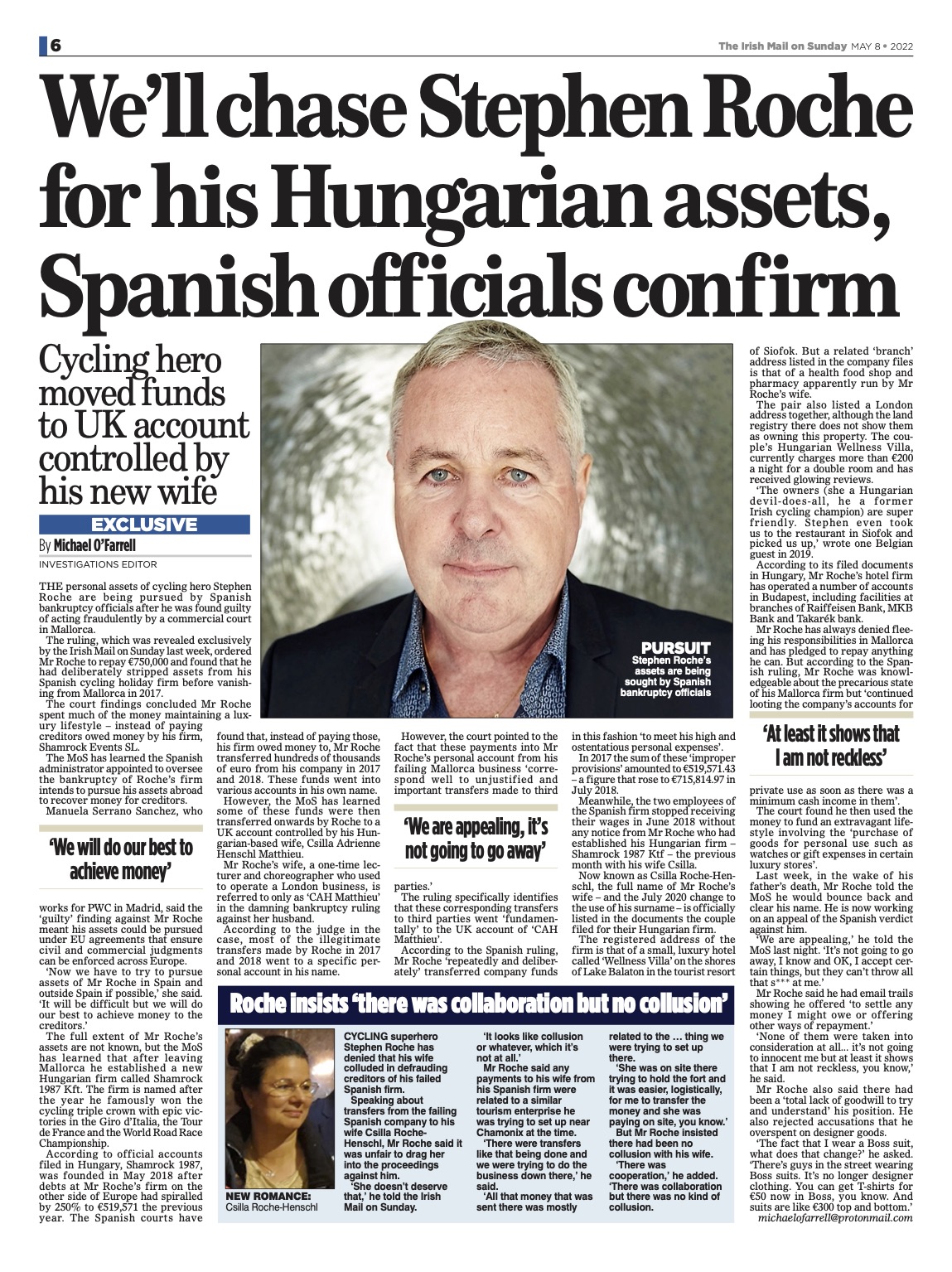
The full extent of Mr Roche’s assets are not known, but the MoS has learned that after leaving Mallorca he established a new Hungarian firm called Shamrock 1987 Kft. The firm is named after the year he famously won the cycling triple crown with epic victories in the Giro d’Italia, the Tour de France and the World Road Race Championship. According to official accounts filed in Hungary, Shamrock 1987, was founded in May 2018 after debts at Mr Roche’s firm on the other side of Europe had spiralled by 250% to €519,571 the previous year. The Spanish courts have found that, instead of paying those, his firm owed money to, Mr Roche transferred hundreds of thousands of euro from his company in 2017 and 2018. These funds went into various accounts in his own name.
However, the MoS has learned some of these funds were then transferred onwards by Roche to a UK account controlled by his Hungarian-based wife, Csilla Adrienne Henschl Matthieu.
Mr Roche’s wife, a one-time lecturer and choreographer who used to operate a London business, is referred to only as ‘CAH Matthieu’ in the damning bankruptcy ruling against her husband.
According to the judge in the case, most of the illegitimate transfers made by Roche in 2017 and 2018 went to a specific personal account in his name.
However, the court pointed to the fact that these payments into Mr Roche’s personal account from his failing Mallorca business ‘correspond well to unjustified and important transfers made to third parties.’
The ruling specifically identifies that these corresponding transfers to third parties went ‘fundamentally’ to the UK account of ‘CAH Matthieu’.
According to the Spanish ruling, Mr Roche ‘repeatedly and deliberately’ transferred company funds in this fashion ‘to meet his high and ostentatious personal expenses’.
In 2017 the sum of these ‘improper provisions’ amounted to €519,571.43 – a figure that rose to €715,814.97 in July 2018.
Meanwhile, the two employees of the Spanish firm stopped receiving their wages in June 2018 without any notice from Mr Roche who had established his Hungarian firm – Shamrock 1987 Ktf – the previous month with his wife Csilla.
Now known as Csilla Roche-Henschl, the full name of Mr Roche’s wife – and the July 2020 change to the use of his surname – is officially listed in the documents the couple filed for their Hungarian firm.
The registered address of the firm is that of a small, luxury hotel called ‘Wellness Villa’ on the shores of Lake Balaton in the tourist resort of Siofok. But a related ‘branch’ address listed in the company files is that of a health food shop and pharmacy apparently run by Mr Roche’s wife.
The pair also listed a London address together, although the land registry there does not show them as owning this property. The couple’s Hungarian Wellness Villa, currently charges more than €200 a night for a double room and has received glowing reviews.
‘The owners (she a Hungarian devil-does-all, he a former Irish cycling champion) are super friendly. Stephen even took us to the restaurant in Siofok and picked us up,’ wrote one Belgian guest in 2019.
According to its filed documents in Hungary, Mr Roche’s hotel firm has operated a number of accounts in Budapest, including facilities at branches of Raiffeisen Bank, MKB Bank and Takarék bank.
Mr Roche has always denied fleeing his responsibilities in Mallorca and has pledged to repay anything he can. But according to the Spanish ruling, Mr Roche was knowledgeable about the precarious state of his Mallorca firm but ‘continued looting the company’s accounts for private use as soon as there was a minimum cash income in them’.
The court found he then used the money to fund an extravagant lifestyle involving the ‘purchase of goods for personal use such as watches or gift expenses in certain luxury stores’.
Last week, in the wake of his father’s death, Mr Roche told the MoS he would bounce back and clear his name. He is now working on an appeal of the Spanish verdict against him.
‘We are appealing,’ he told the MoS last night. ‘It’s not going to go away, I know and OK, I accept certain things, but they can’t throw all that s*** at me.’
Mr Roche said he had email trails showing he offered ‘to settle any money I might owe or offering other ways of repayment.’
‘None of them were taken into consideration at all… it’s not going to innocent me but at least it shows that I am not reckless, you know,’ he said.
Mr Roche also said there had been a ‘total lack of goodwill to try and understand’ his position. He also rejected accusations that he overspent on designer goods.
‘The fact that I wear a Boss suit, what does that change?’ he asked. ‘There’s guys in the street wearing Boss suits. It’s no longer designer clothing. You can get T-shirts for €50 now in Boss, you know. And suits are like €300 top and bottom.’
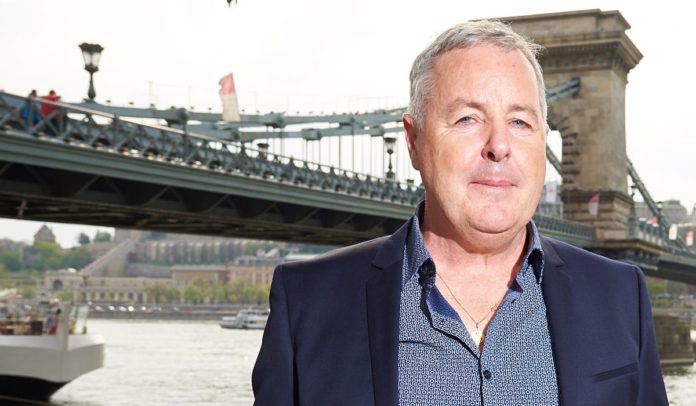
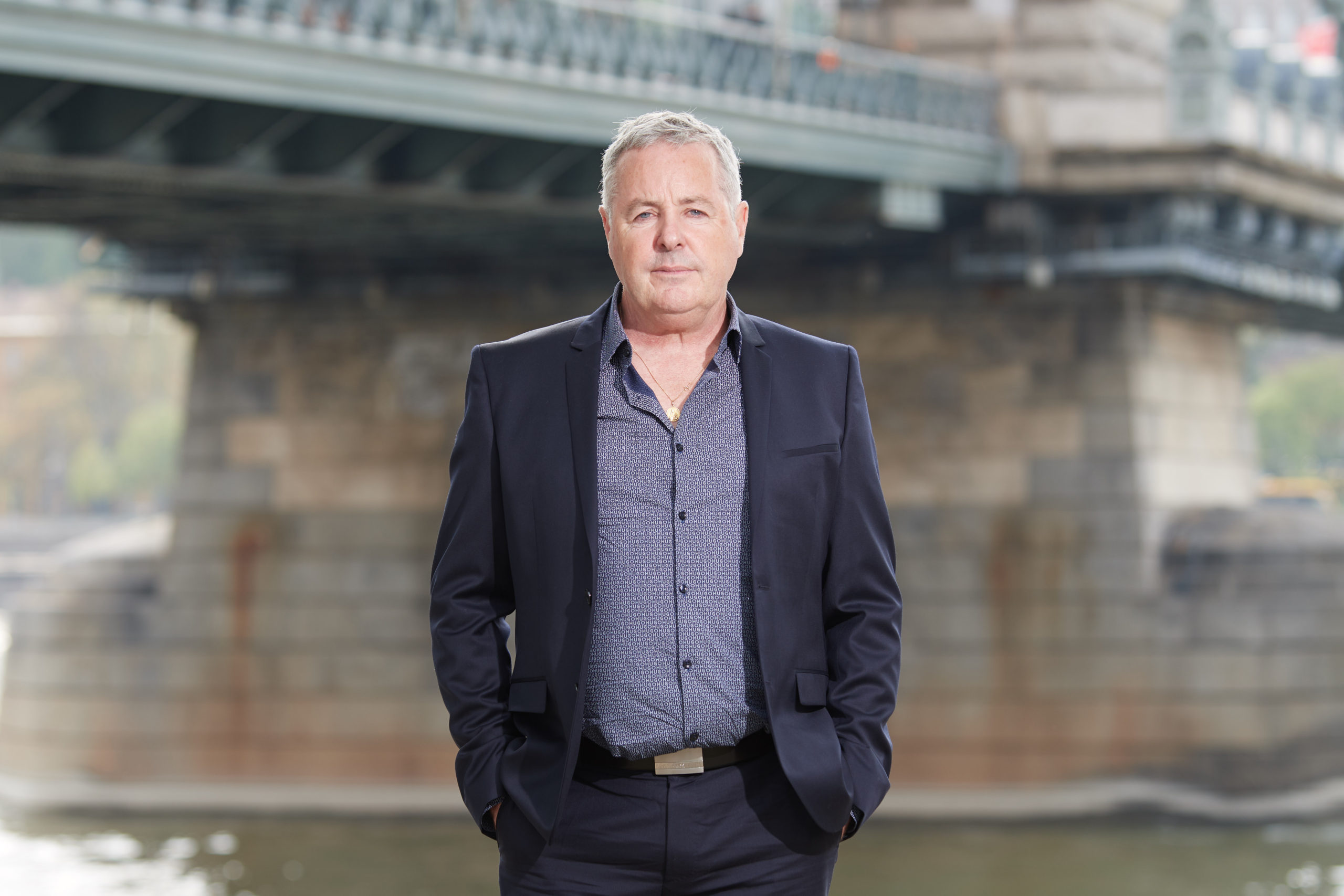
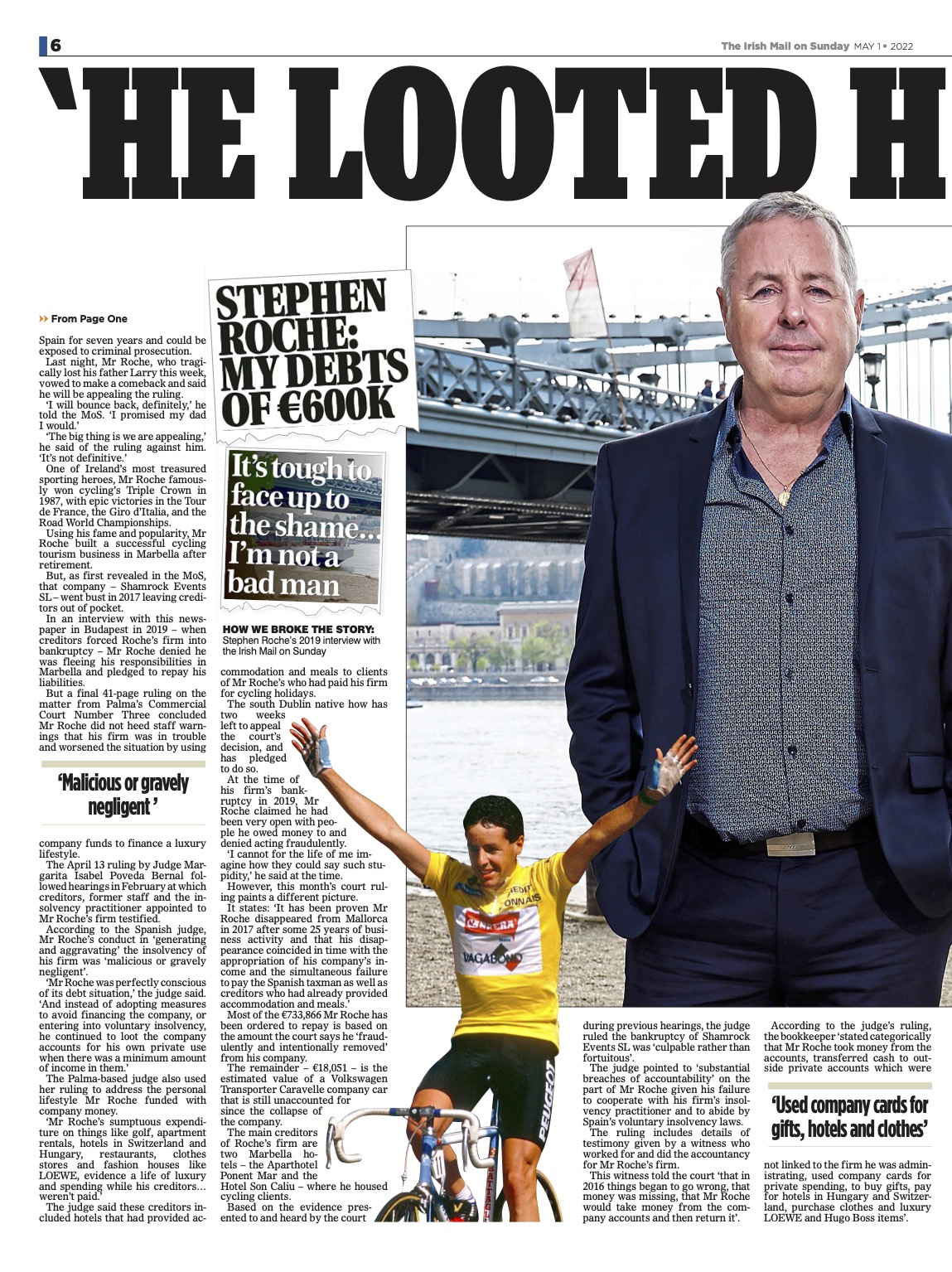
Stephen Roche, photographed in Budapest, Hungary, on the banks of the Danube. Photo by Sean Dwyer 10/04/19
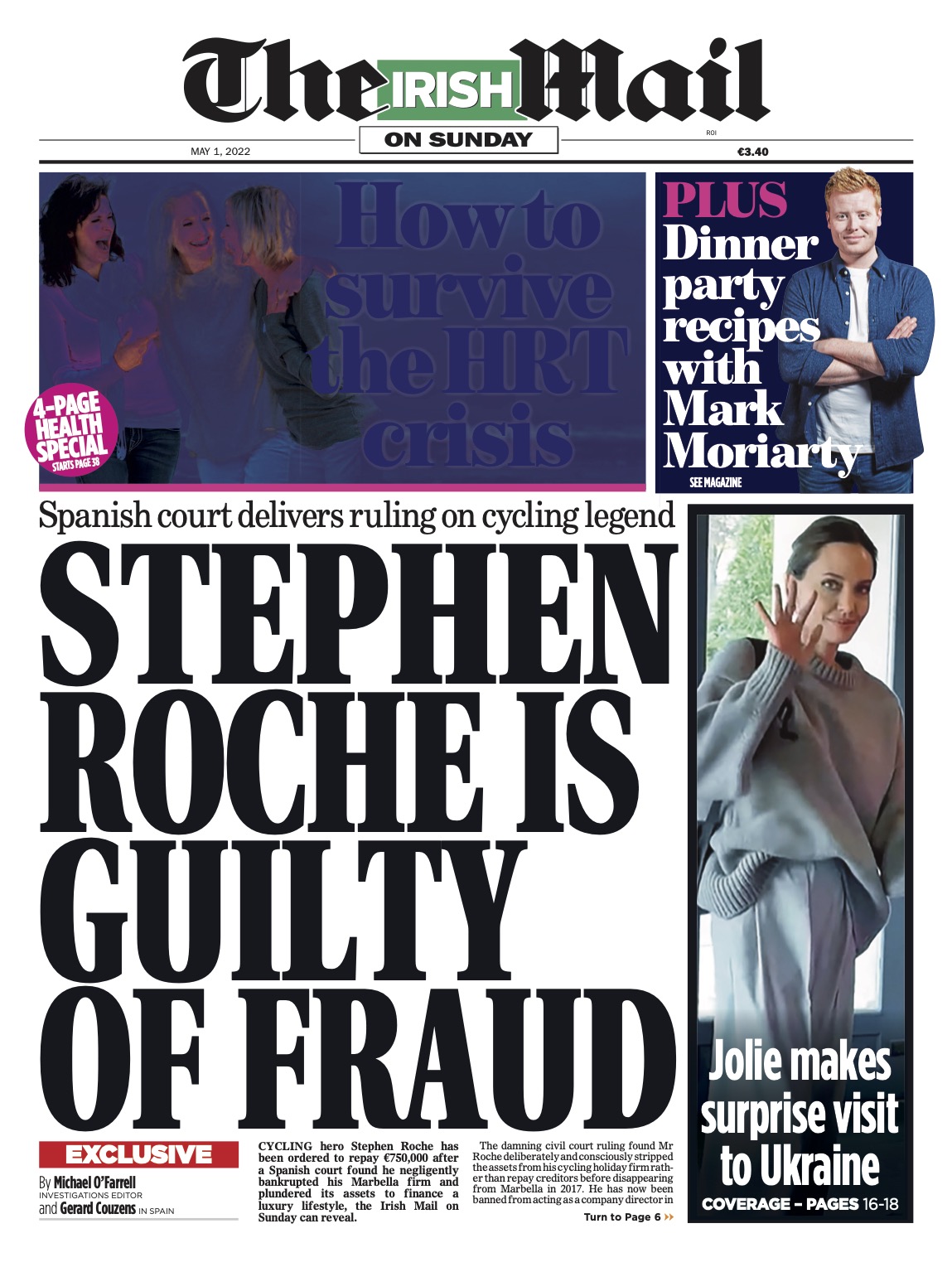
CYCLING hero Stephen Roche has been ordered to repay €750,000 after a Spanish court found he negligently bankrupted his Marbella firm and plundered its assets to finance a luxury lifestyle, the Irish Mail on Sunday can reveal.
The damning civil court ruling found Mr Roche deliberately and consciously stripped the assets from his cycling holiday firm rather than repay creditors before disappearing from Marbella in 2017. He has now been banned from acting as a company director in Spain for seven years and could be exposed to criminal prosecution.
Last night, Mr Roche, who tragically lost his father Larry this week, vowed to make a comeback and said he will be appealing the ruling.
‘I will bounce back, definitely,’ he told the MoS. ‘I promised my dad I would.’
‘The big thing is we are appealing,’ he said of the ruling against him. ‘It’s not definitive.’
One of Ireland’s most treasured sporting heroes, Mr Roche famously won cycling’s Triple Crown in 1987, with epic victories in the Tour de France, the Giro d’Italia, and the Road World Championships.
Using his fame and popularity, Mr Roche built a successful cycling tourism business in Marbella after retirement.
But, as first revealed in the MoS, that company – Shamrock Events SL – went bust in 2017 leaving creditors out of pocket.
In an interview with this newspaper in Budapest in 2019 – when creditors forced Roche’s firm into bankruptcy – Mr Roche denied he was fleeing his responsibilities in Marbella and pledged to repay his liabilities.
But a final 41-page ruling on the matter from Palma’s Commercial Court Number Three concluded Mr Roche did not heed staff warnings that his firm was in trouble and worsened the situation by using company funds to finance a luxury lifestyle.
The April 13 ruling by Judge Margarita Isabel Poveda Bernal followed hearings in February at which creditors, former staff and the insolvency practitioner appointed to Mr Roche’s firm testified.
According to the Spanish judge, Mr Roche’s conduct in ‘generating and aggravating’ the insolvency of his firm was ‘malicious or gravely negligent’.
‘Mr Roche was perfectly conscious of its debt situation,’ the judge said. ‘And instead of adopting measures to avoid financing the company, or entering into voluntary insolvency, he continued to loot the company accounts for his own private use when there was a minimum amount of income in them.’
The Palma-based judge also used her ruling to address the personal lifestyle Mr Roche funded with company money.
‘Mr Roche’s sumptuous expenditure on things like golf, apartment rentals, hotels in Switzerland and Hungary, restaurants, clothes stores and fashion houses like LOEWE, evidence a life of luxury and spending while his creditors? weren’t paid.’
The judge said these creditors included hotels that had provided accommodation and meals to clients of Mr Roche’s who had paid his firm for cycling holidays.
The south Dublin native how has two weeks left to appeal the court’s decision, and has pledged to do so.
At the time of his firm’s bankruptcy in 2019, Mr Roche claimed he had been very open with people he owed money to and denied acting fraudulently.
‘I cannot for the life of me imagine how they could say such stupidity,’ he said at the time.
However, this month’s court ruling paints a different picture.
Irish Mail on Sunday – May 1, 2022.
It states: ‘It has been proven Mr Roche disappeared from Mallorca in 2017 after some 25 years of business activity and that his disappearance coincided in time with the appropriation of his company’s income and the simultaneous failure to pay the Spanish taxman as well as creditors who had already provided accommodation and meals.’
Most of the €733,866 Mr Roche has been ordered to repay is based on the amount the court says he ‘fraudulently and intentionally removed’ from his company.
The remainder – €18,051 – is the estimated value of a Volkswagen Transporter Caravelle company car that is still unaccounted for since the collapse of the company.
The main creditors of Roche’s firm are two Marbella hotels – the Aparthotel Ponent Mar and the Hotel Son Caliu – where he housed cycling clients.
Based on the evidence presented to and heard by the court during previous hearings, the judge ruled the bankruptcy of Shamrock Events SL was ‘culpable rather than fortuitous’.
The judge pointed to ‘substantial breaches of accountability’ on the part of Mr Roche given his failure to cooperate with his firm’s insolvency practitioner and to abide by Spain’s voluntary insolvency laws.
The ruling includes details of testimony given by a witness who worked for and did the accountancy for Mr Roche’s firm.
This witness told the court ‘that in 2016 things began to go wrong, that money was missing, that Mr Roche would take money from the company accounts and then return it’.
According to the judge’s ruling, the bookkeeper ‘stated categorically that Mr Roche took money from the accounts, transferred cash to outside private accounts which were not linked to the firm he was administrating, used company cards for private spending, to buy gifts, pay for hotels in Hungary and Switzerland, purchase clothes and luxury LOEWE and Hugo Boss items’.
knowledge and his lack of access to financial records had impacted on his ability to deal with matters in Marbella .
‘Shamrock went into administration on April 26, 2019. The UK ceased to be an EU member state on January 31, 2020,’ the judge commented in her ruling.
She also dismissed Roche’s claims that accounting records his company had failed to hand over to the insolvency practitioner were in the hotel where he had registered his firm and that he had been prevented from getting to them.
‘The excuse the accounting records that were constantly requested but never handed over,
The ruling said the bookkeeper further ‘stated that he reproached Mr Roche’s behaviour on several occasions, telling him he couldn’t do this’.
The bookkeeper also told the court ‘the company’s financial adviser had warned Mr Roche about the accounting irregularities and told him he had to sort things out and put the money back or the company would go bust’.
The ruling also notes the same witness told the court ‘during his evidence that Roche earned €3,900 a month as the company’s ‘director’.
In her ruling, the judge also criticised arguments from Mr Roche that Brexit, his lack of business were in the offices of the insolvent company insi- the Aparthotel Ponent Mar is quite a poor one,’ she wrote.
‘As if accounting records, instead of being digitalised and able to be sent from any computer terminal in the world, were in obsolete and dusty accounting books or on computers that were not connected to the internet and had been abandoned in a physical place.’
Unless he can overturn the ruling on appeal, the seven-year ban imposed on Mr Roche disqualifies him from ‘administering third-party assets, as well as representing or administering anyone’.
He has also been ordered to pay all costs and personally repay any debt left over following the completion of the insolvency process.
José Luis Lopez Morey, the lawyer acting for Ponent Mar SA, which was one of the companies that took Mr Roche to court, said the ruling was ‘very comprehensive’.
‘The judge has supported our assertion which was that the actions of Mr Roche were completely negligent ‘ and contrary to the behaviour of a law-abiding and dependable administrator,’ he said.
‘He’s taken advantage of his company for his own private benefit, to the detriment of many people including his creditors and his own employees.
‘He’s left a mess behind him in Mallorca and he hasn’t returned.
‘He can appeal but the fact the ruling is so hard-hitting and Mr Roche has been censured not just over a single action but for many of his actions means that, in my view, any appeal has little chance of prospering.’
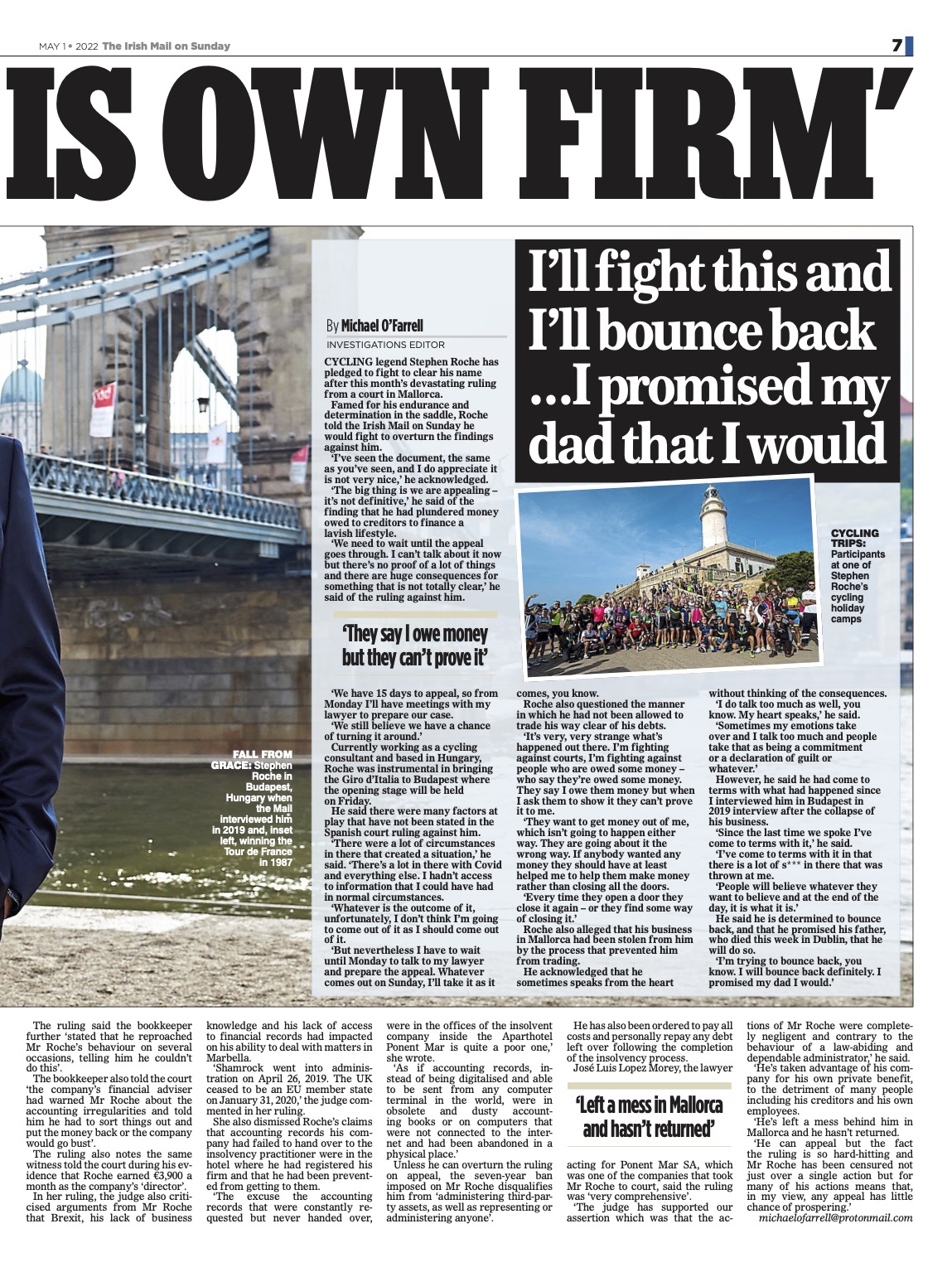
Michael OFarrell
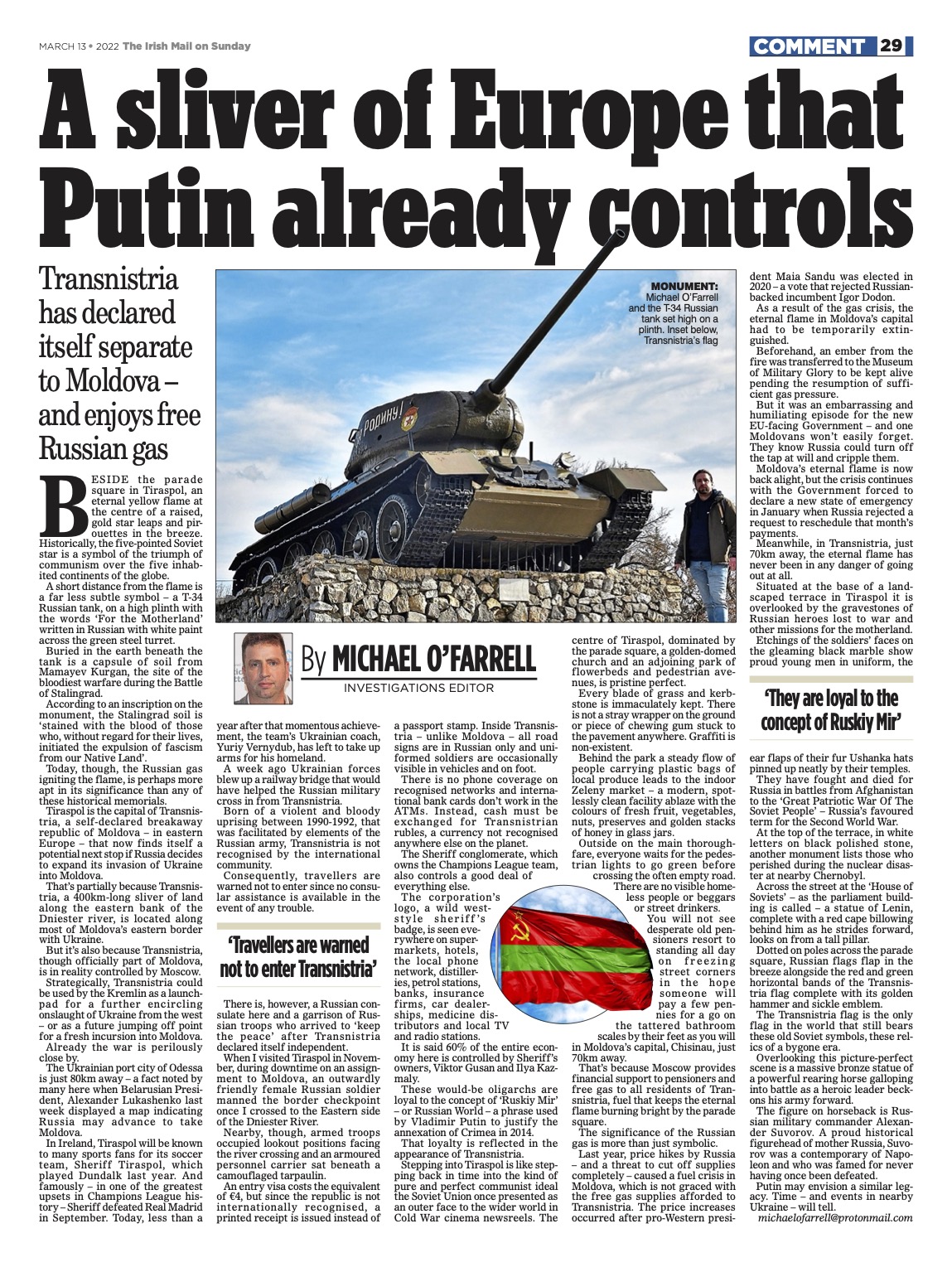
and the T-34 Russian
tank set high on a
plinth
BESIDE the parade square in Tiraspol, an eternal yellow flame at the centre of a raised, gold star leaps and pirouettes in the breeze.
Historically, the five-pointed Soviet star is a symbol of the triumph of communism over the five inhabited continents of the globe.
A short distance from the flame is a far less subtle symbol – a T-34 Russian tank, on a high plinth with the words ‘For the Motherland’ written in Russian with white paint across the green steel turret.
Buried in the earth beneath the tank is a capsule of soil from Mamayev Kurgan, the site of the bloodiest warfare during the Battle of Stalingrad.
According to an inscription on the monument, the Stalingrad soil is ‘stained with the blood of those who, without regard for their lives, initiated the expulsion of fascism from our Native Land’.
Today, though, the Russian gas igniting the flame, is perhaps more apt in its significance than any of these historical memorials.
Tiraspol is the capital of Transnistria, a self-declared breakaway republic of Moldova – in eastern Europe – that now finds itself a potential next stop if Russia decides to expand its invasion of Ukraine into Moldova.
Irish Mail on Sunday – March 13, 2022.
That’s partially because Transnistria, a 400km-long sliver of land along the eastern bank of the Dniester river, is located along most of Moldova’s eastern border with Ukraine.
But it’s also because Transnistria, though officially part of Moldova, is in reality controlled by Moscow.
Strategically, Transnistria could be used by the Kremlin as a launchpad for a further encircling onslaught of Ukraine from the west – or as a future jumping off point for a fresh incursion into Moldova.
Already the war is perilously close by.
The Ukrainian port city of Odessa is just 80km away – a fact noted by many here when Belarusian President, Alexander Lukashenko last week displayed a map indicating Russia may advance to take Moldova.
In Ireland, Tiraspol will be known to many sports fans for its soccer team, Sheriff Tiraspol, which played Dundalk last year. And famously – in one of the greatest upsets in Champions League history – Sheriff defeated Real Madrid in September.
Today, less than a year after that momentous achievement, the team’s Ukrainian coach, Yuriy Vernydub, has left to take up arms for his homeland.
Stepping into Tiraspol is like stepping back in time into the kind of pure and perfect communist ideal the Soviet Union once presented as an outer face to the wider world in Cold War cinema newsreels.
A week ago Ukrainian forces blew up a railway bridge that would have helped the Russian military cross in from Transnistria.
Born of a violent and bloody uprising between 1990-1992, that was facilitated by elements of the Russian army, Transnistria is not recognised by the international community.
Consequently, travellers are warned not to enter since no consular assistance is available in the event of any trouble.
There is, however, a Russian consulate here and a garrison of Russian troops who arrived to ‘keep the peace’ after Transnistria declared itself independent.
When I visited Tiraspol in November, during downtime on an assignment to Moldova, an outwardly friendly female Russian soldier manned the border checkpoint once I crossed to the Eastern side of the Dniester River.
Nearby, though, armed troops occupied lookout positions facing the river crossing and an armoured personnel carrier sat beneath a camouflaged tarpaulin.
An entry visa costs the equivalent of €4, but since the republic is not internationally recognised, a printed receipt is issued instead of a passport stamp.
Inside Transnistria – unlike Moldova – all road signs are in Russian only and uniformed soldiers are occasionally visible in vehicles and on foot.
There is no phone coverage on recognised networks and international bank cards don’t work in the ATMs. Instead, cash must be exchanged for Transnistrian rubles, a currency not recognised anywhere else on the planet.
The Sheriff conglomerate, which owns the Champions League team, also controls a good deal of everything else.
The Transnistria flag is the only flag in the world that still bears these old Soviet symbols, these relics of a bygone era.
The corporation’s logo, a wild weststyle sheriff’s badge, is seen everywhere on supermarkets, hotels, the local phone network, distilleries, petrol stations, banks, insurance firms, car dealerships, medicine distributors and local TV and radio stations.
It is said 60% of the entire economy here is controlled by Sheriff’s owners, Viktor Gusan and Ilya Kazmaly. These would-be oligarchs are loyal to the concept of ‘Ruskiy Mir’ – or Russian World – a phrase used by Vladimir Putin to justify the annexation of Crimea in 2014.
That loyalty is reflected in the appearance of Transnistria.
Stepping into Tiraspol is like stepping back in time into the kind of pure and perfect communist ideal the Soviet Union once presented as an outer face to the wider world in Cold War cinema newsreels.
The centre of Tiraspol, dominated by the parade square, a golden-domed church and an adjoining park of flowerbeds and pedestrian avenues, is pristine perfect.
Every blade of grass and kerbstone is immaculately kept. There is not a stray wrapper on the ground or piece of chewing gum stuck to the pavement anywhere. Graffiti is non-existent.
Behind the park a steady flow of people carrying plastic bags of local produce leads to the indoor Zeleny market – a modern, spotlessly clean facility ablaze with the colours of fresh fruit, vegetables, nuts, preserves and golden stacks of honey in glass jars.
Outside on the main thoroughfare, everyone waits for the pedestrian lights to go green before crossing the often empty road.
There are no visible homeless people or beggars or street drinkers.
You will not see desperate old pensioners resort to standing all day on freezing street corners in the hope someone will pay a few pennies for a go on the tattered bathroom scales by their feet as you will in Moldova’s capital, Chisinau, just 70km away.
That’s because Moscow provides financial support to pensioners and free gas to all residents of Transnistria, fuel that keeps the eternal flame burning bright by the parade square.
The significance of the Russian gas is more than just symbolic.
Last year, price hikes by Russia – and a threat to cut off supplies completely – caused a fuel crisis in Moldova, which is not graced with the free gas supplies afforded to Transnistria. The price increases occurred after pro-Western president
Maia Sandu was elected in 2020 – a vote that rejected Russianbacked incumbent Igor Dodon.
As a result of the gas crisis, the eternal flame in Moldova’s capital had to be temporarily extinguished. Beforehand, an ember from the fire was transferred to the Museum of Military Glory to be kept alive pending the resumption of sufficient gas pressure.
But it was an embarrassing and humiliating episode for the new EU-facing Government – and one Moldovans won’t easily forget. They know Russia could turn off the tap at will and cripple them.
Moldova’s eternal flame is now back alight, but the crisis continues with the Government forced to declare a new state of emergency in January when Russia rejected a request to reschedule that month’s payments.
Meanwhile, in Transnistria, just 70km away, the eternal flame has never been in any danger of going out at all.
Situated at the base of a landscaped terrace in Tiraspol it is overlooked by the gravestones of Russian heroes lost to war and other missions for the motherland.
Etchings of the soldiers’ faces on the gleaming black marble show proud young men in uniform, the ear flaps of their fur Ushanka hats pinned up neatly by their temples.
They have fought and died for Russia in battles from Afghanistan to the ‘Great Patriotic War Of The Soviet People’ – Russia’s favoured term for the Second World War.
At the top of the terrace, in white letters on black polished stone, another monument lists those who perished during the nuclear disaster at nearby Chernobyl.
Across the street at the ‘House of Soviets’ – as the parliament building is called – a statue of Lenin, complete with a red cape billowing behind him as he strides forward, looks on from a tall pillar.
Dotted on poles across the parade square, Russian flags flap in the breeze alongside the red and green horizontal bands of the Transnistria flag complete with its golden hammer and sickle emblem.
The Transnistria flag is the only flag in the world that still bears these old Soviet symbols, these relics of a bygone era.
Overlooking this picture-perfect scene is a massive bronze statue of a powerful rearing horse galloping into battle as a heroic leader beckons his army forward.
The figure on horseback is Russian military commander Alexander Suvorov. A proud historical figurehead of mother Russia, Suvorov was a contemporary of Napoleon and who was famed for never having once been defeated.
Putin may envision a similar legacy. Time – and events in nearby Ukraine – will tell.
TAOISEACH Micheál Martin and An Tanaiste Leo Varadker ignored a letter from a woman who was subjected to misogynistic abuse in a WhatsApp group set up by Green Party TD Brian Leddin.
Their failure to respond contrasts with EU President Ursula von der Leyen response to the woman through a spokesman, saying it ‘saddens’ her ‘to hear about the gender-based online targeting you have endured’.
Justice Minister Helen McEntee is to spearhead a new drive to tackle all forms of abuse against women in the wake of the killing of Ashling Murphy.
Last weekend, Ms McEntee promised to ‘eradicate social and cultural attitudes – among men – that contribute to women feeling unsafe.’
She said: ‘That means appropriate education, from primary school up, on healthy relationships, gender equality and consent. It means changing our culture so we are not bystanders, but call out inappropriate behaviour when we see it – in the workplace, in the pub, in the Whats- App group.’
Ms McEntee was on maternity leave during the controversy which meant she has never before been asked to address the matter directly.
Cllr Elisa O’Donovan was targeted by WhatsApp group.
When the Irish Mail on Sunday asked her to address the failure of the Government parties to sanction Mr Leddin, a spokesman said she believes ‘it is important that all of us together learn that we must challenge attitudes which can be undermining and damaging to women and Mr Leddin has said he should have challenged such comments and regrets not doing so’.
The spokesman added: ‘Minister McEntee believes that there is no place for such misogynistic and demeaning language in any discourse and that it must be called out everywhere, including WhatsApp groups.’
We asked Ms McEntee to address the failure of many male TDs – including the Taoiseach and the Tánaiste – to show the kind of leadership she is now calling for.
‘The Taoiseach, Tánaiste and others have said that men have a lead role in bringing about the necessary cultural change to achieve zero tolerance of violence and abuse against women. The Minister believes there is a responsibility on those in public life to take action to demonstrate a zero-tolerance approach,’ her spokesman added.
Yesterday, a spokesman for Tánaiste Leo Varadkar addressed the Leddin scandal for the first time. He said: ‘The Tánaiste fully backs Minister McEntee’s plans to shortly publish an updated strategy based on prevention, protection, prosecution and policy co-ordination which will take a zero tolerance approach to violence against women. She will publish a detailed action plan outlining the exact measures to be undertaken across Government and State agencies and clear timelines for when these actions will be completed.’
But he didn’t answer direct questions as to why he did not respond to the woman.
Mr Martin also did not respond to a letter sent last September from the woman targeted in the WhatsApp group set up by Mr Leddin. Similarly, he did not respond when asked by this newspaper to address the woman’s concerns this week.
A spokesman for Green Party leader Eamon Ryan this week said: ‘Minister Ryan fully supports Minister McEntee in developing a new strategy on domestic, sexual and gender-based violence, which will have input from across government. He is pleased to see that it will be underpinned by clear actions, timelines, clear accountability mechanisms, and will be properly resourced.’
The belated responses contrast to how the EU Commission addressed the matter when the woman – a respected Limerick-based professional – wrote directly to Ms von der Leyen. She referred the matter to the head of the Commission’s gender equality unit, Karen Vandekerckhove, who responded before Christmas.
‘It saddens me to hear about the gender-based online targeting you have endured,’ Ms Vandekerckhove wrote. ‘All forms of gender-based violence and harassment can have far-reaching effects. In addition to negative health consequences, they can result in withdrawal from societal and political discussions and negatively affect women’s democratic participation.’
The woman – whose face was emblazoned with the word ‘c***’ on Mr Leddin’s WhatsApp group – said events last week had reignited her sense of vulnerability.
She said: ‘Threats posed in Whats- App groups encourage others to implement those threats. They enable and they feed abusive behaviour. The Dáil should lead by example’ and call out their colleagues who they know have engaged in reprehensible and abusive conduct.’
Limerick Counci l lor El isa O’Donovan, who was also subjected to abuse in the group, said: ‘I think most women know that WhatsApp groups are toxic towards them.
Ms O’Donovan said Mr Ryan had ensured there would be no ‘real repercussions for those that engage in sexist and demeaning behaviour towards women’.
Seven senior Green Party members – including Deputy Leader Catherine Martin and MEP Grace O’Sullivan – criticised the party’s failure to sanction Mr Leddin.
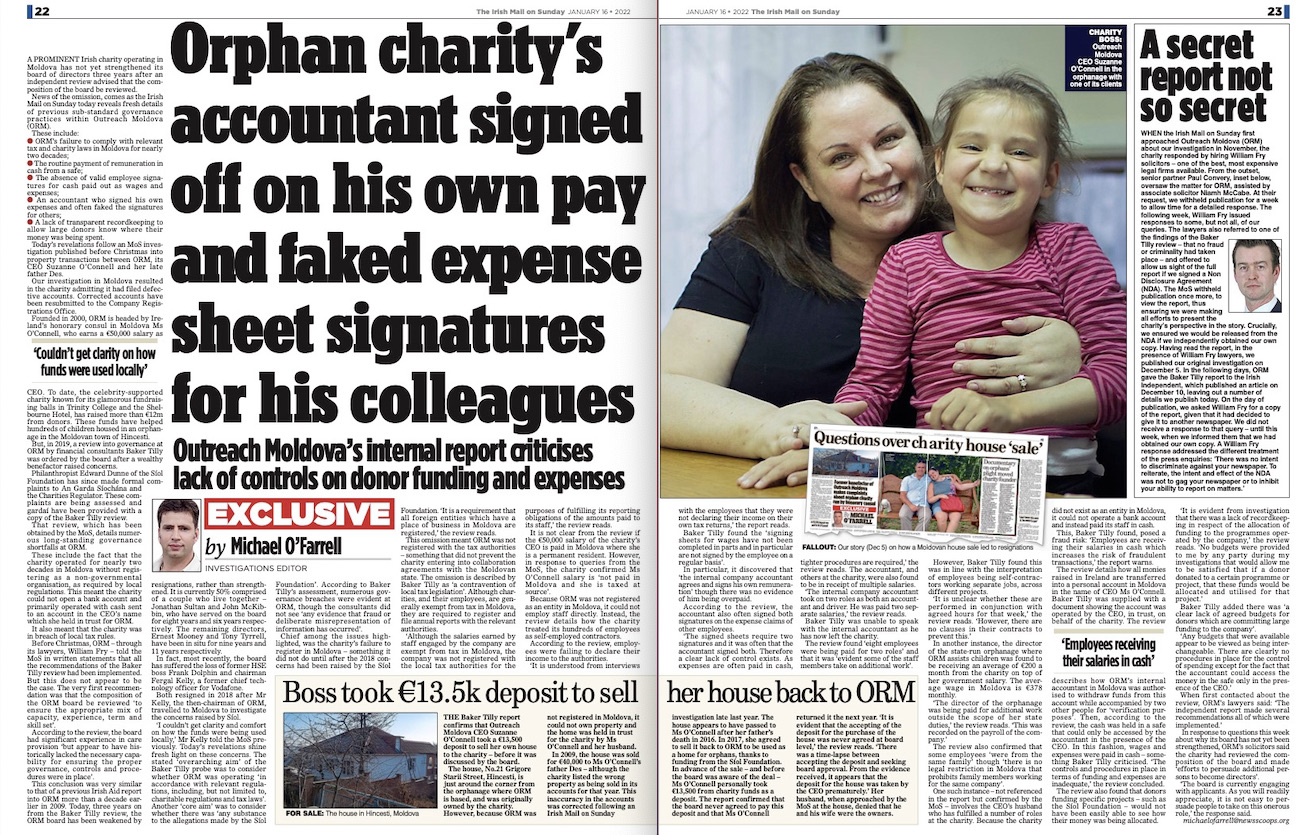
A PROMINENT Irish charity operating in Moldova has not yet strengthened its board of directors three years after an independent review advised that the composition of the board be reviewed.
News of the omission, comes as the Irish Mail on Sunday today reveals fresh details of previous sub-standard governance practices within Outreach Moldova (ORM).
These include:
ORM’s failure to comply with relevant tax and charity laws in Moldova for nearly two decades;
The routine payment of remuneration in cash from a safe;
The absence of valid employee signatures for cash paid out as wages and expenses;
An accountant who signed his own expenses and often faked the signatures for others;
A lack of transparent recordkeeping to allow large donors know where their money was being spent.
Today’s revelations follow an MoS investigation published before Christmas into property transactions between ORM, its CEO Suzanne O’Connell and her late father Des.
Our investigation in Moldova resulted in the charity admitting it had filed defective accounts. Corrected accounts have been resubmitted to the Company Registrations Office.
Founded in 2000, ORM is headed by Ireland’s honorary consul in Moldova Ms O’Connell, who earns a €50,000 salary as CEO.
Outreach Moldova CEO, Suzanne O’Connell.
To date, the celebrity-supported charity known for its glamorous fundraising balls in Trinity College and the Shelbourne Hotel, has raised more than €12m from donors. These funds have helped hundreds of children housed in an orphanage in the Moldovan town of Hincesti.
But, in 2019, a review into governance at ORM by financial consultants Baker Tilly was ordered by the board after a wealthy benefactor raised concerns.
Philanthropist Edward Dunne of the Síol Foundation has since made formal comresignations, plaints to An Garda Síochána and the Charities Regulator. These complaints are being assessed and gardaí have been provided with a copy of the Baker Tilly review.
That review, which has been obtained by the MoS, details numerous long-standing governance shortfalls at ORM.
These include the fact that the charity operated for nearly two decades in Moldova without registering as a non-governmental organisation, as required by local regulations. This meant the charity could not open a bank account and primarily operated with cash sent to an account in the CEO’s name which she held in trust for ORM.
It also meant that the charity was in breach of local tax rules.
Before Christmas, ORM – through its lawyers, William Fry – told the MoS in written statements that all the recommendations of the Baker Tilly review had been implemented.
But this does not appear to be the case.
The very first recommendation was that the composition of the ORM board be reviewed ‘to ensure the appropriate mix of capacity, experience, term and skill set’.
According to the review, the board had significant experience in care provision ‘but appear to have historically lacked the necessary capability for ensuring the proper governance, controls and procedures were in place’.
Irish Mail on Sunday – Jan 16, 2022.
This conclusion was very similar to that of a previous Irish Aid report into ORM more than a decade earlier in 2009.
Today, three years on from the Baker Tilly review, the ORM board has been weakened by rather than strengthened.
It is currently 50% comprised of a couple who live together – Jonathan Sultan and John McKibbin, who have served on the board for eight years and six years respectively. The remaining directors, Ernest Mooney and Tony Tyrrell, have been in situ for nine years and 11 years respectively.
In fact, most recently, the board has suffered the loss of former HSE boss Frank Dolphin and chairman Fergal Kelly, a former chief technology officer for Vodafone.
Both resigned in 2018 after Mr Kelly, the then-chairman of ORM, travelled to Moldova to investigate the concerns raised by Síol.
‘I couldn’t get clarity and comfort on how the funds were being used locally,’ Mr Kelly told the MoS previously.
Today’s revelations shine fresh light on these concerns.
The stated ‘overarching aim’ of the Baker Tilly probe was to consider whether ORM was operating ‘in accordance with relevant regulations, including, but not limited to, charitable regulations and tax laws’.
Another ‘core aim’ was to consider whether there was ‘any substance to the allegations made by the Síol Foundation’.
According to Baker Tilly’s assessment, numerous governance breaches were evident at ORM, though the consultants did not see ‘any evidence that fraud or deliberate misrepresentation of information has occurred’.
Chief among the issues highlighted, was the charity’s failure to register in Moldova – something it did not do until after the 2018 concerns had been raised by the Síol Foundation.
‘It is a requirement that all foreign entities which have a place of business in Moldova are registered,’ the review reads.
This omission meant ORM was not registered with the tax authorities – something that did not prevent the charity entering into collaboration agreements with the Moldovan state.
The omission is described by Baker Tilly as ‘a contravention of local tax legislation’.
Although charities, and their employees, are generally exempt from tax in Moldova, they are required to register and file annual reports with the relevant authorities.
‘Although the salaries earned by staff engaged by the company are exempt from tax in Moldova, the company was not registered with the local tax authorities for the purposes of fulfilling its reporting obligations of the amounts paid to its staff,’ the review reads.
It is not clear from the review if the €50,000 salary of the charity’s CEO is paid in Moldova where she is a permanent resident. However, in response to queries from the MoS, the charity confirmed Ms O’Connell salary is ‘not paid in Moldova and she is taxed at source’.
Because ORM was not registered as an entity in Moldova, it could not employ staff directly. Instead, the review details how the charity treated its hundreds of employees as self-employed contractors.
According to the review, employees were failing to declare their income to the authorities.
‘It is understood from interviews with the employees that they were not declaring their income on their own tax returns,’ the report reads.
Baker Tilly found the ‘signing sheets for wages have not been completed in parts and in particular are not signed by the employee on a regular basis’.
In particular, it discovered that ‘the internal company accountant agrees and signs his own remuneration’ though there was no evidence of him being overpaid.
According to the review, the accountant also often signed both signatures on the expense claims of other employees.
‘The signed sheets require two signatures and it was often that the accountant signed both. Therefore a clear lack of control exists. As expenses are often paid in cash, tighter procedures are required,’ the review reads.
The accountant, and others at the charity, were also found to be in receipt of multiple salaries.
‘The internal company accountant took on two roles as both an accountant and driver. He was paid two separate salaries,’ the review reads.
Baker Tilly was unable to speak with the internal accountant as he has now left the charity.
The review found ‘eight employees were being paid for two roles’ and that it was ‘evident some of the staff members take on additional work’.
However, Baker Tilly found this was in line with the interpretation of employees being self-contractors working separate jobs, across different projects.
‘It is unclear whether these are performed in conjunction with agreed hours for that week,’ the review reads. ‘However, there are no clauses in their contracts to prevent this.’
In another instance, the director of the state-run orphanage where ORM assists children was found to be receiving an average of €200 a month from the charity on top of her government salary. The average wage in Moldova is €378 monthly.
‘The director of the orphanage was being paid for additional work outside the scope of her state duties,’ the review reads. ‘This was recorded on the payroll of the company.’
The review also confirmed that some employees ‘were from the same family’ though ‘there is no legal restriction in Moldova that prohibits family members working for the same company’.
One such instance – not referenced in the report but confirmed by the MoS – involves the CEO’s husband who has fulfilled a number of roles at the charity.
Because the charity did not exist as an entity in Moldova, it could not operate a bank account and instead paid its staff in cash.
The Irish Mail on Sunday – January 16, 2022.
This, Baker Tilly found, posed a fraud risk: ‘Employees are receiving their salaries in cash which increases the risk of fraudulent transactions,’ the report warns.
The review details how all monies raised in Ireland are transferred into a personal account in Moldova in the name of CEO Ms O’Connell. Baker Tilly was supplied with a document showing the account was operated by the CEO, in trust, on behalf of the charity.
The review describes how ORM’s internal accountant in Moldova was authorised to withdraw funds from this account while accompanied by two other people for ‘verification purposes’.
Then, according to the review, the cash was held in a safe that could only be accessed by the accountant in the presence of the CEO.
In this fashion, wages and expenses were paid in cash – something Baker Tilly criticised. ‘The controls and procedures in place in terms of funding and expenses are inadequate,’ the review concluded.
The review also found that donors funding specific projects – such as the Síol Foundation – would not have been easily able to see how their money was being allocated.
‘It is evident from investigation that there was a lack of recordkeeping in respect of the allocation of funding to the programmes operated by the company,’ the review reads.
‘No budgets were provided to me by any party during my investigations that would allow me to be satisfied that if a donor donated to a certain programme or project, that these funds would be allocated and utilised for that project.’
Baker Tilly added there was ‘a clear lack of agreed budgets for donors which are committing large funding to the company’.
‘Any budgets that were available appear to be viewed as being interchangeable. There are clearly no procedures in place for the control of spending except for the fact that the accountant could access the money in the safe only in the presence of the CEO.’
When first contacted about the review, ORM’s lawyers said: ‘The independent report made several recommendations all of which were implemented.’
In response to questions this week about why its board has not yet been strengthened, ORM’s solicitors said the charity had reviewed the composition of the board and made ‘efforts to persuade additional persons to become directors’.
‘The board is currently engaging with applicants. As you will readily appreciate, it is not easy to persuade people to take on this onerous role,’ the response said.
Boss took €13.5k deposit to sell her house back to ORM
THE Baker Tilly report confirms that Outreach Moldova CEO Suzanne O’Connell took a €13,500 deposit to sell her own house to the charity – before it was discussed by the board.
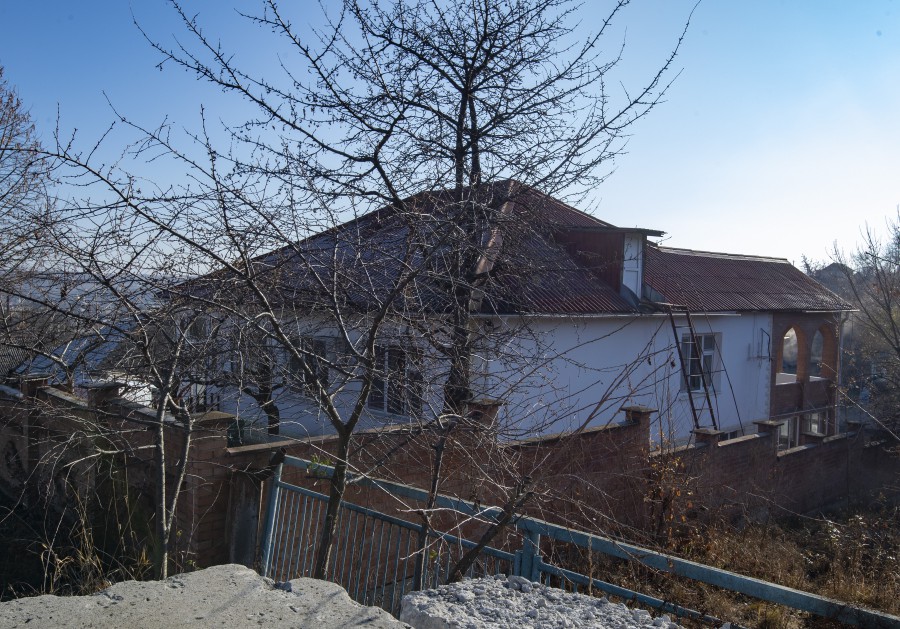
The house, No.21 Grigore Starii Street, Hincesti, is just around the corner from the orphanage where ORM is based, and was originally owned by the charity.
However, because ORM was not registered in Moldova, it could not own property and the home was held in trust for the charity by Ms O’Connell and her husband.
In 2009, the house was sold for €40,000 to Ms O’Connell’s father Des – although the charity listed the wrong property as being sold in its accounts for that year. This inaccuracy in the accounts was corrected following an Irish Mail on Sunday investigation late last year.
The house appears to have passed to Ms O’Connell after her father’s death in 2016. In 2017, she agreed to sell it back to ORM to be used as a home for orphans, thanks to funding from the Síol Foundation.
In advance of the sale – and before the board was aware of the deal – Ms O’Connell personally took €13,500 from charity funds as a deposit.
The report confirmed that the board never agreed to pay this deposit and that Ms O’Connell returned it the next year.
‘It is evident that the accepting of the deposit for the purchase of the house was never agreed at board level,’ the review reads.
‘There was a time-lapse between accepting the deposit and seeking board approval. From the evidence received, it appears that the deposit for the house was taken by the CEO prematurely.’
Her husband, when approached by the MoS at the house, denied that he and his wife were the owners.
FORMER Irish Nationwide boss Michael Fingleton is facing renewed accusations of fraud involving a multimillion-euro hotel deal in Montenegro.
The accusations, contained in new court documents filed in Montenegro, relate to a decades-long dispute between Mr Fingleton and a former business partner, Louis Maguire.
The pair were once partners in a €70m plan to develop Hotel Fjord in Kotor into a luxury resort and marina in 2006. In return for putting together the deal, Mr Maguire secured a 25% stake in the project.
From 2008, relations appear to have soured, creditors went unpaid and Mr Maguire launched a series of commercial cases accusing Mr Fingleton of acting illegally.
The bitter falling out has already resulted in Mr Fingleton facing down a criminal inquiry in Montenegro amid allegations of money laundering and questions about the origins of the funds used to buy the hotel.
Mr Fingleton has steadfastly maintained he always acted legitimately and that Mr Maguire’s allegations are unfounded. Now, in the latest case before the courts, Mr Maguire is accusing Mr Fingleton of defrauding him of his 25% stake in the project.
Mr Maguire’s Irish-registered firm, United Entertainment Partners Ltd, is taking the case as a ‘subsidiary prosecutor’. This mechanism allows injured parties in Montenegro to file criminal indictments for an investigative judge to consider.
The indictment, first filed in November 2019, accuses Mr Fingleton of ‘fraud’ contrary to Article 244 of the Criminal Code of Montenegro – an offence which can carry a three-year jail sentence.
Mr Fingleton and named associates – including his son Michael Fingleton Jr – are also accused of using ‘false balance sheets, simulated loan agreements, forged documents and other means, all with the intention of obtaining illegal property gain on behalf of Michael Fingleton and other persons’.
In April this year the Ministry of Justice in Montenegro wrote to the Department of Justice in Ireland to request that Mr Fingleton be formally served with a summons.
But Irish authorities rejected the request from Montenegro on the basis of insufficient assurances relating to action that may be taken against Mr Fingleton should he be compelled to travel to the country.
The assurances included that Mr Fingleton ‘will not be proceeded against, sentenced, detained or otherwise restricted other than for the offence specified in the request’.
‘It is unclear from your request what the position is in your country,’ wrote an official from the Department of Justice’s Central Authority for Mutual Assistance.
In a hearing on September 22 this year, the courts in Montenegro noted that ‘such a guarantee for the service of summons cannot be given to this defendant’.
Mr Fingleton bought Hotel Fjord in Kotor for €5.5m in a 2006 deal reportedly involving Veselin Vesko Barovic – an alleged cigarette smuggler. Amidst ongoing disputes with Mr Maguire he sold the property for €10.5m in 2018.
As previously revealed by the MoS, Mr Fingleton travelled to Montenegro to sign the sale agreement as he told Irish authorities he was too ill to attend the Central Bank’s inquiry into Irish Nationwide. Subsequently, in December 2019, the Central Bank quietly dropped its inquiry into Mr Fingleton on medical grounds.
This week Michael Fingleton Jr acknowledged questions from the MoS on behalf of his father but said he could not add to previous statements issued by his father. Mr Fingleton Sr previously told the MoS any criminal allegations against him were ‘unfounded, without merit and completely false’. He said: ‘All transactions in relation to this [hotel] project to date were totally legitimate, fully transparent and fully funded by me from my own personal resources.’
It is not clear what Mr Fingleton did with the proceeds of the hotel sale. But there are indications he may have sent the funds to the UK with the help of Michael Jr, who once oversaw Irish Nationwide’s British operations.
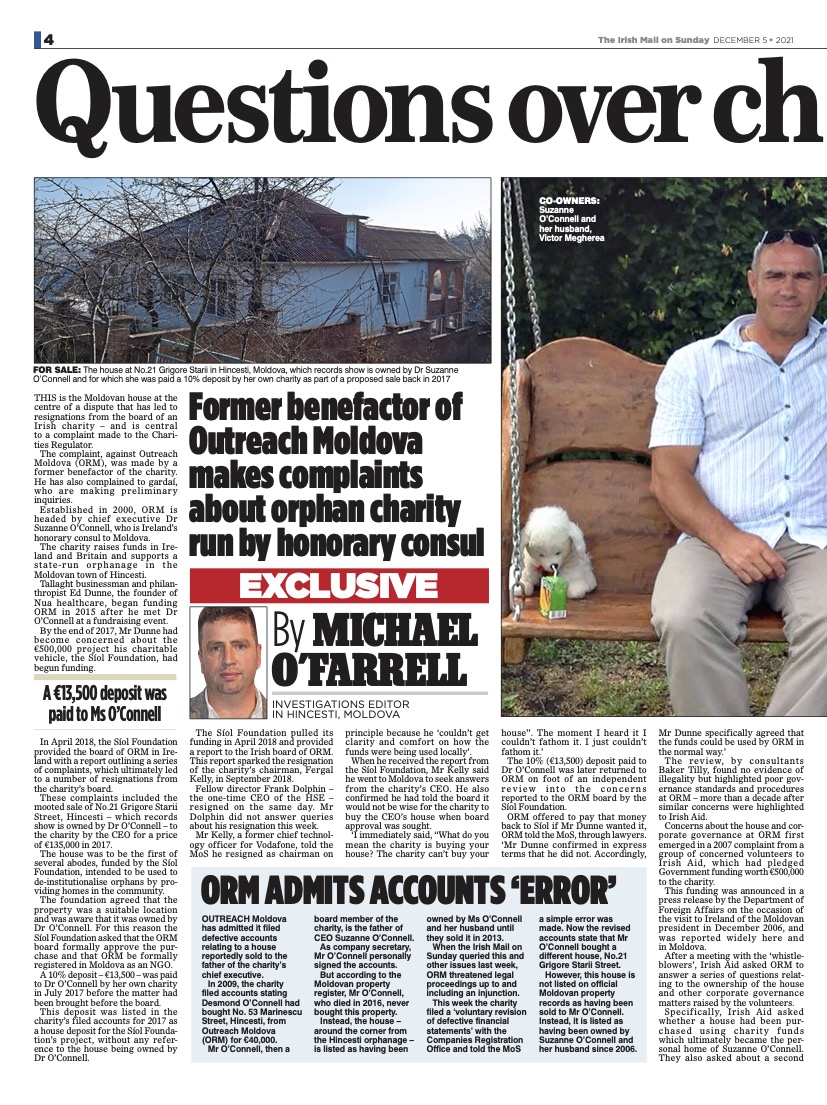
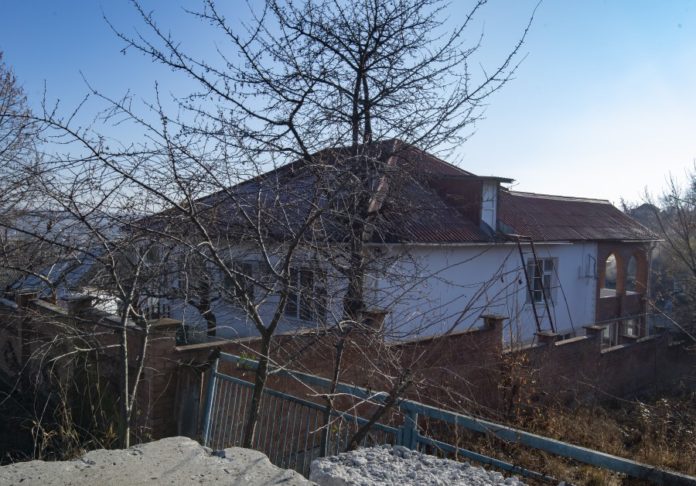
THIS is the Moldovan house at the centre of a dispute that has led to resignations from the board of an Irish charity – and is central to a complaint made to the Charities Regulator.
The complaint, against Outreach Moldova (ORM), was made by a former benefactor of the charity. He has also complained to gardaí, who are making preliminary inquiries.
Established in 2000, ORM is headed by chief executive Dr Suzanne O’Connell, who is Ireland’s honorary consul to Moldova.
The charity raises funds in Ireland and Britain and supports a state-run orphanage in the Moldovan town of Hincesti.
Tallaght businessman and philanthropist, Ed Dunne, the founder of Nua healthcare, began funding ORM in 2015 after he met Dr O’Connell at a fundraising event.
By the end of 2017, Mr Dunne had become concerned about the €500,000 project his charitable vehicle, the Síol Foundation, had begun funding.
In April 2018, the Síol Foundation provided the board of ORM in Ireland with a report outlining a series of complaints, which ultimately led to a number of resignations from the charity’s board.
These complaints included the mooted sale of No.21 Grigore Starii Street, Hincesti – which records show is owned by Dr O’Connell – to the charity by the CEO for a price of €135,000 in 2017.
The house was to be the first of several abodes, funded by the Síol Foundation, intended to be used to de-institutionalise orphans by providing homes in the community.
The foundation agreed that the property was a suitable location and was aware that it was owned by Dr O’Connell. For this reason the Síol Foundation asked that the ORM board formally approve the purchase and that ORM be formally registered in Moldova as an NGO.
A 10% deposit – €13,500 – was paid to Dr O’Connell by her own charity in July 2017 before the matter had been brought before the board.
Irish Mail on Sunday – December 5, 2021
Irish Mail on Sunday – December 5, 2021
This deposit was listed in the charity’s filed accounts for 2017 as a house deposit for the Síol Foundation’s project, without any reference to the house being owned by Dr O’Connell.
The Síol Foundation pulled its funding in April 2018 and provided a report to the Irish board of ORM. This report sparked the resignation of the charity’s chairman, Fergal Kelly, in September 2018.
Fellow director Frank Dolphin – the one-time CEO of the HSE – resigned on the same day. Mr Dolphin did not answer queries about his resignation this week.
Mr Kelly, a former chief technology officer for Vodafone, told the MoS he resigned as chairman on principle because he ‘couldn’t get clarity and comfort on how the funds were being used locally’.
When he received the report from the Síol Foundation, Mr Kelly said he went to Moldova to seek answers from the charity’s CEO. He also confirmed he had told the board it would not be wise for the charity to buy the CEO’s house when board approval was sought.
‘I immediately said, “What do you mean the charity is buying your house? The charity can’t buy your house”. The moment I heard it I couldn’t fathom it. I just couldn’t fathom it.’
The 10% (€13,500) deposit paid to Dr O’Connell was later returned to ORM on foot of an independent review into the concerns reported to the ORM board by the Síol Foundation.
ORM offered to pay that money back to Síol if Mr Dunne wanted it, ORM told the MoS, through lawyers. ‘Mr Dunne confirmed in express terms that he did not. Accordingly, Mr Dunne specifically agreed that the funds could be used by ORM in the normal way.’
The review, by consultants Baker Tilly, found no evidence of illegality but highlighted poor governance standards and procedures at ORM – more than a decade after similar concerns were highlighted to Irish Aid.
Concerns about the house and corporate governance at ORM first emerged in a 2007 complaint from a group of concerned volunteers to Irish Aid, which had pledged Government funding worth €500,000 to the charity.
This funding was announced in a press release by the Department of Foreign Affairs on the occasion of the visit to Ireland of the Moldovan president in December 2006, and was reported widely here and in Moldova.
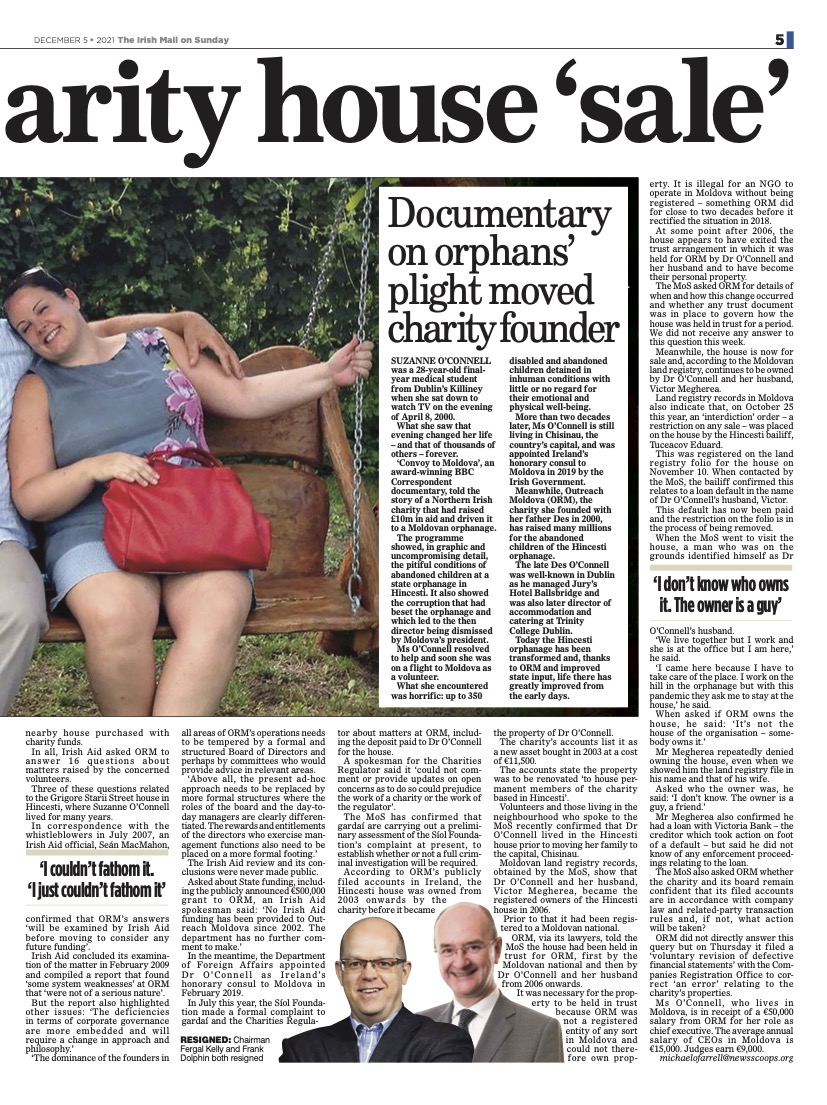
Outreach Moldova founder, Dr Suzanne O’Connell, and her husband, Victor Megherea.
After a meeting with the ‘whistleblowers’, Irish Aid asked ORM to answer a series of questions relating to the ownership of the house and other corporate governance matters raised by the volunteers.
Specifically, Irish Aid asked whether a house had been purchased using charity funds which ultimately became the personal home of Suzanne O’Connell. They also asked about a second nearby house purchased with charity funds .
In all, Irish Aid asked ORM to answer 16 questions about matters raised by the concerned volunteers.
Three of these questions related to the Grigore Starii Streethouse in Hincesti, where Suzanne O’Connell lived for many years.
In correspondence with the ‘whistleblowers’, in July 2007, an Irish Aid official, Seán MacMahon, confirmed that ORM’s answers ‘will be examined by Irish Aid before moving to consider any future funding.’
Irish Aid concluded its examination of the matter in February 2009 and compiled a report that found ‘some system weaknesses’ at ORM that ‘were not of a serious nature’.
But the report also highlighted other issues: ‘The deficiencies in terms of corporate governance are more embedded and will require a change in approach and philosophy.’
Irish Mail on Sunday – December, 5, 2021.
‘The dominance of the founders in all areas of ORM’s operations needs to be tempered by a formal and structured Board of Directors and perhaps by committees who would provide advice in relevant areas.
‘Above all, the present ad-hoc approach needs to be replaced by more formal structures where the roles of the board and the day-today managers are clearly differentiated. The rewards and entitlements of the directors who exercise management functions also need to be placed on a more formal footing.’
The Irish Aid review and its conclusions were never made public.
Asked about State funding, including the publicly announced €500,000 grant to ORM, an Irish Aid spokesman said: ‘No Irish Aid funding has been provided to Outreach Moldova since 2002. The department has no further comment to make.’
In the meantime, the Department of Foreign Affairs appointed Dr O’Connell as Ireland’s honorary consul to Moldova in February 2019.
In July this year, the Síol Foundation made a formal complaint to gardaí and the Charities Regulator about matters at ORM, including the deposit paid to Dr O’Connell for the house.
A spokesman for the Charities Regulator said it ‘could not comment or provide updates on open concerns as to do so could prejudice the work of a charity or the work of the regulator’.
The MoS has confirmed that gardaí are carrying out a preliminary assessment of the Síol Foundation’s complaint at present, to establish whether or not a full criminal investigation will be required.
According to ORM’s publicly filed accounts in Ireland, the Hincesti house was owned from 2003 onwards by the charity before it became the property of Dr O’Connell.
The charity’s accounts list it as a new asset bought in 2003 at a cost of €11,500.
The accounts state the property was to be renovated ‘to house permanent members of the charity based in Hincesti’.
Volunteers and those living in the neighbourhood who spoke to the MoS recently confirmed that Dr O’Connell lived in the Hincesti house prior to moving her family to the capital, Chisinau.
Moldovan land registry records, obtained by the MoS, show that Dr O’Connell and her husband, Victor Megherea, became the registered owners of the Hincesti house in 2006.
Prior to that it had been registered to a Moldovan national.
ORM, via its lawyers, told the MoS the house had been held in trust for ORM, first by the Moldovan national and then by Dr O’Connell and her husband from 2006 onwards.
It was necessary for the property to be held in trust because ORM was not a registered entity of any sort in Moldova and could not therefore own property.
It is illegal for an NGO to operate in Moldova without being registered – something ORM did for close to two decades before it rectified the situation in 2018.
At some point after 2006, the house appears to have exited the trust arrangement in which it was held for ORM by Dr O’Connell and her husband and to have become their personal property.
The MoS asked ORM for details of when and how this change occurred and whether any trust document was in place to govern how the house was held in trust for a period. We did not receive any answer to this question this week.
Meanwhile, the house is now for sale and, according to the Moldovan land registry, continues to be owned by Dr O’Connell – and her husband, Victor Megherea.
Land registry records in Moldova also indicate that, on October 25 this year, an ‘interdiction’ order – a restriction on any sale – was placed on the house by the Hincesti bailiff, Tuceacov Eduard.
This was registered on the land registry folio for the house on November 10. When contacted by the MoS, the bailiff confirmed this relates to a loan default in the name of Dr O’Connell’s husband, Victor .
This default has now been paid and the restriction on the folio is in the process of being removed.
When the MoS went to visit the house, a man who was on the grounds identified himself as Dr O’Connell’s husband.
‘We live together but I work and she is at the office but I am here,’ he said.
‘I came here because I have to take care of the place. I work on the hill in the orphanage but with this pandemic they ask me to stay at the house,’ he said.
When asked if ORM owns the house, he said: ‘It’s not the house of the organisation – somebody owns it.’
Mr Megherea repeatedly denied owning the house, even when we showed him the land registry file in his name and that of his wife.
Asked who the owner was, he said: ‘I don’t know. The owner is a guy, a friend.’
Mr Megherea also confirmed he had a loan with Victoria Bank – the creditor which took action on foot of a default – but said he did not know of any enforcement proceedings relating to the loan.
The MoS also asked ORM whether the charity and its board remain confident that its filed accounts are in accordance with company law and related-party transaction rules and, if not, what action will be taken?
ORM did not directly answer this query but on Thursday it filed a ‘voluntary revision of defective financial statements’ with the Companies Registration Office to correct ‘an error’ relating to the charity’s properties.
Ms O’Connell, who lives in Moldova, is in receipt of a €50,000 salary from ORM for her role as chief executive. The average annual salary of CEOs in Moldova is €15,000. Judges earn €9,000.
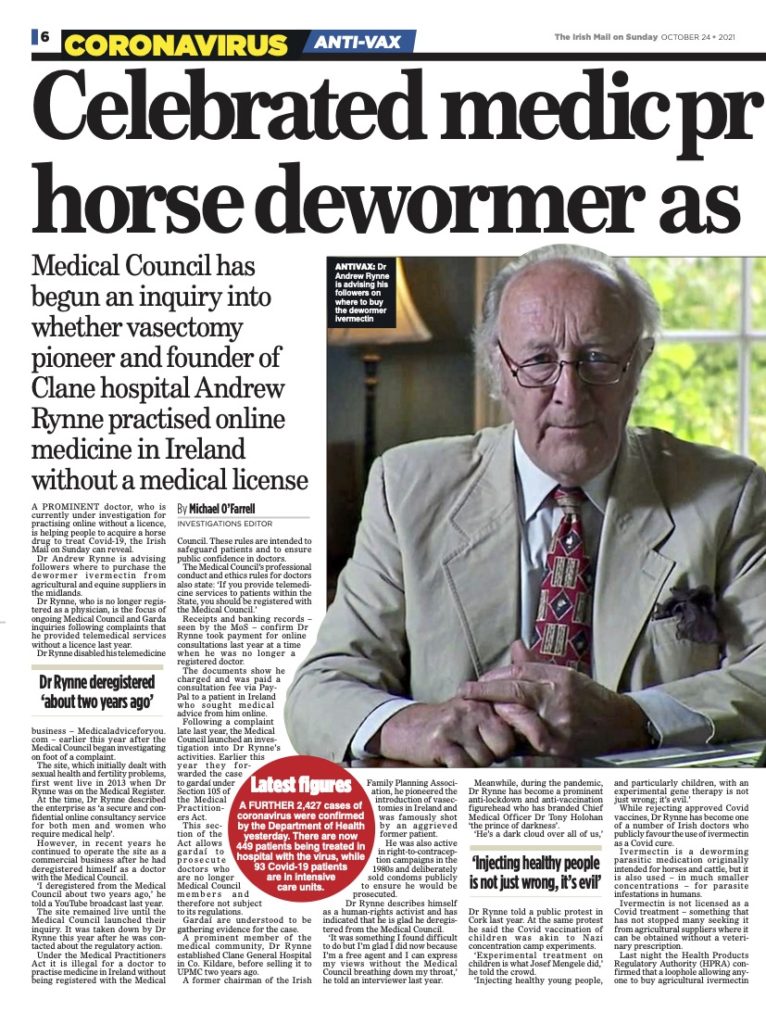
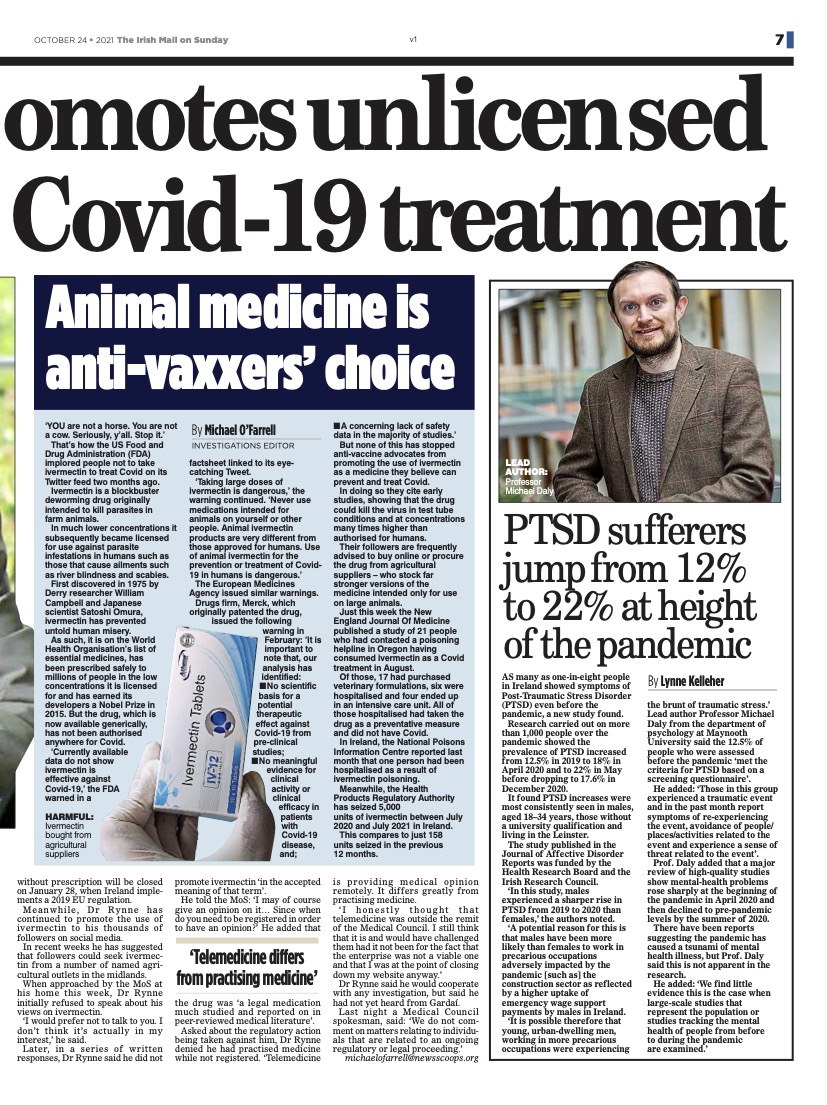
A PROMINENT doctor, who is currently under investigation for practising online without a licence, is helping people to acquire a horse drug to treat Covid-19, the Irish Mail on Sunday can reveal.
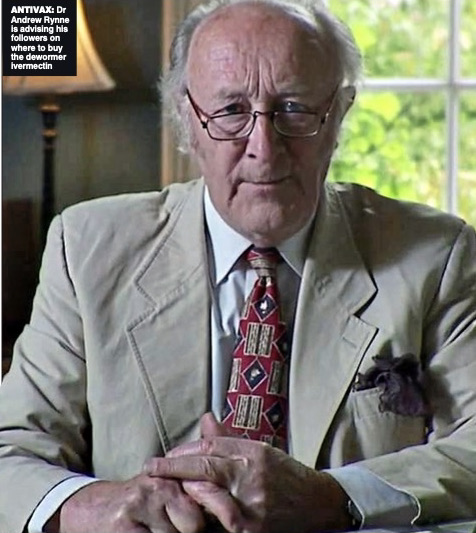
Dr Andrew Rynne is advising followers where to purchase the dewormer ivermectin from agricultural and equine suppliers in the midlands.
Dr Rynne, who is no longer registered as a physician, is the focus of ongoing Medical Council and Garda inquiries following complaints that he provided telemedical services without a licence last year.
Dr Rynne disabled his telemedicine business – Medicaladviceforyou.com – earlier this year after the Medical Council began investigating on foot of a complaint.
The site, which initially dealt with sexual health and fertility problems, first went live in 2013 when Dr Rynne was on the Medical Register.
At the time, Dr Rynne described the enterprise as ‘a secure and confidential online consultancy service for both men and women who require medical help’.
However, in recent years he continued to operate the site as a commercial business after he had deregistered himself as a doctor with the Medical Council.
‘I deregistered from the Medical Council about two years ago,’ he told a YouTube broadcast last year.
The site remained live until the Medical Council launched their inquiry. It was taken down by Dr Rynne this year after he was contacted about the regulatory action.
Under the Medical Practitioners Act it is illegal for a doctor to practise medicine in Ireland without being registered with the Medical Council. These rules are intended to safeguard patients and to ensure public confidence in doctors.
The Medical Council’s professional conduct and ethics rules for doctors also state: ‘If you provide telemedicine services to patients within the State, you should be registered with the Medical Council.’
Receipts and banking records – seen by the MoS – confirm Dr Rynne took payment for online consultations last year at a time when he was no longer a registered doctor.
The documents show he charged and was paid a consultation fee via Pay- Pal to a patient in Ireland who sought medical advice from him online.
Following a complaint late last year, the Medical Council launched an investigation into Dr Rynne’s activities.
Earlier this year they forwarded the case to gardaí under Section 105 of the Medical Practitioners Act. This section of the Act allows gardaí to prosecute doctors who are no longer Medical Council members and therefore not subject to its regulations. Gardaí are understood to be gathering evidence for the case.
Irish Mail on Sunday – October 24, 2021.
Irish Mail on Sunday – October 24, 2021.
A prominent member of the medical community, Dr Rynne established Clane General Hospital in Co. Kildare, before selling it to UPMC two years ago.
A former chairman of the Irish Family Planning Association, he pioneered the introduction of vasectomies in Ireland and was famously shot by an aggrieved former patient. He was also active in right-to-contraception campaigns in the 1980s and deliberately sold condoms publicly to ensure he would be prosecuted.
Dr Rynne describes himself as a human-rights activist and has indicated that he is glad he deregistered from the Medical Council.
‘It was something I found difficult to do but I’m glad I did now because I’m a free agent and I can express my views without the Medical Council breathing down my throat,’ he told an interviewer last year.
Meanwhile, during the pandemic, Dr Rynne has become a prominent anti-lockdown and anti-vaccination figurehead who has branded Chief Medical Officer Dr Tony Holohan ‘the prince of darkness’.
‘He’s a dark cloud over all of us,’ he said of Dr Holohan.
‘Injecting healthy people is not just wrong, it’s evil’ Dr Rynne told a public protest in Cork last year. At the same protest he said the Covid vaccination of children was akin to Nazi concentration camp experiments.
‘Experimental treatment on children is what Josef Mengele did,’ he told the crowd.
‘Injecting healthy young people, and particularly children, with an experimental gene therapy is not just wrong; it’s evil.’
While rejecting approved Covid vaccines, Dr Rynne has become one of a number of Irish doctors who publicly favour the use of ivermectin as a Covid cure.
Ivermectin is a deworming parasitic medication originally intended for horses and cattle, but it is also used – in much smaller concentrations – for parasite infestations in humans.
Ivermectin is not licensed as a Covid treatment – something that has not stopped many seeking it from agricultural suppliers where it can be obtained without a veterinary prescription.
Last night the Health Products Regulatory Authority (HPRA) confirmed that a loophole allowing anyone to buy agricultural ivermectin without prescription will be closed on January 28, when Ireland implements a 2019 EU regulation.
Meanwhile, Dr Rynne has continued to promote the use of ivermectin to his thousands of followers on social media. In recent weeks he has suggested that followers could seek ivermectin from a number of named agricultural outlets in the midlands.
Dr Andrew Rynne.
When approached by the MoS at his home this week, Dr Rynne initially refused to speak about his views on ivermectin.
‘I would prefer not to talk to you. I don’t think it’s actually in my interest,’ he said.
Later, in a series of written responses, Dr Rynne said he did not promote ivermectin ‘in the accepted meaning of that term’.
He told the MoS: ‘I may of course give an opinion on it. Since when do you need to be registered in order to have an opinion?’ He added that ‘Telemedicine differs from practising medicine’.
Asked about the regulatory action being taken against him, Dr Rynne denied he had practised medicine while not registered. ‘Telemedicine is providing medical opinion remotely. It differs greatly from practising medicine.
‘I honestly thought that telemedicine was outside the remit of the Medical Council. I still think that it is and would have challenged them had it not been for the fact that the enterprise was not a viable one and that I was at the point of closing down my website anyway.’
Dr Rynne said he would cooperate with any investigation, but said he had not yet heard from Gardaí.
Last night a Medical Council spokesman, said: ‘We do not comment on matters relating to individuals that are related to an ongoing regulatory or legal proceeding.’
Animal medicine is anti-vaxxers’ choice
‘YOU are not a horse. You are not a cow. Seriously, y’all. Stop it.’
That’s how the US Food and Drug Administration (FDA) implored people not to take ivermectin to treat Covid on its Twitter feed two months ago.
Ivermectin Tablets
Ivermectin is a blockbuster deworming drug originally intended to kill parasites in farm animals.
In much lower concentrations it subsequently became licensed for use against parasite infestations in humans such as those that cause ailments such as river blindness and scabies.
First discovered in 1975 by Derry researcher William Campbell and Japanese scientist Satoshi Omura, ivermectin has prevented untold human misery.
As such, it is on the World Health Organisation’s list of essential medicines, has been prescribed safely to millions of people in the low concentrations it is licensed for and has earned its developers a Nobel Prize in 2015.
But the drug, which is now available generically, has not been authorised anywhere for Covid.
‘Currently available data do not show ivermectin is effective against Covid-19,’ the FDA warned in a factsheet linked to its eyecatching Tweet.
‘Taking large doses of ivermectin is dangerous,’ the warning continued. ‘Never use medications intended for animals on yourself or other people. Animal ivermectin products are very different from those approved for humans. Use of animal ivermectin for the prevention or treatment of Covid-19 in humans is dangerous.’
The European Medicines Agency issued similar warnings.
Drugs firm, Merck, which originally patented the drug, issued the following warning in February: ‘It is important to note that, our analysis has identified:
No scientific basis for a potential therapeutic effect against Covid-19 from pre-clinical studies;
No meaningful evidence for clinical activity or clinical efficacy in patients with Covid-19 disease;
A concerning lack of safety data in the majority of studies.’
But none of this has stopped anti-vaccine advocates from promoting the use of ivermectin as a medicine they believe can prevent and treat Covid.
In doing so they cite early studies, showing that the drug could kill the virus in test tube conditions and at concentrations many times higher than authorised for humans.
Their followers are frequently advised to buy online or procure the drug from agricultural suppliers – who stock far stronger versions of the medicine intended only for use on large animals.
Just this week the New England Journal Of Medicine published a study of 21 people who had contacted a poisoning helpline in Oregon having consumed ivermectin as a Covid treatment in August.
Of those, 17 had purchased veterinary formulations, six were hospitalised and four ended up in an intensive care unit. All of those hospitalised had taken the drug as a preventative measure and did not have Covid.
In Ireland, the National Poisons Information Centre reported last month that one person had been hospitalised as a result of ivermectin poisoning.
Meanwhile, the Health Products Regulatory Authority has seized 5,000 units of ivermectin between July 2020 and July 2021 in Ireland.