Home Blog Page 32

Pat Kenny’s property deal with Nama developers

This article was first published on 30/01/2011

By: Michael O’Farrell
Investigations Editor

RTÉ broadcaster Pat Kenny is involved in a Dublin docklands property deal with controversial businessmen including Nama developer Seán Dunne and disgraced Anglo Irish Bank executive Lar Bradshaw, the Irish Mail on Sunday can reveal.

The secretive deal was structured by the firm of yet another controversial figure – tycoon Derek Quinlan, who moved to Switzerland after the crash and has also seen his massive Irish property loans taken over by Nama.

Mr Kenny, who has hosted debates on his TV and radio shows about Nama, Anglo Irish Bank and developers such as Seán Dunne, is one of seven investors who officially registered a business partnership at the Companies Registrations Office last month.

Until then the existence and make up of the Quinlan-designed business structure – called The Lucy Partnership – was not publicly known.

Mr Kenny, Ireland’s best-paid broadcaster, has also previously used the services of Mr Quinlan’s investment firm to look after his RTÉ earnings, which are channelled through a company called Pat Kenny Media Services Ltd.

Apart from Mr Kenny, Mr Dunne and Mr Bradshaw, the newly established Lucy Partnership includes businessmen Pat O’Donnell, William Walsh, Brendan O’Mara and paint supplier Kevin O’Connor.

Property deeds show that the seven men first took ownership of 3 George’s Dock – a valuable IFSC Dublin docklands property – in 1997. The building’s current tenants are NCB Stockbrokers and CIT Aerospace.

Deeds for the property show that in January 1997 a 200-year lease was provided to the men by the Custom House Docks Development Authority – a forerunner to the Dublin Docklands Development Authority (DDDA), of which Lar Bradshaw was chairman.

However, the lease start date is listed as Jan 1, 1989.

Mr Bradshaw did not respond to questions this weekend asking about this potential conflict of interest.

He, and other Anglo figures such as fellow DDDA board member Seán FitzPatrick, have already faced similar questions in relation to other properties and deals in the docklands area.

But the relationships formed through the Lucy Partnership also raise questions for other members.

Mr Kenny is frequently called upon to host radio discussions on topics such as Nama-bound developers and the continuing Anglo Irish Bank controversy.

Yet it is not known if he has declared his business interests with Nama developers and disgraced Anglo bankers to RTÉ or its listeners as a possible conflict of interest when dealing with such subjects.

Last night Mr Kenny did not directly answer questions about what declarations of possible conflicts of interest he had made and whether he had considered leaving the Lucy Partnership to avoid such perceptions.

Mr Kenny was the highest paid RTÉ presenter in 2008, when he earned €950,956.

Through Quinlan, he also has stakes in property syndicates with interests in Budapest, Prague and London, which collectively owe Anglo Irish Bank €95m.

He has also suffered significant losses on AIB and Bank of Ireland shares, while a €600,000 share in the Four Seasons Hotel in Budapest is now part of a Nama loan.

Only one of the investors approached by the MoS, including Mr Kenny, was prepared to discuss the Lucy Partnership.

When asked why the partnership had just been registered after more than a decade in existence, paint supplier Kevin O’Connor said: ‘I can’t comment on that, you’ll have to ask Quinlan Private.’

He added: ‘Lots of partnerships have been struggling.

But this has been a good one.’
ENDS

Share This:

DISPATCH FROM INDIA – The House That Tim Bought

This article was first published in the Irish Examiner on 20/04/2003

By Michael O’Farrell

In India

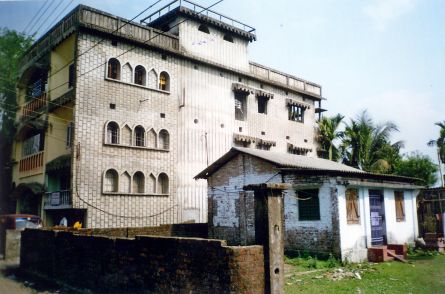
THE house stands proudly amid the palm trees, three storeys-tall in a city where concrete walls are a luxury and up to 100,000 people live in squalid street slums.

Known to local charity workers as the “house that Tim bought”, this building will be used to save children as young as eight from a life of prostitution and pornography.

Earlier this year when a district court judge ordered disgraced TV chef Tim Allen to pay a €40,000 fine for possession of child pornography, the Irish public was outraged, seeing it as another example of the rich escaping justice.

But justice comes in many forms, and 4,511 miles away in India, the children smiling in “the house that Tim bought,”, see a sanctuary of hope in a place of despair.

Every day local children from the surrounding slums come to the house for a couple of hour’s education organised by the Indian charity Cosmos. Many are sick and undernourished, their stomachs distended from worms, their legs bent out of shape from rickets.

Often – far too often – a child will go missing never to return; perhaps a victim of TB which ravages children here killing thousands annually, or perhaps the child will simply have been sold.

Roughly $20 for a 12-year-old girl is the current market price. Situated in the joined conglomerate towns of Siligiuri and New Jailpaiguri (NJP), just beneath the foothills of the Himalayas in the corner of north-eastern India, the house is right in the middle of one of the world’s busiest child trafficking hubs.

Presently the home, a mammoth structure compared to most of the surrounding dwellings, is rented by Cosmos. But in association with the Indian NGO, Ireland’s newest charity, the Edith Wilkins Calcutta Street Children’s Foundation, is about to buy the building and turn it into a rescue centre for trafficked children.

Here up to 30 of the worst cases of trafficked children will be housed permanently and given full-time education and counselling until they are 18.

There are several such houses already in Calcutta and Bombay but none here to catch trafficked children before they reach the large cities.

That Tim Allen’s money will pay for the first one is a curious quirk of fate which matters little to the children who will be rescued.

High above Siligiuri and NJP within sight of Mount Everest and the border with Nepal, a Cosmos drop-in centre at Choom gives child labourers and local shanty children the most basic education and health care.

But apart from offering the children a two-hour break from endless days of child labour the centre gives aid workers the chance to identify those most at risk from preying traffickers.

Many of these children, through basic poverty, are at risk of being sold into sex slavery.

Others have already been sold by their parents as domestic servants – a practice notorious for ending up with the child being abused and sold on to traffickers and pimps.

Inside the dirty classroom, sitting barefoot in the cold, four such girls – Rinky, 11, Amari, 14, Shanti, 13, and Lamu, 15, – are practising the alphabet on dirty copybooks. Each of these girls was sold by her impoverished parents to buyers who said they would use the girls as domestic servants.

Each of the girls cost as little as 1,000 rupees ($20). None of the girls has seen her parents since being sold. As girls they were not valued in an outmoded traditional practice that continues to this day.

Eleven-year-old Rinky wears a cheeky grin, her eyes sparkling with mischief. But Lamu’s expression and the misery in her eyes most truly reflect the plight of these four.

While the other three were sold over a year ago, Lamu, who says she is from Nepal, arrived in the area within the last week. She refuses to say how she was brought from her own country but says she is being beaten by the family she works for.

When I meet her, she appears dazed, confused and deeply unhappy. None of the girls is paid anything and aid workers suspect that all are being abused.

It is children like these who end up in the massive brothels of Calcutta and Bombay, hundreds of miles away. Children like these who feature on the under-the-counter DVDs said to be widely available in those cities. It is children like these who wind up being traded and further violated on the internet as their images are distributed among paedophiles worldwide.

And it is, no doubt, children like these who were abused in the kind of photos Tim Allen downloaded from the internet.

Listening to the girls, Edith Wilkins is compassionate, angry and determined.

“The sooner we get that house set up and running the better,” she muttered to herself and then even though they don’t understand English she turns to the girls: “We’ll get you out of here soon.”

The girls looking puzzled seem somehow reassured and nod their heads.

Before girls like Rinky, Amari, Shanti, and Lamu reach the big cities or become digital images on the internet, they typically come through Siligiuri and NJP.

Indian development consultant, Uday Bhanu Sen, has studied the trade in children for the World Bank and identifies this location as a focal point for traffickers. It is a huge business run by organised crime gangs, up to five of which are thought to be operating in the Siligiuri area.

The most lucrative route in trafficking originates from Nepal down through the hills to Siligiuri and on to the cities like Calcutta.

Typically the traffickers are women who don’t raise suspicions travelling with children. The women never know who their bosses are and are paid by intermediaries. Any women caught never talk; and even if they did, they could never identify the person behind the trafficking operation.

Thousands of trafficked children as young as 10 pass through the slums and red light districts of Siligiuri and NJP before being sent on to shadowy houses known as breaking houses in the suburbs of India’s large cities.

Here they will quite literally have their spirits broken as they are institutionalised into a life of abuse before being paraded in underground flesh markets and sold to the highest bidder.

Once bought, girls and boys are put to work in the massive sprawling brothels of Bombay and Calcutta where young children on street corners can openly be seen soliciting older male clients.

Others are sent abroad or delivered to order to wealthy clients. Still more wind up as images of abused children bought and sold worldwide on the internet.

The numbers are shocking. According to a 2001 report compiled by the US State Department, anywhere between 12,000 and 50,000 women and children are trafficked into India for the sex trade each year. Most come from Nepal, Bhutan and Bangladesh all within 100km of here.

Many more children are taken from India’s seven eastern states, the transport routes of which also all converge in Siligiuri.

The mountainous regions between Nepal and Siligiuri see young girls regularly go missing according to Mr Sen. By the time the police allow a missing person’s report to be officially filed  – after five to seven days – a trafficked child will already be hundreds of miles away.

THE Khalpara red light district extends for almost half a kilometre along the open rail track in Siligiuri. Just off the main dusty track, over a large open sewer, dozens of small maze-like alleyways contain a community of 5,000 people built on the wages of sex and child trafficking.

Everywhere – on street corners and along the alleyways – they sit on wicker stools chatting, sharing bowls of fruit and nuts, waiting for the next customer.

Many of the girls, dressed in pretty coloured saris their lips plastered with heavy red lipstick, look no more than 14. One is still in her school uniform.

These young girls are among the estimated 345,000 children working as prostitutes in India. NGOs believe over a million girls and women are forced into India’s massive sex trade at any given time.

The International Labour Organisation estimates 15% of the country’s 2.3 million prostitutes are children.

All along the railway in the sweltering heat the truck drivers sit watching before selecting a girl.

Pimps and traffickers lurk in the shadows of shacks selling tea and hot snacks cooked on open fires. Opening onto the alleys each stable-like brothel contains dozens of girls working from rooms on either side of a long corridor.

Each working place is an earth-floored room smaller than the average double bed. Every room contains a basic wooden bed and a bucket. Every three paces there is another brothel, another row of stable rooms, more miserable lives playing themselves out amid the rats and stench of human excrement.

This squalid place is effectively a sorting market and transport hub for the child trafficking business.

From here girls from neighbouring states as well as those trafficked from Nepal, Bangladesh and Bhutan are gathered and sent to India’s large cities and elsewhere in Asia.

Under cover of darkness some of the girls on the edge of the district agree to talk and offer us their seats. They won’t disclose their ages but the oldest could, at a stretch be 17. None is from the area and all refuse to disclose how they ended up here. They say they earn between 100 and 200 rupees ($2 to $4) an hour.

As we speak several customers are lining up impatiently kicking their heels in the dust and leaning on their bicycles. The girls agree to meet in the morning but when we return they have paid the price for talking. They have been beaten and threatened. They run when they see us coming. Local pimps escort us to our car making sure we leave.

In his air-conditioned office across town the district’s police chief admits there is little he can do.

This is fertile land for trafficking, officer R Mishra says. These girls come from outside. Few are born here. Last week his men caught traffickers with five children crossing from Nepal. But that’s a rare occurrence given how open the borders are and how overstretched the police force is.

Officer Mishra doesn’t say it but border police are themselves notorious for accepting bribes and are counted among the customers in the red light areas.

“We don’t have time for this. I have been propositioned by a lot of organisations who want to help but nobody has the willingness required,” the police chief says with a shrug.

“Everything is poverty driven. It all comes down to money – people have to eat. The shame is much of what is wrong here could be helped for free. The love these people need costs nothing.”

Much to their delight, he agrees to co-operate with the foundation’s new rescue home to be bought with Tim Allen’s €40,000 fine, but he wears the pessimistic air of someone resigned to India’s ways.

And in many ways once intervention is made the problems encountered by aid workers will have only begun. “Once we open this can of worms we cannot afford to walk away,” Edith Wilkins often repeats as she tours the area. “Look at them everywhere,” she says as she surveys the young girls in the brothels. “We’re going to need 100 rescue homes.”

One study of 25,000 street children here found 30% were HIV positive while up to 80% had some form of sexually transmitted disease.

“They are not catching this disease on trees. We are sitting on a time bomb. India is going to have the highest HIV rate in the world very soon,” says Dr Chatterjee the author of the report.

According to Dr Chatterjee every business lining the roads in this area will have child labour levels of between 30% and 40%. And that figure is no coincidence.

The businesses he speaks of – garages, hotels, eating establishments all run from tiny dirty shacks cater to the steady stream of truckers who often facilitate child trafficking and abuse the children themselves.

“This issue of child exploitation and trafficking is the major issue in India. The process of childhood is very necessary and these children – thousands and thousands of them – are being deprived of their childhood and grow up with no education, no skills and no future. An entire generation is being devastated,” says Dr Chatterjee.

AS the main transport arteries into Calcutta reach the suburbs the rich smell of opium occasionally wafts up from squalid dens along the road.

This route doubles as the main drugs artery from northern Asia. Here, in a series of halfway houses around the city, more than 500 miles from the house Tim Allen’s money will buy, young trafficked girls are broken into prostitution by traffickers who force drugs on them until they become addicted.

Local NGOs estimate 80% of the child sex workers of Calcutta originate in Nepal before coming through the half-way homes.

Few have seen these breaking houses but during his research, development consultant Mr Sen has been told of their existence by rescued girls.

“They are refused food or water for days until they agree to have sex. When they submit the first customer is carefully chosen and through the act becomes the girl’s husband, pimp and owner,” he says.

Girls sold by their families as domestics in the foothills of the Himalayas for as little as 2,000 rupees ($40) will fetch many times that in Calcutta.

Virgin girls are especially prized – fetching up to 20,000 rupees ($400) – because many Indian men believe sex with them will rid them of impotency. Other common myths such as the one that sex with a virgin child will clear up sexually transmitted diseases (STDs) does nothing to help the spread of HIV and other diseases.

Virgin children acquired to order for a wealthy client can fetch as much as 100,000 rupees ($2,000) for a trafficker.

For many trafficked children the infamous brothels situated in the polluted black hole of Calcutta is the end of the line.

“Eighty percent of the kids in the brothels of Calcutta docks are from Nepal,” says Mr Sen. This city of 14 million is a world away from the clean air of the Himalayas where they were first sold.

IN a temporary rescue centre close to Kaligat, the infamous red light district where Mother Teresa catered to the dying, Mia (not her real name) is a living example of India’s terrible flesh trade.

From Bangladesh, 17-year-old Mia was recently intercepted by India’s Border Security Force (BSF) as traffickers attempted to smuggle her to Saudi Arabia.

Ironically it was BSF officers at the Bangladeshi border who originally took a bribe allowing Mia to be trafficked into India in the first place.

Aid workers say Mia had been forced to work in Calcutta’s red light district for years. Like thousands each year Mia was trafficked from the mountains, into Siligiuri and NJP and on to Calcutta.

Wearing a dark grey dress she appears withdrawn and shy. She does not mix with the other girls in the centre.

“I did nothing wrong but I am suffering,” is all she will say over and over again. “I did nothing wrong but I am suffering.”

Mia’s is the silent voice of thousands of children lost to this hell annually. It is a voice ignored by the authorities, and suppressed by the traffickers.

It is also the unheard voice of anguish behind every picture of abused children bought and sold on the internet.

It is a voice we cannot afford to ignore.

Donations to the Edith Wilkins Foundation can be made through the foundation’s website – http://edithwilkinsfoundation.org

Share This:

Will NAMA give O’Reilly €10m to tear up 1916 site?

This article was first published in the Irish Mail on Sunday on 11/12/2011

By: Michael O’Farrell
Investigations Editor

NAMA has signed off a budget of up to €10m for one of the country’s most indebted developers to knock down a historical building linked to the 1916 Easter Rising as part of a new €1bn shopping centre development.

The proposal, which calls for much of Dublin’s Moore Street to be demolished, forms part of a proposal by developer Joe O’Reilly. Mr O’Reilly, whose companies owe close to €3bn, is believed to be one of two developers being paid a €200,000 salary by Nama.

Despite the huge debts, he continues to live in a house that is 10 times the size of the average Irish home. With an indoor pool, sauna, gym and cinema, the house is worth about €10m – the same amount Nama will pay for the Moore Street development.

Mr O’Reilly’s company, Chartered Land Ltd, has conditional planning permission for the shopping centre, which stretches from the old Carlton cinema site on O’Connell Street to Moore Street.

The only obstacle is the fact that No.16 Moore Street and three neighbouring properties have been designated national monuments and cannot be touched without ministerial consent.

With just five years to go before the centenary of the Easter Rising, the Nama plan has raised the prospect that the whole historical area will be a building site.

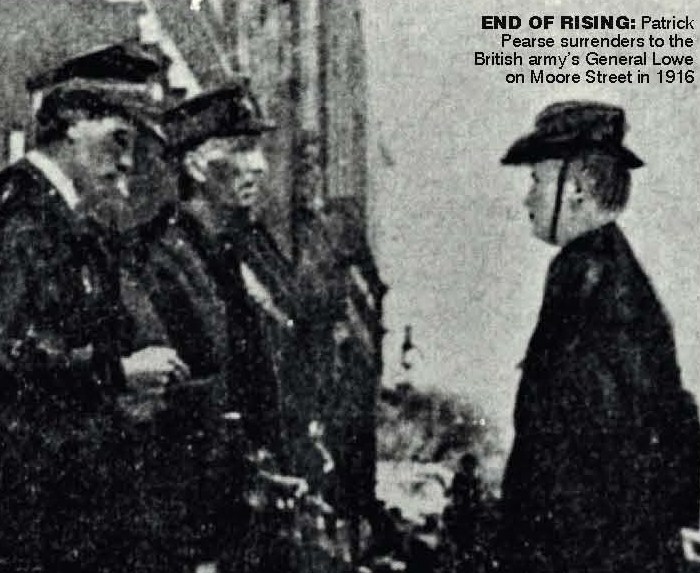
Moore Street was at the centre of the rebellion when, after six days of fighting, the leaders were in dire trouble.

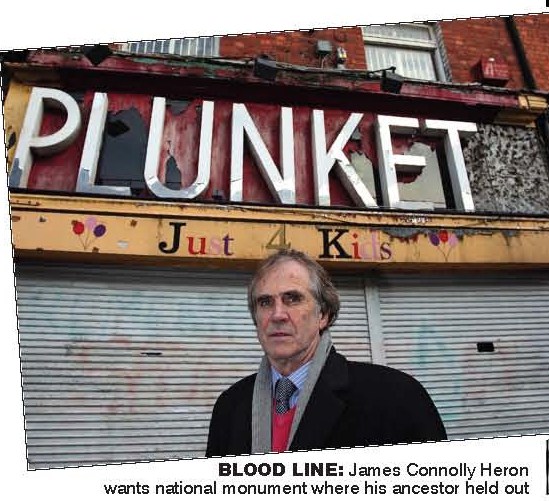
With the GPO and surrounding area reduced to rubble, Patrick Pearse and fellow leaders converged in Plunkett’s butchers at No.16 Moore Street.

In a back room on the first floor, the ‘provisional government’, including the wounded James Connolly, set up headquarters. On Saturday, April 30, Pearse, in neat handwriting signed a letter of surrender.

As the centenary of that defining day approaches, the signatures of a new generation – among them Nama’s most indebted developer, Joe O’Reilly – will shortly seal the fate of the historic site.

Permission has been given for the remainder of the original Moore Street terrace to be demolished but the site has been subject to dispute.

Chartered Land has proposed that No.16 Moore Street be turned into a commemorative centre and an application is already on the desk of Heritage Minister Jimmy Deenihan. But the matter is complicated by the fact that Dublin City Council has also passed a motion calling on the Government to designate all of Moore Street as a national monument.

When the matter is resolved, Mr O’Reilly and Nama will be free to either develop the planned shopping centre or sell on a ready-made site with full planning permission to someone looking for a bargain.

That’s what some city councillors and Moore Street campaigners believe will happen.

Officials from O’Reilly’s company met Dublin City Council on September 7 last. According to reports, the company gave the impression that Nama had agreed to back it to the tune of €10m to complete the commemorative centre – a move that would then clear the way for a possible sale.

Since the plans would see much of the original terrace demolished, it is opposed by the Save 16 Moore Street Campaign, of which James Connolly Heron, a great grandson of James Connolly, is a member.

When campaign founder Patrick Cooney wrote to Nama querying the €10m funding, he received this response: ‘I can confirm that Nama approved funding in respect of the application for Ministerial consent to works at the National Monument.’ The response was sent via email by Felix McKenna of Nama on September 14.

But when pressed to be more specific, Mr McKenna’s next email seemed to row back.

‘I confirm that no decision has yet been taken in respect of funding the proposed works to the National Monument, the subject of the Ministerial consent application,’ he wrote.

Independent Councillor Niall Ring submitted a question to the City Manager asking if Councillors had been misinformed about Nama funding. The response came in the form of a statement from Chartered Land to last month’s City Council meeting.

‘The company had secured funding, with the approval of Nama, for the proposed works associated with the National Monument… up to the point of tender stage completion,’ wrote project director Gary Cooper.

However, after a decade of campaigning, those determined to preserve the area are not prepared to give up.

Mr Connolly Heron said he is appalled that the taxpayer is being asked to fund the work to benefit an indebted developer.

He asked: ‘If the State, through Nama, can finance the lavish lifestyles of those who engaged in activity that brought this country to its knees, is it too much to ask that funding can be made available to ensure that those who gave their lives for the country can be honoured in a fitting manner?’
ENDS

Share This:

Billionaires offer Anglo €150m for developer’s loans

This story was first published in the Irish Mail on Sunday on 27/11/11

By: Michael O’Farrell
Investigations Editor

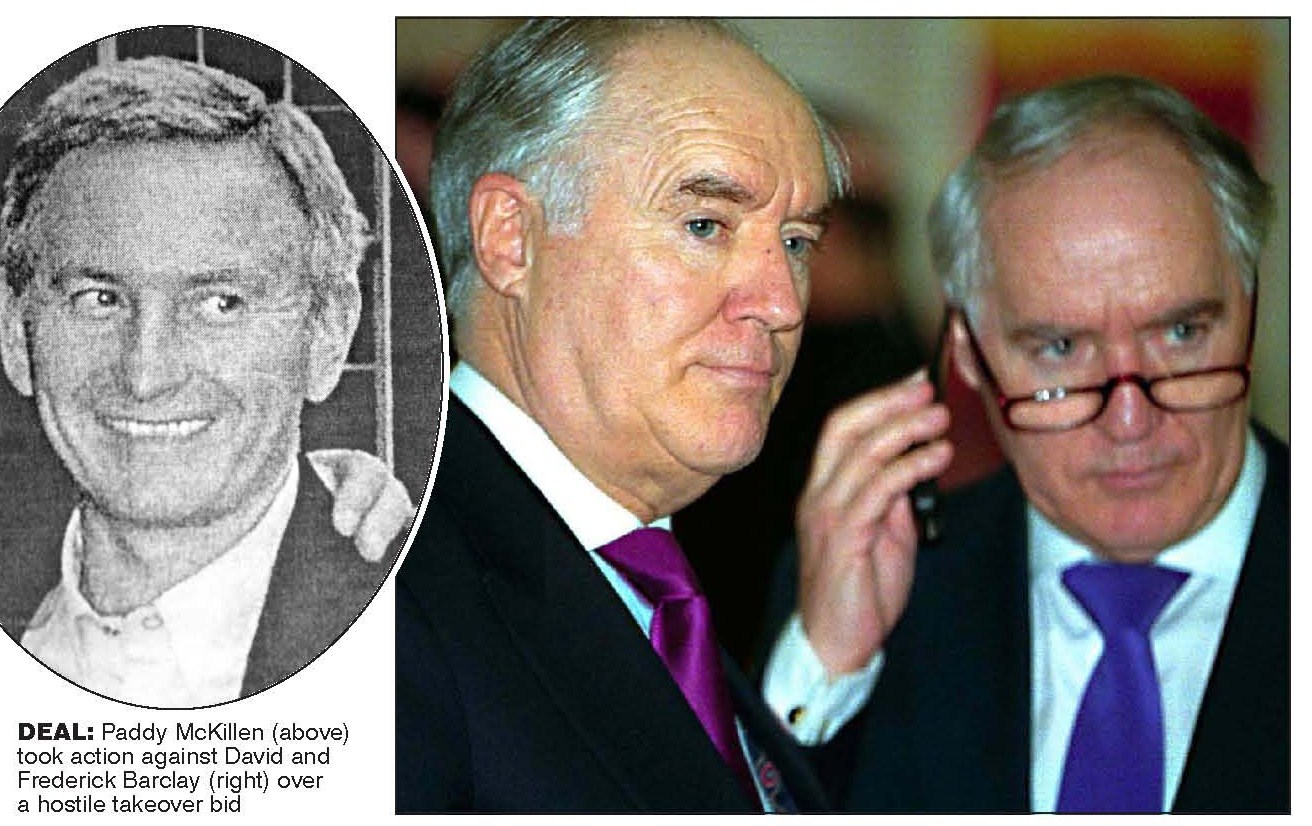
TWIN billionaire brothers – David and Frederick Barclay – have offered Anglo Irish Bank £130m (€152m) in cash to take over some of the debts owed to the bank by the developer Paddy McKillen. the Irish Mail on Sunday has learned.

The debts are secured against three of London’s most famous landmark hotels – Claridge’s, the Berkeley and the Connaught.

The offer would help Anglo – now rebranded the Irish Bank Resolution Corporation (IBRC) – to recover money on behalf of the taxpayer.

But the Barclay brothers, who own businesses such as the Ritz Hotel and the Daily Telegraph newspaper, have become frustrated at what they perceive as Anglo’s unwillingness to do the deal, according to insiders.

Their offer to buy McKillen’s debt was first made in writing to the IBRC on October 28.

It was followed by a number of communications and one face to face meeting since then.

It is understood that Anglo has raised the possibility of a bigger deal in which even more of McKillen’s debt would be sold – but sources say that although that possibility has been favourably received by the Barclay brothers, no specific details have yet been provided.

‘We would consider doing a bigger deal if it would make it easier for them,’ said a spokesman for the businessmen.

But in advance of an Anglo board meeting on Wednesday he stressed that the bank had to make a decision quickly – or face seeing its security diluted.

‘All we can do is tell them that the pressure on IBRC is to accept our offer now and get a full value for the Irish taxpayer,’ a spokesman said.

The Barclay brothers are making the offer because it would allow them to take over control of the three hotels.

They recently acquired control of over 64% of the hotels by purchasing the related debts of Derek Quinlan for €800m from Nama.

Mr McKillen, whose loans from Anglo are understood to run to hundreds of millions, owns the remaining 36% of the hotels. He won a landmark court action to prevent his loans being taken over by Nama because he was servicing them.

‘We have done the fair thing and offered the Irish taxpayer a very strong offer now or they can wait for the inevitable rights issue and what pressure will we be under ever to engage in a conversation with IBRC again?’ the spokesman said.

‘We have placed a value on the security that they hold and if they don’t take the offer then we are going to have a rights issue.

‘Then we won’t be making the offer to the Irish taxpayer because the company would have been refinanced by us,’ he continued. A rights issue – meaning the creation of new extra shares in order to raise more capital – has to be offered to existing shareholders first. The price at which such shares are offered is usually at a discount which gives shareholders an incentive to buy them.

But if an existing shareholder does not or cannot buy the new shares their overall stake in the company is diluted.

The move puts a cocked gun to Anglo’s head and if accepted could see Mr McKillen’s percentage stake in the prestigious hotels, which are currently controlled by the Maybourne Hotel Group, reduced.

Anglo will now have to decide whether it wants to continue supporting McKillen’s debts or cash in so as to see an immediate return for the taxpayer.

The matter has already been aired in court in London this week as Mr McKillen launched a case saying he had been oppressed as minority shareholder by the Barclay brothers’ launch of a hostile takeover bid.

Nama, too, is on the verge of being dragged into the case and has been named as a party by the London High Court.

But in the short term the £130m offer now on the table from the Barclay brothers will put the bank under immediate pressure to decide whether it wants to continue to bankroll McKillen’s shareholding, or recover a large chunk of his debts in the interest of the taxpayer.
ENDS

Here at NewsScoops we are always delighted when others follow up our scoops. Here’s how the Irish Times covered the story a week after we first broke it.

December 6, 2011

Barclay brothers move to take control of hotel group
SIMON CARSWELL Finance Correspondent

THE BARCLAY brothers, who control 64 per cent of the Maybourne Hotel Group in London, will this week propose injecting about £200 million (about €230 million) into the group in an attempt to wrest control from fellow investor Paddy McKillen.
The group behind the Claridge’s, Connaught and Berkeley hotels is at the centre of a tug of war between media tycoons the Barclays and Mr McKillen, a 36 per cent shareholder in the hotels.
David and Frederick Barclay, owners of the Daily Telegraph , will propose a rights issue at a board meeting this week to raise about £200 million from the shareholders.
This would force Mr McKillen to inject £72 million if he is to avoid his shareholding being diluted in a move which is interpreted as an attempt by the brothers to take control of the group.
The brothers have recently made a proposal to Irish Bank Resolution Corporation, formerly Anglo Irish Bank, to buy £130 million of debt secured on Mr McKillen’s shareholding.
The Barclays have presented their proposal to the bank as a means of reducing the State’s loan book, as the bank is being wound down.
IBRC is resisting the overture because the loans owing on Mr McKillen’s shares represent only part of its commercial relationship with him.
The High Court was told during Mr McKillen’s legal action with the National Asset Management Agency last year that he had loans and connected borrowings totalling €800 million with Anglo.
A spokesman for the Barclays had no comment on their plans.
A spokeswoman for Mr McKillen queried whether they could seek cash from shareholders. “We would question their right to a single seat on the board, let alone to propose a rights issue,” she said.
Mr McKillen has taken legal proceedings against the brothers in London High Court, claiming oppression of his minority rights, in a case to be heard in March.
The brothers have taken majority control of the group by purchasing the bank debt secured on the 35.5 per cent shareholding held by investor Derek Quinlan.
They have also bought a Cypriot firm, which held a 25 per cent stake owned by the family of Manchester businessman Peter Green and a 3 per cent stake held by stockbroker Kyran McLaughlin.
They borrowed from UK bank Barclays to buy €800 million debt on the group from Nama.
Mr McKillen raised his stake several years ago through a cash call on shareholders, leapfrogging Mr Quinlan on the share register to become the biggest shareholder.

Share This:

3bn debtor living the life of O’Reilly

This article was first published in the Irish Mail on Sunday on November 20, 2011.

By: Michael O’Farrell
Investigations Editor

HE IS Nama’s largest client with debts of close to €3bn but the Irish Mail on Sunday can reveal that developer Joe O’Reilly still retains a lifestyle of extraordinary opulence at his luxury Dublin home.

Mr O’Reilly – who has negotiated a salary of €200,000 from Nama in addition to the state picking up a large portion of his debts and supporting the survival of his business – lives in Cnocard, a sprawling multi-million euro mansion in Foxrock.

The indebted developer’s negotiations with Nama ensure that he is in no danger of losing the extravagant house.

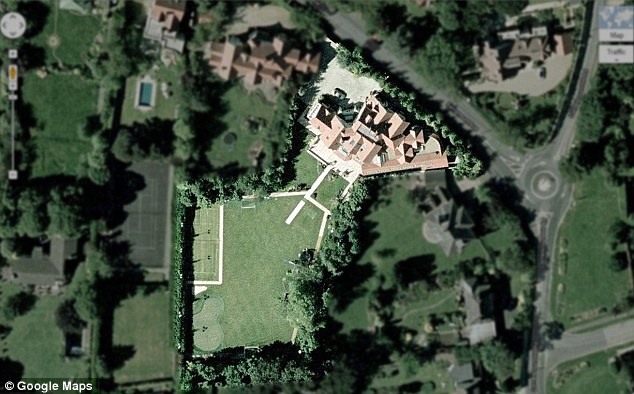
Internet satellite images reveal such amenities as a back garden tennis court, a putting green and a sand bunker amid half a hectare of manicured lawns overlooked by decking and terraces.

But now for the first time, an MoS investigation can bring you inside the vast interior of the salubrious home, revealing every detail of the luxurious comforts enjoyed by Nama’s most indebted developer.

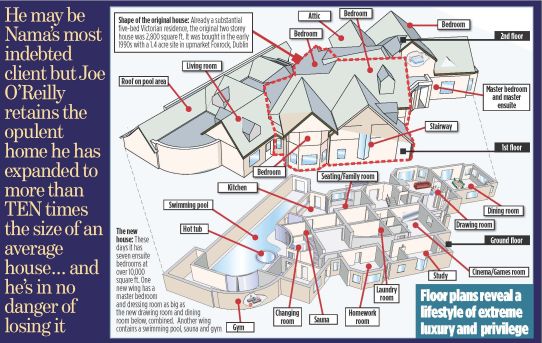
Those comforts – outlined in plans which were given the go-ahead by Dun Laoghaire Rathdown Council in 2004 – include a 20m indoor swimming pool, a private gym, a cinema/games room, a hot tub and sauna and an assortment of recreation and living rooms extending to three floors.

The average size of homes in Ireland is 947 square feet. In contrast the seven bedroom O’Reilly home extends to 10,150 square feet – more than ten times the size of most houses.

When his loans were first taken into Nama Mr O’Reilly and his related companies owed Anglo Irish Bank €1.8bn. More than €1bn is owed to other banks, primarily to AIB.

A Fianna Fáil supporter and donor, Mr O’Reilly is best known for the development of the Dundrum Town Centre. Famously he was also one of the Anglo Golden Circle who agreed to borrow money from the bank to bail out a catastrophically bad share deal by Seán Quinn – a matter still being investigated by gardaí, the director of corporate enforcement o e ll he nt and the financial regulator.

He was also one of the largest housing developers in the State through his companies Chartered Land and Castlethorn Construction.

During the housing boom in the 1990s Mr O’Reilly’s construction business began to grow rapidly after he bought and developed a €7.5m site at the former Carysfort College near Blackrock in Dublin.

It was during this period that he acquired his current Foxrock home.

At the time the property, although a respectable five-bed Victorian residence, was a much more modest affair than it has become today.

Its transformation since then has mirrored the success of the Celtic Tiger as Mr O’Reilly and his wife Deirdre continually upgraded and extended the property as their speculative wealth and bank borrowings spiralled.

The O’Reillys applied for permission for the first of what would become many extensions in 1993. But the first extension was modest compared with what was to come, adding just a single storey wing to the side of the home to allow for a new family sun room and more living space on the ground floor. The following year the garage was moved and a new gate and drive were installed.

Then in 2001/2002 a new two-storey side and rear extension was applied for. Plans featured a gym, walk-in wardrobes and a playroom.

In January 2003 permission was granted for another two-storey side extension as well as a ‘two storey plus dormer rear extension’ which featured a steam room as part of the master bedroom ensuite.

But even as these new wings were being built in 2004 the O’Reillys applied to alter the plans mid-construction and they added some distinctly Celtic Tiger accessories.

And for the first time Mr O’Reilly, fd who had always used his name on planning applications, was replaced by his wife who used her maiden name – Deirdre Traynor – on the application.

The plans submitted by Mrs O’Reilly – and subsequently built by the family – are nothing short of breathtaking.

Indeed such is the scale of the property that it clearly cannot be managed by the family alone. And so provision for staff accommodation is included alongside thousands of square feet of living and recreation space.

The bespoke kitchen overlooks a 20m indoor pool alongside which is a private sauna and hot tub. At the foot of the pool is a complete gym beside male and female changing rooms and showers.

Beyond that the ground floor consists of several family and drawing rooms as well as an office, a children’s den, a cinema/games room and a room described as ‘playroom/homework.’ Upstairs all seven bedrooms are en suite while behind the home a sunken terrace overlooks the back garden golf and tennis facilities.

Later that year yet another planning application added a dormer double garage and storeroom which at almost 700 square feet would be considered a good-sized apartment.

Unlike the tens of thousands of families who face losing their homes because they cannot pay their mortgages, Mr O’Reilly does not have to fear losing his home even though his debts are astronomical. That’s because he has negotiated a deal with Nama which allows him to remain in his own home and earn a tax payer-funded salary of €200,000 in return for helping the agency to manage his ongoing property developments.

His company’s income from the state has not ended there. Despite the downturn in property in 2008 Fingal County Council bought a site for two schools for more than half a million euro per acre. The council had rezoned the land in 2007, multiplying its value, but went ahead with the price last year despite the recession.

The sum was paid to Mr O’Reilly’s Castlethorn Construction.

At the time then opposition TD Joan Burton was scathing about what she called a ‘sweetheart deal’.

‘It simply beggars belief that boom-time prices are being handed over to Nama developers for school sites at a time when property prices are on the floor,’ she said. ‘€7m for a school site is a king’s ransom.’ ‘This sweetheart deal for a Namabound developer in the dying days of a Fianna Fáil government stinks to high heaven. Spending €7m on acquiring the Kellystown site means that less money is available for the construction of the muchneeded permanent building for Luttrelstown Community College.’ But the story of Nama’s ‘crackdown’ on developers continues. The other Nama client receiving a €200,000 salary from the state’s asset management company is Sean Mulryan who lives in a similarly plush home – complete with pool, Jacuzzi and hot tub – as revealed by the MoS two weeks ago.

Mr O’Reilly emerged with his Nama deal even though he was one of the developers who initially sought to put the family home and other properties out of reach of Nama by transferring them to his wife.

As revealed first in the MoS the Foxrock home was transferred out of Mr O’Reilly’s name and into that of his wife on March 5, 2009 – just months before the establishment of Nama.

Then, in the summer of 2010, Mr O’Reilly was snapped by the MoS enjoying a sun-kissed break in the exclusive Monte da Quinta resort in the Algarve. Mr O’Reilly owns a villa in the resort although a loan on the property has now been taken over by Nama.

Just days after he was photographed by the MoS relaxing and lounging by the pool in the 35 degree Algarve heat, Nama boss Frank Daly promised that his agency would not go soft on developers.

‘The banks have displayed what I can only describe as remarkable generosity towards some of their borrowers,’ he said adding that bankers were ‘probably sentimentally or emotionally attached to some borrowers.’ A year later it emerged that Nama had agreed to pay Mr O’Reilly his €200,000 salary and that a profit sharing arrangement had also been reached which could see the indebted developer earn commission on any targets he exceeds.
ENDS

Here at NewsScoops we are always delighted to see others follow our example. In the instance below the Evening Herald puts its own spin on our article six days after we first went to press.

By Conor Feehan

Saturday November 26 2011

THE resident of this luxury mansion has bank debts of €2.8bn but is paid €200,000 a year by NAMA.

Prominent politicians and businessmen have branded developer Joe O’Reilly’s position “an absolute outrage” and said “it is no wonder Germany are disgusted with us”.

Mr O’Reilly, who developed the Dundrum Town Centre, is NAMA’s largest client with debts of €2.8bn.

Yet it is paying him his huge salary with taxpayers’ money while allowing him to live in his seven-bed Foxrock mansion complete with indoor swimming pool, sauna, gym, tennis court and golfing facilities.

Today, People Before Profit’s Richard Boyd Barrett described the decision as “an absolute outrage that is beyond words”.

And veteran businessman Ben Dunne said NAMA was “rubbing our noses in it” when it comes to the treatment some developers.

“People who helped to bankrupt the country are being paid with taxpayer’s money while others are being slaughtered by austerity cuts,” said Mr Boyd Barrett.

“It beggars belief. The poor and the vulnerable are being pushed over the edge by this,” he added.

“This developer has loans he cannot repay to the banks, so the taxpayer has to stump-up and then pay their salary too while suffering cut after cut themselves.”

Mr O’Reilly was also one of the Anglo Golden Circle of 10 who agreed to borrow money from the bank to buy up shares being offloaded by the now bankrupt businessman Sean Quinn.

That matter is still under investigation by gardai, the director of corporate enforcement and the financial regulator.

Mr O’Reilly was also one of the largest housing developers in the State through his companies Chartered Land and Castlethorn Construction.

He bought his Foxrock home during the housing boom in the mid-90s. It was a more modest five-bed Victorian residence at the time, but an ambitious list of extensions have transformed it into a luxury mansion. And Mr O’Reilly’s negotiations with NAMA ensure that he is in no danger of losing the house.

In the back garden, amenities include a tennis court, a putting green and a sand bunker on half a hectare of lawns overlooked by decking and terraces.

Plans approved by Dun Laoghaire Rathdown Council in 2004 for the property include a 20m indoor swimming pool, a private gym, a cinema/games room, a hot tub and sauna and an assortment of recreation and living rooms extending to three floors.

When his loans were first taken into NAMA, O’Reilly and his related companies owed Anglo Irish Bank €1.8bn. More than €1bn is owed to other banks, mostly to AIB.

“I don’t know if NAMA are worse or Joe O’Reilly is worse, they’re both as bad as each other,” businessman Mr Dunne told the Herald.

“Joe O’Reilly has as much chance of living in that house on that money as the man on the moon.

“It’s no wonder the Germans are disgusted with us. He’s rubbing our noses in it,” Mr Dunne added.

Mr O’Reilly’s deal with NAMA allows him to remain in his own home and earn a tax payer-funded salary of €200,000 in return for helping to manage his ongoing developments

Share This:

Exposed: Quinn’s palatial bolthole

A version of this story was first published in the Irish Mail On Sunday on 13/11/2011

By: Michael O’Farrell
Investigations Editor

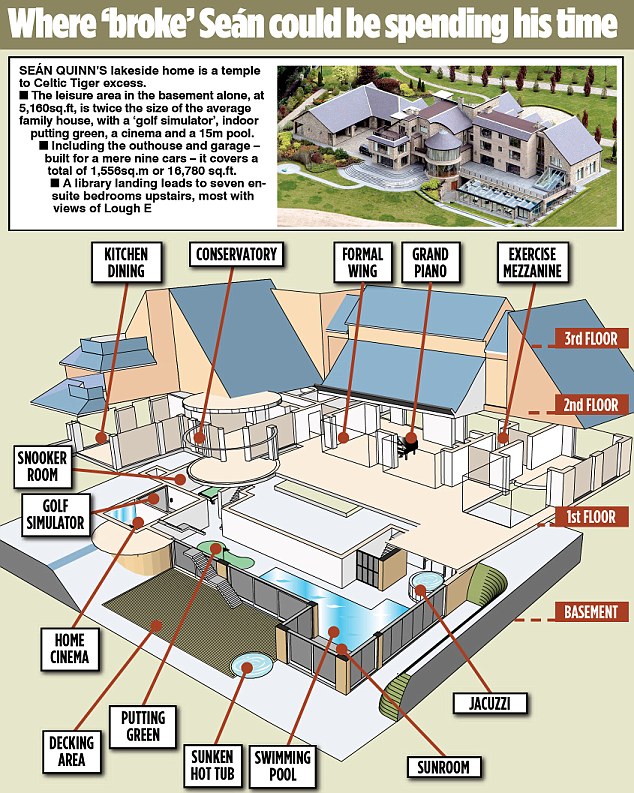
AN INDOOR golf simulator, a putting green overlooking a 15 metre swimming pool, a sunken hot tub, a Jacuzzi pool, a cinema and a snooker room – welcome to the bankrupt world of Seán Quinn.

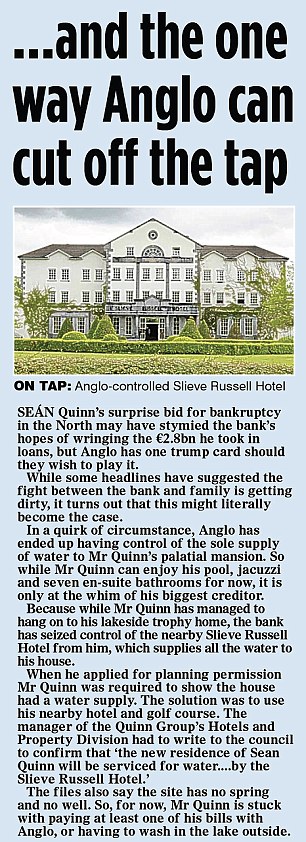
He declared himself penniless on Friday but the controversial Cavan businessman who owes Anglo Irish Bank €2.8bn will still be entitled to live in his family home, which cannot be seized. And few bankrupts can claim a family home as impressive as Mr Quinn’s 14,700 square foot mansion beside the Quinn Group’s Slieve Russell Hotel in Ballyconnell, Co. Cavan.

During bankruptcy proceedings, all assets – bar the family home – are collated and put under the control of a court-appointed bankruptcy official. This means that Anglo Irish Bank will not be able to seize the Quinn home despite the mind-boggling amounts of money it is owed by the family.

Quinn’s move on Friday was an 11th hour action prompted by a belief that the bank would attempt to force him into bankruptcy south of the border tomorrow. In the Republic of Ireland, he would have faced 12 years of penury overseen by the courts, but a few miles across the border from his Cavan home he can work through the process in just one year.

And Quinn’s own home may now become involved in the row. In court Quinn’s lawyer claimed that the family home in fact belongs to his children, and that he had no assets and a pension worth just €10,000. But Land Registry documents show the house was only ever registered in the name of Mr Quinn and his wife, implying that some sort of private transfer of ownership may have happened since, with paperwork lodged in public registry.

There have been other transfers of assets by the Quinn family, who were recently accused in court by Anglo of engaging in a ‘conspiracy’ to hide and redistribute their assets. His children and sons-in-laws are already facing criminal investigation in Sweden for allegedly putting assets out of the reach of Anglo Irish Bank.

As revealed by this paper last month, the bank lodged formal complaints to the Company Registrations Office in Stockholm, claiming the Quinns had illegally transferred properties worth hundreds of millions out of its reach.

The complaints were made under Chapter 11 of the Swedish Criminal Code, which carries prison sentences of up to six years.

Regardless of who owns the many assets and properties in the wider Quinn empire, public docu-ments appear to place ownership of the family mansion squarely in the hands of Mr Quinn and his wife.

Planning permission and land registry documents show that the home was registered in the names of Seán and Patricia in June 2004 and was completed in 2006. At the time of construction, Mr Quinn was still considered the richest man in Ireland – something that is clearly reflected in the plans.

‘Seán Quinn is a well-known businessman in the Cavan area,’ reads the application by architect Paul Joyce. ‘This present application seeks to demolish their existing house and replace it with a new family house which is more fitting to their needs.’ Those needs included seven en-suite bedrooms and a luxurious leisure area.

Overlooking the pool area is an exercise mezzanine, where Mr Quinn liked to work out in the morning while watching business TV news channels. The home also boasts its own bar, a grand piano, a library, a lift, a built-in dog house, balconies and a large deck overlooking Lough Aghavoher. Outside, at the end of a covered walkway, is a nine-car garage.

It is likely that Anglo will challenge the validity of Mr Quinn’s Belfast bankruptcy since it will allow him to emerge clear of debts in just 12 months – even though the legal cases he is involved in will continue much longer than that.

In a statement, Anglo, now rebranded the Irish Bank Resolution Corporation, said it was ‘examining the validity of this application for bankruptcy in light of Mr Quinn’s residency and extensive business interests and liabilities within the state.’ Mr Quinn will have to satisfy the UK authorities regarding having lived and conducted business in Northern Ireland.

Steve Thatcher, a British insolvency expert with Irish Bankruptcy UK, said that all Mr Quinn had to do to qualify was live in Northern Ireland for a few months.

‘It doesn’t say under any case law how long that must be but you have to be in the area for at least three months. So he could have lived in Northern Ireland for as little as four months,’ he told the MoS.

Mr Thatcher, who is currently advising many Irish people considering bankruptcy in the UK, said Anglo would likely have difficulty contesting this.

Although his family home has always been in Cavan, Mr Quinn has had businesses and properties on both sides of the border.

Mr Thatcher said that Mr Quinn will likely be able to negotiate his residency arrangements with the official receiver and may be allowed to live in his Cavan home during his bankruptcy period.

But even if he is forced to remain in Northern Ireland, he can return for good after 12 months and travel to visit his wife across the border as long as he informs the bankruptcy receiver.

In a lengthy statement, Mr Quinn said he had been born, reared and worked all his life across the border in Fermanagh. ‘I have done absolutely everything in my power to avoid taking this drastic decision.

The vast majority of debt that Anglo maintains is owed is strenuously disputed,’ he said.

‘However, I cannot now pay those loans which are due, following Anglo taking control of the Quinn Group of companies, which I and a loyal team spent a lifetime building.

I find myself left with no other alternative.’ Mr Quinn also accepted some of the blame for his downfall. But he accused Anglo of self-interest, lack of responsibility and bad lending.

‘I am not in the business of pointing fingers or making excuses,’ he said. ‘However, recent history has shown that I, like thousands of others in Ireland, incorrectly relied upon the persons who guided Anglo and who wrongfully sought to portray a “blue chip” Irish banking sector.

‘Anglo is now tirelessly working with its PR advisers to tell a different story of how I supposedly brought down the Quinn Group. This is wrong,’ he said.

Share This:

Will ALL new judges have ties to FG/Lab?

This story was first published in the Irish Mail on Sunday on 06/11/2011

By: Michael O’Farrell
Investigations Editor

THE Government could fill a fifth of all judges’ positions with party supporters before the next election – despite Taoiseach Enda Kenny’s vow to make judicial appointments less political.

Including three appointments made this week, 30 new judges are due to be appointed in the next four years.

In their eight months in office, all five people chosen by the Fine Gael-Labour coalition to be appointed or promoted to top judicial posts have been close political allies.

The Government appointed its first two High Court judges – Michael White and Kevin Cross – early last month. And this week the Cabinet nominated three new District Court judges: Michael Coghlan, Patrick Durcan and Gráinne Malone.

Michael Coghlan was an election agent for Labour MEP Nessa Childers in the 2009 European elections, while Gráinne Malone is a sister of Labour councillor Emer Costello, who is married to Labour TD Joe Costello, and a sister of Labour senator Mary Moran.

Patrick Durcan, a four-time election running mate of Enda Kenny, is a Fine Gael party trustee, a key party strategist, a former party election agent, a former member of Mayo County Council and a former Fine Gael senator.

The two new High Court appointees also have close party connections.

Judge White is a former Workers’ Party colleague of Labour leader Eamon Gilmore and represented him as a solicitor. And Judge Cross made a political donation of €1,200 to European Affairs Minister Lucinda Creighton prior to February’s general election.

The appointees are all highly qualified for their new judicial roles but their political connections have left the Government open to criticism.

Newspaper revelations of these political leanings prompted an attack by Justice Minister Alan Shatter two weeks ago.

‘It seems that the decency, competence and integrity of individuals appointed to undertake onerous duties for the benefit of the State and its citizens, and the integrity of those who make such appointments, is to be consistently targeted and undermined by some sections of the media.

‘Any suggestion that either appointment is based on anything other than merit or has any base or hidden motive is completely untrue,’ he added.

Yet, when he was in opposition, Mr Shatter persistently criticised Fianna Fáil’s appointment of politicallyconnected judges. In 2000, he called for judicial nominees to be cross-examined by the Oireachtas justice committee.

He also confronted then justice minister John O’Donoghue about a delay in appointing a judge, asking if the delay was because the government ‘could not identify a card-carrying member of the Fianna Fáil party?’ In response, O’Donoghue admitted he had received 40 representations in just over two years. Following a recent landmark ruling, details of the previous government’s lobbying were revealed under the Freedom of Information Act. However, details of what, if any, lobbying has taken place in the current administration is not known.

Mr Shatter has promised to review the process for appointing judges and he has appointed three independent lay figures to the Judicial Appointments Advisory Board, which assesses applications from would-be judges.

…same story when it comes to State boards

LIKE judicial appointments, positions on State boards have traditionally been seen as a political gift to be shared among loyal supporters.

And despite promises to eliminate such cronyism, Fine Gael and the Labour Party have, in recent months, made a number of controversial appointments.

In June, Justice Minister Alan Shatter appointed barrister Oliver Connolly to a €12,500 part-time position in the Garda Síochána.

Mr Connolly had previously donated €1,000 to Mr Shatter.

Also this year, Food Minister Simon Coveney appointed one-time Fine Gael election candidate Brody Sweeney as a board member of Bord Bia.

Mr Coveney also appointed Labour supporter Gary Brown to the board. Mr Brown made a donation of €640 to Ruairi Quinn’s election campaign in 2007.

These appointments come despite a commitment from Enda Kenny to eliminate appointments that could be perceived as being politically motivated.

As part of this commitment, Government departments are now advertising on their websites for applicants who believe they are suitably qualified to work on a State board.

However, as demonstrated by one such advert posted on the Department of Communications, Energy and Natural Resources website, the initiative does not guarantee that ministers will not be politically motivated: ‘The applicant accepts that appointments are made in the exercise of a statutory discretion, that the minister is not obliged to consider the expressions of interest offered, that he is not confined to making an appointment from amongst those who have expressed an interest…’ Former Fine Gael TD and chairman of the Public Accounts Committee Bernard Allen was appointed to the board of the Irish Sports Council last weekend following one such advertisement for applicants.

Mr Allen – who is working for free – was appointed by Sport Minister Leo Varadkar. Mr Varadkar rejected suggestions that the appointment was political, saying Mr Allen was ‘by far the best person for the job’.
ENDS

NewsScoops is always happy when others follow in our footsteps. Here’s how the Irish Times covered the story on November 14 – two weeks after we published our version.

Five out of six judges appointed have connections to Fine Gael or Labour

PAUL CULLEN, Political Staff

JUDICIARY: THE GOVERNMENT has nominated six judges to date – and five have a personal, family or funding link to Fine Gael or Labour.

Last month, the Government nominated Judge Michael White, a former Workers’ Party election candidate, to the High Court. Judge White was promoted from the Circuit Court, to which he was appointed by the last Coalition government in 1996.

In the Workers’ Party, part of which morphed into Democratic Left and later merged with Labour, Judge White was a colleague of Labour leader Eamon Gilmore.

The other appointee, Kevin Cross, a son-in-law of former Fine Gael minister Patrick Lindsay, made a political donation of €1,200 to Minister of State for European Affairs Lucinda Creighton before February’s general election. High Court judges earn €243,000 a year but this will fall shortly to €187,000 on foot of the “Yes” vote in the referendum on judicial pay.

Minister for Justice Alan Shatter professed himself appalled at the way the party connections of the two appointees were highlighted in the media, rightly pointing out that there was nothing to suggest the appointments were made on any criterion other than merit. Both men are regarded as being exceptionally well-qualified for the positions to which they have been appointed.

Mr Shatter had already vented his fury last June when it emerged that the Government’s appointee as a liaison for whistleblowers in An Garda Síochána, barrister Oliver Connolly, had donated €1,000 to his election campaign in 2007. Mr Connolly is the founder of Friary Law, which has developed a family mediation model together with Mr Shatter, a solicitor and expert in family law.

Mr Shatter said Mr Connolly’s donation had “no connection” with the Cabinet’s appointment. “Nobody has ever suggested that an individual who contributes to democratic politics in this country should be discriminated against, pilloried and excluded from ever being appointed to any body whatsoever.” The part-time post of “confidential recipient” for complaints from gardaí about corruption in the force pays €12,500 a year.

Last week, the Government appointed a further three judges to the Bench, this time in the District Court. Solicitor Michael Coghlan was an election agent for Labour MEP Nessa Childers in the 2009 European elections. Patrick Durcan was Fine Gael Taoiseach Garret FitzGerald’s nominee in the Seanad in the 1980s and a former running-mate of Taoiseach Enda Kenny. Gráinne Malone is a sister of Labour councillor Emer Malone (wife of Labour TD Joe Costello) and sister of Mary Moran, who was nominated to the Seanad this year by Labour leader Eamon Gilmore.

District Court judges earn €148,000 a year but this will fall shortly to €124,000.

Applications for judicial vacancies are assessed by the Judicial Appointments Advisory Board, which presents government with a shortlist of suitable candidates. The actual appointments are made by the president. The idea is to take sole discretion for appointments away from government.

The board does not interview applicants or seek out suitable candidates; it has the power to do so but cites “practical difficulties” preventing this. Effectively, therefore, it screens for suitability and competence but does not rate candidates according to merit. As a result, the seven-name “shortlist” it passes to government gives politicians plenty of freedom to plump for party supporters if they wish to.

Indeed, the government is free to ignore the names on the shortlist and offer a post to someone else, provided it advertises this fact in the official State publication, Iris Oifigiúil.

In May, the Taoiseach pledged he would not use “political bias” in the appointment of personnel to the advisory board. The following month, Mr Shatter appointed three new lay members of the 10- person body, including Karen Dent, an accountant who is a long-time Fine Gael activist in Mr Shatter’s constituency, and Dr Valerie Bresnihan, an independent NUI Seanad candidate in 2002 and 2007 who was a member of the Labour party in the 1990s.

All the evidence is that political party affiliation does not play a decisive part in decision-making once judges are appointed, and it’s worth pointing out that the calibre of Irish judges is generally very high. However, Mr Shatter has ordered a review of the system of judicial appointments.

Pre-election pledges on ending political cronyism ring hollow

Paul Cullen

ANALYSIS : The Coalition has reneged on promises to end feather-bedding and patronage

THE APPOINTMENT of political cronies to State boards is as old as our democracy. Complaints by opposition parties about the practice they themselves indulged in while in government are almost as old.

The current Government will be judged on the scale of its considerable promises in this area.

Fine Gael and Labour politicians have repeatedly promised a comprehensive reform of the political system and, specifically, the elimination of political patronage.

The reality is that the Government has not, or not yet, lived up to its ambitions. As this review of appointments shows, the selection of large numbers of people with political links to the Government continues.

Although there is no reason to believe any of the appointees are not up to the job, there remains little or no transparency in the process for selecting board members of State bodies.

In its manifesto, Labour promised to end the system whereby appointments to State boards were used as a form of political patronage and for rewarding insiders. In future, all appointments would be based on a “demonstrable capacity to do the job”.

The party promised to publicly advertise all vacancies, not just the chairmen, and to ensure that Oireachtas committees considered the suitability of nominated candidates.

Fine Gael, in its manifesto, promised to tackle “cronyism and feather-bedding” in politics. As well as scrapping some agencies, the party said paid directorships would be advertised.

These commitments failed to appear in the Coalition’s programme for government. The only commitment in that document is an assurance that at least 40 per cent of each gender will be represented on State boards.

Shortly after coming to power, Taoiseach Enda Kenny said he wanted to put an end to political cronyism. But what he had in mind in his Dáil speech was the rash of more than 100 appointments, some politically influenced, made by the outgoing government between the election and its last day in office.

On legal advice, the Coalition had to abandon a pledge to sack those appointed by their Fianna Fáil/Green predecessors.

In April, the Cabinet resolved that vacancies on public boards should be advertised online and that chairmen would have to appear before a relevant Oireachtas committee before their appointment was ratified.

Crucially, the committee has no power of veto and the final decision still rests with the Minister.

Minister for Transport Leo Varadkar was quick to implement the new rules, with public advertisements for the posts of chairman of CIÉ and its subsidiary companies. And most of the chairmen he appointed have appeared before committees.

At least seven other departments have yet to start advertising for posts, let alone ensuring that chairmen appear before the committees.

Five departments have begun implementing the rules; in a number of others, some posts have been filled by the new process while others have not.

The Government has also imposed a “one person, one salary” rule on the public service by decreeing that from the start of this month public servants sitting on State boards should not be paid fees.

Tasc, in a report published last July, criticised the “ad hoc and politicised manner” in which people are appointed to boards and called for reforms to address a lack of accountability and oversight.

The think tank estimated there are more than 600 public bodies, to which several thousand board members are appointed on a regular basis.

Between 1997 and 2006, for example, nearly 7,000 appointments were made.

Ministers and senior civil servants are responsible for appointing most of those serving on public boards: “In many cases, appointments are entirely at the ministers’ discretion, requiring neither justification nor any evidence that appointments have been made on the basis of . . . qualifications.”

Few modern politicians would concur – at least not in public – with Fianna Fáil minister Donogh O’Malley’s admission in the 1960s that, faced with a choice between two people of equal merit, he would always choose the Fianna Fáil person. However, they generally defend their right to appoint people to State boards.

Tánaiste Eamon Gilmore, for example, argued last year that government should appoint the boards as one of its executive functions. The making of appointments on a “tribal” basis would be avoided “by exercising discipline, by exercising good judgment”, he said, and people would be appointed “on merit”.

Mr Gilmore was expressing his opposition to the creation of an independent body to carry out this task, an idea favoured by Tasc, the Institute of Directors and many business groups. Tasc argues that the existing system of appointment-by-minister gives elite groups a near-monopoly over public board positions, and thus inordinate and unaccountable influence over public policy.

“Essentially, the governing party – regardless of ideological hue – is allowed to shape public boards in its own [political] image,” its report argues.

And since board terms do not coincide with Dáil elections, the governing party is able to exercise influence beyond its term of office.

Government picks backers for posts despite promise

PAUL CULLEN, Political Staff

THE GOVERNMENT has been sharply criticised by Fianna Fáil for failing to deliver on pre-election promises by Fine Gael and Labour to reform the way in which people are appointed to State boards.

A review of Government appointments shows that at least 20 past or present party members, strategists or donors have been appointed to such posts since the Coalition came into office in March.

Half of all departments have yet to recruit board members through public advertisement, as promised by the Government, while only five departments have so far fully implemented the commitment to seek expressions of interest online.

In only two cases has a person appointed as chairman appeared before an Oireachtas committee, another Government pledge. But some hearings are pending and some departments have yet to appoint any chairmen.

Fianna Fáil TD Michael McGrath said it was clear the Government had not followed through on its commitments to introduce a transparent system of political appointments.

“Nothing has changed. The promised transformation hasn’t materialised,” said Mr McGrath, adding that as long as appointments were in the gift of politicians, “cronyism will remain”.

Minister for Transport Leo Varadkar has made three appointments to the Road Safety Authority, where board members are paid €8,100 a year. Among his appointees are Ronan Melvin, who lives in the Minister’s constituency and nominated Fine Gael candidate Kieran Dennison in the 2009 local elections. Another choice is Seán Finan, a Macra na Feirme member from Castlerea, Co Roscommon and a regional organiser for Young Fine Gael.

Last month, Mr Varadkar appointed former Fine Gael minister Bernard Allen to the board of the Irish Sports Council. Mr Allen, who retired last February, was the country’s first sports minister in the 1990s and also chaired the Public Accounts Committee. He is not taking any fee for the post.

Last week, the Government appointed four new directors to Pobal, including Labour county councillor (and former Progressive Democrat TD) Mae Sexton and Siobhán McLoughlin, a former Labour election candidate from Co Donegal.

However, Ms Sexton said yesterday she was not in a position to take up the post.

In April, Minister for Agriculture Simon Coveney announced the appointment of Phil Meaney as chairman of Bord na gCon.

Mr Coveney said his choice was “eminently well-qualified” for the appointment, with a business background and a 25-year involvement in the greyhound industry.

Mr Meaney is chairman of Fine Gael’s electoral strategy group in Carlow-Kilkenny and played a major part in the party’s success in winning three seats in the constituency last February. As chairman, Mr Meaney is paid €21,600 a year plus expenses.

Mr Coveney has also appointed two people with party links to the board of Bord Bia. One is Brody Sweeney, the founder of O’Brien’s Sandwich bars which went into liquidation in 2009, who got 3,400 votes as a Fine Gael candidate in Dublin in the 2007 general election.

Another of Mr Coveney’s appointees is Gary Brown, chief executive of Below the Line Marketing, who donated €640 to Labour TD Ruairí Quinn in 2007.

Among those Minister for Justice Alan Shatter has appointed to the Parole Board is Ciairin de Buis, who has sat on a number of Labour Party committees. Ordinary members of the board are paid €7,695 a year plus a per diem payment for each prison visit up to a limit of €12,600, plus travel and other allowances at Civil Service rates.

There’s no remuneration for sitting on the board of the National Concert Hall but the list of names appointed by Minister for Arts Jimmy Deenihan includes Gina Menzies, a theologian and former Fine Gael county councillor; and Pat Heneghan, a public relations consultant and former party strategist.

Minister for Communications and Energy Pat Rabbitte has appointed former Labour treasurer James Wrynn to the board of An Post and Bride Rosney to the board of Eirgrid. Ms Rosney was adviser to president Mary Robinson, the party’s 1candidate for the presidency in 1990.

Some 14 of the special advisers appointed to Government ministers are also being paid above approved guidelines which state they should be paid on the first point of the principal office scale in the Civil Service, just over €80,000. Four of the advisers are earning over €100,000, according to figures provided by Minister for Public Expenditure and Reform Brendan Howlin.

Share This:

Now three-pools Sean in line for Nama bonus

This story was first published in the Irish Mail on Sunday on 30/10/2011

By: Michael O’Farrell
Investigations Editor

THREE swimming pools, a gym, a powder room, landscaped gardens, a private bar – and a taxpayer-funded salary of €200,000.

Welcome to the opulent world of Nama developer Sean Mulryan.

The Dáil Public Accounts Committee heard this week that he is in line for a lucrative bonus from Nama if he makes anything anything above the cut price it paid for loans. And that’s on top of the salary he’s paid to manage his developments.

Because the State has also bailed out the banks, it means the taxpayer will lose out on the double – and developers such as Mulryan are set to accrue a fortune.

Nama’s CEO Brendan McDonagh said that if developers recover just the price paid by Nama, and not even the value of the loan they took out, they could retain 10% of money repaid above that ‘financial milestone’ to encourage debt repayments.

This means that if Nama paid €1bn for a €2bn loan book, the taxpayer is left paying out €1bn, yet the developer is getting a bonus if he can get back half the money he borrowed.

If the figures sound too big to be true, look again. Mr Mulryan owes Nama €2.8bn. And while we are paying for the risks taken by his company, the developer’s life of luxury continues. His firm Ballymore Properties is the bad loans agency’s second largest client, after Joe O’Reilly, who was photographed last year by the Irish Mail on Sunday as he relaxed at an Algarve golf resort.

But the scale and luxury of Sean Mulryan’s home in Kildare dwarfs even that of other Nama developers.

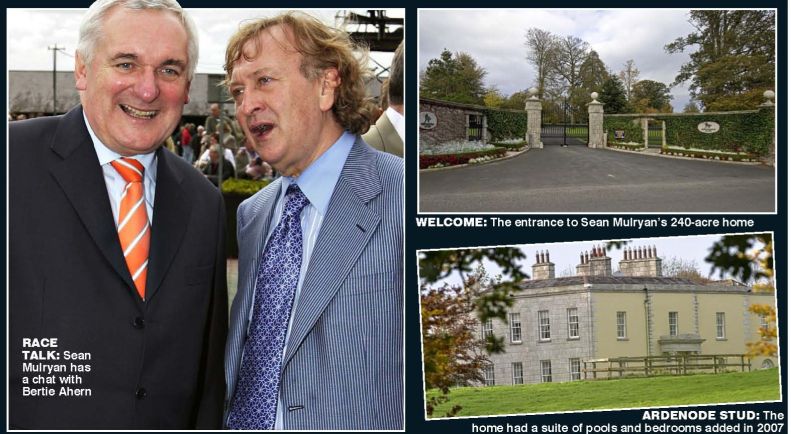
Set amid 240 acres, Mr Mulryan lives in the stunning Ardenode Stud, a renovated late 18th century home, close to Ballymore Eustace. It’s a long way from his youth when he left school in Roscommon to become a stone mason.

The house is a massive 1,458 sq. m. – 17 times bigger than the average Irish house.

Mr Mulryan and his wife Bernadine also got permission in 2007 to add a new ‘floating transparent glass pavilion wing’, adding a gym, spa pool and hydro pool, as well as a master bedroom and relaxation room. The two new pools are in addition to an existing outdoor pool.

Plans submitted to Kildare County Council also give an insight into the lives of the Mulryans, who were famous for throwing lavish parties where guests such as Anglo Irish Bank’s Sean FitzPatrick would min-gle with Fianna Fáil’s Charlie McCreevy and Brian Cowen. The plans detail arrangements to ensure that enough water and waste provision is available for eight double bedrooms, a permanent office staff of five, a grounds staff of seven, and functions for between 150 to 200 guests seven to eight times a year.

The home has its own bar – a feature which was no doubt in full use in 2004 when Mulryan had Debbie Harry perform at his 50th birthday.

Mr Mulryan is tipped to be one of the most likely Nama developers to survive, even though he had €1.4bn in Anglo loans and €750m in Irish Nationwide loans.

That’s because Mulryan is widely recognised as a key contributor to the regeneration of parts of London, as well as being the biggest landowner in the docklands area for the 2012 London Olympics.

While refusing to comment on the €200,000 Nama salary, the company has defended its potential. ‘As the majority of our assets are Londonbased and deemed independently as prime assets, we are now working to the plan agreed,’ a statement said, adding that all of its staff had taken ‘extensive pay cuts’, and that no member of staff was paid more than €200,000.
ENDS

Share This:

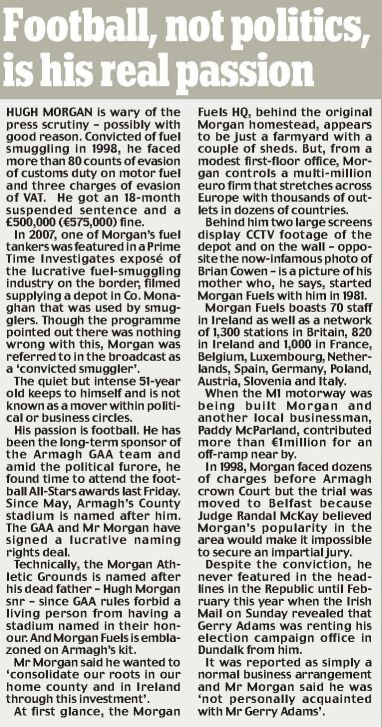
Hugh Morgan v Sean Gallagher

By: Michael O’Farrell
Investigations Editor

THE convicted smuggler who claims he gave Seán Gallagher a €5,000 cheque for a secret Fianna Fáil fundraiser in 2008 spoke last week to the Irish Mail on Sunday – the newspaper that first raised the issue with the presidential candidate.

Armagh businessman Hugh Morgan claims that he has financial records to prove the transaction took place. He also maintains that Mr Gallagher personally telephoned him to solicit the money before calling into his office to collect the cheque. According to Mr Morgan, a thankyou letter in Mr Gallagher’s name arrived in the post shortly after the donation.

A framed photo of Mr Morgan with a jovial-looking Brian Cowen – which the businessman claims was organised by Mr Gallagher – hangs in his office just across the border in the North.

Also in the office are the financial records that prove Morgan Fuels, a substantial pan-European company with thousands of outlets, issued a €5,000 cheque to Fianna Fáil on Friday June 27, 2008 – a few days before the secret fundraising dinner took place in the Crowne Plaza Hotel in Dundalk on Tuesday, July 1. The Irish Mail on Sunday first learned of the controversial donation six days ago in a tip-off.

And in an initial telephone conversation with the MoS, Mr Morgan confirmed the details of Mr Gallagher’s involvement and agreed to meet the following morning.

Details of the documents could not be published until now because Mr Morgan declined to allow his name to be made public and because the information he provided about the identity of others present at the fundraiser did not stand up to the verification process carried out by the MoS.

Furthermore he could not, after several days of searching, produce the thank-you letter from the presidential favourite.

In the initial phone conversation, Mr Morgan said he remembered receiving a call from Mr Gallagher inviting him to the dinner. ‘He phoned me, yes,’ he confirmed. ‘Gallagher asked me for €5,000.’ Mr Morgan said he remembered being brought up to the top of the hotel to attend the event.

“I think there was food. There was grub at it,’ he recalled.

‘Then Cowen gave a bit of a thing about the downturn and the economy and then we got our photograph taken with Cowen.

‘And then what do you call him delivered the photograph here – Gallagher delivered the photograph out to the yard here.’ During the call, Mr Morgan consulted his diary and, reading from it, confirmed that it contained a note of a meeting with Mr Cowen at 7pm on July 1. This, he said, confirmed he had attended the event.

Interestingly, when the MoS checked the taoiseach’s diary for evidence of the Dundalk dinner, the relevant entry had been redacted by his officials before it was made public under the Freedom of Information Act.

There was no record of the €5,000 in Fianna Fáil’s 2008 donation declarations because the amount was just below the declarable limit.

During the call, Mr Morgan also named five other businessmen who he thought had also attended the fundraiser.

But he seemed unsure of his information about those present and said he could not be 100 per cent certain whether most of them had been there.

These businessmen included Paddy McParland, a developer and hotelier who owns the Carrickdale Hotel near Dundalk, just down the road from Mr Morgan’s business headquarters. Mr McParland is a known supporter of Fianna Fáil and has previously held fundraising breakfasts for the party at his hotel.

Also said to have been present were Martin McCaughey of McCaughey Developments, a Dundalk-based property developer and known Fianna Fáil supporter, as well as Dublinbased businessman Philip Lynch. Mr Morgan also said he thought that one of the Newry brothers and developers, John or Joe Doherty, had also been present.

Joe Doherty has in the past attended a Fianna Fáil fundraising breakfast in Mr McParland’s hotel and John Doherty is an acquaintance of former justice minister Dermot Ahern.

ENDING the call, Mr Morgan agreed to meet the following day after he had searched for all the relevant documents to corroborate his account.

On Thursday morning at 10am, the MoS met Mr Morgan at the headquarters of Morgan Fuels. While waiting in his reception, the MoS could clearly hear staff being ordered to look for the 2008 cheque stubs.

Soon afterwards, in the privacy of his first-floor office, Mr Morgan again insisted that he did not want his name made public before producing his diary.

Entered into the July 1, 2008, page in the 7pm slot were the words ‘Brian Cowen’ written in black Biro.

He then produced a single photocopied sheet of paper that contained a table of cheques logged by his in-house bookkeeper on June 27, 2008. Midway down the table he pointed to an entry recording a €5,000 cheque issued to Fianna Fáil that day.

Next he produced an original bank statement from Bank of Ireland that showed a cheque – with the same number as the one logged in-house – had been cashed on July 1, the day of the Dundalk fundraiser.

Mr Morgan said he would consider releasing the documents in redacted form to protect his identity.

During the two-hour meeting that ensued, Mr Morgan spoke passionately of his love of Ireland and said he could not stand what he felt was Mr Gallagher’s duplicity in distancing himself from Fianna Fáil.

He conceded that he had been wrong to smuggle and he clearly regretted it. But he added that he believed he had paid the price while those in Fianna Fáil who were responsible for the country’s downfall would not be punished.

He agreed to consider a formal interview along these lines and once again went through his recollections of Mr Gallagher’s involvement in the Fianna Fail fundraiser.

He also asked and speculated several times about the damage the revelations would do to Seán Gallagher’s presidential campaign and which other candidates would benefit.

However, under sustained questioning he was unclear about specifics and even began to change some details.

This seems to be have been connected to a poor memory because Mr Morgan forgot even the name of the MoS and the journalist to whom he had been speaking for days.

For example, he now said it may actually have been Fianna Fáil TD Seamus Kirk who had called him with the invitation to attend the Dundalk fundraiser.

And he couldn’t remember details of the day Mr Gallagher collected the cheque or dropped off the photograph.

But Mr Morgan seemed determined to confirm his version of events and even agreed, when asked, to dismantle the photo frame of his picture with Mr Cowen to see whether the photographer’s details could be obtained.

Once again, he promised to look further for the thank-you letter he said he had received from Mr Gallagher and there was a tentative agreement to meet again the following day.

Given Mr Gallagher’s denial of ever meeting Mr Morgan, made yesterday, such a letter would have been explosive. The next day, on Friday morning last, Mr Morgan confirmed in a telephone call that he could not find the letter and that he did not wish to go public or do an interview.

So the MoS set about approaching those whom Mr Morgan had identified as probably being present at the controversial fundraiser to see if they had also been solicited to donate by Mr Gallagher.

Paddy McParland hung up when the MoS called his mobile and did not respond to a message on his phone and a letter left for him at his hotel.

When approached at his home close to Newry, Joe Doherty spoke freely and confirmed that he had not attended the event and had never met or spoken to Mr Gallagher. He did confirm attending another Fianna Fail fundraiser in Mr McParland’s hotel but was certain that he had not been present at the Crowne Plaza event.

His brother, John, also spoke freely and said that he had, through Dermot Ahern, been to other Fianna Fail events, where he once met Bertie Ahern, but that he had not been at the 2008 Dundalk dinner.

HE said that he did not know Mr Gallagher and had never been solicited by him. Philip Lynch – who was recently dismissed as chief executive of investment group One 51 – was on holiday but he confirmed in writing and by phone that he was not a Fianna Fáil supporter and had not been present.

And finally Martin McCaughey said he had been abroad at the time and had not attended the event.

He confirmed that he was a Fianna Fáil supporter but added that he had never been asked to donate to the party by Mr Gallagher.

At this point Mr Morgan was not taking calls from the MoS. So he was informed by text that these businessmen had either not been present or, in the case of Mr McParland, had refused to comment.

The newspaper again requested that he continue to look for the thank-you letter.

However, he did not respond. On Saturday morning, however, the MoS formally asked Mr Gallagher in writing to respond to the claims that Mr Morgan had made.

Mr Gallagher’s spokesman subsequently issued a one-line statement on Saturday evening.

‘This is further evidence of the ongoing smear campaign against Mr Gallagher and we will not be commenting,’ she said.

The MoS did not print Mr Morgan’s claims on Sunday since he was refusing to go public and had not given permission for his financial documentation to be revealed.

There the matter rested until Monday night’s Frontline debate during which Martin McGuinness used Mr Morgan’s assertions to launch a devastating on-air attack on Mr Gallagher.

Share This: