

‘You think this is one person Suzie. It’s not.’
That chilling line is just one from the latest poison pen letter in a series of hundreds sent to Susan and Dave Plower – and many others linked to them – for over half a decade now.
But the letter is actually addressed to Joe Duffy, and was sent on March 20, in the days after the Plowers and family members went on RTÉ’s Liveline to tell of the nightmarish campaign of abuse by a sinister letter writer –or writers – who has targeted them and their family in the rural town of Loughrea.
Our sister newspaper the Irish Daily Mail also published a story about the Plowers that week.
People might assume publicity would scare away the perpetrator, but in fact it regularly provokes a letter in response. So much so, that the Plowers are aware that this article may also engender a letter. But despite more than 500 poison pen letters, a five-year Garda investigation has led to no one having been arrested.
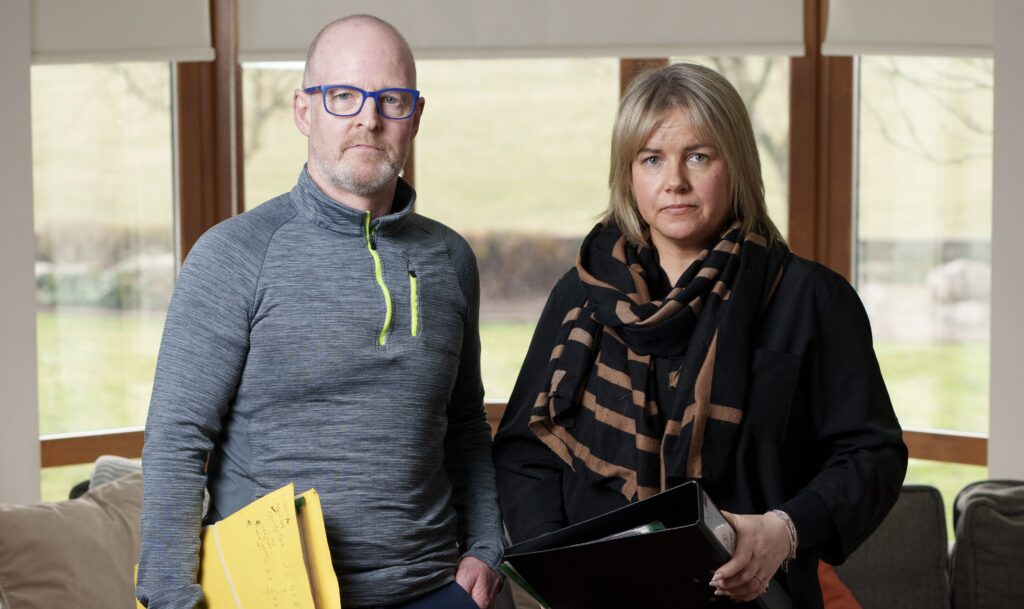
‘There are no suspects. There’s been nothing confirmed by the guards. This is an ongoing case and we’re as much in the dark as anyone else,’ Susan Plower told the Irish Mail on Sunday this week.
Dave Plower added: ‘We are victims, and there are other victims, and I suppose the case has not been taken seriously enough.’
The MoS spoke with Garda sources to get a direct insight into where the investigation was. And we can reveal that gardaí have reached an impasse – with their investigations having only served to clear one local person who was considered to be in the frame.
And another person named locally as the perpetrator was never considered to be a real suspect. As such, Garda sources admit that the best hope of a breakthrough is that a mistake will result in a forensic breakthrough that will lead to whoever is responsible.
It’s a situation the letter writer seems wise to, adding in the March 20 letter: ‘No DNA on anything. We know how this game works!’
A single-page letter sent on February 26, which starts with the foulest of personal abuse, was sent along with a zip lock plastic bag containing an apparently used condom complete with a sticky, oozy substance inside. Identical letters, also with condoms inside, arrived on the same day to the home of Dave’s twin brother and a close friend of Susan’s. It is not uncommon for others to receive letters like this.
‘We are aware of other people outside of our family, completely unassociated with us, that have received letters who binned them because this person has written to so many people,’ Dave Plower said. Accompanying the condoms in each envelope is a thin slip of cut paper containing the printed words: ‘Suck on that you gobby, no neck, buck teeth, ugly hippo of a ****.’
Previous letters of this type have been examined for DNA and fingerprints by gardaí. Nothing was found. The perpetrator wore gloves and had used liquid hand soap to mimic the appearance of semen. It is clear by now that considerable planning and effort has been expended in this campaign of hatred.
But who would do such a thing, and why? This simple questions led this newspaper to engage with the Plowers, and a variety of experts in an attempt to unearth any clue or signpost that could help identify the writers. The MoS sent samples of the letters to forensic handwriting experts in the US and the UK.
We also sent the material to a renowned New York-based criminal profiler. Those samples included the very first 32 handwritten letters from five years ago – and 30 more recent typed letters.
The experts all agreed on one thing. That a handwriting comparison was impossible because of the lack of suitable writing to compare them to. Another one thing was also clear, however.
‘There are several different personalities writing these awful letters,’ Barbara Weaver, a handwriting analyst with the Cambridge School of Graphology concluded.
That could mean two things; either more than one person is involved – or a single writer is mimicking different personalities and writing styles to disguise themselves. This is the view of Meredith DeKalb Miller, a former forensic document examiner with the FBI Laboratory in Quantico, Virginia.
Now in private practice, DeKalb Miller has also worked with the United Nations Office on Drugs and Crime and George Washington University. She told the MoS: ‘The questioned letters are disguised… they do not contain naturally prepared writing.
‘The writer has disguised in different ways with the handwriting style, slant, etc.’
This means the writing cannot be easily compared – if at all – with handwriting samples from suspects.
‘Unfortunately, this type of writing is not suitable for comparison,’ Ms DeKalb Miller concluded.
But this does not mean that the handwritten letters may not contain other forensic clues. These could include invisible indented impressions left behind on pages from something written on a page above them.
Gardaí, using the services of Forensic Science Ireland, did try this – but to no avail so far.
It has never before been reported before, but gardaí also raided multiple premises in the Galway area and spoke with potential suspects.
A Garda source confirmed that, in one instance in 2022, a warrant was obtained to raid the home and workplace of a long-term acquaintance of Ms Plower.
Computers, printers, paperwork and other materials were seized during the operation.
But after a thorough forensic examination, the suspect was then ruled out as innocent and all materials returned.
In the early days, the Plowers and others in the area were asked to provide multiple samples of their handwriting. But this too led to nothing. Whoever is responsible has also deliberately dropped decoys into their letters that point to others, not caring how this will affect those who may be vulnerable or fragile.
As a result, lifelong friendships have been irrevocably damaged, and completely innocent parties have been recklessly outed on social media as the culprit.
‘This person, whoever they are, they’re thriving on people’s pain and are also jealous of people’s success,’ Dave Plower told the MoS.
‘When they get an opportunity, if something significant happens in somebody’s life, that’s a happy occasion, they lambast it. They comment on it, you know, be it a communion, be it a wedding.’
Meanwhile, for the Plowers a sense of paranoia follows them everywhere. Someone who knows them intimately is watching them with malice and sinister intent.
Photos of Dave in his garden – perhaps obtained via the use of a drone – have been secretly taken and included in the letters.
Details from inside the Plower household have been casually referenced. So too are frequent descriptions of them going about their daily lives. Private trips to the hospital, nights out in the local pub, weddings, golf games, funerals and other events are all seized on by someone close enough to have this kind of access.
Their photos are pulled from social media and sent back to them with graphic pornographic images superimposed on them.
The best clues to what kind of person the author could be are in the letters, according to renowned forensic psychiatrist and criminal profiler, Dr Michael McGrath.
Based in New York, Dr McGrath is a board member of the Forensic Criminology Institute, a distinguished Life Fellow of the American Psychiatric Association and a founding member of the International Association of Forensic Criminalists.
After reading the letters and listening to radio interviews given by the Plowers, Dr McGrath made several observations. Firstly, after conducting a textual analysis of the radio interviews, Dr McGrath said he found ‘no markers of deception’ when the Plowers themselves spoke. This, he said, points to the Plowers’ ‘lack of involvement in writing the letters’.
This is important. Ruling the victims out is one of the first steps any Garda investigation will have done.
Moving beyond that, Dr McGrath accepts that there could be more than one writer but adds that while he cannot be certain, he feels the perpetrator is most likely a man.
‘Do not assume the sex of the person who wrote this stuff,’ Dr McGrath advised. ‘Most likely it’s a man, but we don’t know that.’
But whatever their gender, Dr McGrath is clear the culprit is supremely self-important and
narcissistic.
‘Whoever this person is, they’re very narcissistic. They may not necessarily appear that way on the surface, but they’re very narcissistic,’ he said.
‘Some kind of narcissistic injury occurred, either by the husband or the wife to this person to set this stuff in motion.’
So the Plowers did something – or were perceived by the letter writer/s to have done something – that slighted them. In response, they took revenge.
Whoever they are, they lack the control most people have to let something go when they are slighted and become angry. Think Donald Trump, Dr McGrath advises, as an example.
‘We should all have a good, healthy sense of narcissism, feeling that that you’re worthwhile, that you’re important. Some people have an overblown sense of narcissism,’ he said. ‘Some people can get very upset over the slightest things… they’re like a malignant narcissist, anything can upset them.
‘They see themselves as the most important person in the world. Everybody should essentially kiss their ass. And if they don’t… they have a problem with that.’
It is more likely than not that such a person will not be married. If they are, they will be the clearly dominant party. But while a ‘loner’ with no wife or steady girlfriend is most likely to be ‘at the top of the list’ Dr McGrath warns any such conclusion is purely speculative.
‘The guy in the basement, you know certainly is up there near the top of the list but that may be a red herring… if you start giving a profile based on speculation, then you could lead things astray.’
The key, Dr McGrath added, is understanding the close link any suspect may have to the Plowers.
Dr McGrath also advised that narcissistic types dislike confrontation and said the letter writer/s were obsessional but not necessarily obsessive. They have, for example, dedicated time into preparing by doing the research necessary to evade capture, aside from the time needed to sustain the actual letter-writing campaign.
‘I would not give a diagnosis of obsessive-compulsive disorder, or anything like that. But the adjective obsessional would certainly fit someone who’s writing, say two or three letters a week over the course of five years.’
Dr McGrath agreed it is clear the author/s ‘get off’ on the hurt they cause.
‘I wouldn’t say they get off in the sexual sense,’ he said. ‘But this makes them feel good. This gets the dopamine going when they’re sitting there writing these out, and then when they go mail them.’
Dr McGrath also points to the possibility of a nightmare scenario in which those responsible are not in any way connected to the Plowers at all. ‘That’s a long shot, but not impossible,’ he said.
But one thing Dr McGrath is sure of, is that the Plowers, despite the prospect of provoking more letters, are doing the right thing in going public. He said: ‘It was going to go on anyway – by going public, they’re alerting this person, it’s like confronting the person.’
CATCH US IF YOU CAN
THE first letter arrived in January 2020 and falsely accused the eldest son of Susan and Dave Plower of selling drugs.
That theme has since been repeated – but only rarely.
Instead, the aim over time appears to be to destroy the Plowers’ marriage.
‘Your so-called marriage is a shambles. It’s over. It’s dead,’ is one of many examples.
In the beginning, the letters were all handwritten in varying styles before they changed to typed.
Sometimes they use colloquial language fluently, sometimes they present as written by an Eastern European. Sometimes Polish and other foreign words are used.
Sometimes they appear to be the work of a polite professional who writes neatly and coherently.
Other times they appear deranged with poorly structured sentences, apparently deliberate misspellings and messy writing.
The handwriting alternates from all caps to joined, slanted left and right – as well as neater, straighter writing.
Early letters concentrate primarily on unfounded claims that Dave, a supermarket manager, was stealing from work and having affairs.
Claimed video footage of this never materialises but is frequently threatened.
In the beginning of the hate campaign, expletives were rare or non-existent and the letters were presented as staff at Dave’s workplace complaining about him. But there is a clear escalation in tone and aggression over time.
Today, the old workplace claims have been largely dropped and vile expletives accompanied by pornographic images have been introduced.
Now Susan’s appearance as a woman is routinely targeted with vile comments as she is compared to the supposed beauty of the fictional women her husband is said to be seeing.
She and Dave are also attacked as parents. The spread of the letters has expanded with up to 14 friends, family members and workplaces now also targeted. Sometimes multiple salvos of hatred arrive on the same day.
That pattern of attack began in July 2020 when three letters were sent to Susan at home and at work on one morning. Some weeks later three or four letters are sent. The longest period without any letters has been about six weeks.
Aside from the intent to break up the Plowers, several other trends emerge as very frequent. Apparently knowledgeable details about the cars driven by the Plowers, for example, are very common.
‘Ye were nicer people when ye had bangers of cars like normal people,’ one early letter reads. From then on, every car change has been noted in detail, complete with registration numbers, and mocked extensively as Dave buys and sells them.
‘What do you know about cars. You have no qualifications. no knowledge. No nothing,’ one reads.
Occasionally, an entire letter is dedicated to mocking car ads placed by Dave.
There are also very frequent references to Dave being ‘cocky’ ‘narcissistic’ and ‘arrogant’ – something our profiler has identified as a likely trait of the letter writer themselves.
‘I have watched you leave work, cocky and full of self-importance,’ one letter reads.
This who-do-you-think-you-are tone spills from almost every letter.
Motivations are carefully disguised, but occasionally the writer appears to reference their own situation.
One letter reads: ‘You think you’re the only ones with problems. Your not. Everyone has more serious problems but they keep it to themselves.’
Meanwhile, the ongoing Garda investigation is routinely mocked and taunted.
‘Ye will never catch us. The cops will never catch us,’ one letter reads. A common sign off is: ‘Catch us if you can!’
