Home Blog Page 36

Licensed To Kill.

By Michael O’Farrell and Paul Henderson

In the latest Bond movie, Quantum Of Solace, the South American republic of Bolivia is characterised as a fearsome police state, riddled with murderous government forces, villainous coup plotters… and a savage would-be dictator waiting to take power in the Andes on behalf of shadowy corporate forces. This is fiction.

The truth is far worse.

In the steamy, ramshnckle city of Santa Cruz, fear does stalk the streets. Fatal duels really do happen, although rarely as cleanly and professionally as on the silver screen.

The CIA’s official analysis of Bolivia documents a continuous series of 200 coups and counter coups since independence in 1825 – more than one a year for well over a century. Each of those added to the murderous toll of death and destruction wreaked ever since the conquistadors first arrived in South America.

But then again, there is a great deal at stake.

The country’s biggest business is cocaine. After Columbia and Peru, it is the third largest producer in the world.

Bolivia also has huge reserves of natural gas, and of lithium – the metal of the future, which will power pollution-free cars and homes.

It was into this maelstrom of power, money and opportunity that Michael Dwyer, a 24-year-old nightclub bouncer from Co. Tipperary, walked last year. And it was in this same maelstrom that Michael Dwyer ended up dead, gunned down by heavily-armed special forces in the bedroom of a tatty hotel in Santa Cruz. Lying in his underpants, with bullet holes riddling his body and those of two friends, Dwyer achieved the kind of international fame he may have fantasised about at his beloved video-games console. His death is now at the centre of an international manhunt and an even bigger worldwide debate over the key question; was he just an innocent kid on an adventure holiday, executed by the Bolivian state forces for their own propaganda purposes? Or was he, in fact, part of a right-wing hit squad that, for political or financial purposes, had been sent to the Andes to murder the president?

What is indispulably true is that Bolivia is dangerously divided since socialist leader Evo Morales was swept into power in 2005 on a promise to sieze wealth from prosperous non-indigenous communities and share it out among the natives.

‘Since taking office, his controversial strategies have exacerbated racial and economic tensions between the Amerindian populations of the Andean west and the non-indigenous communities of the eastern lowlands,’ is how the CIA public analysis sums up the situation.

Privately, no doubt, the spooks at Langley would have other ways of describing this South American hotbed.

Claims of interference by Washington are common. Indeed, US Ambassador Philip Goldberg was expelled last September, accused by Morales of aiding violent opposition groups based in Santa Cruz – a city of wealthy merchants vehemently opposed to Morales and his stated intention to rid thorn of their wealth.

There are plenty of multinationals, too, such as Shell – which has extensive interests in Bolivia’s lucrative gas fields. Morales nationalised a pipeline part-owned by the oil giant – not something the multinational took lightly.

Cocaine, gas and power. Such assets are worth fighting for. In a Bond movie, they would be worth killing for.

Enter Dwyer, infused with a sense of derring-do gleaned probably from the movies. He became associated with an unholy mix of right-wing nationalists and fascist ‘freedom fighters’. And, conspiracy theorists take note, he met some of these unsavoury characters while working as a security guard for Shell, through a security firm employed on Shell’s Corrib project in Mayo.

Pre-Bolivia, Dwyer’s world appears to have been dominated by the familiar cliches that most young men eventually grow out of. Popular culture and a sense of freedom and adventure – not political idealism – appeared to dominate his psyche. Nowhere, in more than a month of trawling through his past, has anyone found any reference to any form of political interest.

He had been brought up by his parents, Martin and Caroline, in a loving home in Ballinderry. He had two sisters and attended St Joseph’s College secondary school in Borrisoleigh. A fun-loving hurling fan, he went on to study at the Galway-Mayo Institute of Technology – and it was his part-time work as a nightclub bouncer in Galway that may have got him started on the path that would lead to his blood-soaked end in a Bolivian hotel room. He never served with the armed forces and has no criminal record.

‘He is supposed to have gone from being a doorman to opening and closing gates in Mayo to plotting to assassinate a president. That’s a hell of a jump.’ a security source told the Irish Mail on Sunday.

Friends of Dwyer point out that, throughout his trip, he posted Facebook pictures of himself – in nightclubs, partying with friends, out in the jungle – hardly the actions of an international terrorist. Indeed, he even named his “co-conspirators’ as his Facebook friends. Could this smiley young man really be a modern-day Carlos the Jackal, intent on overthrowing an elected leader in the name of international power politics?

Having posed for macho photos in assorted Santa Cruz hotels brandishing a range of assorted firearms, it is ironic that the final photo of Dwyer was of his lifeless, bloodied corpse splayed out on the tiled floor of Room 457 of the Hotel Las Americas in his underwear.

His travelling companions – Eduardo Rozsa Flores, 49, a Bolivian-born poet turned ‘freedom fighter’, and Arpad Magyarosi, 39, a Romanian of Hungarian descent – were also killed in the now infamous raid.

The presence of Flores immediately gave weight to Morales’s assassination claim. A communist in his youth, – Flores later fought with the Croatians in the Balkans conflict, and was awarded Croat citizenship. He then converted to Islam and supported a wide and often contradictory range of causes, many on the right-wing fringe.

‘There is a need for weapons so it , isn’t about the boys marching in the streets with flags and bamboo sticks – if co-existence doesn’t work under autonomy we will be ready, in a few months, to proclaim independence and create a new country,’ Flores had told a journalist in Budapest prior to his departure for Santa Cruz.

He had proclaimed chillingly that he was prepared to die if that’s what it took to make Santa Cruz ‘independent’ – an echo of his success in helping to win independence for Croatia.

Nevertheless, the events surrounding the death of Dwyer and his friends, on April 16, at the hands of Bolivia’s elite Delta Group are still to be satisfactorily explained.

The official version – doubted by many and now under investigation – is that FIores and Dwyer were part of a terrorist cell that planned to assassinate Morales and cause an uprising against the current regime.

But the conspiracy theories grow daily, fuelled by all sides, including Morales, who immediately accused the US of being behind the assassination plot. He was taken seriously enough by Washington to force a denial from Barack Obama.

‘The United States, obviously, has a history in this region that’s not always appreciated from the perspective of some,’ Obama told reporters the following day.

‘Specifically on the Bolivia issue, I just want to make absolutely clear that I am absolutely opposed to and condemn any efforts at violent overthrows of democratically elected governments.’

It is extraordinary by any standards to think that those words, uttered by a serving president of the United States, could refer to a happy-go-lucky construction-management graduate who, less than 12 months earlier, had been sitting final exams in the halls of GMIT.

The truth about Dwyer’s intentions in Bolivia may never be known but a vast amount of research largely carried out by bloggers and contributors to forums such as politics.ie <http://politics.ie> has raised many disturbing questions.

Debate on the site has raged between posters who claim to have been friends with Dwyer who insist he was just a big kid – and those who claim he was a neo-Nazi, as evidenced by the tattoo on his shoulder (which can appear to contain the twin lightning-stripe insignia of the SS).

Chief among the questions posed on the site is the role that an Irish security company led by former army special forces commanders played in introducing Dwyer to others involved in the conspiracy.

It is now known that Kildare-based security firm Integrated Risk Management Services (I-RMS) played a part in bringing Dwyer together with right-wing Hungarian elements from a group known as the Szekler Legion – an outfit prepared to use violence to achieve autonomy for ethnic Hungarians in a border region of Romania.

One of those elements was Tibor Revesz, a commander of the Szekler Legion and the owner of its websites – upon which appeals for volunteers for an insurgency campaign in Santa Cruz were advertised late last year.

Both Revesz – who is being sought by Bolivian law enforcement and thought to be still in Ireland – and Dwyer worked for I-MRS protecting the Shell Corrib gas project. It is here, facing down protests from the Shell to Sea campaign, that the pair are thought to have met.

Revesz also travelled to Bolivia as part of a group of 15 but had left before the police raid that killed his friends.

Appropriating the lingo of the Irish special forces unit, the Army Ranger Wing, Revesz even took to selling mission badges with Irish team names such as Foireann Cahill and Foireann Ardal on his website.

Other items on sale included hyped-up memento badges commemorating supposedly ‘glorious battles’ against anti-Shell campaigners in Mayo.

One such badge, referring to the defence of Shell’s Glengad Beach depot, incorporated a traditional Nazi-style graphic with a Shell logo.

Revesz also used his website to advertise an I-RMS close-protection course that included pistol, carbine and tactical firearms training. All of Revesz’s web pages have been deleted in recent weeks.

I-RMS – based beside the Army Ranger Wing HQ in the Curragh in Co. Kildare – has refused to comment about its role in bringing Dwyer and right-wing fanatics together.

Apart from raising issues about its recruitment policies and vetting procedures, the I-RMS connection also provides an intriguing link to Shell. The I-RMS website is ‘being updated’ and unavailable since the Bolivia controversy erupted. But the now unavailable company website used to refer to an African subsidiary – I-RMS Africa Ltd – as being based in Nairobi, Kenya.

According to the site, the African subsidiary provides ‘specialised security services’ in east Africa.

Just what these services are is not known. Whether I-RMS has any involvement with Shell in any other African countries is also not known. In the wake of the Bolivia controversy, the company has repeatedly refused to respond to questions from reporters.

Shell, though, has a controversial past in Africa as demonstrated by its conflict with the Ogoni people of Nigeria. In fact, a case being taken by a group of Ogoni suing Royal Dutch Shell plc over the execution of environmentalist and writer Ken Saro-Wiwa and others was due to get under way in a federal court in Manhattan on Wednesday but was stalled again for the umpteenth time.

The case, being taken by the relatives – including Saro-Wiwa’s brother, Owens – of seven activists killed, between 1990 and l995, has now been rescheduled for early next month.

According to the complaint, Shell recruited Nigerian police and military to attack villages and suppress opposition to its presence in the Niger Delta.

Shell’s previous form in Nigeria and the fact that its assets in Bolivia were being part-nationalised and seized by a determined Evo Morales has led to speculation about whether it or agents on its behalf, would like to topple the country’s regime.

Last June, Morales nationalised Bolivia’s main gas pipeline company, Transredes Transporte de Hidrocarburos SA – forcing US-based owners Ashmore Energy International to sell its majority holding for $48 a share. Ashmore had previously co-owned the company with Shell, but had bought out the Dutch giant’s 25pc stake in 2007. Morales had previously forced oil companies to renegotiate contracts in 2006.

There is no indication that Shell had any intention of doing anything illegal in Bolivia and it is only one of myriad commercial interests in the country’s natural resources.

After all, Bolivia has the second largest gas reserves in South America – after Chavez’s Venezuela – and in many cases, exploration has just begun, with the Russians recently pledging a billion-dollar-plus investment for exploring the country.

But there is no doubt that any of the foreign-owned oil companies present in Bolivia would certainly have an easier life if something were to happen to Morales. Same goes for the wealthy separatists in Santa Cruz.

In the fantasy world of James Bond, the unseen hand pulling the strings could be a foreign intelligence service, a stereotypically evil oil company willing to stop at nothing to secure its assets or a group of wealthy Bolivians intent on overthrowing a president who is threatening their livelihoods and security.

But all these options have also played themselves out in real life elsewhere. Frequently, it is only years later that the truth emerges.

Many have made much of the apparent ineptitude of Dwyer and the band of would-be revolutionaries he accompanied to South America.

‘The key issue, to my mind, is that no member of the group had the skills necessary for a military operation that would involve confronting the entire State security apparatus of Bolivia. The only two with any military experience were late middle-aged men. Mike Dwyer’s brief experience as an Airsoft enthusiast (just a step or two above paintballing) hardly qualified him as a potential assassin,’ wrote one contributor to the massive online debate still raging more than a month on from the Bolivia killings.

But others, including security specialists who spoke to the MoS, had a different view.

‘The Rangers had paintball before anyone else had it,’ an Irish security source said. ‘It’s even modified specially to suit their weapons. All security services train with paintball systems.’

Those familiar with the security industry also point to the fact that these days, trained-up former special forces members have adequate employment opportunities in the private sector, protecting commercial personnel and business interests in Iraq and Afghanistan.

The six-figure sums available for such work have all but eliminated the days of professional mercenaries hiring themselves out to one side or another in some desert civil war or banana-republic coup. The people attracted to such activities are, more often than not, emotionally or ideologically driven and not necessarily the most professionally trained for the job – like the rag-tag band of men the sense of adventure in Michael Dwyer seems to have been attracted to.

But that is not to say they could not have been successful. History has shown that assassinations are frequently carried out by amateurs.

An inept, overweight self-styled freedom fighter is just as capable of starting a revolution with one lucky or well placed shot as a crack commando. And if there are sinister backers with political or financial motives behind the plot, it is all the better for them that those seen to be responsible are written off as crazy amateurs.

There are ample examples of ultimately successful but initially inept assassinations leading in some cases to even world-wide consequences – remember Gavrilo Princip, the Bosnian Serb twice rejected by revolutionary groups for being too small and weak, who managed to spark off World War I by assassinating the Austro-Hungarian Arch-Duke.

And coups are not historical fiction: even now in Africa, a group of British-led mercenaries languishes in jail after being caught trying to overthrow the government of Equatorial Guinea for its oil reserves.

What is also notable is the muted reaction of our Government. Last week, the Department of Foreign Affairs was refusing to comment on the status of the investigation it had called for into Dwyer’s death. His case is not being publicly raised by ministers, leading some to believe that our administration wants nothing to do with a plot to overthrow an elected leader.

Moreover, this is a government that already stands accused of selling out to multinationals over the very same Corrib gas project where Dwyer worked as a security guard. The truth, when it finally emerges, will make the last Bond movie seem very, very tame indeed.

2009_05_31_dwyer_mail_on_sunday_review_pages

Share This:

Let There Be Music – The Tax Payer Is Paying.

By: Michael O’Farrell
Investigative Correspondent

STATE training agency FÁS hired a personal pianist to play in Mary Harney’s hotel suite during a lavish trip to South Africa, the Irish Mail on Sunday can reveal today.

In the most breathtaking example yet of the minister’s pampering at the expense of Irish taxpayers, FÁS officials arranged for the pianist – dazzling brunette Christine McLeroy – to come to the minister’s suite in one of the coun-try’s most opulent hotels.

There, Miss McLeroy entertained Miss Harney and guests on the Steinway baby grand piano that is the proudest feature of the €2,600-a-night presidential suite. While her repertoire is mostly classical, guests said Miss McLeroy was happy to oblige with renditions of guests’ favourites such as Danny Boy to their great delight.

The revelation will pile pressure on Miss Harney over her propensity for allowing FÁS – which was chaired for four years by her husband – to pick up the bills for her entertainment and grooming on taxpayer-funded trips abroad.

She has already been forced to defend allowing the State training agency to pay hundreds of dollars to have her hair done in her Florida hotel room, as well as picking up the bill for dinners, drinks and limousines during a 2004 visit.

Now the MoS has learned extraordinary details of her trip to South Africa in November 2000 when, as tánaiste and enterprise, trade and employment minister, she was in Cape Town to launch the agency’s Jobs Ireland campaign.

FÁS spared no expense for the lavish trip, during which Miss Harney stayed in the five-star Table Bay Hotel. The room in which she stayed – the Table Mountain Presidential Suite – is on offer today at a cost of €2,636 per night.

Situated on the eighth floor of the hotel overlooking the Atlantic Ocean and with Table Mountain as a backdrop, the luxury suite can seat a full dinner party of eight and has its own Jacuzzi as well as the piano.

Sources say that Miss Harney personally asked for a pianist to play during a drinks party in her suite – a suggestion which her spokesman has refused to confirm or deny.

The surprise request resulted in a panicked last-minute search as FÁS staffers sought a suitable musician.

In the end, a Cape Town entertainment agency recommended by the hotel provided a pianist called Christine McLeroy. Ironically, the hotel already has its own in-house pianist – but he plays only in the lobby.

FÁS’s director general Rody Molloy, its outgoing chairman Patrick Lynch and newly appointed chairman Brian Geoghegan – who married Miss HarHara year later – accompanied the minister on the South Africa trip.

It is not known if the FÁS board members attended the piano funcfuncThe trip took place less than a week after Miss Harney had appointed Mr Geoghegan chairman. Months later, the pair began formally dating and they married the following year.

During the trip, FÁS management are understood to have been particularly anxious to gain approval from Miss Harney for the continuation of their rapidly expanding Jobs Ireland campaign.

‘We were told to pull out all the stops – so we did,’ said one source. ‘The stuff in Florida pales into insignificance compared to this.’

FÁS declined to provide details of the cost of the trip to the MoS this week but a spokesman for Miss Harney said all expenditure and arrangements for the trip had been the responsibility of the State training agency.

According to the spokesman, the event in Miss Harney’s suite was an official reception attended by ‘representatives from companies, members of the wider business community and members of the Irish community in Cape Town’.

‘As would be normal for such events, all the arrangements and organisation for this reception would have been the responsibility of FÁS. The official costs associated with the tánaiste’s visit were the responsibility of FÁS , in line with established procedures,’ he said.

Miss Harney’s spokesman refused to answer questions about whether Miss Harney had personally requested the pianist and how such expenditure could be justified. He was also unable to provide a detailed list of those attending the function.

The latest revelation comes just five days after FÁS director general Molloy resigned when the State training agency was found to have spent more than E640,000 over four years on transatlantic travel promoting its Science Challenge programme.

Fine Gael leader Enda Kenny and Labour Party leader Eamon Gilmore have both called on the entire FÁS board to resign.

One of the most controversial FÁS trips to Florida took place in July 2004 when Miss Harney flew to Cape Canaveral on the Government jet at an estimated cost of €80,000.

The five-day trip saw her complete just one full day of activities and involved considerable leisure time for her and husband Mr Geoghegan.

But this weekend Miss Harney justified the trip during which she incurred a $410 hair salon bill. ‘I was not on a holiday. I was there working,’ she said, adding that she only ‘engaged in legitimate expenses’.

‘I don’t use taxpayers’ money for personal grooming,’ she said. ‘When I am on personal business, I look after my own personal affairs. But clearly, if I’m on official business – and I stress official business – official expenses are paid and any personal expenses I would have on official business would never be claimed.’

In a statement last night, the FÁS board said it intended ‘to strengthen the internal audit function’ within the organisation.

Share This:

A Taoiseach’s Inspiration – A Historical Investigation Into Enda Kenny’s Grandfather

By: Michael O’Farrell
Investigative Correspondent

JAMES McGINLEY watched as his father, John, carefully completed the census form. It was April 10, 1901, and, as the sun set on the Atlantic and the family’s thatched cottage, the 22-year-old possibly sensed the significance of the occasion.

The McGinleys had lived in the coastal townland of Malinbeg in Donegal for generations but no one had bothered to count them before. Now, they officially existed.

But James, a renowned fiddle player like his father, could not have known that 106 years later, in a packed auditorium in west Dublin, one of his grandchildren would ensure his immortality.

Rising to the emotional climax of his ard fheis speech last week, Fine Gael leader Enda Kenny invoked the proud memory of his maternal grandfather.

‘I leave you with thoughts of one man who kept his contract, kept his word. His name was James McGinley,’ said Mr Kenny.

‘He was a lighthouse keeper on our west coast. Just a lighthouse keeper. Not famous, not rich, but crucially important. Cross the Atlantic and he was the first and last Irishman, the first and last European. In his ordinary life, with his ordinary family, in his ordered lighthouse, he didn’t just keep the light, he kept his contract – that was his job.

‘Whatever the weather, he had to. It was up to him. People depended on him for their lives. You see, James McGinley was my grandfather. He kept his contract and he used it to look out for people, to make their journey better, to bring them safely home. So tonight, people of Ireland, I give you our light, our contract.’ It was an intriguing story, worth a closer look – and this week, Mr Kenny told the Irish Mail on Sunday that he and the other grandchildren clearly remembered fishing with their grandad.

‘He was expert in preserving fish. He’d gut them and rub them with coarse salt that he’d import specially. He’d then layer them in a barrel – salt, fish, salt, fish.

‘When he needed the fish, he’d take one out and steep it overnight in water. The salt would come out, the fish would plump back up to size and would taste delicious,’ said the Fine Gael leader.

BACK IN 1901 though, James had not yet become the lighthouse keeper that Mr Kenny would speak of so proudly more than a century later – though there was a certain inevitability about his career path.

The three-room whitewashed family home described in the census form directly overlooked the island of Rathlin O’Birne and its gleaming lighthouse.

Ever since his birth – registered as October 27, 1879 – James was drawn to that beacon.

Described by relatives as a jolly man with a deep, serious side, James followed that beacon all his life, through hardship, personal tragedy and, ultimately, a second chance at happiness. Crucially, his parents, John and Hannah, had given their children an education that allowed them surpass their farming background.

The 1901 census shows that James’s generation was the first to move up in the world. Patrick McGinley, an uncle of James and one of the seven living in the cramped cottage, was illiterate and could speak only Irish. But James and his siblings could read and speak both Irish and English.

James’s brother Michael also became a lighthouse keeper on the west coast while another brother, John, wound up manning a lighthouse on the Brazos River in Texas.

A sister, Brigid, emigrated to Anaconda, Montana, where her family worked in the copper mines.

Commissioners of Lights records show that James travelled to Dublin to enter the lighthouse service on February 1, 1905, aged 25.

Six months’ training at the Baily lighthouse in Howth was followed by promotion to assistant keeper and a posting back to Rathlin O’Birne for four years.

There, still single and cut off from the mainland by a narrow gorge, he began a tough and often lonely career that would last a lifetime.

Returning to the mainland for a week once a month if the weather allowed, he would bring eggs from the hens he kept as well as lobsters, crayfish and crab from the pots he had dotted around the island.

Perhaps loneliness was the worst hardship but there were others, such as claustrophobic living conditions, late nights sitting up through vicious storms and irregular relief services. At times, men would remain on their stations for months on end as poor weather prevented boats from landing.

But the position had its advantages, too. It was permanent and pensionable, accommodation at most stations was good, with ample supplies of coal and household equipment, and there was annual leave with pay – an almost unheardof perk back then.

In 1910, now stationed on lonely Beeves Rock in the Shannon estuary, James took time off to marry Margaret Heekin, a 23-year- old merchant’s daughter from Carrick in Donegal.

Margaret moved into a Commissioners of Lights cottage on the mainland, No.12 Cloonreask, near Askeaton, Co. Limerick. She must have spent many lonely days in the six-room house as her husband did his duty out in the estuary.

ON THE night of the 1911 census, she was again alone and completed the record herself, signing the form ‘Maggie McGinley – head of family’. But she was in daily communication with her husband via semaphore.

‘She could see the lighthouse, he could see the cottage but, as there were no phones, semaphore it was. Some of the Kenny boys remember her using the flags and binoculars to communicate with grandad,’ Mr Kenny told the MoS this week.

James spent World War I on Tuskar Rock off Wexford, three years on Inis Eoin in Donegal, three years on Aranmore and 18 months on Inisheer. There were also two further spells on Rathlin O’Birne.

But much of this time was spent alone as, some time after that 1911 census, Maggie McGinley, by then the mother of two children – Ethna, Enda’s mother, and Andrew – died. Details of the untimely death are sketchy – Maggie is said to have died in childbirth.

Many years later, in his 50s, James married again, to Margaret Crowley, a Dublin nurse whose father had been a lighthouse keeper. Beginning with the birth of a daughter, Una, in 1932, the couple went on to have six children – five daughters and one son.

That son, Joseph, born on April 29, 1934, at the lighthouse in Loop Head, was six months old when his father took up his final, five-year posting in 1935 in Rathlin O’Birne.

Like Enda, Joseph has nothing but fond memories of James who, he confirmed, was a staunch Fine Gael supporter.

He still remembers all the children gathering at the front door every evening to watch their father light the beacon on the island.

‘There was a red light that was supposed to point to the shore and a white light to sea. But we’d take our mother’s black shawl and hold it against the whitewashed house so he’d see us,’ remembers Joseph.

‘Every night, he’d turn the mirror so the white light shone towards us for a few seconds to tell us that he could see us in the doorway.’ On retirement in 1940, James settled down to a quiet life of farming, building his own home directly overlooking the lighthouse.

‘Every Sunday, he and his friends had two or three bottles of stout in Big Annie’s after Mass. He liked to have a little drop after Mass but then there’d be none until the next week,’ remembers Joseph.

James passed away in 1962 when Enda Kenny was just 11 years old – but if he was alive today, there is little doubt whom he would vote for.

Share This:

The Charitable Hand-Me-Downs That Make Millions. The Second Hand Rag Trade Exposed.

Share This:

OPERATION DIRTY TRICKS

First published in the Irish Mail on Sunday on 20/05/2007

By: MICHAEL O’FARRELL
Investigative Correspondent

ON FRIDAY, May 4, an unknown Fianna Fáil supporter sat down at a computer to put the finishing touches to a document.

The file – called ‘Memo re Rehab’ – was then printed off and saved to the machine’s F drive.

With just 20 days left before polling day, and after months of sustaining damage from leaked tribunal documents, Fianna Fáil was about to get down and dirty.

Whatever politicians say, no election passes without its share of dirty tricks from the trivial to the deadly serious.

The trick Fianna Fáil was about to play fell firmly into the latter category, even if its execution was somewhat haphazard.

The intended smear involved serious but wholly unsubstantiated accusations that Fine Gael election director Frank Flannery and others close to the party were associated with large-scale financial irregularities at international charity group Rehab.

Mind you, it was not the only scurrilous allegation to do the rounds this week.

Fine Gael party leader Enda Kenny has ended up the subject of a string of utterly bizarre and totally unfounded rumours in what has become an increasingly febrile election.

The allegations against Mr Kenny have not only been spread by word of mouth but also through the pages of malicious websites.

A nervous party spokesman admitted last night that ‘Fine Gael have been fielding calls all week about a variety of allegations against Mr Kenny’.

Taoiseach Bertie Ahern has also been the subject in the past of scurrilous and wholly unsubstantiated claims about his private life.

There is no evidence that there is a single grain of truth in either these or the damaging charges the memo levied against Mr Flannery, who stood down as Rehab boss last summer six months after his right-hand man and fellow Fine Gael supporter John Hussey departed as vice-chairman.

Never mind. As far as Fianna Fáil supporters were concerned, the ‘Flannery File’ was going to find its way into the press.

However, before the Soldiers of Destiny could start throwing mud, a little more work was needed.

Six days after the initial memo was written, and probably using it as a guide, another Fianna Fáil supporter logged onto the internet in London on Thursday, May 10.

Working from an office at 10 Station Yard, Park Avenue, Southall, this mystery person set about compiling a detailed brief to back up the Rehab allegations.

Wikipedia was consulted for information about Fine Gael National Executive member Enda Marren, a director of Rehab.

Information about Frank Flannery and his 33-year spell as the head of Rehab was pulled off the website of the Irish Business and Employer’s Federation (IBEC) The home pages of the British Chaseley Trust and global disability organisation Workability International were also consulted. Mr Flannery is trustee of the former and president of the latter.

Then, also on May 10, information about Frank Flannery’s company directorships was accessed on the website of Companies House in London.

But whoever was compiling this information also deemed it necessary to check out John Hussey – twin brother of Derry Hussey, husband of Gemma Hussey. A former minister for education, social welfare and labour, Gemma Hussey’s name evokes Fine Gael like few others – and unsubstantiated but explosive allegations about her brother-in-law’s dealings with Frank Flannery at Rehab are central to the story Fianna Fáil was attempting to piece together.

Until his unannounced and apparently sudden departure from Rehab on February 16, 2005, Mr Hussey had been vice-chairman of the Rehab Group.

The unsubstantiated Fianna Fáil memo alleges that he and Frank Flannery had been involved in sanctioning expenses and consultancy fees for each other, something the Rehab board had supposedly become concerned about.

To complete the picture, whoever was responsible for compiling this brief finally accessed all of Mr Hussey’s company directorships on vision-net.ie, a subscriptiononly company-information service.

One company in particular – Cumberdale Investments Ltd – was circled in ink to ensure anyone perusing the file would realise the firm was in liquidation.

But this is not the only instance of a struggling, liquidated firm in this saga of dirty politics and subterfuge.

Another firm being liquidated – Hennellys Utilities Ltd – plays a central role.

Indeed it was from Hennelly’s Southall office that someone faxed copies of the collated internet information on Friday, May 11, a week after the first memo had been written.

The company’s fax number – 020 85710771 – is still visible on the sheets that were faxed to a third party in Ireland to be discretely passed onto journalists.

By the next day, the Irish Mail on Sunday and the Sunday Independent had already received an anonymous folder containing the brief. RTÉ, too, received the file.

Helpfully, the Fianna Fáil memo even suggested relevant questions that journalists should ask of Mr Flannery and Rehab.

Why was the departure of Mr Hussey not announced? What was Mr Flannery’s settlement package?

Was the board dissatisfied with financial accountability?

Were they signing off each other’s contracts and expenses?

Leading questions were also posed about Mr Flannery’s lifestyle and how he funded it. But perhaps the most interesting nugget involved details of more than E300,000 in consultancy fees paid by Rehab to John Hussey over a two-year period. In some respects, it does appear unusual for a vice-chairman to be paid consultancy fees by his own organisation, especially as he was politically linked to his superior.

However, there was no evidence to back up any claim of anything untoward about the payments.

Speaking to the MoS last night, Mr Hussey denied the claims. ‘At all stages, any requests for fees were approved in the appropriate manner,’ he said before referring further queries to Rehab.

Fine Gael, too, referred questions to Rehab. ‘We are aware that questions have been circulated in relation to certain issues at the Rehab group. Any queries should be directed to Angela Kerins at Rehab,’ said a spokesman.

Miss Kerins, the current chief executive, also said any payments to Mr Hussey were fully above board and that any contracts between him and Rehab had been ‘terminated by mutual agreement’.

‘Mr Hussey did provide management consultancy services through his company, Hussey & Co, to Rehab and its subsidiaries, on corporate finance matters.

These included advice on acquisitions, disposals and investment opportunities,’ she said.

Miss Kerins did not respond to a number of questions asking how much Mr Flannery and Mr Hussey had received in expenses and golden handshakes. Nor did she address questions about whether salaries and expenses were being drawn simultaneously from Rehab companies in Ireland and Britain.

Some of these may, indeed, be valid questions but, given the circumstances, the most interesting question is why on earth such information was emanating, at least in part, from the London office of Hennellys Utilities Ltd?

Perhaps it had something to do with the fact that the owner of the firm is none other than Fianna Fáil fundraiser Seán Hennelly, 61.

He denied any knowledge of the papers, saying he had a personal fax machine with a different number to the office one.

‘I guarantee, it certainly did not come from me. That’s for sure. If I was to fax something, it would not be from that machine. There’s over 30 people using that fax,’ he said.

Mr Hennelly said he became aware of Mr Flannery only recently because of his connections to Rehab.

‘I don’t know Frank Flannery from Adam other than that he did a very good job there,’ he said.

Though he is a Fianna Fáil supporter, Mr Hennelly said he did not even have a vote.

‘I do a golf day once a year but I don’t canvass or anything.’ But Mr Hennelly’s party connections go back a long way and this is not the first time his Fianna Fáil associations have made headlines.

Like many Fianna Fáil supporters and benefactors, he is the owner of a large construction business albeit a perpetually failing one if dissolutions and liquidations are any indicator.

In 1998, he was banned from holding company directorships in England for eight years after running up debts of £10m through a number of failed companies.

Engaged in everything from Channel Tunnel work to railway and motorway construction, Mr Hennelly’s various firms even saw him enter the publishing, personnel hire and waste-collection sectors.

At one point, he employed 100 people in Ireland through Hennellys Civil Engineering, a Galway firm long since dissolved. In November 1998, the former publican and newspaper publisher was listed as the organiser of a Friends of Fianna Fáil celebration dinner scheduled for London’s plush Grosvenor House Hotel.

However, after mounting negative publicity about Mr Hennelly’s insolvency problems, the party claimed his inclusion on the list was an administrative error.

Newspapers at the time reported that Fianna Fáil sources declined to confirm that Mr Hennelly was chairman of the Friends of Fianna Fáil Golf Classic committee.

It seems they will soon again be denying links with Mr Hennelly.

But whether or not anyone central in Fianna Fáil was in any way behind the Rehab allegations, there is a certain poetic irony that the scheme was being cooked up by party friends just as Mr Ahern finally managed to shake off months of damaging tribunal leaks.

Despite his determination to leave the issue behind, he couldn’t help but refer to his belief that Fine Gael had waged a concerted ninemonth campaign against him.

‘There’s no doubt about that,’ he said on Monday. ‘It didn’t just happen and I certainly don’t think it was put together by the media.

People were orchestrating this.’ Mr Ahern went as far as alleging the campaign had been planned in a west Galway hotel last August.

‘I’ve no evidence. I can’t prove it but I was tipped off way back last August that these things were being talked out in west Galway in a particular hotel and people were chatting about it,’ he said. Party handlers Mandy Johnston and PJ Mara this week refused point blank to discuss the comment.

‘We’ve put it behind us and we’re moving on,’ said a brusque Mr Mara.

But the slur had already been put into the public domain. Inevitably, the finger of suspicion was being pointed at Renvyle House Hotel, the exclusive Connemara hideaway where politicians and lawyers have summered for generations.

It was over a series of nightcaps in the bar of Renvyle House that the PDs were dreamed up in the 1980s.

What more plausible venue for another plot to destabilise a charismatic Fianna Fáil leader?

Suggestions that Bertiegate is a Fine Gael plot have been fuelled by the revelation that a formal Garda inquiry has been launched into the leak to the Irish Times.

At the centre of the inquiry are allegations that private correspondence between the tribunal and recruitment millionaire David McKenna – one of eight friends who contributed £22,000 to Mr Ahern in 1993 – was stolen and leaked.

Irish Times editor Geraldine Kennedy and reporter Colm Keena are currently locked in a High Court battle to protect their source.

In the meantime, however, there is ample opportunity to point the finger of suspicion.

Unfortunately for Fianna Fáil, there will be no need for a Garda inquiry to establish who was playing dirty this week. The party has already been caught red-handed.

A LONG, IGNOBLE TRADITION

There is only one rule when it comes to dirty election tricks – don’t get caught. Otherwise, anything goes as plenty of previous efforts have shown.

Perhaps the dirtiest election stunt ever was perpetrated against Dublin Independent TD Tony Gregory in 1981.

As polling day dawned, rivals plastered bogus posters all over the constituency: ‘Vote Tony Gregory. Support the H-Block hunger strikers,’ read the dud slogans. He rushed to tear them down but the damage was done.

He lost his seat by 150 votes.

In 1987, Barry Desmond, Labour Party TD for Dún Laoghaire and outgoing minister for health, was on the receiving end of damaging allegations in a leaflet circulated by John P Clerkin, secretary of the Children’s Protection Society.

Entitled ‘Barry Desmond and Sexual Exploitation’, the document claimed Mr Desmond was ‘perhaps the only member of the outgoing Dáil to have called for child contraception…’ He was forced to obtain an injunction to ban the leaflet and managed to hang onto his seat.

But many dirty tricks – tearing down posters, spreading rumours and so on – involve candidates of the same party.

So concerned at such behaviour was Fianna Fáil Kerry North TD Tom McEllistrim that, in 1977, he took out a last-minute ad in the Kerryman newspaper.

‘There is a rumour going around that my seat is safe… this is a mistake. My seat could be in danger… I appeal to my voters to come out and vote for me.’ The Fianna Fáil director of elections tried to buy every copy of the Kerryman but the newspaper resisted his attempts.

Share This:

Michael Meegan – When Charity Turns To Harm

First published in the Irish Mail on Sunday on 25/04/2010

Click for page one of original article pdf
Click for page two of original article pdf
Click for page three of original article pdf
Click for page four of original article pdf

By: Michael O’Farrell and Barbara Jones

THE HIGH Court has rejected a bid by Irish charity boss Michael Meegan to gag an extensive Irish Mail on Sunday investigation into a series of allegations of sexual assault, financial impropriety and inappropriate behaviour against him.

Having read more than 100 pages of affidavits and exhibits submitted by both sides last weekend, High Court President Judge Nicholas Kearns ruled on Monday that the MoS had gathered sufficient evidence to defeat the injunction application and reasonably defend any future defamation actions. On that basis, Judge Kearns ruled that Meegan – whose charity fundraisers have been supported by celebrities ranging from Chris de Burgh to Britney Spears – was not entitled to an injunction to prevent publication even though he denied all of the allegations against him.

During the hearing, the court heard that six Kenyan men, all of whom had worked for Meegan’s charity ICROSS – International Community for Relief of Starvation and Suffering – had made signed and recorded statements to the MoS alleging sexual abuse, assault and inappropriate behaviour.

According to the evidence seen by the court, the allegations of assault stretch back almost a quarter of a century, having begun in 1986.

One of the men subsequently withdrew his statement although a former ICROSS board member and a one-time volunteer had in their sworn affidavits confirmed elements of it.

Meegan also provided evidence in the form of sworn affidavits that another of the men – Maasai tribesman Meriape Ole Sangaire – had retracted his allegations twice in the past.

In his own sworn testimony to the court, however, Meriape said the retractions were forgeries to which he had never signed his name.

‘I reiterate that Michael Meegan has sexually abused all of us and I am willing to repeat this at any forum,’ his affidavit reads. ‘I am craving for justice and I hope that it will be done. I have repeatedly sought help in vain.’ One of the accusers, Nixon S Jacob, said in his statement given to the court that he was caned for Meegan’s pleasure.

‘He told me if I wanted money, I should strip for him and let him cane me. He told me to take down my trousers right there in his office.

‘He took a bamboo stick and gave me about 10 strokes on my bare buttocks. Then he gave me the money. He was like a sadist. He had taken off his shirt and was wearing just tracksuit bottoms. He became sexually aroused.’ Nixon’s evidence also informed the court of other approaches.

‘One night I went to bed. I was a bit drunk.

He came to my bedside, tried to wake me up.

He was naked and said, “I need you to come with me. I need you to hold my penis”.

‘I said, “No”.’ Nixon’s statement included allegations that charity money was used to fly sexual partners from abroad to Meegan.

‘I remember seeing him looking at gay websites with naked young men on them. Some were white Europeans and others were from Asia. He made contact and paid the fares for some of them to come over. We all met them.’ Evidence provided to the court by another man, Paulo Lerat, included similar allegations.

‘I was in Meegan’s clinic/office and he told me to take my clothes off, he intended to cane me. He was trying to joke about it.

‘I took my rungu – the Maasai club we always carry with us – and I hit him hard on the hand. He ran into the next room and closed the door.’ Details of a statement from another accuser, Haron K Wambiri, were also provided to the court.

In his statement – a synopsis of which was provided to the court – Haron alleges he was responsible for ‘handing out cash for guys who agreed to be caned’.

‘There would be ksh50 for being caned with trousers on; ksh100 for being caned on bare buttocks; and an extra ksh50 if Meegan was allowed to fondle their bare buttocks still hot from caning.’ Haron’s evidence also included allegations that he cooperated with Meegan in creating ‘ghost projects’ for ICROSS in order to justify donor funds.

In an affidavit provided to the court from Kenya, Meegan denied outright all of the allegations and accused two named fellow aid workers from what he called ‘a rival’ NGO of conducting a 25-year smear campaign against him.

On balance, however, the court ruled that the MoS had provided sufficient supporting evidence in the form of original documentation and affidavits from independent witnesses to show that it had a likely chance of defending any libel claim.

This evidence included a 1986 letter, signed by Meegan, in which he acknowledged and confirmed to one of his own board members that he was the subject of a police investigation.

It also included an affidavit from one-time ICROSS board member Dr Vincent Kenny who travelled to Kenya in 1986 to help Meegan deal with the sexual allegations against him.

Evidence from a former board member who confirmed Meegan had insisted on sleeping with an employee in her home in Dublin, and a former volunteer, now working for Concern, who swore Meegan had made a casual sexual advance toward him, was also included.

In addition, a British Labour Party peer, Lord Nicholas Rea, provided an affidavit in which he confirmed that after a visit to ICROSS he had found a plea for help in his jacket pocket from a male member of staff whom Meegan had teased during dinner about ‘the size of his enormous penis’.

The signed note, the court was informed, read: ‘Michael Meegan is a liar and a cheat. Don’t believe anything he says.

‘He also molests the boys.’ Other evidence provided to the court by the MoS included the complete details of a five-page 2006 letter from the Irish and British board of ICROSS to Meegan in which the board requested Meegan’s response to a large number of allegations that had come to its attention.

Evidence before the court showed that this letter – sent to Meegan as a draft form to allow him to comment – included allegations of ‘financial impropriety’, ‘character/integrity issues’ and ‘sexual impropriety’.

The letter asks Meegan about newspaper revelations that he had exaggerated his academic qualifications and ‘misleading’ claims by Meegan that he lives amongst the Maasai while in fact he lives in an urban compound.

It also raises allegations involving ‘the skimming off of ICROSS funds for personal use’ and that employees have allegedly been ‘induced to engage in false reporting about the use of donated funds and the effectiveness of projects’.

Further details of the letter, opened as evidence in court, involve what the board referred to as ‘a constant stream of allegations that Mr Meegan likes the company of younger men’.

The letter refers specifically to an allegation that Meegan shares a bed with a named ICROSS employee.

The court learned that the board, in its letter, expressed uneasiness about the number of allegations against Meegan, something the letter says has ‘been compounded by the perception that Mr Meegan has been less than open and honest’.

Further correspondence deemed Meegan’s response to the allegations as ‘wholly inadequate’ before the board closed the British arm of the charity down completely.

Meegan also provided affidavits from a number of individuals who alleged that the MoS had offered large sums of money to anyone who would make false statements against Meegan.

This allegation was refuted by MoS editor Sebastian Hamilton who swore an affidavit confirming that no inducements or payments had been offered or made by the newspaper in return for any statements.

In his affidavits, Meegan also alleged that his accusers were making up false stories in the hope of being able to sue for compensation.

However, Meegan’s legal team admitted that three weeks ago ICROSS Kenya had tried to get Kenyan police to arrest his accusers and said they wanted the investigation by the MoS gagged until those concerned had been put on trial and were convicted or cleared.

Meegan denied that a risqué Gaydar profile of him submitted as an exhibit was genuine and argued that the revelation of his sexuality would be a breach of his privacy which would make it impossible for him to remain in Kenya.

However, Judge Kearns threw out Meegan’s case, saying the draconian gag order sought was not appropriate or justified in the circumstances.

He awarded costs against Meegan, saying his legal team had misled the court during a brief earlier application in which the amount of time needed to hear the case had been exaggerated.

Judge Kearns said there was an obligation on Meegan’s side to ‘make full and honest disclosure to the court’ in their application for an injunction against the newspaper group but ruled: ‘This has not happened in this case. I am particularly angered by the fact that on Friday, when this matter was brought before the court at 12.45, I was assured by counsel for the applicant [Meegan] that this was a matter that would take two days.

‘This was a completely false representation.’

‘I became Meegan’s first victim’

IN A statement provided to the court as evidence, former ICROSS worker Meriape Ole Sangaire outlined the allegations he had made against Meegan. ‘In 1986, he began harassing me by touching me continually. I asked him not to but he continued, telling me I had sexy buttocks and telling me to touch his secret parts.

‘I became Meegan’s first victim, I realise now. One night he pulled me into his bedroom and tried to force me to take off my trousers, trying to rip them off me. I resisted him, but although I was strong he was stronger.

‘Even now I have problems with sex, problems I do not even discuss with my wife.

‘Everything he did to me was against my customs, my family, my Christian religion. It was a terrible abuse.’ The statement, backed up by a sworn affidavit, considered by the court also included allegations of caning.

‘He said if I needed money I should let him cane me. He forced me to partially strip and he caned me. I was angry and wanted to hit him but I knew I would end up in jail. He was the powerful white man and the police would believe him, not me.

‘He gave me Ksh1,000. I still have the scars on my buttock and inner thigh from his caning me.

‘I wanted to go back to the police and insist they arrest him but I was worried that he was bribing someone and I would be arrested instead of him.’ Meriape’s statement also made the court aware of alleged deceptive practices at ICROSS.

‘He started telling everyone that he was “living with the Maasai”. This was a lie, he was living in a house. He never slept in a manyatta [Maasai community] in his whole time in Kenya.’ Meegan’s legal presentation included claims that Meriape has twice previously admitted making false claims. However, Meriape swore a separate affidavit, shown to the court, saying that these claims were untrue and that documents used to back them up – which used an incorrect ID number and even spelt Meriape’s name wrong – were forgeries.

‘He paid Ksh20 to cane me on my naked buttocks’

IN A statement presented to the court, one-time ICROSS worker James Njenga recalled alleged sexual approaches by Meegan. ‘My job included making tea for him. One day when I was taking tea to him in his bedroom, he pulled me into his bed and tried to kiss me. I tried to resist but he was very powerful. ‘ James’s court statement continued: ‘There was a time when I was sharing a bedroom with Laurence, a friend and colleague. We guys would quite normally sleep close together. In the middle of the night, Meegan got into our bed between us. He wore the bottom half of a tracksuit.

‘He tried to kiss us…

Laurence was furious and pushed him out of bed, shouting and screaming. Meegan was very aroused. He was repeating: ‘Tigreu!

Tigreu!’ which means Shut your mouth in Maasai.

‘Several times he would take his bamboo cane to me and hit me hard on my naked buttocks. Then he would give me Ksh20. This was a horrible experience for me.

‘I did not tell my parents. In my culture it is completely shameful to have any sexual relations with another man, for cash or for anything. I felt very confused and very ashamed. This is how I feel today.’ The statement, read by the court, also included other allegations. ‘A French guy came to do some work for ICROSS and was sleeping every night with Meegan. Also I saw him looking at a gay website on his laptop several times. He was looking at pictures of young guys, some white, some Asian. He made contact… and paid their fares to come over to ICROSS where they slept with him. I remember them well.’

‘He massaged my shoulders and said I should join him in his bed’ IN A sworn affidavit and a letter from 2005 Brion Ó Loinsigh – now working with Concern in Chad – informed the court of his concerns about Meegan and his friendship with Elle Kihara, a local man.

‘Mike operates what felt like to me a concentration camp. He engages in complete and utter brainwashing. Firstly, you’re not allowed to have any thoughts of your own, you must share them, if you don’t answer his questions, or reveal your thoughts to him he tries to emasculate and humiliate you in front of others.’ Mr Ó Loinsigh’s court evidence also dealt with inappropriate sexual behaviour while he and a colleague were in Africa.

‘Talking to Brett and myself once, he asked Brett when was the last time he masturbated and what was he thinking of. One night while in the main house and not the guest house, Mike came in drunk and sat on the couch and we were watching a movie.

‘At the end of the movie, he asked me if I was okay in my room by myself. I said I was fine. He started to massage my shoulders and asked if I was sure, that I could always sleep in Mike’s bed with himself and Elle. I said No, I was fine, that I liked my small room. He said we have to look after the little baby now.

‘While on a trip to Nakumatt with an ICROSS worker and Elle, Mike said, “Brion, do you use a dildo?”.’

‘He agreed to quit Kenya in 1986 over sex claims. Months later he was back’

IN A sworn affidavit to the court, Dr Vincent Kenny, one of Ireland’s most respected aid experts, recounted his experience of dealing with sexual allegations against Meegan.

‘In 1986, I became aware that allegations of a sexual nature had been made by a number of young males working in the ICROSS project in Kenya against the founder and administrator of ICROSS Kenya, Michael Meegan, whom I knew personally.

‘Mr Meegan appeared concerned for his own safety because these allegations were of a sexual nature. He was looking for advice and he wanted me to help him.

‘I then spoke with Mr Shaw who said he was with CID in Nairobi. Mr Shaw outlined a series of sexual allegations against Mr Meegan. He said the complainant was Meriape Ole Sangaire, a member of staff in ICROSS Kenya whom I knew. Mr Shaw said the allegations were very serious and would, if proven, result in a jail sentence for Meegan.’ Dr Kenny’s evidence to the court also told of the response of the ICROSS board. ‘Mr Shaw expressed concerns about the impact of the allegations on the expatriate community in Kenya and the possible reaction against missionaries and priests in particular. Mr Shaw was impressing on me and the ICROSS board the need to take the situation seriously.

‘When I arrived in Kenya, I told Mr Meegan that he would have to withdraw from Kenya and return to Ireland. The reason for this was not alone the sexual allegations that had been made but also the fact that the board of ICROSS has real concerns relating to the policy and procedure put in place by Mr Meegan in ICROSS… I proposed that Mr Meegan withdraw from Kenya with some dignity and that this would minimise the scandal on the expatriate community and the dangers therein.

‘Mr Shaw appeared satisfied with the proposal and indicated he would not prevent Mr Meegan from leaving the country. Mr Shaw gave me the impression the allegations were credible and that Michael’s character had been discredited by them. He also indicated that Mr Meegan should not be operating in Kenya and that his actions were bringing the Non-Government Organisation, its work and the people dependent on it into disrepute.

‘I informed the board that Mr Meegan was advised to leave Kenya and return to Ireland and that he had agreed to do so in the interests of ICROSS.

‘Some weeks later, I received letters and other information to the effect that Mr Meegan had returned and was interfering with the work of the charity – I was disappointed that, despite his agreement, Mr Meegan had returned to Kenya. There was disagreement between me and other members of the board on these subjects, as a result of which I resigned from the board.’

///////////////////////////////////////////////////////////////////////////////////////////////////////////////////////////////////////////////////////////////////////////////////
First published in the Irish Mail on Sunday on 25/04/2010

How the MoS won free speech battle

For over five years MichaelMeegan MichaelMeegan has been using legal threats to silence critics and suppress a string of claims about theway he about theway he behaveswith the behaveswith the young Kenyan men he ismeant men he ismeant to be helping. But now the High Court has ruled thatwe have the that we have the right to tell all…

By: Michael O’Farrell
Investigative Correspondent

IT WAS, perhaps, ironic that a man who for years allowed himself to be falsely portrayed as a Christian Brother chose Holy Thursday to make his stand.

For that was the day Michael Meegan, 50, decided to take the desperate course of asking the High Court to stop this newspaper publishing a series of devastating allegations against him.

It was the last throw of the dice after two months in which Meegan had refused to answer any questions put to him by the Irish Mail on Sunday, despite mounting allegations from a variety of sources here, in Britain and in Kenya.

His strategy backfired, however: now Meegan’s court defeat has been reported around the world, as have details of the string of claims against him. His lawyer was publicly rebuked for misleading the High Court and Meegan will have to pay all the costs of his abortive attempt to silence our investigation. Questions are being asked in parliaments across Europe and his reputation appears to have been shattered.

Yet Meegan’s decision to seek to gag the MoS was not just made on a whim. It is the hallmark of a man who, for almost five years, has been fighting to stop the press reporting disturbing claims. Despite having been previously caught lying about his academic qualifications and his religious background – often calling himself ‘Brother Meegan’ – he and his team of lawyers were able to fend off the tide of concerns raised.

Indeed, when the MoS first invited Meegan to talk to us about these claims, we were met with a hostile response. His lawyers issued a series of legal threats against us and against other witnesses prepared to give evidence against him.

In Kenya, ICROSS went to the local police and demanded his accusers be arrested. In a country where human rights abuses are frequent and the police force has been implicated in mass killings and rapes, this act was a declaration of war on those perceived as trying to bring Meegan down.

For his part, his lawyer said Meegan was entitled to make a complaint of criminal libel and perjury against those he believed had falsely accused him. As the legal letters flew, Meegan insisted he was the victim of a vast international conspiracy: a conspiracy between aid workers with impeccable credentials, internationally respected academics, a member of the British House of Lords – and, of course, a number of Kenyan men.

His enemies also apparently included PricewaterhouseCoopers, which carried out a 2006 audit into the way he was spending charity funds, and even Irish Aid, the Irish taxpayers’ body which last year took back E100,000 it had given him.

The truth, in fact, is simply that the concerns about Michael Meegan had become too many and too serious to be ignored, and that, for once, he had met an opponent who was not willing to be cowed by threats.

The MoS investigation began almost two months ago in the last week of February when a source in Ireland expressed concern about the manner in which ICROSS was being run. It quickly emerged that there appeared to be a very real basis for these concerns and after just a couple of days, Barbara Jones – the Mail’s distinguished Foreign Correspondent – was dispatched to Kenya.

A mounting dossier of claims had been built up in the six weeks since inquiries into Michael Meegan had begun. It was clear there was a considerable public interest involved if a man in receipt of public and Government donations stood accused of any impropriety whatsoever, never mind the disturbing scale of the allegations being uncovered by the newspaper – all of which are denied by Meegan.

Then, in an extraordinary move on Friday, March 5, Meegan had his Irish solicitor threaten an injunction even before Meegan had been contacted by the MoS. At this stage, the newspaper provided him with a detailed list of the allegations made against him but agreed to withhold publication of the most serious accusations since he was travelling at the time and unavailable for comment.

Instead, on March 7, the MoS ran a front-page story about the fact that the Irish board of ICROSS had repaid almost E100,000 to the Government, frozen its account and taken steps to wind down amid independent and damning audit evidence of financial irregularities and a lack of accountability at the charity.

The following week, an increasingly familiar pattern began to emerge. Although at every stage the MoS provided Meegan with all of the information he requested, he declined to comment or respond on the record whatsoever other than to continue threatening injunctions.

In the meantime, through his lawyers, he set about discrediting many of the witnesses, accusing the African ones of being thieves, liars and cheats spurred on by a supposed 25-year conspiracy against him.

Supporting evidence – damning documentation from his own board, testimony from former board members and other witnesses, and letters in his own handwriting – were all ignored by Meegan.

It was a case of challenging any African witnesses he could and ignoring other evidence. When two former Irish board members gave testimony to the MoS, Meegan’s response was not to address the concerns they had raised – but to issue legal threats against them, too.

The MoS knew if it failed to prove its claims against Meegan in court, it could be liable for huge damages.

Eventually, however, the newspaper made it clear it was happy with the material it had gathered and that it planned to publish an article on April 3. As it had done from the start, it informed Meegan of what it planned to report so he could give a proper response.

This time, Meegan carried out his threat to try for an injunction. On the morning of April 1, his Dublin-based lawyer went before Judge John Edwards to ask for an emergency injunction against the MoS. As soon as the MoS was told of the application, it went to court, seeking an urgent hearing of the case but, in the event, the matter was put on hold until after Easter.

The Holy Thursday application was a tactic that had proven successful for Meegan against other newspapers in the past. However, senior executives at the MoS – including the editors and managing director – decided to support those who had cooperated with the newspaper’s investigation in Kenya and its duty to publish.

There was no guarantee of success – and a loss would have placed a draconian universal reporting ban on all of the allegations against Meegan forever. It would also have landed the paper with a huge bill for the legal costs involved in fending off Meegan’s gagging attempt.

A hearing was scheduled for the following Friday, April 9, before Judge Bryan McMahon. However, it was held over once more until the following Monday. After two further appearances before Judge Mary Laffoy, the case was set down for hearing on Friday, April 16. In the meantime, the MoS was hastily trying to get key witnesses to swear signed affidavits to present in the court case. Sworn statements were taken in Kenya, Dublin and London. The MoS also received fresh evidence to counter claims being made by Meegan and his associates about the alleged campaign against him.

Then, just after noon on Friday, April 16, Meegan’s barrister made what the judge would later say was a seriously misleading statement. The MoS had just learned the Kenyan police had been set on our witnesses: fearing for their safety, our barrister Liz Walsh asked High Court President Judge Nicholas Kearns to hear the case there and then.

Meegan’s barrister Morgan Shelley, however, objected. He told Judge Kearns the case would take two days to hear as it contained 60-page affidavits which would need to be considered in detail: and he warned the judge his decision could set a precedent for the future and so should not be rushed. On this basis, the judge agreed to postpone the hearing one more time – and set aside Monday and Tuesday to hear it in full.

When the two legal teams returned on Monday, however, the judge was livid. Having spent the weekend reading the case files, he realised that the case could have been heard the previous Friday. He said: ‘I am particularly angered by the fact that on Friday, when this matter was brought before the court at 12.45, I was assured by counsel for the applicant this was a matter that would take two days, with an affidavit running in length to some 60 pages,’ the judge said in his ruling.

‘This was a completely false representation, and this morning has been acknowledged as such. It did have the effect of putting off the hearing of the matter until today. The court deprecates in the strongest possible terms the making of the representation in question, which was manifestly untrue.’ It was a devastating rebuke; and worse was to come for Meegan’s team. Judge Kearns emphatically rejected his attempt to gag the MoS, deciding the evidence produced by the newspaper was more than sufficient to prove any future libel case had a reasonable prospect of being successfully defended.

Judge Kearns said the gagging order sought by Meegan would only be appropriate if the paper had insufficient evidence to back up its story. He also ruled that the question of Meegan’s sexuality – which Meegan had argued was a breach of his privacy – was an unavoidable by-product of the allegations against him and, as such, could be reported.

The judge awarded the full costs of the case against Meegan and also refused to place a ban on reporting of the case pending a possible Supreme Court appeal. Meegan’s lawyers have since confirmed he will not appeal… and his court defeat was complete.

Now Meegan faces questions in the Dáil and growing demands in Kenya for an inquiry. He may well regret his decision to go to war on the MoS.

///////////////////////////////////////////////////////////////////////////////////////////////////////////////////////////////////////////////////////////////////////////////////

First published in the Irish Mail on Sunday on 25/04/2010

I shared bed with Kenyan employee, says charity boss Display: Unformatted Line wrapped
It was not sexual, he insists after losing court case to MoS
By: Michael O’Farrell

CHARITY boss Michael Meegan has admitted sharing a bed with a junior male member of his Kenyan staff.

Meegan, who this week failed in a High Court attempt to gag an MoS investigation into a string of allegations against him, said he had spent three nights sleeping with the unnamed worker during a trip to Ireland.

Meegan told the Irish Times he was not having a sexual relationship with his African subordinate, insisting he had never had sex with any of his staff. He said that on this occasion he and his employee only shared a bed for reasons of space.

‘Most people – when you’re travelling and you’re staying in someone’s house and there’s only two bedrooms, one for the husband and wife and one for the guests – will crash. It doesn’t mean that you’re s****ing each other,’ he said.

However, evidence presented before the High Court last week stated that Meegan and the Kenyan employee in question were widely believed to be in a sexual relationship. Both parties denied this during the course of the High Court case – although evidence was also heard that the charity’s board had questioned Meegan in 2006 about sharing a bed with the same young man in Kenya.

The court hearing was told a number of Kenyan men had made allegations of sexual abuse or assault against Meegan. It was also alleged he had skimmed charity funds to pay for his lifestyle, flying sexual partners to Kenya from around the world. He was also alleged to have paid Kenyans to be allowed to cane them. He denied all the claims.

In this weekend’s interview, Meegan admitted wrongly using the title ‘Doctor’ and also conceded that Irish taxpayers’ cash given to ICROSS had apparently gone missing.

‘I called myself doctor in good faith,’ he said. ‘It had nothing to do with conning anyone; it was about furthering your academic qualifications… I had no idea the college was not accredited.’ He admitted his charity had failed to account for all Government funding properly. ‘We didn’t meet their criteria for expenditure. They didn’t know where money went but that didn’t mean it was stolen or swiped,’ he said. ‘You can’t be everywhere and police everything.

We never found any evidence of embezzlement.’ Since the early 1990s, ICROSS has relied on the Government and EU for funding although significant financial support was also provided by the US and Japanese Governments through donor programmes.

Public donations to the charity jumped sharply – to more than E1.4m in a two-year period – following a glowing RTÉ documentary and Meegan’s appearance on the BBC’s Hard Talk in 2005.

It is not clear how much money the Government provided to ICROSS but, since 1995, at least E500,000 was sent by the Department of Foreign Affairs through its donor section, Irish Aid.

The charity’s accounts in Ireland also show the EU provided grants totalling more than E290,000 in the 1990s.

In a parliamentary question to Foreign Affairs Minister Micheál Martin this week, Fine Gael’s Leo Varadkar asked the Government to provide details of how much grant aid had been given to ICROSS and whether efforts would be made to recoup it.

In addition, Socialist Party MEP Joe Higgins has tabled an emergency question to the EU Commission asking whether it has ever ‘received complaints about the activities and methods of operation’ of the charity. He has also asked whether the Commission ‘will review the EU’s relationship with this charity in view of the current allegations’.

A month ago, the MoS revealed the Irish board of ICROSS had frozen the remaining E500,000 in its accounts and changed the account signatories following a damning Ernst & Young audit of ICROSS in Kenya.

The board also returned almost E100,000 to the Government at the request of Irish Aid, which had also uncovered financial practices it was not happy with.

Share This:

Limerick – Facing Life & Death Through A Bullet Hole In The Living Room Window

First published in Ireland on Sunday (now the Irish Mail on Sunday) on 12/11/2006

By: MICHAEL O’FARRELL
Investigative Correspondent

PAUL CRAWFORD is pretty sure of two things – he will be killed soon and someone else’s life will be taken in revenge for his death.

Such is life for those who participate in the drug-fuelled gang warfare that has taken root in Limerick’s most deprived areas.

Sitting in the front room of the family home, he appears remarkably calm about the prospect of impending death. But as he speaks, he glances sideways through the front window each time he hears the sound of a car approaching through the notorious O’Malley Park estate.

At the bottom of the window pane, a neat bullet hole has been covered over with Sellotape to keep the draught out. But that is the least of this particular family’s worries.

Because of his connections to Limerick’s ongoing gangland feud, Paul Crawford, 32, has a price on his head. That also puts anyone close to him in grave danger, no matter how young or innocent they may be.

An associate of the southsidebased McCarthy-Dundon gang, he has so far been the target of four murder attempts, three of which came in a recent frenetic 72 hours.

The hole in the Crawfords’ front window was caused by one of 17 rounds that were sprayed at the house from an automatic weapon on Thursday week.

The next night, just after 8pm, a stolen Hyundai Sports Coupé containing three members of the rival Keane-Collopy gang pulled up beside him in nearby Carew Park.

From the open car window, a semiautomatic weapon was pointed directly at his head – but it jammed.

The four attackers, one of them aged just 15, were later apprehended by the Garda Emergency Response Unit, following a chase involving speeds of almost 250km/h.

Then, last Sunday, his five-yearold nephew, Jordan, was shot as a gunman stepped out of a vehicle and aimed a machine gun at family members. The attackers had attempted to draw the Crawford family into the open by smashing a car window outside their house.

The gun jammed after just one shot but that bullet ripped through Jordan’s left thigh, leaving him screaming in a pool of blood on the kitchen floor.

In July, Jordan’s eight-year-old brother, Dylan, had a miraculous On his right middle finger, a chunky gold ring carries a large, blue gem stone. His left ear sports a discreet loop earring while a small gold stud pierces his left eyebrow.

A jagged L-shape scar on the left side of his face bears testimony to a recent bar fight when he was glassed.

‘It was just a normal bar fight,’ he shrugs.

According to Garda sources, he is a potentially violent criminal linked to the McCarthy-Dundon gang, who are involved in the drugs trade.

‘He projects himself as being one of their head men. He would like to see himself as that and has a bit of an ego.’ The Crawford name may not be well known nationally – unlike other feuding families in Limerick – but there are few people in the city who do not associate it with the ongoing fued.

Last November, one family member was arrested close to Colbert station after allegedly ferrying a E300,000 stash of cocaine on the train from Dublin. The drugs were hidden beneath a twoyear-old child in a pram. The person absconded and their whereabouts are currently unknown.

Gardaí suspect the haul was being delivered to a major drugs gang based in Southill.

Paul Crawford himself, however, denies any involvement in drugs.

Nor, he claims, has he ever handled a firearm.

‘The gardaí will tell you that but it’s not true,’ he says, adding that he has only been convicted of ‘minor offences – car theft when I was 18 and stuff like that.’ His latest brush with the law saw him imprisoned on remand two weeks ago for what he described as a road-traffic offence.

‘That was a couple of weeks ago but it was struck out,’ he says.

After the attack on his home last Thursday week, he was arrested again on the northside of the city, in the Moyross area.

‘The gardaí said I was dangerous driving. How could I be dangerous driving when I was only doing 15 miles an hour?

‘I was kept in the barracks all escape. He was a passenger in his uncle Paul’s car when another gunman sprayed it with automatic gunfire.

In his short life, Dylan has already witnessed three shootings at close quarters.

As he speaks, Paul Crawford’s home phone and mobile never stop ringing. One of the calls had warned him of our approach through the Southill area. For the moment, no one enters this warren of deprivation unseen.

He halts the interview as the phone rings again. This time, it’s business.

‘Yeah, he got bail but he’ll be back next week,’ he tells the person on the other end.

‘Every one of my friends are in jail.

There’s 50 of them,’ he says, after hanging up the phone.

But just who is Paul Crawford and why are others in Limerick so resolutely determined to kill him?

On the surface, the unemployed father of two appears friendly and accommodating. His manner is almost gentle and he frequently flashes a pleasant smile.

He says he had one good friend who was shot dead in the ongoing Limerick feud but does not want to name the man or identify the circumstances.

‘He was just shot dead, that’s all,’ he says.

‘I’ve 50 friends – every one of them in jail’ night and my mother and father had no protection. They were left here on their own after the house being riddled with 17 bullets.’ Garda sources have indicated that the attacks on Paul Crawford are being ordered by the Keane-Collopy gang. Most of the violence and killing in Limerick can be attributed to the drugstrade turf war between the McCarthy-Dundon gang on the southside of the city and the Keane-Collopy gang on the northside.

The depth of the hatred between the two groupings is demonstrated by the graffiti scrawled on the walls of burned-out houses just across the road from the Crawford home and elsewhere throughout the Southill area.

‘Keanes-Collopys rats 10,000 per cent,’ reads one of the slogans.

Paul Crawford has no problem with being identified with the McCarthy-Dundon faction, although he prefers not to use the term ‘associate’.

‘I’m friends with them, alright.

I’ve known them years.’ However, he denies this has led to the Keane-Collopy gang ordering an end to his life.

‘It’s not the Collopys. It’s a northside-based gang,’ is all he will say.

‘I can’t tell you. If I told you, you’d print it.’ And why would they want to kill him?

‘They just want targets, they want to be on top. They’re dopes.

They’re fools. They can’t do nothing right.’ Paul’s pregnant sister, Sandra, who has been chain-smoking throughout the interview, also joins in to deny the Collopy theory.

‘It’s not the Collopys. Sure, I was going out with a Collopy for six years. We had a child.’ According to some locals, the baby boy, who tragically died of cot-death syndrome last year, brought the Crawfords closer to the Collopy gang for a time.

According to that theory, the Collopys are now annoyed that the Crawfords are aligning themselves with the McCarthy-Dundons again.

Whatever the truth, it seems inevitable that Limerick’s feuding families are about to take another life. When asked if he thinks he will be shot soon, Paul Crawford’s answer is brutally straightforward.

‘Probably,’ he says, with a shrug. ‘It’s devastating but what can you do?’

Share This:

REVEALED – Ireland’s Cosmetic Surgery Scandal

The story below was first published on 14/10/2007

A top hospital consultant is so worried about the shocking record of this woman’s surgery clinic that today he takes the remarkable step of going on record to warn that someone will die unless the authortie’s take action

By: Michael O’Farrell
Investigative Correspondent

SHORTLY before 11pm on Wednesday night, an ambulance sped down the short tree-lined avenue leading from the headquarters of Advanced Cosmetic Surgery (ACS) – Ireland’s largest and best known commercial surgery company.

On board was a terrified woman who had undergone cosmetic surgery with ACS on Monday. She was bleeding internally and her blood count was dropping by the minute.

Blue lights flashing, the emergency crew swung the vehicle into traffic on Foster’s Avenue, turned left onto the Stillorgan Road and headed at speed for nearby St Vincent’s University Hospital.

Minutes later, an ACS anaesthetist, who had accompanied the woman in the ambulance, told staff in Vincent’s A&E unit that the patient had received an abdominoplasty (tummy tuck) two days earlier.

He then left, placing her care in the hands of hospital staff. The role of ACS in the treatment of the patient was documented in the operative notes, transfer notes and nursing notes, all on ACS headed paper.
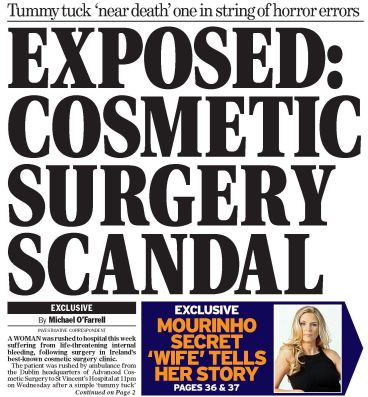
Working quickly, casualty doctors checked her vitals. They found the patient’s heart rate was racing, while her haemoglobin level (blood count) was dangerously low and dropping.

She was bleeding to death.

Doctors had to transfuse a full four pints of blood to save her life, as the on-call plastic surgeon carried out emergency surgery to remove a large haematoma (a build up of blood) from beneath her skin in the early hours of Thursday morning.

The patient also received a CT-scan to make sure there wasn’t any inter-abdominal injury. She is now in a stable condition in hospital.

Given that she was herself scheduled to undergo surgery, it is likely that the patient watched with interest the Late Late Show special on cosmetic surgery three weeks ago.

She must have cringed when she saw photos of a botched tummy tuck patient who had undergone the procedure in Dublin this May. Perhaps the photo even caused her to think twice about going ahead with her own procedure.

But she would have had no way of knowing that the awful gaping wound displayed in that photo – and greeted by gasps of horror by the Late Late studio audience – was the result of an Advanced Cosmetic Surgery procedure.

As he arrived at work on Thursday morning, consultant plastic surgeon Seán Carroll was immediately told of the ACS incident.

He was appalled. ‘She was bleeding internally and they couldn’t sort it out. Totally, utterly, unquestionably her life was in danger,’ he said.

Mr Carroll is so concerned about ACS that he has decided he must go public with his concerns. For a senior hospital consultant, such a move is almost unprecedented. But he is afraid that if he keeps his silence someone may die.

‘They just effectively left her, allowing another team to carry the can. A transfer from a private institution into a public hospital is always inappropriate if not done in the proper way because of the circumstances and this is totally, totally and utterly inappropriate.’ Mr Carroll’s concern is not simply based on this week’s incident. He is currently involved in the treatment of seven former ACS patients who need surgery following problems with procedures.
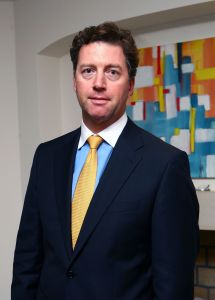
And there have been other ACS patients saved by St Vincent’s after an emergency dash from the ACS clinic, which is situated in a detached Georgian house to the rear of the nearby UCD campus.

‘They related primarily to weight-reduction surgery where, for instance, gastric banding was being done and the patient ended up in life-threatening situations because the expertise was not available in Advanced Cosmetic Surgery and an emergency transfer had to be made from their institution to St Vincent’s Hospital in order to save the life of a patient.

‘People are lucky to be alive because the institution is so close to St Vincent’s Hospital and the people running the institution realise that the expertise in the public sector exists to save the lives of these patients.’

Fronted by prominent 52-year-old socialite Halina Ashdown-Shiels, Advanced Cosmetic Surgery is by far the largest and longest-established cosmetic surgery company in Ireland. ACS is now run jointly by Miss Ashdown-Shiels and her 37-year-old daughter, Debbie.

Since 1993, the company claims to have carried out 20,000 cosmetic operations, the most popular being breast augmentation, breast reduction and liposculpture.

The daughter of a Polish miner who emigrated to Doncaster when she was just a year old, Ms Ashdown-Shiels real name – still used in her company filings – is Halina Ubermanowics.

Now, though, she has transformed herself into Ireland’s de facto cosmetic-surgery queen, featuring in numerous advice columns, magazine spreads and on hit makeover shows on national TV. She freely admits that gastric banding took her from a size 16 to an eight recently, after she reacted badly to the death of her sister by bingeing.

A walking endorsement of her own company, she has also had her breasts done twice, a neck lift, an eye job, liposculpture and a small thigh lift. Next year, a bottom lift is said to be on the cards.

As tough as they come – her idol is Margaret Thatcher – Ms AshdownShiels launched her company to national prominence in the 1990s with a billboard campaign.

’48 Years Old. Grandmother. Has Had Cosmetic Surgery,’ read the ad which featured a daring photo of the her reclining in the nude.

BACK then the company was called Transform Medical (Ireland) Ltd but would later change its name to the present logo. Now writing her memoirs, Halina told a Yorkshire newspaper this summer that her company had a turnover of E18.6m and employed 200 staff.

But the latest available company accounts – filed in July 2006 seem to show that the firm was largely reliant on creditors. While a profit of E200,000 was posted in 2005, the company owed creditors E2.4m at the end of the year.

Accounts have not yet been filed for 2006, since ACS has applied for permission to change its annual return date. It is likely though that SSIA spending last year has benefited the enterprise greatly.

Ms Ashdown-Shiels is also listed as a director of British company AHB Laboratories Ltd, a firm which only avoided insolvency in 2003 by entering into a special agreement with a rescue firm specialising in debt problems. In 2002, AHB Laboratories was the subject of a complaint which was upheld by the UK Advertising Standards Authority.

As the best-known face of the industry in Ireland, Mrs AshdownShiels has been seen to frequently call for better regulation of a business which is now worth in excess of E36m and is growing by 50pc annually.

‘One issue that we are particularly concerned about is in relation to lack of aftercare,’ she said recently.
ENDS
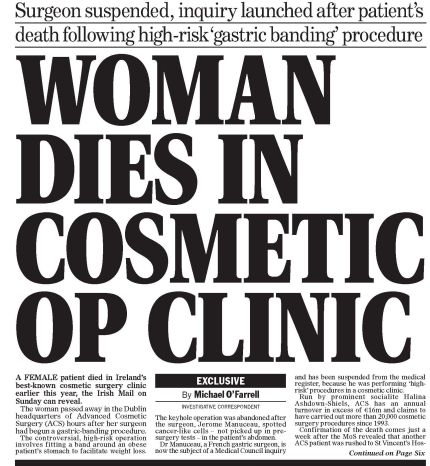
The story below was first published on 21/10/2007

WOMAN DIES IN COSMETIC OP CLINIC
Surgeon suspended, inquiry launched after patient’s death following high-risk’gastric banding’ procedure

By: MICHAEL O’FARRELL
Investigative Correspondent

A FEMALE patient died in Ireland’s best-known cosmetic surgery clinic earlier this year, the Irish Mail on Sunday can reveal.

The woman passed away in the Dublin headquarters of Advanced Cosmetic Surgery (ACS) hours after her surgeon had begun a gastric-banding procedure.

The controversial, high-risk operation involves fitting a band around an obese patient’s stomach to facilitate weight loss.

The keyhole operation was abandoned after the surgeon, Jerome Manuceau, spotted cancer-like cells – not picked up in pre-surgery tests – in the patient’s abdomen.

Dr Manuceau, a French gastric surgeon, is now the subject of a Medical Council inquiry and has been suspended from the medical register, because he was performing ‘high-risk’ procedures in a cosmetic clinic.

Run by prominent socialite Halina Ashdown-Shiels, ACS has an annual turnover in excess of E16m and claims to have carried out more than 20,000 cosmetic surgery procedures since 1993.

Confirmation of the death comes just a week after the MoS revealed that another ACS patient was rushed to St Vincent’s Hospital suffering from life-threatening internal bleeding as the result of a tummy-tuck procedure.

The MoS has also confirmed that numerous ACS patients have been admitted to hospitals throughout the country as a direct result of their cosmetic surgery.

Meanwhile, ACS and its surgeons are currently facing up to 30 medical-negligence High Court suits in Dublin and a further 27 cases in Belfast’s High Court. However, a spokeswoman for ACS said many patients had expressed satisfaction with ACS.

At least a dozen of the cases coming before the courts relate to the work of one former ACS surgeon – Samy Malhas.

A German citizen, Dr Malhas, who declined to comment this weekend, is understood to have had his insurance withdrawn by the Medical Defence Union and is thought to have returned to Germany with his Irish wife.

Speaking from Paris this weekend, Dr Manuceau said he believed his patient – a middle-aged woman from Dublin – simply died in her sleep.

‘She passed away in her sleep. The nurses went to give her some normal aftercare and they discovered she was dead,’ he said.

‘It was 12 to 15 hours after the operation. She died in the clinic in ACS. After the operation, she was perfect. She was awake. She was able to go to the toilet. She was normal. There was no problem. There was no reason for the death.’ Dr Manuceau said he stopped the surgery immediately when he saw cancer-like cells in the patient’s abdomen.

‘She only had the beginning of surgery, which was stopped immediately. The surgery was very short. There was no surgery at all really.

‘When I inserted into the abdomen, I saw she had cancer. I stopped the operation and took a biopsy. Results later proved the presence of digestive-system cancer.

Although an inquest is yet to take place, Dr Manuceau said an autopsy had found no obvious cause of death.

‘They found nothing so they concluded that she died in her sleep without any organic reason,’ he said.

An inquest into the patient’s death, which occurred on February 28 last, is scheduled before the Dublin Coroner’s Court early next year.

Dr Manuceau confirmed that he had ceased to work at ACS in August after the Medical Council suspended his registration pending the outcome of an inquiry.

‘During the inquiry, they asked me to stop. It was because they said I was doing high-risk operations in a cosmetic clinic,’ he said.

‘The Royal College of Surgeons in Ireland thinks gastric banding is too risky an operation and they don’t want it done in a cosmetic clinic.’ Dr Manuceau first registered with the Medical Council in June 2006, the month ACS began offering gastric banding for E10,000 per patient.

He says he completed more than 300 gastric banding procedures for ACS – a feat that would have netted the company in excess of E3m.

When Dr Manuceau was suspended in August, ACS hired a new gastric surgeon, Wojciech Jan Makarewicz, a Polish doctor with an address in Gdansk. Dr Makarewicz was entered on the medical register on August 30.

But Dr Manuceau said he now expected the Irish authorities to forbid all surgeons to carry out gastric banding in cosmetic clinics ‘He will have the same problem like me because the Irish surgeons do not want it happening in cosmetic surgeries,’ he said.

Dr Manuceau said he had sent only three ACS patients of more than 300, to hospital after surgery.

‘In France, 80pc of this surgery is performed in private clinics. Every time we have a problem we cannot solve in the clinic they go to the hospital.

‘In Ireland, it seems they do not like this. Three times I sent people to the hospital and they complained it was not normal. If I knew that, I would never have come to operate in Ireland.

‘But I loved Ireland. I would like to come to Ireland to discuss with the Irish surgeons and to train your surgeons for free. I don’t want any money. I would do it for free.’ In a letter to the MoS this weekend, Halina Ashdown-Shiels said she was always ‘disturbed if a patient has a problem in our clinic for whatever reason. It would be impossible to eliminate all risks and problems at any hospital.’ Miss Ashdown-Shiels said confidentiality prevented her from commenting on the death but she indicated that ACS was not at fault.

‘I can assure you that her death was not as a consequence of her being a patient of ours,’ she said.

‘We work very hard to satisfy all our clients and I believe I can say with some conviction that a patient at ACS is a safe patient.’ Miss Ashdown-Shiels complained that successive health ministers had not responded to calls for the industry to be regulated.

‘I first wrote to Micheál Martin, who categorically ruled out the introduction of regulations in our industry. Subsequent requests to Mary Harney have similarly been rejected.

‘We in ACS would welcome regulations as patients would then have a forum to approach. About 18 months ago, I wrote to all cosmetic surgery providers in Ireland to ask them to join in the creation of an association where we could initiate this issue. Apart from the Clane Hospital, there was no response.’ However, several consultant plastic surgeons have told the MoS that they are currently involved in treating patients who were allegedly disfigured by ACS operations.

Others said they were appalled at the fact that ACS was carrying out gastric banding in a setting that did not have all of the necessary backup should a problem occur.

‘This is a risky procedure and these are obese patients who are, by definition, susceptible to problems with anaesthesia,’ said one expert.

Last week, Seán Carroll, a prominent consultant plastic surgeon at St Vincent’s University Hospital, took the unprecedented step of publicly criticising ACS’s safety record.

Mr Carroll, who is involved in the care of several patients in need of corrective surgery after ACS procedures, said he was in no doubt some of the clinic’s patients were lucky to be alive.

This week, Mr Carroll said he was shocked to hear of the death.

‘I’m saddened but it was, perhaps, inevitable given the lack of postoperative expertise in many of these private, commercially-run, cosmetic institutions,’ he said.

Although just 10pc of all cosmetic operations carried out in Ireland are done by registered plastic surgeons, the Government has yet to take any action to regulate the industry.

A spokeswoman for Health Minister Mary Harney said that it was the job of the Medical Council to ‘protect the public through implementing appropriate standards and controls on the medical profession’.

The Medical Council did not respond to questions from the MoS on on whether there were any moves afoot to regulate the cosmetic surgery industry.
ENDS

The below story was first published on 28/10/2007

The cosmetic surgeon who is so risky, insurers can’t even cover him
SPECIAL INVESTIGATION: Medic behind plastic surgery clinics faces raft of complaints

By: MICHAEL O’FARRELL
Investigative Correspondent

A GERMAN surgeon who worked for Ireland’s best-known cosmetic surgery clinic is facing several complaints to the Medical Council from women who have been left disfigured by failed operations.

Samy Malhas worked with Advanced Cosmetic Surgery (ACS) for several years before helping to set up a new clinic in Wicklow last year.

However, the Medical Defence Union insurers took the rare step of suspending the 44-year-old doctor’s cover in August because of the number of negligence cases being taken against him.

Mr Malhas is currently the subject of at least a dozen medical negligence cases involving procedures he carried out at ACS.
Other cases have already been settled for undisclosed sums and several patients are preparing complaints to the Medical Council.

One prominent university hospital surgeon also sought to complain about Mr Malhas to the Medical Council in recent weeks.

However, since he was involved in assessing Mr Malhas’s work for ongoing High Court cases, he was advised by his lawyers not to do so.

The claims against ACS and Mr Malhas involve a number of procedures including tummy tucks, eye lifts, breast reductions and enlargements, facelifts and liposuction.

All of the patients concerned have either undergone, or are still undergoing, corrective surgery.

Mr Malhas, who holds a 1991 degree from the Westfälische Wilhelms-Universität in Münster, first registered with the Medical Council here in June 2002.

A year later, he upgraded his status to that of a general surgeon. However, he is not registered as a specialist plastic surgeon – and does not have to be since there is a complete lack of regulation of the area.

Mr Malhas declined to respond to questions from the MoS this week. His Irish wife and business partner, Elaine Galvin, also refused to comment. A lawyer representing ACS said the company could not comment on Mr Malhas, ‘as he is no longer employed by us and we cannot speak for him professionally or clinically’.

The pair have not been seen at their Dublin address in recent months and it is believed that Mr Malhas has returned to work in Germany.

Together with his wife and two other partners, Mr Malhas was a founding director of the Wicklowbased clinic, Cosmedico, in May 2006. He ceased working there in August when the Medical Defence Union withdrew his insurance.

Last night, a spokesman for Cosmedico said Mr Malhas and his wife no longer had any involvement with the company.

‘Dr Samy Malhas has no stake in Cosmedico Cosmetic Surgery Clinic nor will he at any stage in the future. He is no longer clinical director of Cosmedico Cosmetic Surgery Clinic.

‘He has never performed any procedures nor, indeed, reviewed or assessed any patients without full medical insurance.’ News of fresh complaints against an ACS surgeon comes just a week after the MoS revealed that another ACS surgeon had been suspended by the Medical Council.

French-based gastric-banding expert Dr Jerome Manuceau was suspended in August after Royal College of Surgeons President Pro fessor Gerald O’Sullivan complained that Dr Manuceau was carrying out ‘high risk’ procedures in the ACS clinic.

The complaint against the French surgeon is understood to have centred on cases in which Irish surgeons found themselves dealing with complications in public hospitals and were unable to contact Dr Manuceau.

An autopsy into the cause of the death of an ACS patient at its clinic in February was inconclusive and the matter is now the subject of an inquest scheduled for February.

Speaking to the MoS from Paris this weekend, Dr Manuceau denied gastric banding was a risky procedure and said his suspension was by no means connected to the ACS death.

‘All international specialists agree that gastric banding, performed by an experienced surgeon through keyhole surgery, is a very low-risk procedure,’ he said.

Dr Manuceau also denied assertions by Irish surgeons that the deceased ACS patient would have survived in a hospital setting.

‘I saw several similar deaths in the best French hospitals,’ he said. Dr Manuceau will now face a full Medical Council fitness-to-practise hearing – a process that typically takes several years.

Last year, ACS surgeon Hassan Sulaiman was the subject of a successful High Court negligence claim.

In February, the same surgeon settled another High Court negligence claim involving scarred eyelids for E38,000.

In total, ACS, which is run by prominent socialite Halina Ashdown-Shiels, is facing up to 60 negligence cases in Dublin and Belfast.

But Miss Ashdown-Shiels has this week repeatedly moved to reassure patients that ACS is a safe clinic.

‘I believe I can say with some conviction that a patient at ACS is a safe patient,’ she said adding that the clinic had been to the forefront of calls for industry regulation.

Reacting to MoS revelations in recent weeks, Health Minister Mary Harney this week warned patients to be wary of private cosmetic surgery clinics.

However, despite renewed calls for urgent regulation of the sector, the Government does not appear to have any intention of hastening the introduction of regulation.

‘The minister has asked the Commission on Patient Safety and Quality Assurance to develop proposals for a statutory system of licensing. It is expected the commission will report by mid-2008,’ a spokesman said.

But there already exist at least two templates for the regulation of the cosmetic-surgery sector. The Association of Irish Plastic Surgeons, which has been campaigning for regulation for years, has already sent its recommendations to Miss Harney.

Moreover, the British Association of Cosmetic Doctors recently appointed Dr Patrick Treacy, director of Dublin’s Ailesbury Clinic, as its Irish regulator.

Dr Treacy has just drawn up a list of recommendations that will shortly be forwarded to Miss Harney. Chief among the proposals is the creation of a new regulatory body that would have the ‘power to regulate and inspect all establishments in Ireland that carry out invasive and non-invasive cosmetic surgery’.

The body would also have the power to enforce standards and revoke licences to operate.

Other aspects of the plan include a demand that all cosmetic surgeons be registered on the Medical Council’s specialist register and have formal, specialist training.

‘Irish patients should be confident their treatment will be safe, that the practitioners who treat them are qualified and competent, and they have the information needed to make decisions,’ said Dr Treacy.

? Have you had problems at the hands of a plastic surgeon? Do you have a story to tell? If so, please ring Michael O’Farrell on (01) 637 5826.
My breast reduction has left me horribly scarred SINCE the MoS began investigating the cosmetic surgery industry in Ireland, more than 30 men and women have come forward to say they have been permanently disfigured in private clinics.

For legal reasons, we cannot, for the moment, identify the clinics or name the patients or doctors.

But many have ended up in A&E wards countrywide. More still have spent lengthy periods in hospital undergoing corrective surgery.

‘I’ve been left horribly scarred for life. The specialist told me it was beyond repair. I wasn’t even able to breast feed,’ said one woman whose breast reduction was botched.

Another, whose breast augmentation went drastically wrong, said: ‘I never got any aftercare. I tried ringing to ask could I come up but there was no answer. There was green stuff coming out of the stitches.

‘I had a tummy tuck six weeks ago and ended up in A&E with septic shock. It’s all been botched and I don’t know what to do now,’ said a tummy tuck patient who was hospitalised for nine days.

‘I went to A&E and was taken in straight away. They took scans and said they didn’t know how I was still alive,’ said another tummy tuck patient who is still undergoing treatment.
ENDS

The story below was first published on 04/11/2007

A timebomb in the tummy
With two doctors suspended, the cosmetic surgery now facing 30 High Court negligence cases has left vulnerable gastric-band patients in limbo and facing…
By: MICHAEL O’FARRELL

HUNDREDS of patients of Ireland’s best-known cosmetic surgery group are facing a gastric band timebomb after their surgeon was suspended by the Medical Council.

French surgeon Dr Jerome Manuceau carried out more than 300 gastric-banding procedures at Advanced Cosmetic Surgery (ACS) prior to being relieved of his duties in August.

The suspension followed a strongly worded complaint from the Royal College of Surgeons of Ireland (RCSI) which was concerned that Dr Manuceau was carrying out ‘high risk’ operations in a private clinic without the backup of emergency hospital facilities.

However, the suspension has left Dr Manuceau unable to supervise the care of his patients, who each paid E10,000 for their ACS operation on the understanding that a year’s aftercare would be available with their surgeon.

On his own website, Dr Manuceau highlights in bold type that ‘two or three years of medical and surgical surveillance are essential for your safety and weight loss’.

Routine aftercare following gastric banding includes intermittent tightening of the band around a patient’s stomach as they lose weight – a procedure which should ideally be supervised by the original surgeon.

The tightening of the band is achieved by injecting a solution into it through a receptor underneath a patient’s skin.

However, emergency complications, anticipated in up to 2pc of cases, can see the band slip, making it impossible for a patient to eat or drink. In such cases, emergency surgery must be carried out to rectify or remove the band to prevent a patient from dying.

Dr Manuceau claimed last night his suspension did not leave patients better off.

‘It is a serious problem. I am very very sad for this situation. I am very sad we cannot find agreement for the benefit of the patients. I don’t know what to do. I am completely lost.

‘The only thing I can say is that they can come to Paris. Or if the band has slipped they need to go to hospital to exclude the emergency. Then they can come to Paris and I can re-operate.’ Dr Manuceau said he was concerned that since his departure the aftercare of his patients was being carried out by an ACS nurse and a replacement Polish surgeon with an address in Gdansk.

The Polish surgeon – Dr Wojciech Jan Makarewicz – was registered with the Medical Council just eight days after the suspension of his predecessor.

He did not apply to the Medical Council’s specialist register as a plastic or gastric surgeon, although since specialist registration is voluntary, he is not obliged to do so.

‘It’s not me. It’s not my band. He has other methods. It’s not at all the same thing. I don’t think Irish patients are better off now than they were before,’ said Dr Manuceau.

‘When they have a band slip, he may not able to put a band back. I don’t know what he is able to do. He does not use the same method or the same band. But if they go to hospital they will have problems as well because they will take off the band and they will be worse than before they began.’ Dr Manuceau feels so strongly about the situation that he has written an open letter (see panel) to his 300 patients in an attempt to explain why they have been left with uncertain aftercare arrangements.

His letter offers to treat them for free in the future.

‘I would like my patients to understand I was obliged to leave Ireland.

‘The Royal College of Surgeons is only seeing the complications. It’s astonishing they didn’t try to see what was positive.

‘I can’t understand their [the Medical Council’s] behaviour.

‘They didn’t discuss this with me. They just went to the High Court to take away my registration. I told them about the aftercare problem but they just said this is a problem for ACS.’ Dr Manuceau said it was not acceptable for a nurse to adjust bands that had been fitted by him without his supervision.

‘There is a nurse in ACS who I trained myself. But it’s not enough. They have to be adjusted by me.

‘When I was there, she did it because I had too many people. But she only did the easy cases. I allowed the nurse to do that because I was there and I could be responsible for what she was doing. I accepted it only if it was very easy and the patient was happy. But now I am not there, it is not the same.’ Until the Irish Mail on Sunday first revealed Dr Manuceau’s suspension two weeks ago, his patients had been unaware their doctor had been ordered to cease working in Ireland pending a Medical Council inquiry.

They were also unaware that an ACS gastric-banding patient died in the clinic in February. An inquest into the death is scheduled for next February.

Speaking to the MoS this week, some gastric-banding patents said they were uncertain about their aftercare arrangements in the event of an emergency.

‘We’re not sure what’s happening. The other surgeon did my fill this week but he did not seem happy to do it. I expected my surgeon to be available when I signed up,’ said one patient.

A spokesman for the RCSI said ACS were responsible under contract to provide ‘routine follow-up’ but added that there were competent Irish surgeons capable of dealing with gastric-banding aftercare.

‘There are reputable consultant surgeons in this country well versed in the aftercare of this type of surgery.

‘As regards the delivery of care to those patients who develop complications in an emergency setting or otherwise, this will be available through any A&E department,’ the spokesman said.

The Medical Council said it could not comment on individual cases but advised concerned patients to contact their GP.

‘If any patient has concerns about continuity of care following any surgical procedure, the council would advise them to contact their local registered GP for advice,’ a spokesman said.

Meanwhile, an ACS tummy-tuck patient who was rushed to St Vincent’s Hospital with life threatening bleeding was released on Thursday after more than three weeks of treatment.

The case was first revealed by the MoS just three days after the incident as the patient was recovering in hospital.

In correspondence with this newspaper, lawyers acting for ACS at first denied that any patient had been rushed to hospital.

The company acknowledged the incident for the first time in a statement to a national radio station only a day after publication.

The patient, a mother of three, had to undergo an emergency operation to save her life during which she received a transfusion of four pints of blood.

Now having contracted an infection, she still has a gaping wound across her stomach which will require further medical treatment in the coming months.

Seán Carroll, a senior consultant at St Vincent’s, has already taken the unprecedented step of publicly criticising ACS for what he believes is an unacceptable level of basic complications. Mr Carroll is personally involved in the care of seven former ACS patients who need corrective surgery.

Now former ACS employees themselves have begun to come forward to express concern at conditions inside the company’s main Dublin clinic.

Two medical employees claim they have witnessed postoperative infections while working at ACS.

Women who claim to have suffered infections and other serious complications at ACS have also come forward to speak of their experiences. Their testimonies cannot be published for the moment for legal reasons.

In 2004, a Medical Council fitnessto-practice inquiry into the surgeon who carried out an operation in which one woman claimed to have suffered an infection folowing an ACS tummy tuck, cleared the doctor involved of any wrongdoing.

However, the hearing did not consider the role of ACS in the patient’s care as the Medical Council has no jurisdiction over private clinics.

Another woman spoke on condition of anonymity about her experience with Samy Malhas, a former ACS surgeon who accounts for a dozen of 30 current High Court medical negligence cases against the company.

Mr Malhas has not worked in Ireland since August when the Medical Defence Union withdrew his insurance.

In a letter to the MoS last week Dr Malhas said he could not comment on specific cases in ACS.

‘I cannot make a statement about my former time there. I have been advised by my insurers to make no comment regarding your enquiries.’

Dr Malhas said it was unfair to single him out for criticism saying he had performed corrective surgery at ACS to remedy the work of other surgeons who had gone on to work in other clinics and hospitals.

‘In my time in Ireland I have operated on more than 2,000 patients, many of whom say my surgery has been a positively life-changing experience for them. The cases you speak of would represent 0.5pc of my entire work.

‘I am an honest surgeon and have always had the very best interests of my patients at heart,’ he added.

Dr Malhas also said that unrealistic expectations often led to disappointment.

‘The end result of surgery is entirely subjective.

‘For example, I could consider the finished result as excellent work, from my point of view, yet a patient may just not like what they see.’ ? Have you had problems at the hands of a plastic surgeon? Do you have a story to tell? If so, please ring Michael O’Farrell on (01) 637 5826.

French doctor tells patients: I’m very sad I was forced to abandon all of you

Open letter to my patients from Professor Jerome Manuceau

FROM August 22, you did not see me in Ireland, and did not know what happened until two weeks ago.

The President of the Royal College of Surgeons of Ireland complained against me to the Irish Medical Council, saying I was doing high-risk operations in a cosmetic clinic.

The Medical Council asked the High Court to suspend my registration.

You already know that gastric banding, performed through keyhole surgery, by an experienced surgeon, is a very low-risk surgery with very rare complications. The only problem is that, it is really efficient only if the patient is very motivated.

Compared to banding, gastric bypass procedures are very invasive, are irreversible and have a lot of complications including death. This is not only an opinion, but an established scientific fact.

Now 20pc of Irish people are obese. Obesity is a very bad illness which kills three times more than smoking. Obese people are dramatically isolated in society, their life is a tragedy.

During one year, I operated on 300 patients. All have not succeeded, but 85pc of you have lost more than half of their excess weight and 30pc are not obese any more.

This is a very good result, much better than what I have in Paris.

But everyone knows that the band is not sufficient for losing weight.

The aftercare is essential and the relationship between the patient and his surgeon is momentous.

When the only serious complication occurs – a band slips in 1pc or 2pc of cases – it is simple for me to put it back at the right place .

But if I can’t do it myself, these patients will have to go to hospital, they will have the band removed, and one year later they will be heavier than before the first operation.

I am very sad I was forced to abandon all of you. But be sure that as soon as this situation will change, I will come back immediately, in any place in Ireland, to continue your aftercare for free.

During this year that I have been with you, I loved Ireland and I loved Irish people.

Thank you very much for your kindness and your trust in me.
ENDS

The story below was first published on 09/12/2007.

The Paris connection
Cosmetic clinic ducks a ban on surgeon by flying patients out to him in France

By: MICHAEL O’FARRELL
Investigative Correspondent

IRELAND’S best-known cosmetic surgery group is circumventing a Medical Council ban on one of its surgeons by sending patients directly to him in Paris, the Mail on Sunday can reveal.

Dr Jerome Manuceau – a prominent French gastric surgeon – has been suspended from the Medical Council register here pending an inquiry into the death of one of his patients at Advanced Cosmetic Surgery (ACS) in February.

However, he is now receiving ACS patients in Paris, where he continues to carry out gastric banding procedures despite his Irish suspension.

A controversial procedure, gastric banding involves the insertion of an internal rubber band around an obese patient’s stomach.

Two months ago, an extensive MoS investigation revealed that a female patient died in the Stillorgan headquarters of ACS after Dr Manuceau had begun a keyhole gastric banding procedure. Dr Manuceau called off the surgery when he saw a cancerous growth in the patient’s abdomen, but she died in her sleep that evening.

A fellow patient who witnessed the death told the MoS that desperate doctors and paramedics tried in vain to resuscitate the patient for at least half an hour in full view of five other patients. ACS later offered to pay for counselling for those present.

An inquest into the death is scheduled for February next year in the Dublin County Coroner’s Court.

In August, the Medical Council applied to the High Court to suspend Dr Manuceau after the Royal College of Surgeons of Ireland complained that high-risk procedures were being carried out in a private clinic.

Separately, the MoS revealed that another ACS patient had been rushed to St Vincent’s Hospital in September suffering from life-threatening internal bleeding as a result of a botched tummy-tuck procedure.

The MoS also revealed that a number of ACS patients have been admitted to hospitals throughout the country following surgery.

The company and its surgeons are currently facing up to 30 medical negligence suits in the High Court in Dublin and a further 27 cases in Belfast’s High Court.

Dr Manuceau’s fitness-to-practise hearing will not be held for at least two years, during which time he is forbidden from practising in Ireland.

ACS, fronted by prominent socialite Halina Ashdown-Sheils, initially sought the use of alternative hospital facilities in order to continue carrying out gastric banding procedures.

With Dublin operations suspended – and a price tag of e10,000 per patient – the procedures are crucial to ACS’s financial wellbeing.

But the MoS understands that approaches to private hospitals – including Mount Carmel Hospital in Churchtown – were not successful.

Instead, ACS has begun sending patients to Dr Manuceau in Paris despite the fact that medical authorities here have suspended his licence.

The necessary aftercare, which involves frequent adjustments and monitoring, is being carried out by a Polish surgeon in Dublin.

Some have begun to worry for the future of the company. Through its new solicitor, ACS said there was no question of ‘the business being in financial difficulty or of it closing’.

ACS did not comment on the fact that 14 staff have departed in recent weeks, while the firm’s financial controller has resigned.
ENDS

The story below was first published on 09/03/2008

Suspended plastic surgeon treats Irish patients in Belfast Display: Unformatted Line wrapped
By: Michael O’ Farrell

CLIENTS of Ireland’s best-known cosmetic surgery group are being treated in the North by a doctor who has been banned from treating them in the Republic.

Dr Jerome Manuceau, a prominent French gastric surgeon, was suspended by the Irish Medical Council pending a fitness-to-practise inquiry into the death of one of his patients at Advanced Cosmetic Surgery (ACS) in February 2007.

In 2006, he also received a year-long ban from French medical authorities forbidding him from treating any public patients.

But the Irish Mail on Sunday can reveal that, last Friday, he attended an ACS clinic in Belfast and treated patients sent to him by the firm’s Dublin office.

All of the patients in question have undergone gastric band operations – which cost E10,000 – through ACS in the past two years.

Gastric banding is a type of weight-loss surgery which reduces the size of the stomach so that only small meals can be eaten. Once inserted, the band requires supervision and regular adjustments, something ACS is contractually obliged to provide for a period of two years.

In a small number of cases, the band can result in a serious medical emergency if it slips out of place.

In the absence of Dr Manuceau, a Polish surgeon had been overseeing adjustments in Dublin in recent months. But he is understood to have left the company last month.

Many of the aftercare bookings to see Dr Manuceau in Belfast this week were made through the Dublin headquarters of ACS – a firm owned by prominent socialite Halina Ashdown-Shiels.

Patients from Dublin were given a reference number to obtain paid-for tickets for trains to Belfast, while others were flown from Cork at the expense of ACS.

Dr Manuceau’s suspension followed the death of Bernadette Kavenagh-Reid, who died in the ACS Mount Merrion clinic on February 5 last year.

An inquest into her death, initially scheduled for last month, is expected to take place during the summer. But on foot of an official complaint about aftercare standards from the Royal College of Surgeons, the Medical Council went to the High Court to suspend Dr Manuceau. A date for his fitness-to-practise hearing has not been set yet.

Approached by the MoS in Belfast on Friday, Dr Manuceau did not deny he had been treating ACS patients in the North.

When repeatedly asked why he was flouting the Irish authorities by seeing patients from the South, he refused to comment.

However, he then launched a scathing attack on this paper, blaming it for his Irish ban.

He shouted: ‘Michael O’Farrell, he tried to kill ACS, and he has killed a lot of patients who could not be operated on because of his articles.

‘Because of what he wrote, I am not allowed to operate in Ireland.’

The standard of aftercare provided by ACS is increasingly becoming a concern among banding patients, who communicate daily on a web forum.

Many patients are concerned that they have been left with uncertain aftercare arrangements despite having already paid E10,000 each for a package which includes up to two years of post-op care. Several have posted negative experiences and complaints about the care they are receiving.

‘This is a nightmare. We have a contract with them so they have to stand by it. I’m boiling mad,’ said one patient.

‘We’re just being fobbed off by ACS… I dread to think if any of us had an emergency what would happen. A&E don’t want to know. I’ve been really worried about the aftercare for months but I can’t believe it’s come to this,’ said another.

Others posting on the forum – but too embarrassed to go public – include an ACS patient who was admitted to hospital with kidney failure last October due to severe dehydration. Because her band had slipped, she ultimately had to undergo corrective surgery to allow her to eat and drink.

But the incident is not the first time an ACS patient has ended up in hospital as a result of a cosmetic procedure.

The MoS has revealed on several occasions that, in fact, numerous ACS patients have been admitted to hospitals throughout the country as a direct result of their cosmetic surgeries.

The company and its surgeons are currently facing up to 30 medical-negligence suits in the High Court in Dublin and a further 27 cases in Belfast’s High Court.
ENDS

The story below was first published on 16/03/2008

Collapse of ACS leaves clients in limbo… and owners silent

By: Michael O’Farrell
Investigative Correspondent

HUNDREDS of patients of Ireland’s largest cosmetic surgery group have been left in doubt over who will treat them after the company was sold this week.

After months of controversy and allegations of sub-standard care, Advanced Cosmetic Surgery (ACS) told patients in a letter on Thursday that the firm was to fold.

‘I just received the news this morning,’ one patient requiring after-care said. ‘I am still in shock. I don’t know what is going to happen now – they promised they would look after me.’

Former owner Halina Ashdown-Shiels wrote that the company had encountered significant financial difficulties in recent months and had no choice but to wind up.

The letter promised that all aftercare would be ‘taken over by the purchaser’.

But the new owners – Manchester property tycoon Carol Ainscow and Helen Roocroft – have yet to issue any guarantee.

However, the pair own the highly respected Artisan Construction Group. A just-established British company, Advanced Cosmetic Surgery (Europe) Ltd, will be responsible for running ACS.

But last night, worried gastric-banding patients continued to contact the MoS to tell of their uncertainty. ACS fitted more than 300 of the bands – a rubber device that restricts the stomach – and promised three years of aftercare.

‘For a whole week now, I’m ringing ACS but I’m just getting the run-around,’ said one patient.

Merseyside-based Howard Lipsey, a director of ACS (Europe), said: ‘I am not allowed to make any comment.’

It is understood that the new owners have been surprised at the level of controversy surrounding ACS. The firm is facing up to 50 personal injury cases in Dublin and Belfast.

Solicitors acting for the old ACS and Miss Ashdown-Shiels declined to answer questions last night.

Despite the expected liquidation, no notice has been received in the Company Registrations Office and notice of a meeting of creditors – some of whom are owed six-figure sums – has not yet been posted.
ENDS
The story below was first published on 30/03/2008

The internal ACS report which sets out a horror catalogue of health risks for their patients

Michael O’Farrell
Investigative Correspondent

AN INTERNAL report into Advanced Cosmetic Surgery (ACS), which was sold to a British businesswoman this month, has revealed a catalogue of faults and safety problems at the company.

The report was commissioned by Halina Ashdown-Shiels, the millionaire owner and face of the firm, following an exposé by this newspaper about its procedures.

However, the first draft of the study – by expert consultants Coyle Hamilton Willis – was an indictment of systems at ACS.

From the first sentence of its conclusions, the report – published in detail for the first time here – pulls no punches.

‘The existing standards and procedures in place are totally inadequate and are in need of urgent review and update,’ it says. ‘The clinic is not suitable for present use and is in need of total refurbishment.’ The surgical theatre, where most of the clinic’s operations were carried out, was particularly singled out for criticism.

Lapses include the fact that the building’s one fire escape can be accessed only through the theatre, windows are broken, isolation switches are inaccessible and an airconditioning system is described as ‘most unsuitable and inadequate’.

The document warns that there was ‘no informal or formal plan in place for the continuation of services in the event of an emergency or a loss of power supply’ – suggesting that had there been a power cut, a patient could have been left in the dark on the operating table.

Theatre hygiene and infection controls were also criticised. ‘Staff have not received education and training in the prevention and control of infection or in decontami-nation of surgical instruments,’ the review found.

The area for sterile equipment used in surgery was found to be too close to the storage of contaminated materials, and there were ‘no procedures for cleaning the operating theatre’.

Given such conditions, the chances of infection were high. But the company had not implemented any infection-control policies even after two reported cases of e-coli in the same week.

Medical records were found to be kept in a publicly accessible, unlocked filing cabinet. And a review of 20 random patient files found all were either badly filled out, had incomplete medical histories, were not signed by surgeons and nurses, had been altered, or did not contain the proper documentation and consents.

The report found that individual procedure sheets outlining details of the patient examination and risks discussed did not allow for the patient’s medical record number (MRN) to be documented, the date, time, sex of the patient and space for next of kin details.

It also noted that there was very limited space on the sheet for the surgeon to record additional details.

All of the charts reviewed contained surgical consent forms which were incomplete, for example no patient details, location of surgery or dates.

One of the 20 charts reviewed contained a consent form for one procedure but the patient appeared to have had additional surgery on another body part and no consent form was found within the chart.

Furthermore, the report concluded there were no arrangements in place with an acute hospital in the event of an unforeseen patient emergency and, when such emergencies occurred, the clinic had neglected to investigate or try to establish the root cause.

The report also found that: ● The person on duty at night had not undergone any form of training including CPR, manual handling and fire safety.

● There was no evidence found to suggest that patients underwent any counselling or psychological assessment prior to surgical procedures.

● There was no corporate or clinical governance structure for the organ-isation or clinic as a whole.

● Unregulated and inferior medical equipment and materials were being sourced from abroad.

● There was no evidence that any patients had undergone routine investigations prior to surgery; for example, an ECG and chest x-ray.

● None of the staff interviewed had received training in manual handling, CPR, infection control, incident reporting, health and safety issues and risk assessments Other concerns raised dealt with deficiencies in the provision of services to more than 300 gastric banding patients who paid E10,000 each for the weight-loss procedure.

Advanced Cosmetic Surgery The first signs of something amiss at ACS came last October when an extensive Irish Mail on Sunday investigation exposed serious concerns about the manner in which the clinic was being run.

Shocking cases, first revealed by this newspaper, included the case of a mother of three who almost died last October after a botched tummy-tuck operation. The patient’s life was saved only after surgeons in St Vincent’s University Hospital carried out emergency surgery.

At first ACS, through its solicitors, denied the near-miss incident had ever occurred. But there were more claims of injuries suffered by ACS patients , and plastic surgeons all over the country are treating former ACS patients.

One surgeon – St Vincent’s consultant Seán Carroll – was so concerned he took the unprecedented step of‘Other commercial institutions are suffering from the same problems but I have had far less complications and dealings with other institutions than I have with ACS,’ he said.

‘The things that I see from Advanced are complications that shouldn’t occur. They are at the extreme end of complications.’

Photos of unfortunate women undergoing reconstructive work to fix poor ACS surgery show horrific scars left as nipples were placed incorrectly and tummy tucks burst open from infection.

In a letter to the MoS last October, Miss Ashdown-Shiels insisted her clinic was safe. ‘I would ask you to appreciate that I am always disturbed if a patient has a problem in our clinic for whatever reason. It would be impossible to eliminate all risks and problems at any hospital.

‘We are very proud of our safety record. The claims made against us are in no way an indication of unsafe care. We work very hard to satisfy all our clients and I can say with conviction that a patient at ACS is a safe patient,’ the letter reads.

Miss Ashdown-Shiels did not respond to a request made through her solicitor last night for comment on the risk report.

On the face of it, business at ACS is continuing as usual. The company’s website is the same as it ever was. The same phone numbers are still answered by the same friendly staff and patients still call looking for appointments.

But behind the scenes, changes are happening as the original Irish company files for liquidation.

In its place, a new British-regis-tered company – Advanced Cosmetic Surgery (Europe) Ltd – has arisen, having bought the business and assets.

As a result, Miss Ashdown-Shiels seems set to wash her hands completely of the business.

She has already sold her business as a going concern to a British-based entrepreneur – multimillionaire property developer Carol Ainscow – for a sum understood to be in the order of E130,000.

Miss Ainscow established ACS Europe as a vehicle to run the firm. The new ACS owner has pledged to completely revamp the firm and its practices and use the name as a brand to build a new cosmetic surgery business in a purpose-built private hospital facility.

The care of existing patients who require aftercare has also been guaranteed by the new owners.

Meanwhile, the winding down of ACS Ireland will enter its final phase when a liquidator is appointed at a creditors meeting in Dublin on Thursday.

But as she walks away into the sunset, Miss Ashdown-Shiels’s company is leaving behind a stack of creditors and a growing list of patients who claim to have suffered horrifying wounds and injuries at her clinic.

And it is by no means clear whether those debts will be paid. In yet another twist to the saga, Jeffrey Burton – a former partner of Miss Ash-down-Shiels – has claimed that he offered to buy the company in January, debts and legal claims included.

Had the offer been accepted, it would have avoided the need for liquidation and all creditors would have been repaid.

Mr Burton, who was forced to step down as a director of ACS after being prosecuted by the director of corporate enforcement five years ago, told the MoS he was prepared to put enough money into ACS to keep it afloat and clear all debts.

The MoS has seen documentary proof of the purchase offer, dated January 22 this year.

This raises the question as to why Miss Ashdown-Shiels chose to liquidate her company.

Mr Burton’s offer may now have to be considered by the company’s liquidator. A third offer – from a British-based health firm – is also understood to have been rejected by Miss Ashdown-Shiels.

There is also considerable legal doubt as to whether all of the 50-plus personal injury cases against ACS will be settled in full, particularly since the company operated without insurance for many years.

Mr Burton said that the company had operated with no insurance from 2002 at least until he sold his 30pc stake in the firm back to Miss Ash-down-Shiels in 2006. During that period, ACS met the cost of legal claims from its own pocket although individual surgeons were insured by the Medical Defence Union (MDU).

Mr Burton said that from 2002 to 2006 the company had met every claim against it. ‘It was normal that a claim would be split between us and the MDU,’ he said. ‘The average split was 2 0 / 8 0 [ACS/MDU]. So, when a claim was settled for, say, E60,000 plus legal costs of around E20,000, it would cost us E16,000, less than the excess under the old policy.’

The fact that ACS appear to have had no insurance means that at least 50 patients with cases against ACS may lose out. Even in the event of a court ruling, there could be a shortfall.

Another unresolved matter – and one of the most serious legal cases against ACS – is the tragic case of Bernadette Kavanagh Reid.

Mrs Kavanagh Reid was an ACS gastric-banding patient who died in the clinic’s main theatre in Owenstown House in Mount Merrion last February after surgery had been initiated.

An inquest into the death has been postponed until this summer and the surgeon involved – Dr Jerome Manuceau – has been suspended pending a Medical Council fitnessto-practice hearing.

Aside from former patients, creditors are understood to include Dublin firm Teknosurgical, Premier Recruitment, Johnson and Johnson and other medical suppliers.

With some suppliers owed hundreds of thousands, each party to the liquidation will be keen to learn how the company was being run in recent times and whether it traded reck-lessly. They will also insist on a full financial trawl to establish just how much profit Miss Ashdown-Shiels withdrew from ACS.

The existing standards and procedures in place are totally inadequate and are in need of urgent review and update. The Owenstown House is not suitable for present use and is in need of total refurbishment. Given that the building is a listed structure this limits the scope for improvement or change and the only option therefore, in the short term, is to lease theatre space from another hospital.

Discussions with managers and staff would suggest that there is no awareness of health and safety within the organisation from a management or operational staff perspective. There is no corporate or clinical governance structure for the organisation or Clinic as a whole. There is no strategic plan for the organisation. There are no management team committees to over-see such activities as health and safety, risk management, infection control but to name a few.

There was no informal or formal plan in place for the continuation of services in the event of an emergency or a loss of power supply. It appears that there is no emergency standby power supply available. An uninterruptible power supply is provided for the anaesthetist equipment. In the event of a power failure during a surgical procedure the emergency lighting would not provide the level of lighting required for a surgeon to safely continue and complete a surgical procedure.

It appeared that no formal or informal arrangements were in place for a preferred 24 hour acute hospital in the event of an unforeseen patient emergency. It was reported that a number of serious patient adverse events had occurred in the Clinic but no investigation or Root Cause Analysis (RCA) had been undertaken.

There are no infection control policies, procedures or guidelines for the operating theatre or the remaining clinical and non clinical areas within the Clinic There is no senior member of staff responsible for the monitoring of infection control and preventative measures within the Clinic No consultation is sought from an infection control nurse/specialist or a microbiolo-gist& Infection rates, trends and surveillance are not recorded and no information is available on the seemingly high number of post operative infections. It was reported during the staff interviews that two patients had contracted E Coli within the same week .Staff and in particular operating theatre staff have not received education and training in the prevention and control of infection or in decontamination of surgical instruments.

It was noted during the site visits that potentially contaminated cleaning materials (mops and brushes) were stored in the linen room and placed beside the theatre uniforms and also ward linen& There was no evidence of an operating theatre cleaning policy and procedure.

There was no evidence found to suggest that patients underwent any counselling or psychological assessment prior to surgical procedures. It was also reported that no Dietician was affiliated with the Clinic especially for patients undergoing gastric banding or other abdominal weight loss surgery.

There was no evidence that any patients had undergone routine investigations prior to surgery for example and ECG and chest x-ray. There is no dedicated member of staff responsible for the treatment and care of post operative patients.

It was reported during the course of the interview process that none of the staff interviewed had received training in manual handling, CPR, infection control, incident reporting, health and safety issues and risk assessments.
ENDS

The story below was first published on 06/04/2008

ACS owner paid herself ?850k as debts mounted at cosmetic clinic

By: MICHAEL O’FARRELL
Investigative Correspondent

THE owner of Ireland’s best-known cosmetic surgery clinic paid herself E850,000 last year – while debts mounted at the controversial clinic.

Halina Ashdown-Shiels confirmed her massive salary this week when her company, Advanced Cosmetic Surgery (ACS), was officially wound up, owing more than €1.5m in unpaid debts. It has assets of just €154,452 and almost 150 creditors have now been left with unpaid bills from ACS.

In addition, the status of at least 50 pending personal-injury cases against the company and its surgeons is uncertain since ACS had been operating without insurance.

At a creditors’ meeting in Dublin this week, liquidator Liam Dowdall of BDO Simpson Xavier set up a special five-member committee of inspection to probe the insurance issue. The committee will also consider the recent sale of ACS to a Manchester-based associate of Miss Ashdown-Shiels.

The sale, which took place just weeks before ACS folded, saw the new owners acquire the company as a going concern without taking responsibility for debts or pending legal cases.

The family of Bernadette Kavanagh-Reid – a gastric banding patient who died in the ACS clinic last year – were also represented at this week’s creditors’ meeting.

On behalf of the family, lawyers asked about the lack of insurance at the clinic and sought answers about safety conditions at ACS.

When approached by the Irish Mail on Sunday after the creditors’ meeting, Miss Ashdown-Shiels declined to comment or respond to questions about safety standards at her clinic.

The first signs of something amiss at ACS came last October when an extensive MoS investigation first exposed serious concerns. Shocking cases included a mother of three who almost died last October after a botched tummy tuck operation at ACS.

A catalogue of serious deficiencies in standards of care and safety at ACS was finally detailed in January in an audit of the company.

However, despite owner Miss Ashdown-Shiels’ enormous salary, the €16,000 bill for the report has never been paid. Others who are owed money include former ACS surgeons.

The largest creditor is the Revenue Commissioners – owed €489,000, more than three times the value of ACS’ current assets.

Miss Ashdown-Shiels also told the creditors’ meeting that her former partner, Jeffrey Burton, was being paid €6,000 a month by ACS throughout 2007. Five years ago, Mr Burton was forced to resign as a director of ACS when he was prosecuted for unlawfully acting as a company director while being an undischarged bankrupt in Britain.

Last week, Mr Burton told the MoS he was prepared to put enough money into ACS to keep it afloat and clear all debts. This purchase offer – and another one understood to have been received – will be scrutinised by the liquidator’s committee of inspection.
ENDS

The story below was first published in 08/02/2009

Halina and her banned surgeon back into facelifts
By: Michael O’Farrell

A PROMINENT socialite whose cosmetic surgery group folded with debts of more than E2m is fronting a new business – sending clients to a surgeon banned from practising after one of his Irish patients died.

Halina Ashdown-Shiels, the former owner of Advanced Cosmetic Surgery (ACS), liquidated her E10m-a-year company last March following a series of Irish Mail on Sunday exposés.

Our findings included the death of a female patient in the firm’s Stillorgan clinic, and a near-fatal incident in which A& E staff at St Vincent’s University Hospital battled to save another patient’s life.

Jerome Manuceau, the Francebased surgeon involved in the death of ACS patient Bernadette Reid, was struck off the medical register and banned from practising in Ireland by the Irish Medical Council.

An inquest into the death of Mrs Reid, who passed away after a gastric banding operation was aborted by Dr Manuceau, concluded that she died of natural causes.

But the medical council found Dr Manuceau guilty of professional misconduct last September.

Now Dr Manuceau and Miss Ashdown-Shiels are involved in Cosmetic Surgery Overseas Ltd, which is recruiting patients to send to France.

Aside from his Irish ban, Dr Manuceau was once sanctioned by the French medical authorities, but he is free to carry out surgery in France.

His services are advertised on w w w. c o s m e t i c – s u r g e r y – o v e r seas.

com, registered in the name of his son, Vincent Manuceau.

The site boasts that the new company has ‘over 25 years of cosmetic surgery experience, over 150,000 successful cosmetic surgery procedures and the most experienced, skilled and regulated European surgeons’.

The site also attempts to demonstrate the importance of due care in choosing cosmetic surgery providers, by featuring press clippings of articles detailing fatal cases in other clinics. When contacted on the site’s British number, Miss Ashdown-Shiels said: ‘I promise you, I haven’t got a company. I was asked to front it by somebody I know for years. It was a good idea to start with, but I’m not going to do it now.

‘That woman dying – that hit me badly. I still have the guilt from that. Even though she died of natural causes, it’s still a very hard thing to have to deal with.’ A company called Cosmetic Surgery Overseas Ltd was registered in Britain on January 21 this year, but has not yet posted details of its directors. Its address is that of an accountancy firm in Bury.

Miss Ashdown-Shiels refused to name the firm’s owner but confirmed she had intended to send patients to struck-off surgeon Jerome Manuceau.

‘I was going to use Jerome because I do believe he is a good surgeon,’ she said.

She called the MoS back later to say she had instructed that the new website be taken down.

She liquidated Advanced Cosmetic Surgery last March, leaving creditors with unpaid bills of E2m.

More than 50 patients are in the process of taking personal injury cases against ACS
ENDS

Share This:

ROMANIA DISPATCH – ‘We Should Turn Them Into Soap’. The M50 Roma Gypsies and their welcome back home.

First published in Ireland on Sunday (now the Irish Mail on sunday) on 29/07/2007.

By: MICHAEL O’FARRELL
Investigative Correspondent in Romania.

MAYOR DOREL Cosma screws up his face as if to spit. Sitting in his town hall office, he does not bother to disguise his contempt, perhaps hatred, for the Roma community.

‘Tigan Borit’ – gypsy puke – he tells the translator, who nods in agreement.

The Roma people he despises so much live at the end of a rough dirt track on a hilltop clearing above the pretty town of Vadu-Crisului in western Romania.

Conditions in the squalid, makeshift commune are appalling, more akin to a Third World country than you would expect to find in the EU. But many houses, some constructed entirely of mud and waste wood, have new satellite dishes fastened to the walls – just one of the apparent inconsistencies of Roma life.

Another is the manner in which members of the community managed to make their way to Ireland to set up camp on the Ballymun slip road of Dublin’s M50 motorway for the past two months.

Eleven of those who sold horses or borrowed money to raise the E600 needed to travel to Dublin came from here. The rest – mostly members of the extended Rostas family – come from within a 60km radius.

Mayor Cosma knows precisely which ones went to Ireland. Having heard that the Irish Mail on Sunday had been to the commune, he summoned us for an interview.

Sliding a freshly printed file across the table containing the names of those sent home by the Irish authorities, he proceeds to list the houses and properties they own.

Already headline news for weeks in Ireland, Wednesday’s chartered flight from Dublin to Timisoara catapulted the issue into every Romanian newspaper and TV channel as well.

The Irish deportation is the second such repatriation in recent weeks.

France, too, sent over 100 Roma home last month.

While much of the Roma story is hard to validate, I discovered one unquestionable fact last week – that in their homeland they are subjected to a degree of racism that is as sickening as it is profoundly shocking.

Listen to one of the 30- strong media scrum which spent all of Wednesday night waiting for the authorities to process the returned migrants at Timisoara airport.

‘They go abroad and steal and give us a bad name. The Nazis had the right idea – we should turn them into soap,’ one of Romania’s top press photographers, a well-educated and otherwise cosmopolitan man in his 30s, told me. He wasn’t alone.

‘You see – they are not like us. Look at their dark skin,’ said another photographer when the press was allowed into the arrivals hall to take photos. ‘They are like animals.’ Only local Roma groups would speak out in their support.

‘We are not very proud about their behaviour but we know that our country hasn’t done anything for them. They did not have jobs or a decent life and we want to help them,’ said Nastase Amdo of the Parudimos Association.

‘We would like to ask the Irish people to not see the Roma people for what they have done but to understand that they have been discriminated against here and in other places and they don’t have opportunities that others have and they need help.’ Amid the swirl of claim and counterclaim, the truth is hard to find. Having embarrassed the Romanian authorities internationally, the M50 Roma are now the subject of a campaign to discredit the claims of poverty they used to justify their trip to Ireland.

All week, the Romanian Ambassador in Dublin, Silvia Stancu Davidoiu, has been arguing that the group could have had local jobs had they wanted. Her claim was backed up by the manager of a local Italian-owned shoe factory, who told the MoS he could not attract enough workers.

In turn, those who returned from Ireland said they had tried to get jobs at the firm but had been turned away because they had lice. Others said the firm would not let them wear traditional dress to work.

Ambassador Stancu Davidoiu also said the Roma lied about their plight to manipulate and mislead the Irish public.

Mayor Cosma backed up the claim – though, when listening to him, I had to keep reminding myself that this is a man whose hatred of the gypsies is undisguised. ‘They have houses. You should know they have property and land and horses and animals.’ His file includes the house numbers of those who travelled to Ireland, the size of their houses, whether the occupants were registered as agricultural workers, and whether social-assistance payments were being received.

In each case, the file indicates that social welfare payments were cancelled on the first of June this year – roughly the date the group arrived in Ireland. If they were getting them, the welfare payments would amount to about €100-a-month, paid in return for 72 hours of community service.

But Mayor Cosma pointed out that there are other ways of making money. Under a new law, introduced this year, newly married couples receive a gift of €200 from the state. In the past two weeks, the commune in Vadu-Crisului has seen 32 weddings.

He says: ‘You cannot do anything with them. They refuse to work. Several years ago, a Norwegian NGO gave them clothes and books and they sold them all.

‘Last year, we brought 40 trucks with rocks for the road to the commune. They stole the stones and used them for their houses.’ There appears to be no middle ground in the battle of lies, innuendo, half-truths and hatred being waged between the Roma and local officials. In the Vadu-Crisului commune itself, for example, members of the Rostas family denied all of the mayor’s accusations and maintained they were not being helped in any way.

The houses identified in the mayor’s list consist of a mixture of mud walls, crumbling asbestos sheeting, corrugated iron and at times rough bricks. One or two are in better condition but, in many cases, the sparse furnishings and colourful gypsy mats hanging on the walls inside are the only thing that distinguishes a home from the ramshackle buildings the gypsies keep their horses in.

Such conditions may be better than living under plastic in the mud and rain on the M50 – but only marginally.

One of the commune’s elder figures, Baron Rostas, said: ‘The mayor, he does nothing. He promised water and it never came. He promised a road and it never came.

‘We are getting nothing. No social welfare. We have nothing. The mayor will not give us anything. They cut the electricity off three months ago. We had no money to pay the bill. We went to Ireland to make money to pay the electricity.’ Still dressed in a Hawaiian shirt donated to him in Dublin, Baron and all the other men sport home-made tattoos of their naked wives on their arms and chests.

In the 40-degree heat, they all have a habit of pulling their shirts up over large pot bellies as they speak, sometimes revealing multiple jagged scars amid the rough black tattoos.

As we speak, Baron pulls out the business card of solicitor Catherine Ghent of Dublin legal firm Kelleher and Doherty. One of two Roma who launched a legal fight to stay in Ireland with the assistance of Pavee Point, he is anxious to know how his case is going.

Like many others, he would like to go back.

He said: ‘Life is good there. There is nothing for us here. The Irish people were good to us. In Ireland the people were good. They have a big soul there and they helped us.

‘It could have been Germany, France, anywhere, but we heard there was a good living to be made in Ireland. We should be allowed to go anywhere we want.’

Others though have learned their lesson.

‘Everybody told us life is easier there, but it wasn’t like that at all. People were giving us food, but it wasn’t as good as it was back home,’ another member of the family, Liliana Rostas, told me just after the charter flight landed in Timisoara airport.

‘We left Ireland because we wanted to, nobody forced us. The people from there treated us very well, helped us, and gave us food. Nobody laid a hand on us, God bless them.’ By far the vast majority of those who came to Ireland live in Tileajd, a town 60km away from the Vadu-Crisului commune.

Here conditions are a little better, thanks to the presence of Baptist charity the Smiles Foundation, which has built a modern school and provides showers and meals to children.

The Roma community here is split into two factions – a camp close to a railway and a camp beside a canal – following a brutal murder 40 years ago. Neither side speaks to the other and there is frequent violence.

But, ironically, members of both factions lived side by side in the M50 encampment.

The prejudice and overt racism expressed by the mayor of Vadu-Crisului is echoed by his counterpart here. ‘They fight with each other, they steal fruits and crops from the fields. They don’t want to go to work. They don’t want to do anything,’ said Mayor Gheorghe Groza.

He, too, had a list, containing more than 52 names, of those from his town who went to Ireland.

Standing up with his arm in the air, he let the faxed page unravel down to his feet, the end of it crumpling up on the floor. Every name, bar one, was a Rostas family member.

As before, property and social-welfare details were outlined. According to the record, roughly half were not receiving any social welfare but more than 26 – highlighted in yellow by the local police commander – had some form of criminal record.

At a discussion organised for the press the previous day at the Smiles Foundation school, regional officials spoke in conciliatory terms about the government’s responsibility to integrate marginalised and disadvantaged groups.

‘We have a policy of improving the situation of the Roma living in Romania but these things cannot be done overnight,’ said regional official Traian Abrudan.

‘We hope now that with the help of the EU, the government will be able to develop a better community that will be able to sustain all Romanians regardless of origin.

‘It is important for us to understand that we can all live in the EU, that we all have the same rights and the same dignities.’ But when alone, Mayor Groza didn’t even attempt to pretend he believes in any such plans.

When asked, he produced a copy of the regional anti-poverty and social integration plan. ‘Yes, we have the plan and are trying to implement it,’ he assured us. However, when asked whether there was anything positive at all he could think of about the Roma people, his answer was brutally simple.

‘Absolutely nothing,’ he responded, banging his fist on the table. ‘They fight, they make scandal. It’s true that they are a nation that does not want to work. They just want to be given things.

‘Before it was different – there was order. Now if the police go to the Roma people, they will lose their jobs in two days when they complain.’ How did he feel when the Roma group returned to his town in the early hours of Thursday morning?

‘Oh it was a black, black day,’ he said with a weary sigh. Would he be happy if they went away again?

‘Very happy,’ he answered with a sweeping of his arms as if he was mentally pushing the community away from his town.

He even went so far as to claim that Roma should not have the same rights as other EU citizens.

‘They aren’t European citizens – they are migrants,’ he said, as he put the regional integration plan back in its place under a pile of documents on his desk.

Kevin Hoy, founder and chief executive of the Smiles Foundation, acknowledged both the faults of many in the Roma community and the extraordinary level of racism directed against them by ordinary Romanians.

He said: ‘The racism, it’s very sad. But it’s based on the history of the Roma people fighting for survival and having to resort to very unsociable things, whether that’s begging or even stealing.

‘It would be a fool that denies that that’s how they’ve lived for so many years. I think there are some in the community who realise that the world is developing so fast that they have to change with it. But there are others who do not want to change at all.’ He added: ‘They don’t get an education and the social supports they receive are inadequate.

‘Therefore, they are forced to less attractive ways of survival. But this has been their history for a long time and, having that travelling nature in their blood, they are more inclined to get on a plane and head across the sea to Ireland.’ Mr Hoy also said the Irish authorities-should be more careful in allowing free access to EU citizens if situations like the M50 camp are to be avoided in future.

He said: ‘The EU opens up borders. It brings freedom to people and, therefore, choices can be made.

Unfortunately, it doesn’t set parameters for protecting people.

‘It might be better to say to someone coming into your country: “Who are you coming with? What are you going to do here? Where is your return ticket?” The questions they ask if you go to America, they should be asking within the EU.’

Share This: