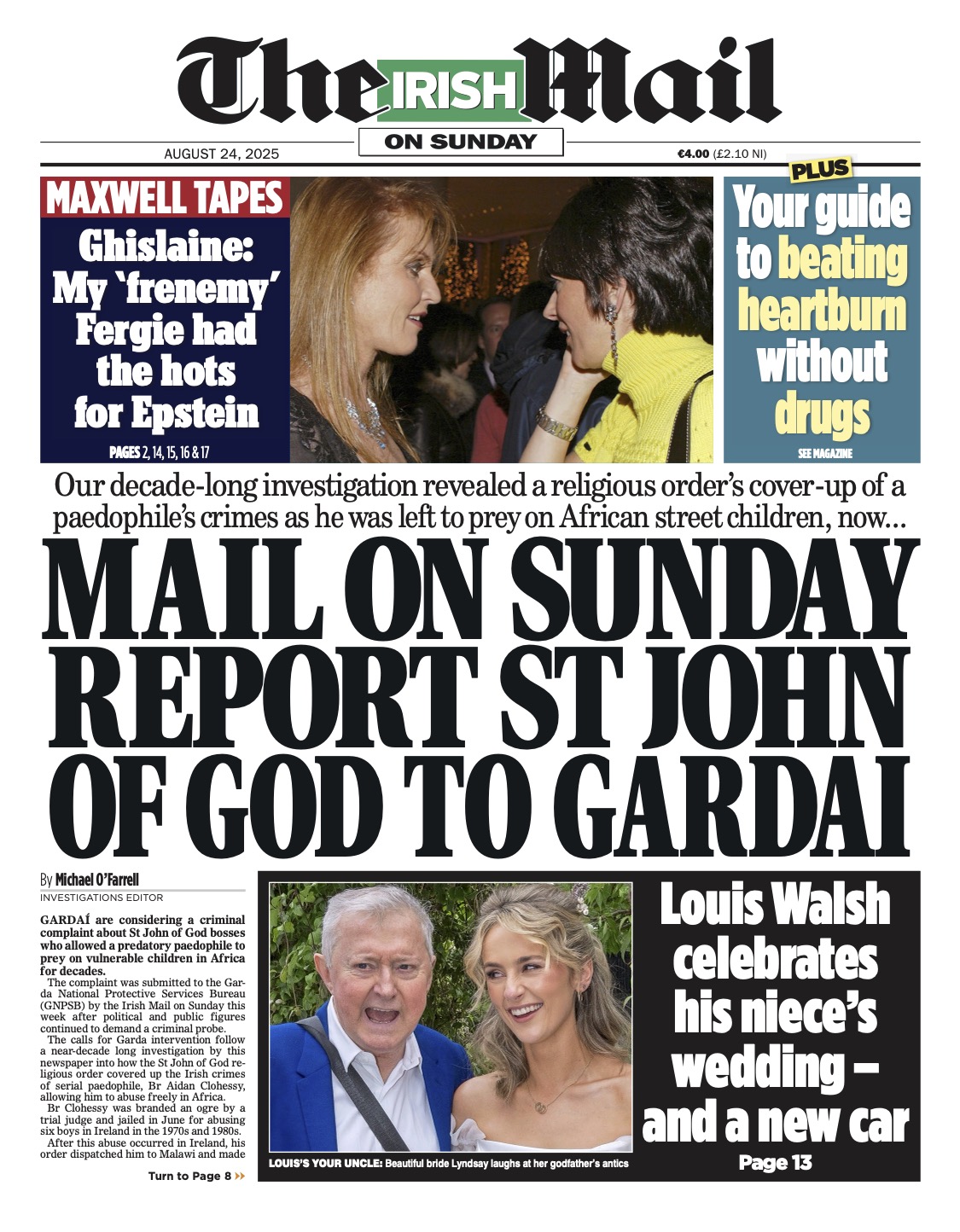
GARDAÍ are considering a criminal complaint about St John of God bosses who allowed a predatory paedophile to prey on vulnerable children in Africa for decades.
The complaint was submitted to the Garda National Protective Services Bureau (GNPSB) by the Irish Mail on Sunday this week after political and public figures continued to demand a criminal probe.
The calls for Garda intervention follow a near-decade long investigation by this newspaper into how the St John of God religious order covered up the Irish crimes of serial paedophile, Br Aidan Clohessy, allowing him to abuse freely in Africa.
Br Clohessy was branded an ogre by a trial judge and jailed in June for abusing six boys in Ireland in the 1970s and 1980s.
After this abuse occurred in Ireland, his order dispatched him to Malawi and made secret financial settlements with multiple victims here.
Now the GNPSB – led by Detective Chief Superintendent Colm Noonan – is assessing whether the complaint warrants a criminal investigation into the alleged reckless endangerment of children.
Putting children at risk of abuse has been a crime since 2006 when the Criminal Justice Act 2006 was enacted.
Under Section 176 (2) of the Act it is a criminal offence for anyone in a position of authority or control of a child abuser to put a child at risk. It is also a crime to fail to take reasonable steps to protect a child from such a risk while knowing that the child is in such a situation.
Upon conviction, the offence carries a prison term of up to 10 years. Crucially it’s not actually necessary to prove abuse took place for a reckless endangerment prosecution.
The law was one of the recommendations of the 2005 Ferns Inquiry into the response by civil and Church authorities to abuse allegations in Wexford.
It was campaigned for by One in Four founder, Colm O’Gorman, a victim of Fr Seán Fortune – a paedophile priest who had been moved around by superiors who knew of the risk he posed.
Last night, Mr O’Gorman welcomed the possibility of a Garda investigation.
‘It’s a good thing in my view that it’s now been reported by the Irish Mail on Sunday to the gardaí and I hope the gardaí carry out a really, really thorough investigation and that a file does go to the DPP,’ he said.
‘Ultimately that’s going to be a decision for the DPP but, on the face of it, there would there would seem to be a prima facie case that needs to be investigated and if the evidence is there then it should be prosecuted.
‘From a read of the legislation it’s very clear that there is at least a case to be brought and a case to be answered,’ Mr O’Gorman added.
‘There needs to be accountability for the fact that Br Clohessy was allowed to continue in positions of authority, that he was allowed to continue to have access to children who he continued to abuse for decades after the order was made aware of it,’ Mr O’Gorman said.
‘There needs to be accountability for that and that should include criminal accountability.’
Labour Justice spokesman Alan Kelly also called for speedy action.
‘Given that a complaint has now been made to gardaí, it is imperative that they investigate in a speedy manner, given how serious the issue is,’ he said.
Others who have called for a criminal inquiry include Sinn Féin education spokesperson Darren O’Rourke, former Bernardos CEO, Fergus Finlay and Kindernothilfe (KNH) – a prominent Christian charity in Germany that funds St John of God in Malawi. The complaint is also backed by all of the Irish victims for whom Clohessy was jailed for abusing – and other victims in Africa who have already received settlements.
Any Garda investigation will consider evidence that St John of God superiors knew Br Clohessy was a risk when they left him in Africa. This will include publicly-available records such as a 2015 church audit into the order.
The audit by the National Board for Safeguarding Children in the Catholic Church in Ireland (NBSCCCI) confirms St John of God superiors received many historical Irish abuse complaints about Br Clohessy as he was left in Malawi.
Other readily-available evidence highlights the free access Br Clohessy had to children in Africa, despite these complaints at home.
This includes a 2010 TG4 documentary on Br Clohessy’s work with children in Malawi. The documentary aired on national TV even as Br Clohessy’s superiors in Ireland continued to receive historical complaints about him.
The role of those who knew – or ought to have known – that children in Africa would be at risk from Br Clohessy will also be examined in any investigation.
This will include – but is not limited to – the current head of the St John of God order, Br Donatus Forkan.
It was Br Forkan who first dispatched Br Clohessy to Malawi and left him there as secret settlements were made to victims back in Ireland.
No one in Malawi was told of these settlements or Br Clohessy’s child-abusing past as he was left free to prey on street children.
The St John of God order then conspired to keep Br Clohessy’s child abuse under wraps after superiors finally withdrew him from Africa in 2012.
This occurred as the Vatican launched a Canonical Inquiry into Br Clohessy and gardaí began investigating Irish complaints.
When the MoS first travelled to track down victims in Malawi in 2017, neither the Vatican nor the St John of God order had ever acted to establish the extent of any abuse Br Clohessy carried out there.
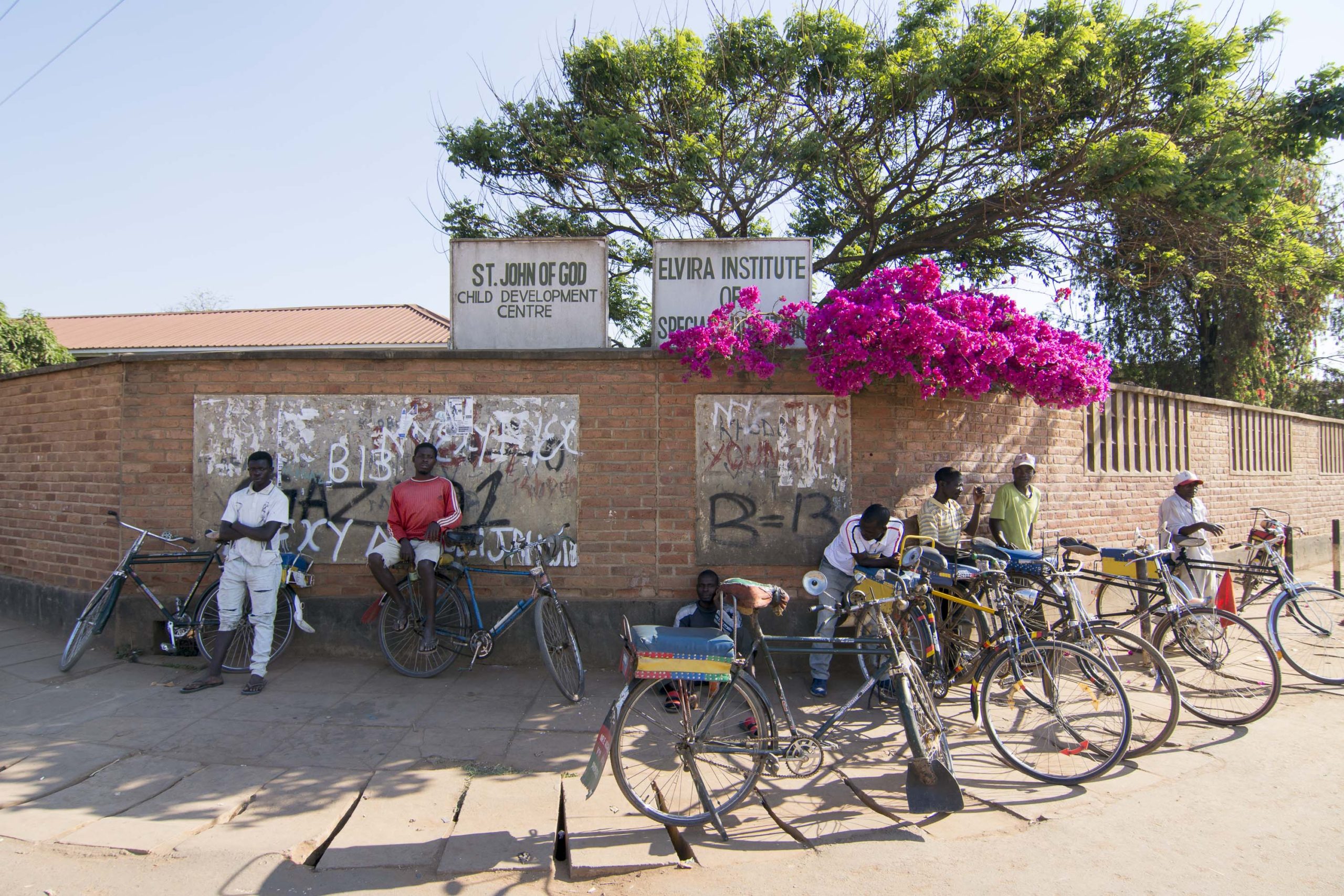
Our investigation uncovered numerous men who had been collected from the streets by Br Clohessy when they were children.
Many were horrifically abused – and although it admits no liability – the St John of God order has recently begun settling civil cases taken on behalf of these victims in Ireland. As many as 60 such cases from Africa have so far emerged – with 20 already settled.
Others in Malawi also told the MoS of the unfettered access to children that Br Clohessy enjoyed.
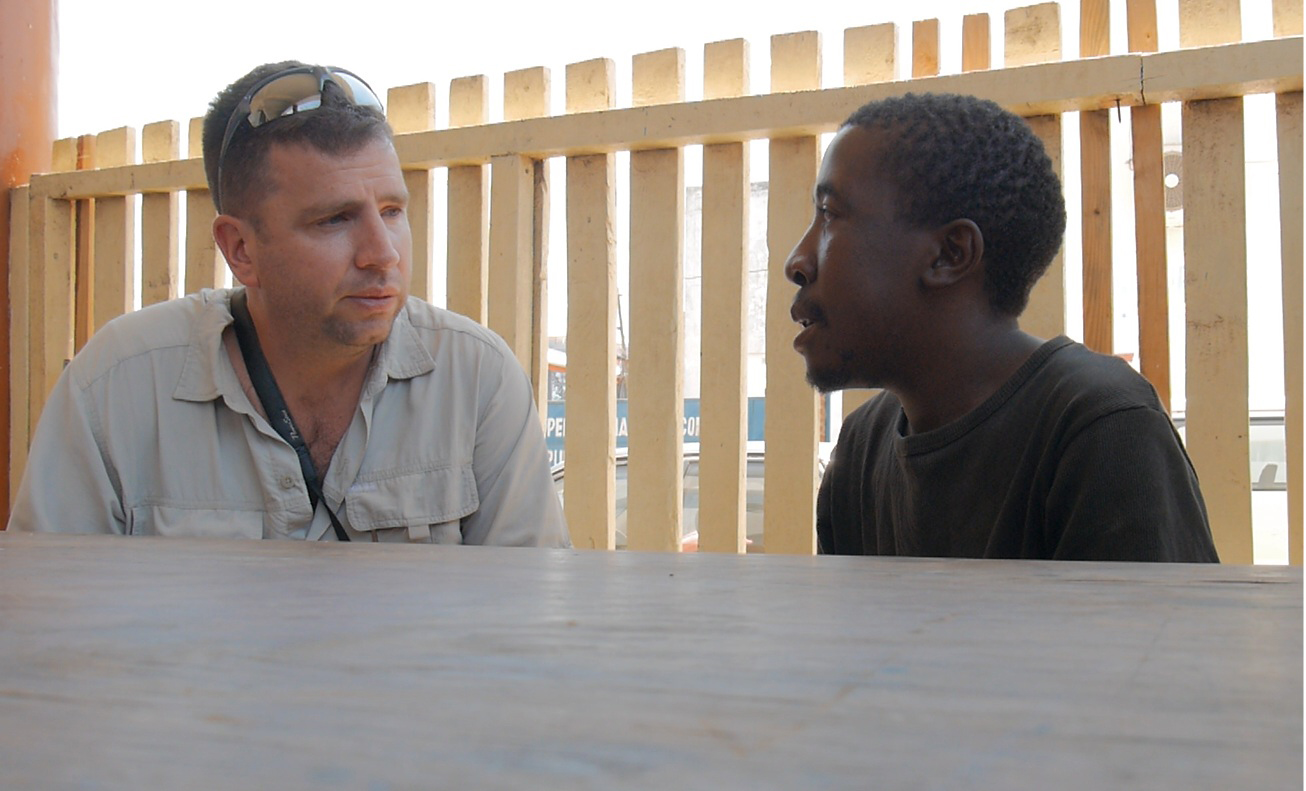
Br Clohessy’s personal cook, Maxwell Chirwa, for example, confirmed that a garage at Brother Aidan’s home had been converted and used to house boys.
‘There was a place where Brother Aidan was keeping them. Built at the back where the garage was. He put some rooms inside. They put the beds there,’ he told the MoS in 2017.
Mr Chirwa said this converted garage had been built in 2006.
‘It was in 2006. The children were sleeping there inside, yes.’
He added that children remained living there for ‘many years – some of them until they finished school.’
Mr Chirwa also said Br Forkan knew of Br Clohessy’s living arrangements with children because he had stayed himself in the compound during visits.
‘Yes When they were building the garage he [Donatus] knew.’
Harrison Chilale – the then Clinical Director for St John of God in Malawi who worked under Brother Clohessy from the beginning – also confirmed these arrangements.
‘They would stay at the Brother’s house. I think Brother Aidan had some space where they would eat, wash and clean themselves up,’ he said. ‘The inside activities and behaviours I don’t know. But I knew he kept children – I think up to 10 sometimes in one roof. There were a group of children he was keeping there.’
No one in Malawi was concerned about these arrangements because they remained unaware that Br Clohessy’s order had received and
settled repeated abuse complaints.
That remained the case even after Br Clohessy suddenly left Malawi overnight in 2012 without warning or explanation, having spent two decades there.
In Ireland, the St John of God order’s charitable services are managed via a corporate structure headed by a parent company called the St John of God Hospitaller Services Group.
As head of the order, Br Forkan remains a director of this company.
This weekend, a spokesperson for the group said it ‘recognises the importance of and is committed to protecting all vulnerable people against any form of abuse.’
‘We operate a zero tolerance approach to all types of abuse for children and adults in receipt of services and supports. We have rigorous policies and procedures to ensure the safeguarding of everyone we encounter, and to ensure that they are supported and protected. We are committed to timely reporting of allegations. We support anyone with concerns about the safety of a child or adult to take immediate action by contacting the appropriate authorities or the designated safeguarding personnel in our services.’
However, the St John of God order itself – and leaders such as Br Forkan – have never publicly acknowledged or addressed the situation in Malawi.
That remained the case this week as a spokesperson for the order declined to comment.
Instead the order said it ‘encourages anyone who has experienced hurt to seek support and talk with the authorities.
An Garda Síochána’s free confidential 24/7 Child Sexual Abuse Reporting number is 1800 555 222 or email GNPSB_SCMU@garda.ie
Independent advice and help can be accessed at Towards Healing – Freephone – 1800 303 416 / 0800 096 3315 (Northern Ireland) / 085 802 2859 (hearing Impaired) / email info@towardshealing.ie
Contact the author on michaelofarrell@protonmail.com
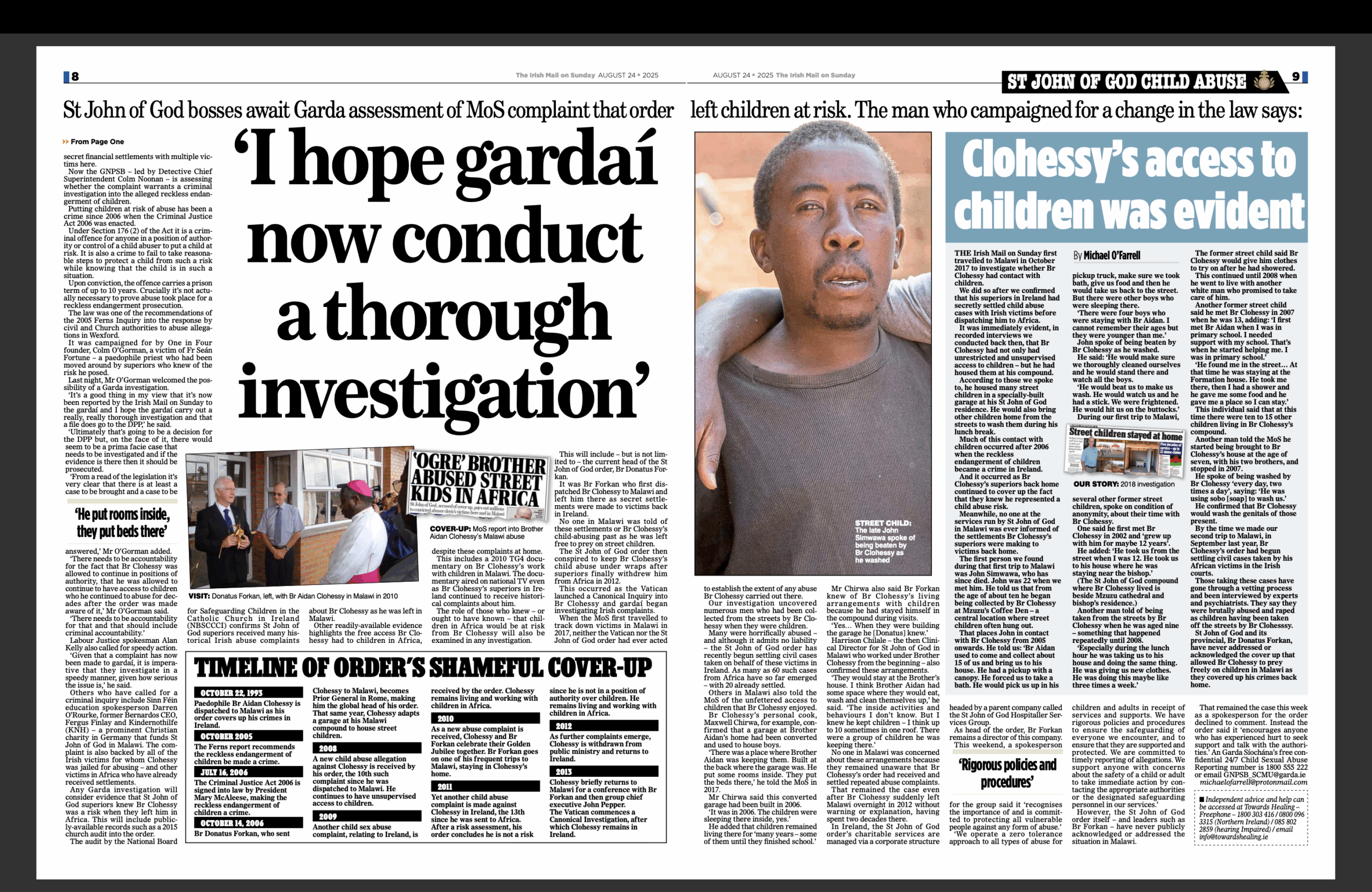
Clohessy’s access to children was evident
THE Irish Mail on Sunday first travelled to Malawi in October 2017 to investigate whether Br Clohessy had contact with children.
We did so after we confirmed that his superiors in Ireland had secretly settled child abuse cases with Irish victims before dispatching him to Africa.
It was immediately evident, in recorded interviews we conducted back then, that Br Clohessy had not only had unrestricted and unsupervised access to children – but he had housed them at his compound.
According to those we spoke to, he housed many street children in a specially-built garage at his St John of God residence. He would also bring other children home from the streets to wash them during his lunch break.
Much of this contact with children occurred after 2006 when the reckless endangerment of children became a crime in Ireland.
And it occurred as Br Clohessy’s superiors back home continued to cover up the fact that they knew he represented a child abuse risk.
Meanwhile, no one at the services run by St John of God in Malawi was ever informed of the settlements Br Clohessy’s superiors were making to victims back home.
The first person we found during that first trip to Malawi was John Simwawa, who has since died. John was 22 when we met him. He told us that from the age of about ten he began being collected by Br Clohessy at Mzuzu’s Coffee Den – a central location where street children often hung out.
That places John in contact with Br Clohessy from 2005 onwards. He told us:
‘Br Aidan used to come and collect about 15 of us and bring us to his house. He had a pickup with a canopy. He forced us to take a bath. He would pick us up in his pickup truck, make sure we took bath, give us food and then he would take us back to the street. But there were other boys who were sleeping there.
‘There were four boys who were staying with Br Aidan. I cannot remember their ages but they were younger than me.’
John spoke of being beaten by Br Clohessy as he washed.
He said: ‘He would make sure we thoroughly cleaned ourselves and he would stand there and watch all the boys.
‘He would beat us to make us wash. He would watch us and he had a stick. We were frightened. He would hit us on the buttocks.’
During our first trip to Malawi, several other former street children, spoke on condition of anonymity, about their time with Br Clohessy.
One said he first met Br Clohessy in 2002 and ‘grew up with him for maybe 12 years’.
He added: ‘He took us from the street when I was 12. He took us to his house where he was staying near the bishop.’
(The St John of God compound where Br Clohessy lived is beside Mzuzu cathedral and bishop’s residence.)
Another man told of being taken from the streets by Br Clohessy when he was aged nine – something that happened repeatedly until 2008.
‘Especially during the lunch hour he was taking us to his house and doing the same thing. He was giving us new clothes. He was doing this maybe like three times a week.’
The former street child said Br Clohessy would give him clothes to try on after he had showered.
This continued until 2008 when he went to live with another white man who promised to take care of him.
Another former street child said he met Br Clohessy in 2007 when he was 13, adding: ‘I first met Br Aidan when I was in primary school. I needed support with my school. That’s when he started helping me. I was in primary school.’
‘He found me in the street. At that time he was staying at the Formation house. He took me there, then I had a shower and he gave me some food and he gave me a place so I can stay.’
This individual said that at this time there were ten to 15 other children living in Br Clohessy’s compound.
Another man told the MoS he started being brought to Br Clohessy’s house at the age of seven, with his two brothers, and stopped in 2007.
He spoke of being washed by Br Clohessy ‘every day, two times a day’, saying: ‘He was using sobo [soap] to wash us.’
He confirmed that Br Clohessy would wash the genitals of those present.
By the time we made our second trip to Malawi, in September last year, Br Clohessy’s order had begun settling civil cases taken by his African victims in the Irish courts.
Those taking these cases have gone through a vetting process and been interviewed by experts and psychiatrists. They say they were brutally abused and raped as children having been taken off the streets by Br Clohesssy.
St John of God and its provincial, Br Donatus Forkan, have never addressed or acknowledged the cover up that allowed Br Clohessy to prey freely on children in Malawi as they covered up his crimes back home.